Stigg vs. Metronome: A 2026 Comparison Guide
Read our Stigg vs. Metronome review and find out how the two platforms compare. Discover what makes Schematic the superior alternative to both.
 Ryan Echternacht
On this page
- Overview
- TL;DR
- Stigg vs. Metronome: What's the Difference?
- Stigg Key Features and Pros
- Metronome Key Features and Pros
- Stigg vs. Metronome: 10 Main Differences Explained
- 1. Usage Metering
- 2. AI Credit Management
- 3. Spend Controls
- 4. Invoicing and Payment Processing
- 5. Price Modeling
- 6. Software Entitlement Management
- 7. Runtime Enforcement
- 8. Developer Experience
- 9. Integration Capabilities
- 10. Pricing Plans
- How to Choose Between Stigg and Metronome
- Limitations of Stigg and Metronome
- How Schematic Fills the Gap
- Ship Usage Billing Your Customers Can Trust With Schematic
- FAQs About Stigg vs. Metronome
- Which is the better usage-based billing platform: Stigg or Metronome?
- Why should AI companies choose Metronome over Stigg?
- Why do teams look for Metronome alternatives?
- Can Stigg enforce feature access at runtime?
Monetizing AI products is harder than traditional software because usage varies and charges can be unpredictable. According to DigitalRoute's State of AI Monetization study, 57% of organizations say billing complexity has increased due to AI.
That's why choosing the right AI monetization platform is important. Stigg vs. Metronome has become a popular comparison for companies that want to make a profit from AI.
Both platforms can meter usage and manage credits, but they differ in functionality and focus. Stigg is a usage enforcement tool that evaluates limits, software entitlements, and balances. Metronome provides a flexible billing infrastructure for usage-based pricing.
In this guide, we'll discuss the ten key differences between Stigg and Metronome to help you make an informed choice.
TL;DR
Stigg and Metronome help companies monetize AI products through usage metering, credit management, and built-in invoicing.
Stigg focuses on real-time entitlement checks, credit wallets, and usage governance to control product access and prevent overspending.
Metronome specializes in high-volume usage metering, flexible pricing, enterprise contract management, and financial reporting.
Both platforms have limitations. Stigg lacks native payment processing and full subscription management, while Metronome doesn't enforce product access or usage limits at runtime.
Schematic is a better choice for software and AI companies selling to enterprises. It combines usage-based billing, metering, credits, runtime entitlements, and self-service controls in one platform.
Stigg vs. Metronome: What's the Difference?
Stigg is a usage runtime platform that decides what every customer, user, and AI agent can do inside a product. It features AI credits, real-time event ingestion, governance, and entitlement checks.
Stigg focuses on real-time enforcement to prevent customers from exceeding their usage limits or credit balances.
It doesn't function as a billing platform. Instead, it sits on top of your existing billing system through a bidirectional sync, so you can manage product access without a billing stack migration.
Metronome provides flexible billing infrastructure designed for AI monetization. It combines metering, pricing, billing, and reporting to help SaaS and AI companies charge customers based on actual consumption.
Metronome can also handle usage-based billing at an enterprise scale. It supports complex contracts, centralized rate cards, minimum commitments, custom pricing models, and financial reporting that supports revenue recognition.
The main difference is that Stigg focuses on controlling AI access, while Metronome handles usage-based billing and flexible pricing.
Stigg Key Features and Pros
Stigg can enforce entitlements and usage limits before a single token exceeds the customer's budget. It sits in the request path and checks remaining credits, SaaS entitlements, and company overrides before an action runs.
Engineering teams can manage entitlements without hardcoding access rules into their products. They just need to layer Stigg on top of existing billing providers.
Instead of replacing a company's billing stack, Stigg simply adds an entitlement management system that controls feature access. Existing tools continue handling payment collection and other billing tasks.
Here are the features of Stigg:
Entitlement checks: Keep pricing logic separate from application code. Then, evaluate customer plans, credit balances, and feature access in one API call.
Real-time limit enforcement: Check usage and credit balances before an action runs. Block requests at hard limits or allow overage pricing with soft limits.
AI credit engine: Manage credit wallets, grants, expiration rules, and priority consumption through a double-entry ledger.
Real-time metering: Capture usage events and use built-in deduplication to prevent double-counting, even at high event volumes.
Self-serve spend controls: Customers set budget caps for individual users, teams, and AI agents.
Contract management and invoicing: Stigg reads the signed contract and generates invoices based on billing schedules or actual usage.
Metronome Key Features and Pros
Metronome is known for its monetization infrastructure that works seamlessly with Stripe Billing. It helps SaaS and AI companies go to market using product-led or sales-led growth strategies.
Metronome goes beyond metering, usage billing, and pricing. It gives product, go-to-market (GTM), and finance teams a single source of truth for monetizing AI products.
Below are the core capabilities of Metronome:
Pricing levers: Support usage-based pricing, recurring subscriptions, outcome-based pricing, prepaid credits, and hybrid pricing models to align with customer value.
Real-time usage ingestion: Store raw usage events and support high billing volume with streaming metrics.
Flexible pricing configuration: Use the modular pricing engine to build centralized rate cards, credit models, and spending commitments. Update pricing rules without major code changes.
Customizable enterprise contracts: Create custom plans with negotiated rates, volume discounts, spending commitments, and flexible payment terms.
Embedded billing dashboards: Show real-time usage and spending data inside your product, while allowing enterprise customers to configure alerts and limits.
In-app reports: Track daily revenue, customer consumption, credit usage, and profit margins in one place. Then, generate reports to support revenue recognition and pricing changes.
Stigg vs. Metronome: 10 Main Differences Explained
Here is a detailed comparison of Stigg and Metronome's monetization platforms.
1. Usage Metering
Stigg supports high-throughput, real-time event ingestion. Its metering engines run in Kubernetes clusters. Engineering teams can deploy them in a bring-your-own-cloud (BYOC) environment.
Stigg tracks AI tokens, inference calls, and agent actions for usage metering and billing. It also supports event deduplication and aggregation to prevent double counting.
However, it primarily acts as a runtime usage control platform rather than serving as a complete billing engine.
Metronome provides a billing infrastructure that can turn raw usage events into billable metrics. It captures events directly from the application and uses SQL-based metrics to calculate customer consumption.
Teams define products in Metronome's product catalog and configure charges through centralized rate cards. These rate cards determine how much customers pay for each unit of usage.
2. AI Credit Management
Stigg offers financial-grade credit infrastructure with native wallets, double-entry ledgers, expiration rules, and priority consumption. It tracks every credit grant, deduction, and adjustment while checking balances before AI requests run.
Teams can grant credits without an active subscription, set expiration dates, and enable auto top-ups. This removes the need to build complex AI credit systems from scratch.
Metronome uses pricing building blocks to support credit-based pricing. It provides credit grants, spending commitments, automatic recharge, and spend previews.
AI companies can connect Metronome to a payment provider to collect payments before granting prepaid credits. Balances and payment updates may involve webhooks between systems.
The main difference is that Stigg ties credit balances to runtime access decisions, while Metronome focuses on tracking credits for billing workflows.
3. Spend Controls
Stigg provides real-time spending controls through its governance feature. Customers can set maximum budgets for individual users, teams, or AI agents. These caps are checked at runtime to prevent surprise bills.
Spend controls are configured through an embedded customer portal. Product teams can ship it without writing application code.
Metronome has an in-product billing dashboard where customers can see real-time usage. This helps minimize billing disputes.
Meanwhile, configurable alerts and limits inside Metronome give buyers more control over their spending. Product teams can also update a contract’s spend threshold either through the Metronome app or the API.
4. Invoicing and Payment Processing
Stigg supports automated invoicing through its built-in contract management system. The platform reads pricing models, billing schedules, commitments, and entitlements from customer contracts.
Once a contract becomes active, Stigg provisions access, tracks usage, and generates invoices automatically based on the agreed billing schedules and actual usage.
However, Stigg does not process payments natively. It integrates with existing payment providers to handle cash collection, tax calculations, and reconciliation.
Metronome calculates usage charges, generates billing data, and issues invoices through connected payment processors.
Metronome is known for its seamless integration with Stripe, which handles multi-currency billing, payment processing, revenue recognition, and other accounting workflows.
5. Price Modeling
Stigg features a product catalog where AI companies can model any pricing. Teams can configure products, plans, add-ons, features, credits, and coupons using Stigg's building blocks.
Plus, the flexible architecture of Stigg means non-technical teams can transfer features to different products or tiers without engineering dependency.
On the other hand, Metronome provides a modular pricing engine with centralized rate cards, credits, and commitments. Product teams can configure all pricing elements and contract terms to fit a customer's needs.
Metronome also includes pricing levers for different go-to-market strategies and monetization models. It can support flat-rate usage, tiered rates, prepaid credits, and other complex pricing models, such as dimensional pricing and a revenue percentage of the software fee.
The key difference is that Stigg connects pricing changes to product entitlements and access rules. Metronome focuses on updating enterprise tier rates, contracts, and billing terms.
6. Software Entitlement Management
Stigg moves entitlement management outside the application's codebase. Instead of hardcoding feature flags, plan limits, and billing logic, developers can manage access rules through one system.
Commercial teams can update feature permissions and pricing packages without engineering dependency.
Metronome lets AI companies define customer contracts, credit allocations, and usage commitments. However, it lacks the same product-side entitlement management system as Stigg.
Engineering teams need to build the entitlement logic needed to gate features and control access based on customer plans.
7. Runtime Enforcement
Stigg specializes in runtime enforcement. It checks customer entitlements, available credits, and usage limits before allowing an AI request to run.
Stigg operates directly in the request path and returns access decisions in milliseconds. When customers reach their credit limits or spending caps, the platform blocks further requests before a single token runs over the budget.
Metronome provides real-time usage metering, spending alerts, and configurable billing thresholds. However, it does not directly enforce product access or block API requests when customers reach their limits.
Developers must implement access controls using Metronome's usage data, alerts, and webhooks.
Without these controls, customers may continue consuming resources beyond their budgets. That can lead to unexpected charges, higher infrastructure costs, and lower profit margins.
8. Developer Experience
Stigg offers monetization SDKs and REST APIs that help developers connect entitlement checks, usage metering, and credit management to their applications.
Once developers integrate Stigg, product managers can update plans, feature limits, and access policies without deploying code. This is useful for SaaS and AI companies that change pricing frequently.
Metronome also provides APIs, SDKs, and tools, but these are designed for configuring billing models. Developers can store usage events, translate them into billable metrics, manage contracts, and schedule price adjustments.
Commercial teams can update rate cards and pricing terms using Metronome's pricing blocks. However, developers still need to connect billing data to product features, entitlement checks, and upgrade flows.
Stigg reduces engineering work tied to access control, while Metronome gives developers more control over billing infrastructure and pricing simulations.
9. Integration Capabilities
Stigg uses a bidirectional sync to integrate with existing billing solutions. It can layer on top of Stripe Billing, Chargebee, Maxio, and Zuora, among other platforms.
Stigg also supports native integrations with enterprise resource planning (ERP) systems, cloud marketplaces, data warehouses, identity providers, and CPQ software.
Metronome connects your entire revenue stack. It connects to Stripe, QuickBooks, NetSuite, Salesforce, and tax management tools such as Anrok and Avalara.
The platform can even export data to Snowflake, SingleStore, Postgres, Redshift, S3, and MySQL. It gives teams access to up-to-date usage, pricing, and revenue data.
The main difference is their focus. Stigg connects billing information to product access and entitlement enforcement. Metronome syncs data across systems to power invoicing, accounting workflows, financial reporting, and enterprise sales conversations.
10. Pricing Plans
Stigg has a public pricing page that shows four different options:
Build (Free): This is the free tier that offers 10,000 managed entities and 5M monthly usage events.
Pro ($499/month): Includes 25M events and 10,000 managed entities per month, plus custom-branded widgets, webhooks, a full audit log, and standard support.
Scale (Custom): Adds committed entity blocks (starts at 50,000 entities), higher event volumes, enterprise integrations, role-based access control, and premium support.
BYOC (Custom): Provides flexible deployment options with a fixed platform fee and unlimited entities.
Metronome offers two pricing plans to simplify the decision-making process.
Starter: Charges 0.8% of billing volume and an additional $0.04 per 1,000 ingested events. This plan comes with real-time metering, alerting, flexible pricing models, billing dashboards, and native Stripe integration.
Custom: Includes negotiated pricing, invoicing integrations, data exports, and access to a dedicated account manager.
How to Choose Between Stigg and Metronome
The choice between Stigg and Metronome depends on your AI monetization needs. Both platforms support usage metering, credits, and pricing, but they focus on different parts of the billing process.
Stigg is better for controlling product access and customer spending. Metronome makes sense when you need a complete billing system for complex pricing models and enterprise contracts.
Use Stigg if you need:
Decoupled entitlements and feature access controls.
Runtime enforcement of usage limits.
Self-serve spending caps configured by customers.
Credit wallets with automatic top-ups and expiration rules.
A usage runtime platform that connects to existing billing tools.
Choose Metronome when you want:
High-volume usage metering and billing.
Flexible pricing models and centralized rate cards.
Custom enterprise contracts and minimum commitments.
Automated invoicing and revenue reporting.
Extensive integrations that connect your entire revenue stack.
Limitations of Stigg and Metronome
Stigg is primarily a usage runtime platform, not a complete billing solution. While it supports contract management and invoicing, it relies on external providers for payment processing, tax handling, and revenue recognition.
The platform also lacks subscription management, financial reporting, and revenue recognition tools.
Plus, Stigg can feel complex for non-technical teams or startups selling just a few subscription plans with fixed usage limits.
Metronome has completely different limitations. Although it handles usage metering, billing, and reporting, it doesn't enforce limits inside the product at runtime.
Developers must build entitlement logic into the application's codebase to control feature access and block requests when customers reach their limits. Without these controls, AI companies risk unexpected usage costs and surprise bills.
How Schematic Fills the Gap
Schematic combines usage-based billing and runtime entitlements in one platform to fill the gaps that Stigg and Metronome leave open.
Software and AI companies use Schematic to meter usage once. That event stream powers invoices, entitlement checks, and revenue analytics without double counting.
Unlike systems that separate billing from access enforcement, Schematic tracks software entitlements against caps set by your team or customers. These policies take effect the moment they're saved, without deploying code or filing support tickets.
Max Ade, the co-founder and CEO of Pickleheads, says, "We needed an entitlement system for usage-based pricing without building it from scratch, and we wanted non-technical team members to manage it easily."
By enforcing usage limits at runtime, Schematic helps businesses protect profit margins before costly AI requests run.
Schematic also stands out for its enterprise credit wallets. These give customers real-time visibility into usage, spending forecasts, and configurable limits to prevent runaway bills and unexpected access throttling.
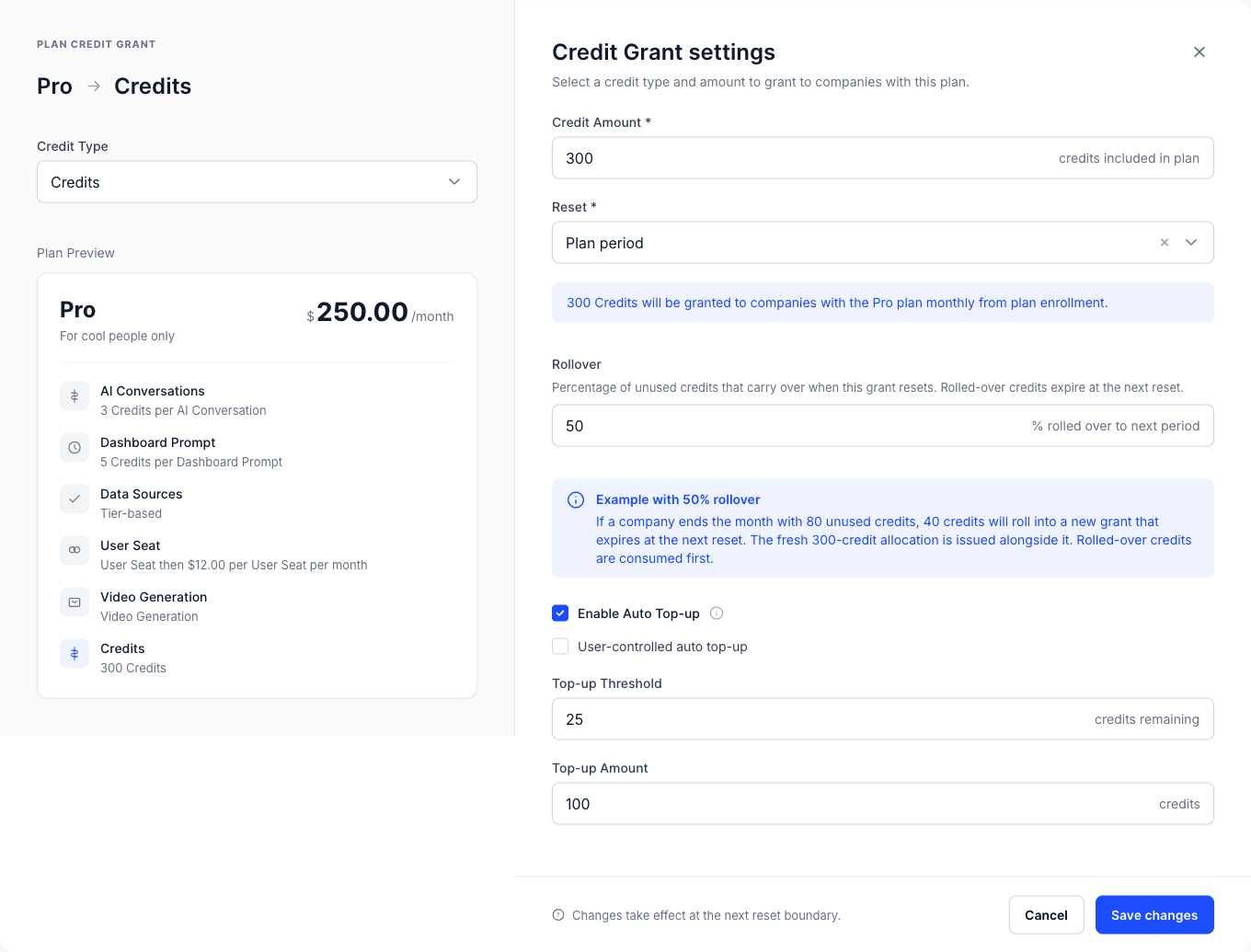
Commercial teams can grant company overrides, set credit rollover policies, enable user-controlled top-ups, and define the top-up threshold.
Book a demo to see how Schematic works!
Ship Usage Billing Your Customers Can Trust With Schematic
Schematic is a complete usage-based billing platform designed for software and AI companies selling to enterprises.
It solves the trust problem in usage-based pricing by connecting credits, metering, entitlements, and usage governance controls on a real-time ledger.
Robust credit wallets show enterprise customers exactly what they use and owe to prevent billing disputes. Schematic also gives buyers full control over their spending.
Customers can set spending limits per user, company, or agent and receive alerts before usage stops. They can even decide what happens at the cap.
Schematic's runtime entitlement engine enforces policies and limits the moment they are saved. This gives both buyers and sellers confidence that usage will stay within budget.
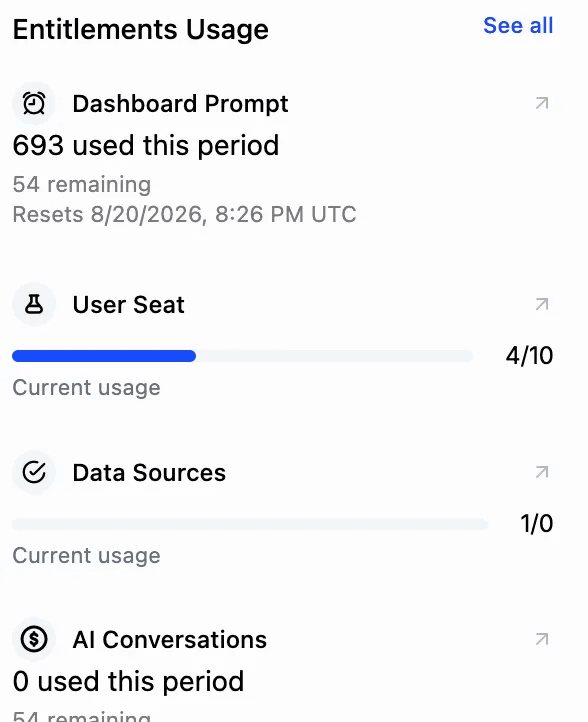
In addition to credits and entitlements, Schematic provides out-of-the-box billing tools. These allow companies to:
Record every credit grant, rollover, expiry, or burn-down.
Version plans, migrate customers, and run pricing experiments.
Recognize revenue under ASC 606 rules.
Implement any pricing model without a billing rebuild.
Use a model context protocol (MCP) server to connect AI assistants and run automated workflows.
Max Ade from Pickleheads shares, "The Schematic MCP is fantastic, and we now do most of our work in Claude, accessing plan and billing information directly without leaving our workflow."
FAQs About Stigg vs. Metronome
Which is the better usage-based billing platform: Stigg or Metronome?
Metronome is better for companies that need usage metering, flexible pricing, invoicing, and enterprise contract management. Stigg is not a usage-based billing platform.
Why should AI companies choose Metronome over Stigg?
AI companies should choose Metronome when they need a flexible billing infrastructure that handles high event volumes, complex pricing models, and enterprise contracts. It also connects billing to financial reporting, invoicing, and other revenue operations.
Why do teams look for Metronome alternatives?
Teams look for Metronome alternatives when they need more than usage metering and billing. Metronome doesn't provide native runtime entitlement enforcement, so developers must build access controls to prevent customers from exceeding usage limits or credit balances.
Can Stigg enforce feature access at runtime?
Yes. Stigg checks customer entitlements, credit balances, and usage limits before allowing a feature or AI request to run. It can automatically block access when customers reach hard limits or allow continued usage under customer-configured soft limits.