Stigg vs. Lago: Which Is Better for AI Products?
Read our Stigg vs. Lago review and find out how the two platforms compare. Discover what makes Schematic the superior alternative to both.
 Ryan Echternacht
On this page
- Overview
- TL;DR
- Stigg vs. Lago: What's the Main Difference?
- Stigg Key Features and Advantages
- Lago Key Features and Advantages
- Stigg vs. Lago: A Side-by-Side Comparison
- Usage Metering
- Billing and Invoicing
- Software Entitlements
- Credit Wallets
- Payment Collection
- Deployment Options
- Developer Experience
- Built-In Integrations
- Pricing Plans
- How to Choose Between Stigg and Lago
- Where Stigg and Lago Fall Short
- Why Do SaaS and AI Companies Consider Schematic
- Schematic Implements Usage-Based Billing That Customers Can Trust
- FAQs About Stigg vs. Lago
- Which is the better usage-based billing platform: Stigg or Lago?
- Is Lago an open-source billing infrastructure?
- What pricing models does Lago support?
Artificial intelligence is no longer just an extra feature in software products. According to High Alpha's 2025 SaaS Benchmarks Report, AI is core to 100% of products among surveyed companies established in 2025.
This shift changes how SaaS and AI businesses monetize their products. Instead of relying on fixed subscriptions, they need pricing models that account for tokens, API calls, AI credits, and actual customer usage.
Stigg vs. Lago is a popular comparison among teams that want to meter usage, manage credits, and send invoices to customers. However, they focus on different parts of AI monetization.
Stigg is a usage runtime platform that enforces limits and entitlements as usage happens. Lago provides an open-source billing platform that companies can run on their own infrastructure.
This article breaks down the key differences between Stigg and Lago to help you choose the AI monetization platform that suits your needs.
TL;DR
Stigg and Lago help companies meter usage, grant credits, and manage software entitlements, but they focus on different monetization needs.
Stigg is a usage runtime system that checks entitlements at request time, enforces spending limits, and provides a financial-grade credit system.
Lago provides one platform for subscription pricing, usage-based billing, prepaid credits, quotes, invoicing, and payment collection.
However, both platforms have downsides that teams should consider. Stigg relies on external billing providers and can be complex for smaller teams. Lago lacks governance controls and runtime limit enforcement.
Schematic is a better choice for software and AI companies selling to enterprises. It combines usage metering, flexible billing, real-time entitlements, credit wallets, and self-service controls in one platform.
Stigg vs. Lago: What's the Main Difference?
Stigg is a usage runtime platform that decides what every customer, user, and AI agent can access inside a product. It checks credits, software entitlements, and usage limits before approving an AI request.
If the account lacks sufficient credit balance or is not entitled to a feature, Stigg blocks access to prevent customers from exceeding their budgets.
Stigg is not a usage-based billing platform. Instead, it connects to your existing billing engine through a bidirectional sync. This allows companies to meter usage events and control product access without finding a new billing vendor.
In contrast, Lago is a complete billing platform that manages the entire revenue workflow, starting from the first quote to the final invoice. It handles subscriptions, prepaid credits, complex pricing models, and usage-based pricing.
Lago also generates itemized invoices, manages payment collection, defines plan entitlements, and provides revenue recognition tools.
The main difference between the two platforms is their focus. Stigg controls access in real time, while Lago manages billing operations and turns actual usage into revenue.
Stigg Key Features and Advantages
Every AI request is a spend decision. Stigg helps SaaS and AI companies make that decision in milliseconds by checking credits, entitlements, and usage limits before a request runs.
Stigg combines metering, credit management, and governance in a usage runtime system. Teams can control what every customer, user, and AI agent can access without building complex billing rules into their products.
Below are Stigg's key features:
Decoupled entitlements: Keep feature access rules separate from billing logic and application code. Commercial teams can ship new features and pricing models without requiring engineers to deploy code.
Runtime limit enforcement: Check credits, limits, and SaaS entitlements before an AI request runs. Stigg automatically blocks access when customers reach their usage caps.
Credit infrastructure: Manage credit wallets, balances, expiry rules, and burn-downs using a double-entry ledger.
Usage metering: Meter API calls, AI tokens, inference requests, agent actions, and other usage data at scale.
Governance controls: Let customers set maximum budgets for individual users, teams, or AI agents.
Contract management and invoicing: Generate invoices based on contract terms and actual usage, then collect payments by integrating with existing payment providers.
Lago Key Features and Advantages
Lago implements subscription, usage-based, prepaid, and hybrid pricing models from one billing engine. It connects product consumption to customer invoices, helping SaaS and AI companies charge for every token, API call, or credit used.
Teams can use the managed Lago Cloud product or choose a self-hosted option for full control over their billing infrastructure.
Lago even connects AI tools, automates billing tasks, and gives finance teams clear reports on usage to know how much revenue to expect.
Here is a breakdown of Lago's features:
Open-source code: Use the AGPLv3-licensed open-source edition to host Lago on your own infrastructure.
Usage billing: Meter usage and turn it into billable metrics, such as AI tokens, API calls, and compute hours.
Custom quotes and order forms: Create quotes from the catalog, negotiate enterprise pricing, and turn signed deals into order forms that you can export as a PDF file.
Flexible cash collection and dunning workflows: Use a supported payment processor to handle multi-currency billing, tax calculations, payment retries, and receipt generation.
AI assistants: Automate routine tasks, test different pricing strategies, and customize dashboards using Lago's built-in AI.
Built-in revenue recognition: Translate invoices, usage data, and credit notes into recognized revenue every billing period.
Stigg vs. Lago: A Side-by-Side Comparison
Let's break down the main differences between Stigg and Lago below.
Usage Metering
Stigg offers real-time, high-throughput metering for AI tokens, inference calls, and agent actions.
It lets you deploy the metering engine inside your virtual private cloud (VPC). This approach gives you full ownership of usage data.
Stigg's event ingestion pipeline runs on Kafka, Flink, and ClickHouse deployed as Kubernetes workloads. It also has built-in deduplication capabilities to prevent double-counting, even at high billing volume.
Lago provides an open-source metered billing system. One engineer can send consumption events through the API, SDKs, or streaming connectors.
Lago then aggregates these usage events into billable metrics, such as tokens, credits, compute hours, or API requests. The platform applies pricing rules to calculate customer charges.
Both platforms support large event volumes. Stigg focuses on metering tied to live entitlement enforcement, while Lago connects metering directly to usage-based billing.
Billing and Invoicing
Stigg generates invoices through its contract management tool. It works by evaluating pricing models, billing schedules, commitments, and entitlements from customer contracts.
Once the company signs the contract, Stigg makes sure that features, limits, credit allocations, and entitlements activate immediately.
Usage tracking begins, and Stigg issues invoices based on actual consumption or agreed contract terms. It's worth noting that Stigg does not operate as a standalone billing platform.
In contrast, Lago provides dedicated billing and invoicing solutions. It can support recurring subscription fees, usage charges, prepaid credits, seat-based pricing, and add-ons.
Lago then calculates charges and generates itemized invoices. Each line item breaks down the costs owed by customers, making them easier to understand.
The platform can automatically send invoices (as a PDF or XML file) at the end of a billing period and apply the right taxes.
Software Entitlements
Stigg decouples entitlement logic from your application codebase and moves it to a real-time access control system.
Instead of hardcoding feature flags, developers can use one API call to evaluate whether customers are entitled to specific features.
The platform checks credit balances, usage limits, and entitlements before approving an AI request. When a customer reaches the cap, Stigg can block further access before a single token runs over the budget.
Lago also offers a native entitlement management system. This helps SaaS and AI companies manage feature access alongside billing.
Teams can attach features and usage allowances to subscriptions, grant or restrict access based on payment status, and override plans for enterprise customers.
Engineers can retrieve current entitlements through Lago's API and track changes within their applications.
Credit Wallets
Stigg provides financial-grade credit wallets, ledgers, and real-time credit enforcement.
Commercial teams can grant prepaid, recurring, or promotional credits. Each credit grant can have its own start date, expiration, consumption priority, cost basis, and category for easier tracking.
Stigg also supports automatic top-ups, one-time promos, and manual adjustments for custom contracts. Meanwhile, its runtime engine checks available balances before allowing AI requests to prevent higher charges than expected.
Lago can sell or grant prepaid credits with real-time balances that customers or finance teams can track. Buyers can see what they left before exceeding their budgets. The finance department can collect cash prior to usage.
Lago can also set up recurring top-ups and send consumption alerts as the credit balance runs low or reaches zero. The product uses these alerts to pause further usage.
The main difference is that Stigg focuses on real-time credit enforcement, while Lago connects credit consumption to billing and spending visibility.
Payment Collection
Stigg does not process payments on its own. Instead, it connects to existing billing and payment solutions to collect customer payments.
Stigg's built-in contract management tool generates invoices based on billing period and actual usage. These invoices can sync with providers, such as Stripe Payments and Airwallex.
The third-party provider handles payment collection, tax processing, and related financial workflows.
Lago offers flexible cash collection for hybrid pricing models. It ensures your company gets paid, regardless of the payment processor used.
Lago connects to Stripe, Adyen, and GoCardless. It also offers community integrations with Cashfree and Moneyhash. Plus, the API and custom webhooks help engineers connect any payment system to Lago.
The billing platform can even handle payment retries, dunning reminders, and credit notes to help companies collect cash faster.
Deployment Options
Stigg offers three deployment options: Cloud API, BYOC, and BYODB.
The Cloud API runs on Stigg's infrastructure. Developers connect through REST APIs or native SDKs without managing servers.
With BYOC, Stigg deploys its services inside your cloud environment. You control the VPC and security settings while Stigg manages the software.
BYODB lets companies use their own database and event queue. Stigg writes to your database, and events pass through your SQS. This deployment method provides full control over the data layer.
Lago offers a managed cloud service and a self-hostable open-source edition under the AGPLv3 license. The latter allows teams to operate Lago on their own servers or VPC.
Lago Premium, which unlocks advanced features, is also available through managed cloud or self-hosted deployments.
Developer Experience
Stigg provides REST APIs and native SDKs to help developers add entitlements, metering, and credit management to their applications.
Its managed Cloud API has zero infrastructure to manage. However, BYOC and BYODB deployments require more planning around security, compliance, and data management.
Lago offers an API-first approach to billing. Developers can create customers, subscriptions, and usage events through its REST API or official SDKs.
It also provides an OpenAPI contract, idempotency keys, and signed webhooks to receive billing updates.
Lago includes a command-line interface (CLI) and model context protocol (MCP) server for managing billing data through AI assistants.
Stigg focuses on runtime access controls, while Lago offers robust developer tools for managing billing workflows.
Built-In Integrations
Stigg connects to Stripe Billing, Chargebee, Maxio, Zuora, and other billing solutions through a bidirectional sync. It works with your existing billing stack to avoid costly replacements and data migration.
Stigg also offers native integrations with enterprise resource planning (ERP) systems, cloud marketplaces, data warehouses, CPQ software, and identity providers.
Lago unifies your entire revenue stack. It works with different payment processors, accounting tools, customer relationship management (CRM) software, data warehouses, cloud marketplaces, and access management platforms.
Lago can even capture usage from AI models, gateways, routers, and agents through the built-in SDK. This helps companies bill customers for consuming AI resources.
Pricing Plans
Stigg offers four pricing tiers:
Build (Free): Supports up to 5M monthly usage events and 10,000 managed entities.
Pro ($499/month): Adds 25M monthly usage events, custom branded widgets, a full audit log, webhooks, and standard support.
Scale (Custom): Offers committed entity blocks, event volumes, role-based access control, CRM integrations, and premium support.
BYOC (Custom): Provides unlimited entities in committed blocks, private deployment, high-volume metering, fixed license fees, and 24/7 support.
Lago has a free open-source edition under the AGPLv3 license. However, companies need to pay for their own hosting and maintenance.
Lago also offers a premium version through managed cloud or self-hosted deployment. However, pricing is hidden, with advanced features offered as paid add-ons.
How to Choose Between Stigg and Lago
The choice between Stigg and Lago comes down to your AI monetization needs. Stigg focuses on real-time usage enforcement and entitlements, while Lago provides a billing system for managing subscriptions, usage charges, credits, and invoices.
Use Stigg if you need to:
Check software entitlements before an AI request runs.
Enforce customer-defined usage limits to prevent budget overruns.
Manage credit balances and spending caps for individual users, teams, and AI agents.
Keep entitlement rules separate from application code.
Connect runtime access controls to your existing billing provider.
Consider Lago if you want to:
Manage subscriptions, usage-based billing, prepaid credits, and hybrid pricing in one system.
Automate invoicing and connect multiple payment providers.
Create custom pricing plans and enterprise contracts.
Use Lago Cloud without managing billing infrastructure.
Self-host your billing system and access open-source code for full control over the infrastructure.
Where Stigg and Lago Fall Short
Stigg is primarily a usage runtime platform, not a complete billing system. Although it can generate invoices from customer contracts, it still relies on external providers for payment processing, tax calculations, subscription management, and revenue recognition.
Its advanced features can also be difficult to handle for non-technical teams or smaller companies selling a few subscription plans with fixed limits.
Lago offers more complete billing and invoicing capabilities, but it lacks usage governance controls. While Lago supports real-time wallet balances, spending alerts, and automatic top-ups, it does not provide the same customer-controlled spending limits and runtime enforcement as Stigg.
Customers also lack direct control over credit consumption priorities and personalized spending forecasts. Developers must build additional controls from scratch to prevent AI requests from exceeding customer budgets.
Why Do SaaS and AI Companies Consider Schematic
Schematic combines usage-based billing, software entitlements, and usage governance controls on a real-time ledger.
It's the best alternative to Stigg and Lago because it can meter consumption, grant credits, enforce limits, and give customers real-time usage visibility.
One event stream powers invoices and revenue analytics. Meanwhile, the runtime entitlement engine checks limits and credit balances before allowing an AI request to run.
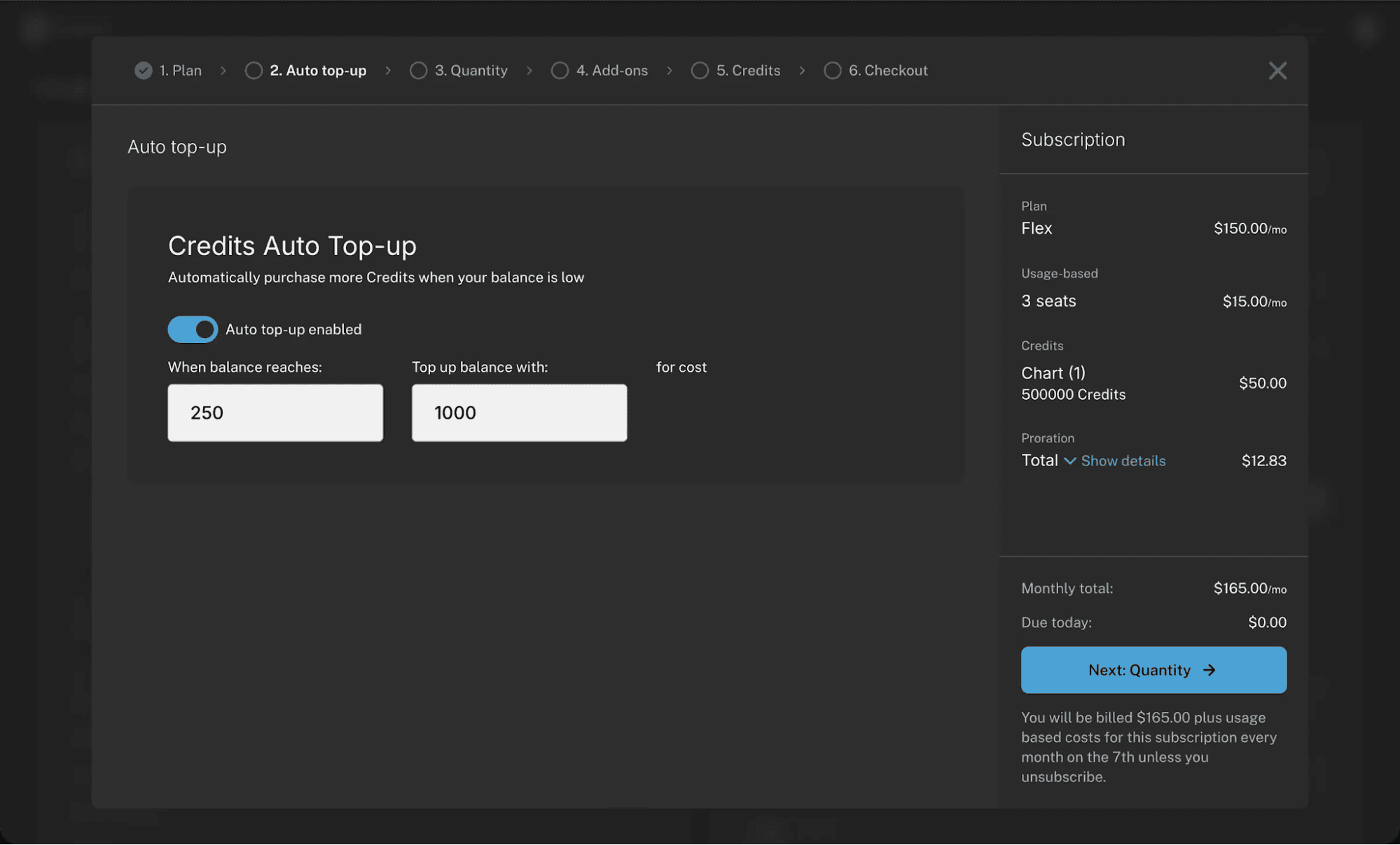
Schematic also stands out for its robust credit wallets that give buyers full visibility and control over their consumption.
Customers can track balances, forecast future spending, and set budget caps per user, company, or AI agent. They can even manage top-ups and receive alerts before usage stops.
Rahul Gill, customer experience lead at Macabacus, says, "Schematic's ability to offer usage caps, bundles, and top-ups gave our customers the cost predictability they need."
Book a demo to see how it works!
Schematic Implements Usage-Based Billing That Customers Can Trust
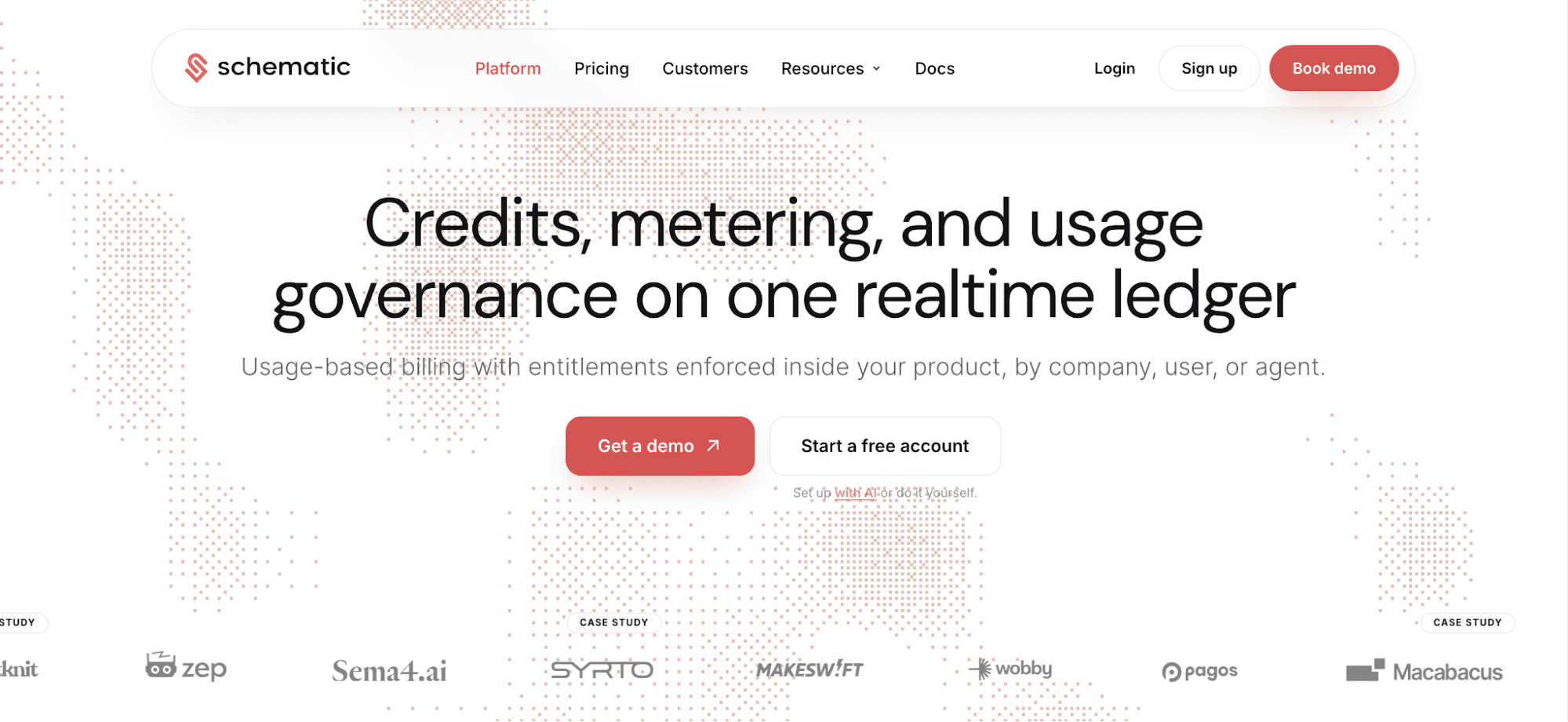
Schematic provides a complete usage-based billing platform for software and AI companies selling to enterprises.
It solves the trust problem in usage-based pricing by integrating metering, billing, credits, entitlements, and usage governance on a real-time ledger.
Unlike traditional billing solutions, Schematic gives enterprise customers real-time visibility into usage, spend forecasts, self-service controls, and configurable spending limits.
Buyers can see exactly what they consume and control their spending before costs get out of hand. These features prevent runaway bills and unexpected access throttling, giving customers more confidence in usage-based pricing.
In addition to self-serve motions, Schematic supports sales-led GTM strategies. Commercial teams can create custom plans, grant company overrides, set billing periods, and renew subscriptions with receipts.
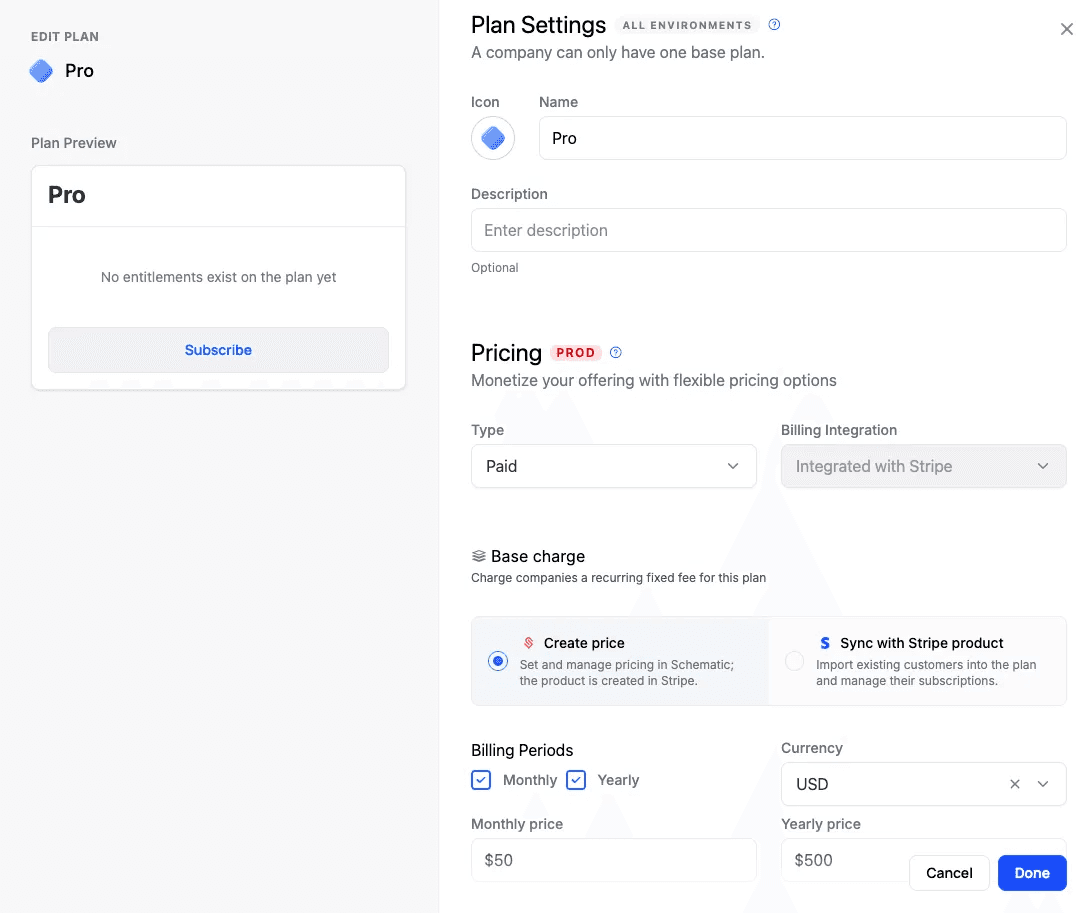
Companies can also use out-of-the-box tools, such as:
Credit rollovers, expiry windows, and priority consumption
Concurrency-safe credit holds
Real-time event logs
Plan versioning
Credit-based revenue recognition
MCP server
Max Ade from Pickleheads says, "The Schematic MCP is fantastic, and we now do most of our work in Claude, accessing plan and billing information directly without leaving our workflow."
FAQs About Stigg vs. Lago
Which is the better usage-based billing platform: Stigg or Lago?
Lago is better for companies that need usage billing, subscription management, invoicing, and revenue recognition in one. Stigg is not a usage-based billing platform. Instead, it focuses on runtime entitlement enforcement, credit management, and basic usage metering.
Is Lago an open-source billing infrastructure?
Yes, Lago offers an open-source billing infrastructure under the AGPLv3 license. Established businesses can self-host it for greater control over their billing operations. Alternatively, early-stage companies can choose Lago Cloud to avoid managing complex infrastructure.
What pricing models does Lago support?
Lago supports subscription-based, usage-based, prepaid, and hybrid pricing models. Companies can charge fixed fees, bill customers based on consumption, grant prepaid credits, and combine two or more monetization models on one invoice.