 Ryan Echternacht
Pricing is one of the most important decisions a SaaS company can make. It can affect revenue, cash flow, customer growth, and success. Yet many organizations still guess their pricing or copy competitors without a clear plan.
Unlike one-time software sales, SaaS relies on a recurring revenue model. This makes pricing more complex and powerful at the same time. A small change in pricing can lead to big gains, but only when done right.
In this guide, we’ll break down proven SaaS pricing strategies and the most popular SaaS pricing models. We'll also teach you how to choose the right approach to boost profitability.
TL;DR
- SaaS pricing strategies answer why you price your product a certain way, while pricing models define how you charge customers.
- Common SaaS pricing strategies include cost-plus, value-based, competitor-based, penetration, skim, captive, and decoy pricing.
- Many companies ship flat-rate, tiered, per-seat, usage-based, hybrid, feature-based, outcome-based, and freemium models.
- To choose the right pricing approach, understand your customers, know your product's value, analyze competitors, track metrics, and test different approaches.
- Schematic is the complete monetization platform that helps AI and software companies manage pricing, billing, and entitlements through configuration. It can model any pricing and give customers real-time visibility and control over their usage.
What Is SaaS Pricing?
SaaS pricing refers to how a Software-as-a-Service company bills customers for product access. Instead of charging a one-time fee, businesses collect a recurring payment every month or every year.
This pricing is based on how the SaaS product is delivered and used. It may depend on factors such as the number of users, features included, or product usage.
SaaS pricing answers how much customers pay, how often they are billed, and what they receive in return. It is a structured way to package and sell software as an ongoing service rather than a single purchase.
SaaS Pricing Strategies vs. SaaS Pricing Models
SaaS pricing can be broken into two parts: strategies and pricing models. Many businesses use these terms interchangeably, but they are not the same.
A SaaS pricing strategy refers to the overarching logic and decision-making process involved in determining a price point. It focuses on what to charge based on your business goals, product value, market share, or operating costs.
A SaaS pricing model is the structural framework you use to bill customers. It defines how customers pay, such as per seat, per feature, or depending on usage.
In other words, the strategy is the "why" behind your pricing, while the pricing model answers the "how."
For example, the pricing strategy tells you to use a value-based approach because your product offers a tangible value to customers, such as cost savings. As a result, you choose a tiered pricing model that scales pricing with value delivered.
7 Effective SaaS Pricing Strategies
The most successful SaaS businesses rely on different pricing strategies to drive revenue, attract customers, and stay competitive. Let's break down the common approaches that help guide pricing decisions.
1. Cost-Plus Pricing
Cost-plus or cost-based pricing is one of the simplest SaaS pricing strategies.
You calculate the total cost to build and deliver your product and add a fixed margin. This margin becomes your profit.
For example, if it costs $20 per user to run your SaaS product and you add a 50% margin, your price becomes $30.
This approach is easy to manage because it relies on internal data.
However, it ignores how customers perceive value. It also does not consider what competitors charge. This can lead to a price point that is either too low or too high.
Cost-plus pricing works best for early-stage businesses that need a starting point. But many SaaS companies move beyond it as their product evolves and customer base grows.
2. Value-Based Pricing
Value-based pricing focuses on what your product is worth to the customer. Instead of looking at operational costs, you set prices that align with customer value.
For example, if your SaaS product helps an enterprise customer save $10,000 per year, pricing it at $1,000 can feel fair.
The key is to understand the customer's perceived value of your product and willingness to pay.
This strategy often leads to higher revenue because pricing reflects the actual impact your software delivers. It also connects customer success to revenue growth. If buyers gain more from your product, you earn more.
Value-based pricing is widely seen as one of the most effective SaaS pricing strategies.
However, you might find it challenging to implement because of the extensive research required. You need to know your target markets, their budget, their price sensitivity, and your product's value metrics.
3. Competitor Pricing
Competitor-based pricing uses other SaaS products' pricing as a benchmark. You set your price based on what similar tools charge in your industry.
This approach is useful when you're entering saturated markets or trying to gain traction. It helps you stay within a price range that matches customer expectations.
There are a few ways to apply competitor pricing:
- Set lower prices to attract more users
- Match competitors to stay neutral
- Price higher to signal better value
The risk in competitor-based pricing is that you rely too much on others. If competitors price poorly, you may follow the same mistake. You might be stuck in a race to the bottom. That can shrink profit margins and make it harder to stand out.
4. Penetration Pricing
Penetration pricing is the strategy used to claim market share before your competitors do. You set a low price at the start to attract a large number of users fast. Later, you can upsell and set higher prices to compensate in the long term.
This SaaS pricing strategy helps build early traction and boost product adoption. It can also create urgency, especially if the low price is only available for a limited time.
New SaaS companies use penetration pricing when launching a new product or trying to break into competitive markets.
However, there are trade-offs. A low price can attract users who are not a good fit. These customers can push back if you increase prices later on.
5. Skim Pricing
Skim pricing, also known as price skimming, is the opposite of penetration pricing. You set a high price point in the beginning and target early adopters who are willing to pay more.
This works best for new or unique SaaS products with strong demand. Early users often value innovation and are less price-sensitive.
Over time, you lower prices to attract a wider audience. Doing so lets you capture high revenue early while expanding later.
The risk of skim pricing is limiting your initial customer base. High prices can also slow product adoption if the value is not clear.
6. Captive Pricing
Captive pricing focuses on selling a core product at a low price point, then charging more for add-ons or extras. The main product attracts users, while additional features drive revenue.
In SaaS, this often shows up as:
- A lower-priced plan with paid add-ons
- Extra fees for advanced features
- Additional charges for integrations or usage
This pricing strategy can increase revenue. As users grow, they pay more for added value.
Still, it must be handled carefully. Too many add-ons can confuse existing customers or lead to frustration.
Captive pricing is only effective when your SaaS product has clear upgrade paths and feature tiers.
7. Decoy Pricing
Decoy pricing is a SaaS pricing strategy that guides customers toward a specific plan by adding a less attractive option. This extra option is not meant to sell. It exists only to make another plan look like a better deal.
For example, you might offer three plans: Basic, Pro, and Premium. The Pro plan is priced close to Premium but offers fewer features. This makes Premium look like the smarter choice for a small price increase.
This strategy uses comparison to influence decisions. Customers often choose the option that feels like the best value, not the cheapest.
Decoy pricing works well with a tiered pricing model. It helps increase the average revenue per customer by pushing users toward higher-priced tiers.
The key to success is balance. The decoy must feel realistic, not obvious.
If done well, it can shift buying behavior without changing your core pricing. When poorly executed, it can damage brand trust and complicate the decision-making process.
Common SaaS Pricing Models to Implement
Below are the most popular pricing models that SaaS companies use. The right pricing model depends on your business objectives, value perception, customer demand, and market competition, among other factors.
Flat-Rate Pricing
With a flat-rate model, pricing stays fixed regardless of how frequently customers use the product or how many people access it.
Unlike other pricing models, flat-rate pricing is easy to understand and sell. Potential customers know exactly how much they will pay each month. Predictable costs reduce confusion and speed up buying decisions.
However, it has clear limits. High-usage customers pay the same price as low-usage customers. This means you may miss out on revenue as customers increase consumption. On the other hand, low-usage customers may feel the selling price is too high.
A flat-rate pricing model works best for products with one clear use case and a similar type of customer.
Tiered Pricing
A tiered pricing model offers various plans with different price points. Each pricing plan includes a set of features or limits. As customers move up tiers, they get more value.
This model helps you meet diverse customer needs. For example, hobbyists or startups can choose a lower tier, while enterprise buyers pay more for advanced features.
Tiered pricing also supports expansion. Customers can upgrade as their needs grow, which increases your company's revenue over time.
The challenge is deciding what to include in each tier. If different pricing tiers are not clear, customers may feel confused or choose the wrong plan.
Seat-Based Pricing
A seat-based pricing model, also known as a user-based pricing model, bills customers based on the number of users using the software. Each user or "seat" has a fixed cost.
This pricing model is common in SaaS products where access creates value, such as collaboration tools or customer relationship management (CRM) software.
Customers will find it easier to calculate their costs. As they add more users, they incur higher costs.
For your SaaS company, it is simple to track and bill for seats. It's also easy to predict revenue.
Still, a per-seat or per-user pricing model can limit growth. Teams may delay adding seats to control costs. Some might share accounts, which reduces revenue.
Seat-based pricing works best when value increases with each user. It is less effective when a few users drive most of the value.
Usage-Based Pricing
Usage-based pricing charges customers based on how much they use the product. This could be API calls, data usage, or transactions.
It's one of the most effective SaaS pricing models because it aligns costs directly with value. Customers pay more as they use more, which feels fair.
A usage-based pricing model suits many SaaS and AI products with variable customer usage patterns, such as developer tools. It ties revenue directly to customer activity and product usage.
Usage-based pricing is further divided into different pricing models:
Pay-As-You-Go Pricing
Pay-as-you-go is a type of usage-based pricing with no upfront commitment. Customers only pay for what they use during a billing period.
This lowers the barrier to entry. Users can start small without risk or long-term contracts.
Credit-Based Pricing
Credit-based pricing requires customers to buy credits in advance. These credits burn down over time as users consume the product or use a specific feature.
AI credits add predictability to usage-based billing. Customers know how much they will spend upfront while still having flexible usage.
Volume Pricing
Volume pricing lowers the cost per unit as usage increases. The more a customer uses, the less they pay per unit.
This encourages higher usage and rewards large customers. It can help increase revenue over time.
Overage Pricing
Overage pricing charges customers when they exceed usage limits in their plan. This is often used with subscription-based pricing.
It allows customers to continue using the product without interruption. At the same time, it lets SaaS companies capture additional revenue.
Hybrid Pricing
Hybrid pricing combines multiple pricing models into one structure. For example, a company may offer different subscription plans and charge based on usage at the same time.
Many modern AI and SaaS businesses now use hybrid billing to balance predictable revenue with upside from usage.
According to Growth Unhinged, hybrid pricing surged from 27% to 41% in 2025.
This pricing model lowers the barrier to entry, supports automatic revenue expansion as usage scales, and provides greater flexibility to companies.
Feature-Based Pricing
Feature-based pricing charges for access to specific features. Different pricing plans include varying capabilities.
For example, lower tiers include core features, while higher plans unlock advanced features.
Feature-based pricing helps customers choose based on their needs. It also allows you to control access to high-value features.
Outcome-Based Pricing
In outcome-based pricing, customers only pay once they have received measurable results or value from your SaaS product. For example, they pay for leads generated or time saved, instead of seats or actual usage.
This pricing model aligns pricing with customer success. If customers see positive results from your product, they are more willing to pay a higher fee.
Freemium Model
A freemium pricing model lets you offer a free version of your product with limited features. Customers can upgrade to paid plans to receive more value.
Freemium pricing helps attract a large number of users quickly. It reduces friction during sign-up and supports product-led go-to-market strategies.
However, converting free users to paid customers can be difficult. Many users stay on the free plan without upgrading.
How to Choose the Right SaaS Pricing Strategy
Here's a step-by-step guide to help you find the most suitable pricing strategy for your SaaS business.
Understand Different Customer Segments
First, you should identify your target markets and analyze how they differ.
Not all users have the same needs, budget, or usage patterns. Some may want basic features, while others need advanced capabilities.
Segment your customers based on size, industry, or use case. For example, startups, medium-sized companies, and enterprises often expect different pricing structures. Each group also has a different willingness to pay.
Understanding these differences helps you avoid one-size-fits-all pricing. It also allows you to match pricing with how each customer segment uses your SaaS product.
Identify Your Unique Value Proposition
Your pricing should reflect what makes your product different. Figure out the main problem your product solves and the results it delivers.
Focus on your value metric. This is the unit that represents how customers get value, such as users, data, or outcomes.
If your pricing does not reflect your product’s value, customers may feel it is unfair or confusing. This can hurt conversions.
A strong value proposition makes pricing easier to justify. It also helps customers understand why your product is worth paying for.
Research Competitor Pricing
Look at how similar SaaS companies price their products. Review their pricing pages, plan structures, and feature breakdowns.
This competitor analysis provides a baseline for market expectations. Customers often compare options before making a decision, so your pricing should stay within a reasonable range.
However, do not rely solely on competitors. If you copy their strategies without understanding your product's value, you risk setting the wrong price point.
Use competitor research as a reference point. Combine it with your own data and market positioning to choose the right pricing approach.
Calculate Costs and Profit Margins
While pricing should reflect customer value, it must also keep your SaaS business profitable.
You need to understand how much it costs to build, run, and support your product. This includes infrastructure, development, support, and sales.
Knowing these expenses helps you set a pricing floor. You should not price below this level to support healthy profit margins.
Track Key Performance Indicators (KPIs)
Pricing decisions should be guided by actual data instead of assumptions.
Track key metrics, such as annual/monthly recurring revenue (ARR/MRR), churn rate, customer lifetime value, customer acquisition cost, and conversion rate.
These metrics show how your pricing strategy performs over time. For example, high churn may signal that pricing does not match perceived value. Meanwhile, conversion rates can show if your pricing is too high or unclear.
By monitoring KPIs, you can spot issues early and adjust your SaaS pricing and packaging strategy.
Test Different Pricing Strategies and Models
The best way to find the right pricing is through testing. Try different pricing structures, plan tiers, or value metrics.
You can run experiments on your pricing page or test with a select group of new customers. These small changes can reveal how users respond to pricing.
Testing also reduces risk. Instead of making large pricing changes all at once, you can validate ideas step by step.
The Importance of Selecting the Right SaaS Pricing Strategy
Pricing is a strategic growth lever that can shape your company's success. Below are the reasons why it's important to choose the right pricing strategy.
Increase Revenue
The right SaaS pricing strategy directly impacts how much revenue you generate. It defines how customers pay and how that revenue grows over time.
A well-structured pricing approach can maximize the revenue generated from each customer. It also creates opportunities for upgrades, add-ons, and expansion.
If pricing is set too low or poorly structured, you leave money on the table. A strong strategy lets you price with purpose.
Improve Customer Retention and Customer Lifetime Value
Pricing affects how long customers stay and how much they spend over time. When pricing matches perceived value, customers are more likely to continue using your product.
A clear and fair pricing structure reduces frustration. It also helps customers feel confident in what they are paying for.
Retention is important in SaaS because it relies on recurring revenue. Long-term customers drive higher lifetime value and steady revenue growth.
Strengthen Market Positioning
Pricing shapes how customers view your brand compared to competitors. The right strategy helps you stand out in a competitive market.
For example, a higher price point can position your product as premium. On the other hand, lower pricing may signal accessibility or value.
Choosing flexible pricing also allows you to react quickly to competitor price changes and market conditions. This lets you maintain relevance and strengthen market positioning.
Align Pricing With Customer Usage and Perceived Value
Good pricing reflects how customers use your product or the results they get from it.
When pricing aligns with usage or outcomes, customers feel the pricing is fair. This builds trust and customer loyalty.
Users are also more likely to stick around when pricing meets their expectations and purchasing power.
How Entitlements Fit in Your SaaS Pricing Strategy
Software entitlements are the mechanism that enforces your SaaS pricing strategy within the product. They define what each customer is allowed to use based on their subscription plan or contract.
In other words, your pricing strategy and model are the business logic. Entitlements apply those rules in-product at runtime.
Entitlements can control:
- Which features a customer can access (e.g., "only the Enterprise plan gets SCIM user management")
- Usage limits and quotas (e.g., "Starter plan: 30 AI credits per month")
- Number of seats or users (e.g., "Team plan: 5 seats included")
- Trial access levels (e.g., full-featured trials, usage-based trials, and feature-gated trials)
Well-structured entitlements ensure accurate billing, prevent revenue leakage, and support different customer segments. They make your pricing and packaging strategies easier to scale.
Schematic Combines Price Modeling, Billing, Metering, and Runtime Entitlements
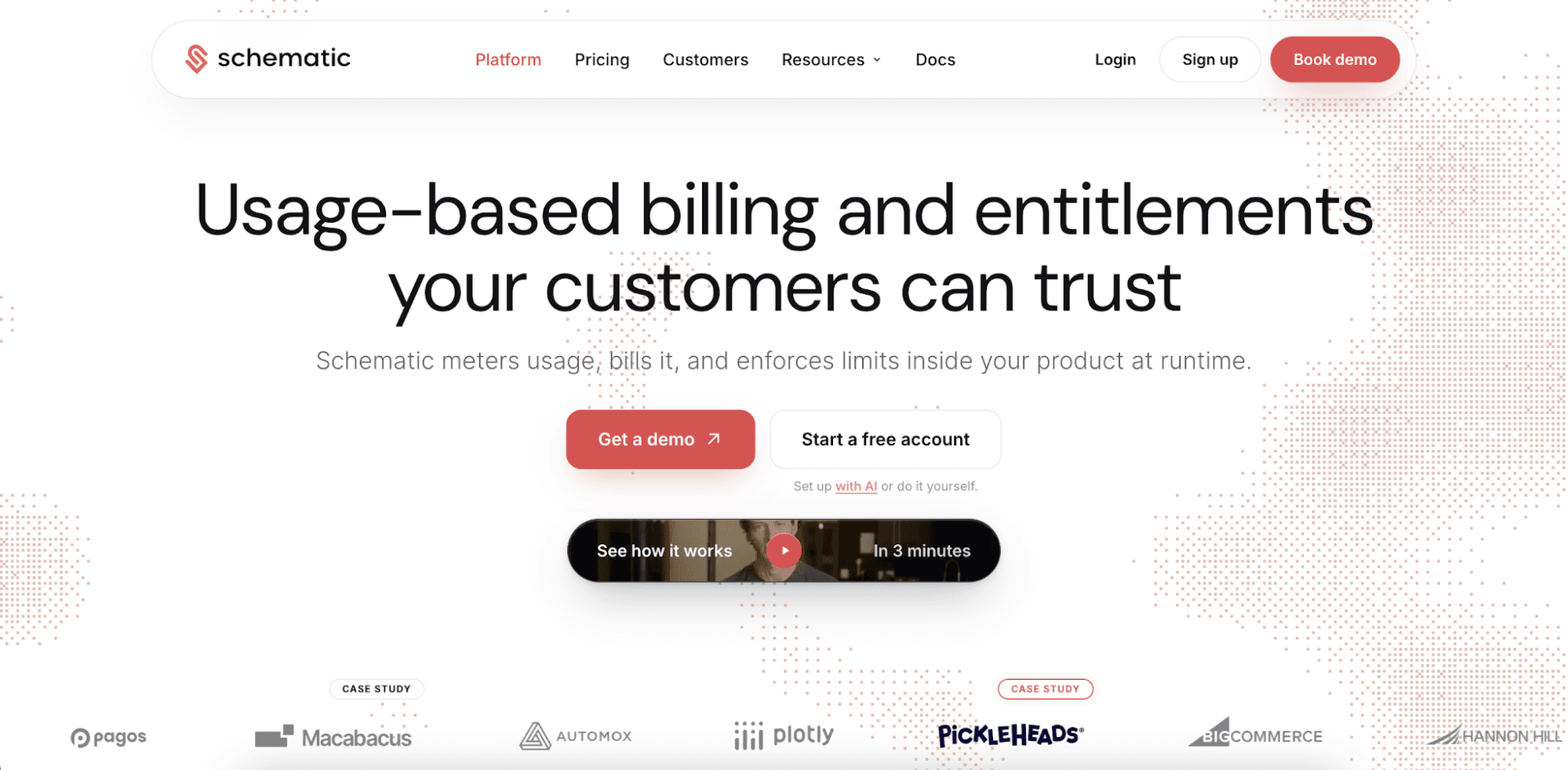
Schematic is the complete monetization platform designed for software and AI companies selling to enterprise customers.
It can support different pricing strategies and models, including seat-based, usage-based, credit burndown, tiered, overage, and hybrid pricing.
With Schematic, teams can meter usage, bill it, and enforce limits inside the product at runtime. They can also version plans and migrate customers without filing an engineering ticket.
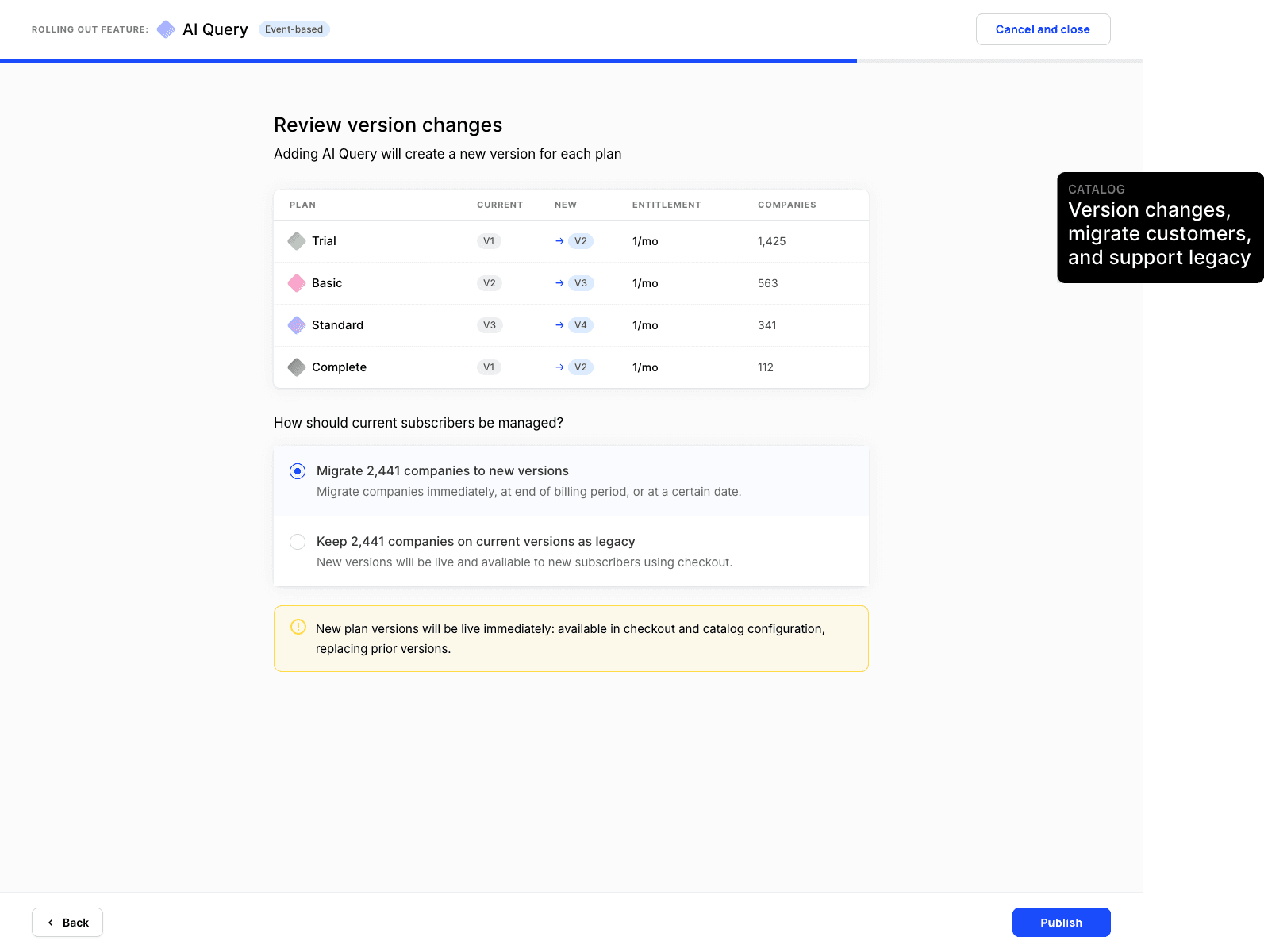
Schematic also provides native credit wallets, spend forecasts, self-service controls, and configurable spending limits.
Enterprise buyers can set usage caps, configure auto top-up policies, and define what happens once the threshold is reached. These solve the trust problem in usage-based pricing by making sure that customers will only be charged for what they expect.
Rahul Gill from Macabacus shares, "Schematic's ability to offer usage caps, bundles, and top-ups gave our customers the cost predictability they need."
The runtime entitlement engine enforces policies the moment your customers or your team save them. One flag check works in React, Node, Python, and Go, and streams back to the real-time ledger used for billing.
FAQs About SaaS Pricing Strategies
What is the 3-3-2-2-2 rule of SaaS?
The 3-3-2-2-2 rule is a growth framework for SaaS companies. It suggests tripling annual recurring revenue for two years, then doubling income for the next three years. Pricing plays a key role by supporting business expansion, customer retention, and consistent revenue growth.
What are the four types of pricing strategies?
The four common pricing strategies are cost-plus, value-based, competitor-based, and penetration pricing. Each strategy uses a different method to set prices, based on costs, customer value, market benchmarks, or growth goals.
What are the seven C's of pricing?
The seven C’s of pricing include cost, customers, culture, competition, channel, currency, and communication. These factors help guide pricing decisions by considering both internal data and external market conditions.