 Ryan Echternacht
SaaS pricing and packaging determine how customers pay and what they receive inside your product. The former sets price metrics and models, while the latter defines plans, usage limits, seats, add-ons, and feature access.
You might start with flat-rate pricing, where everyone pays one price for the same level of access. As usage grows, some customers hit usage limits, others request higher tiers with additional features, and your sales team introduces custom pricing packages.
Soon, your pricing plan, product access, and billing state no longer match.
That shift does not signal failure, but growth. Different customer segments begin using your product in various ways, and your pricing and packaging must adjust to reflect that reality.
This guide explains how to structure SaaS pricing and packaging so product behavior matches pricing decisions as you scale.
TL;DR
- SaaS pricing and packaging define how customers pay and what they receive inside your product, including pricing models, value metrics, plans, seats, usage limits, credits, and add-ons.
- Every scalable model relies on core components: plans and tiers, feature entitlements, usage units, seats, credits, add-ons, trials, and contract overrides.
- A strong pricing structure starts with the right value metric, clear upgrade paths, and separate self-serve and enterprise packaging.
- Schematic is the complete monetization platform that helps software and AI companies sell usage-based plans, bill for consumption, enforce limits at runtime, and give enterprise buyers visibility and control over their usage.
What Is SaaS Pricing and Packaging?
SaaS pricing and packaging define how a SaaS product charges customers and what those customers receive in return.
SaaS pricing determines how customers pay. It includes the pricing model, the price metric, the selected price points, and the overall pricing structure. A pricing model might be flat-rate pricing, tiered pricing, per-user pricing, or usage-based pricing. Each model defines how revenue is generated and how pricing reflects customer value.
Packaging defines what is included in each pricing option. It covers plans, features, usage limits, seats, add-ons, credits, and access levels. Packaging determines how different customer segments experience the product and how different price points connect to product value.
Many SaaS pricing models combine both elements. For example, a subscription model may use tiered pricing with higher tiers unlocking additional features. Meanwhile, usage-based billing charges customers pay-as-you-go for measurable consumption.
A clear pricing and packaging strategy can keep product pricing, customer expectations, and revenue aligned with broader business goals.
Core Components of SaaS Pricing and Packaging
Every SaaS pricing and packaging system is built from several components. These elements define how your pricing plan translates into product access.
- Plans and tiers create structured offerings for different customer segments. Each tier groups features and access under a clear pricing structure.
- Feature entitlements control which additional features are included in each plan. Feature-based access often separates higher tiers from entry plans.
- Usage units and usage limits define measurable consumption. This supports usage-based pricing models tied to product activity.
- Seats and role controls determine how many active users can access the product and what permissions they hold.
- Credits and prepaid consumption support drawdown models for AI tokens, compute, or storage.
- Add-ons allow modular expansion without forcing a full plan upgrade.
- Time-based access includes free trials, grace periods, or temporary upgrades.
- Contract-level overrides adjust software entitlements for negotiated enterprise accounts.
How to Structure SaaS Pricing and Packaging
SaaS teams decide on pricing and packaging structure by making important choices early. Those choices shape revenue growth, customer satisfaction, and long-term pricing performance.
Define the Value Metric
The first decision in any pricing strategy is the value metric. The value metric defines what customers pay for and how revenue scales with product usage.
Examples include active users, API calls, storage consumed, or seats. It should reflect the customer's perceived value of your product rather than the cost of building it.
Make sure the value metric and pricing align with customers’ willingness to pay to avoid pushback.
AI products often use usage-based models tied to tokens or compute. Collaboration tools usually rely on per-seat pricing linked to active users.
Choosing the right pricing model at this stage increases product expansion and average revenue over time.
Determine What Expands as Customers Grow
Growth should increase revenue in a predictable way. That requires deciding what expands.
Expansion can come from higher tiers, more features, multiple users, or usage-based models. Some SaaS companies rely on feature-based differentiation. Others use hybrid models that combine subscription access with metered billing.
The decision depends on the business model and product-market fit. When increased usage reflects the value delivered, pricing based on that growth supports revenue expansion without forcing higher prices.
Separate Self-Serve and Enterprise Packaging
Self-serve and enterprise customers have different needs.
Self-serve packaging decisions often prioritize clear price points, strong conversion rates, and faster customer acquisition.
Enterprise packaging may focus on customization, customer segmentation, and expansion within an existing customer base.
Freemium models or lower prices may drive early growth. Enterprise packaging often supports higher tiers, negotiated price increases, and structures that raise average revenue over time.
Clear separation improves pricing performance while keeping the product consistent.
Create Intentional Upgrade Paths
Upgrade paths should feel logical.
Customers should see how new pricing, specific features, or higher tiers deliver more value. Multiple pricing tiers should map to how different customer segments grow inside the product.
Value-based pricing supports this structure by tying higher prices to measurable outcomes. When pricing reflects product value clearly, conversion rates and customer satisfaction improve.
Align Packaging with Product Adoption Patterns
Packaging should match how different customers adopt the product.
Some start on a free tier and convert to a paid plan later. Others expand through add-ons or move into premium packages as usage increases.
Tracking key metrics, such as active users, churn rate, and paid-to-conversion rate, helps you evaluate pricing performance.
Customer feedback and pricing experiments can also guide packaging adjustments over time.
Instead of copying competitors, you choose the right pricing model for your product, customer base, and revenue growth.
Popular SaaS Pricing and Packaging Patterns in Modern B2B SaaS
Here's how B2B software companies usually implement pricing and packaging in their products.
Subscription-Based with Usage Expansion
Most B2B SaaS companies pair a subscription model with metered usage. Customers pay a fixed recurring fee for core product access, and revenue expands as activity increases.
The subscription fee provides stability, while the usage layer supports growth without forcing constant plan upgrades.
This hybrid billing structure works best when product usage directly reflects value delivered, since higher activity naturally leads to higher spend. It can help maximize revenue from power users while keeping entry pricing simple.
The trade-off is variability, because revenue depends in part on how customers use the product each month.
Seat-Based Collaboration with Usage Caps
Collaboration tools often combine seat-based pricing with usage caps. Businesses get more revenue as active users increase, while usage caps prevent unlimited consumption under a flat structure.
This model feels predictable for buyers because pricing maps to team size. It also improves customer acquisition in products where expansion happens through internal adoption.
The risk appears when seats no longer reflect delivered value, and customers hesitate to add more users.
Credit-Based Models for AI and APIs
Credit-based models allocate prepaid consumption tied to tokens, compute, or API calls. Customers draw down from a credit balance as they generate output.
This structure makes pricing clearer in AI products where usage can spike quickly. It helps users understand expected costs before they scale.
However, forecasting credit usage can be difficult for customers whose workloads vary month to month.
Tiered Feature Access with Modular Extensions
Tiered pricing groups features into structured plans, and add-ons extend functionality without requiring a full upgrade. This pattern keeps packaging clean while still supporting expansion.
When tiers clearly separate capability, it signals good pricing logic and makes upgrade decisions straightforward.
However, if packaging feels arbitrary, customers may question the tier structure and hesitate to move into higher plans.
Standardized Self-Serve with Enterprise Customization
Many B2B SaaS products combine standardized self-serve tiers with enterprise customization. Smaller accounts purchase predefined plans, while larger accounts negotiate terms, limits, or bundled access.
This hybrid structure supports scale without limiting enterprise revenue growth. The complexity appears when negotiated terms drift too far from the core pricing model and require special handling internally.
SaaS Pricing and Packaging in Hybrid GTM Models
Modern SaaS pricing and packaging rarely operate in a single motion. You may serve self-serve customers alongside sales-led enterprise buyers, and each group expects a different buying experience.
Self-serve customers need clear plans, fixed price points, and fast upgrades. Enterprise accounts expect negotiated terms, custom plans, and flexible pricing.
Expansion paths differ. One relies on automated upgrades, and the other depends on a sales team and structured renewals.
If sales exceptions drift too far from standard packaging logic, internal complexity increases. Pricing decisions begin to influence onboarding flow, upsell motion, and retention strategy.
A strong pricing structure supports both motions without fragmenting the product. It allows you to grow the customer base while still accommodating enterprise variability.
A hybrid go-to-market strategy does not change what you sell. It simply changes how consistently your pricing and packaging must scale.
Common Mistakes in SaaS Pricing and Packaging
Pricing and packaging decisions become harder as a SaaS product grows. What starts as a simple pricing page can turn into a mix of plans, usage limits, add-ons, discounts, and custom contracts.
The most common mistakes happen when the pricing structure no longer matches product value, customer behavior, or internal operations.
Giving Away Too Much Value in the Free Plan
A free plan can support customer acquisition, but it should not replace the need to convert.
When too much product value sits inside the free tier, customers may see no reason to upgrade and decide to stay on their current plan.
This often happens when the free tier includes high usage limits, broad feature access, or certain capabilities that are central to the product’s paid tier.
While your SaaS business gets a large user base, not every one of them turns into revenue.
It's best to stick with fewer features and clear limits when offering a free version of your product. This encourages more customers to upgrade as their needs and usage expand.
Copying Competitors' Strategies
Two SaaS companies may look similar on the surface while having different customer segments, cost structures, sales cycles, and usage patterns.
Copying another company’s tiers, limits, or pricing model can create a structure that does not match your product’s value metric or customer needs.
The better approach is to understand why competitors package the way they do. Then, validate your SaaS pricing strategy against customer behavior, willingness to pay, and growth potential.
Pricing should reflect your product's unique value proposition instead of the market average.
Offering Too Many Tiers
When users see too many options, they may struggle to understand which plan fits their needs. This can slow down conversion and overwhelm customers before they ever try the product.
Managing multiple tiers can also increase administrative overhead and create operational issues. Sales, support, product, and engineering teams must understand what each plan includes and control how access should behave.
Tiered packaging typically works best with three or four levels. Too few tiers can limit customer choice, while too many can lead to confusion. There should be a visible increase in value in higher tiers.
Overcomplicating SaaS Packaging
When plans, add-ons, limits, roles, and usage rules become too complex, customers struggle to connect price with value.
This is especially common when companies combine tiered packaging with many add-ons, exceptions, and contract-level overrides. The structure may support flexibility, but it can also confuse users.
Effective SaaS packaging should make upgrade decisions feel logical instead of forcing customers to decode how the product works before they buy.
Ignoring Churn and Usage Data
Many SaaS companies evaluate pricing performance against revenue captured. They fail to account for churn, engagement levels, and other key metrics that show whether customers continue to receive value after they buy.
If users downgrade quickly, hit limits too early, or stop using core features, the pricing structure may be misaligned.
Usage patterns in pay-as-you-go or credit burndown pricing can also reveal where packaging is too restrictive, too generous, or disconnected from the actual value customers experience.
Teams that ignore this data often waste valuable company time debating pricing opinions instead of improving strategies based on actual customer behavior.
Never Iterating on Monetization
Pricing and packaging can influence SaaS growth.
However, many companies only revisit monetization when cash flow or conversion problems become hard to ignore.
Pricing should not be a one-time decision. As the product matures and market conditions change, teams need to adjust plan limits, feature access, and usage thresholds.
This does not always mean increasing SaaS prices. Sometimes, the smarter move is to refine packages, introduce modular packaging, or create clearer upgrade paths.
A Growth Unhinged study reveals that out of all 1,800 pricing and packaging changes in 2025, 43% were connected feature packaging updates.
Why You Need to Operate SaaS Pricing and Packaging at Runtime
Designing SaaS pricing and packaging is only the starting point. What matters is how those decisions behave inside your product when you support self-serve plans, enterprise contracts, and usage expansion at the same time.
When a user attempts to access a feature, you need an entitlement system to evaluate what they can use based on their plan, seats, credits, and enterprise contract overrides. That decision should reflect the current subscription state, not a delayed billing report.
You should also track usage to continuously inform those access checks. If an account exceeds a defined limit, your product should respond with a clear in-product state change instead of waiting for the end of a billing cycle.
Billing state must influence behavior as well. If a subscription lapses or a Stripe payment fails, you should not rely on manual intervention. Access should update automatically.
Consider a common hybrid scenario: A customer starts on a free plan, reaches a usage threshold, and sees a limit message. They upgrade through self-serve, entitlements update, overage is tracked, and later, a sales-led enterprise override increases limits. Access adjusts immediately.
At runtime, your pricing becomes product behavior.
Ship Any SaaS Pricing Model and Change Packaging Without a Deploy Using Schematic
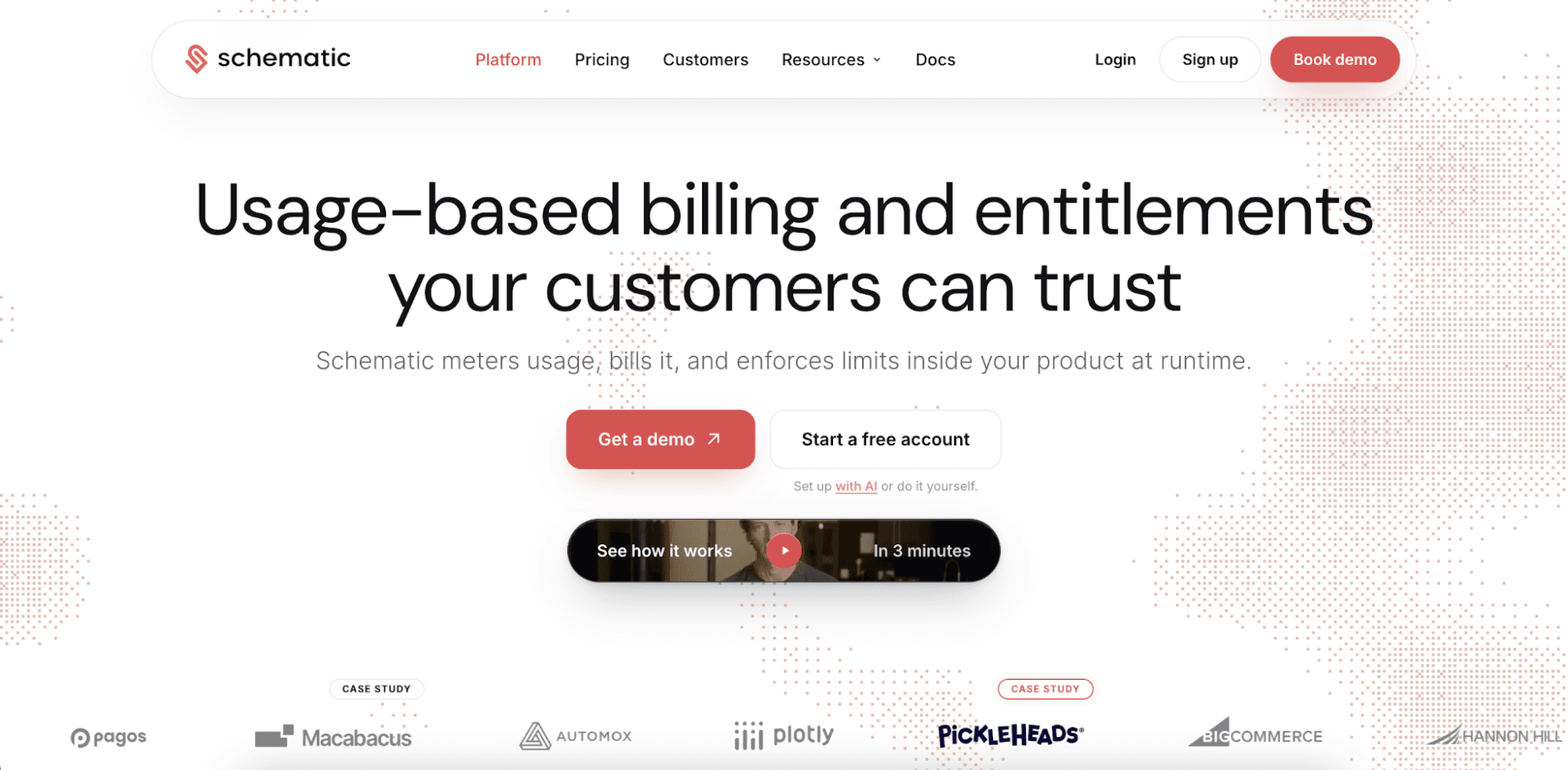
Schematic is the best monetization platform for software and AI companies selling to enterprises. It supports any pricing model, such as usage-based, seat-based, credit burndown, and hybrid pricing.
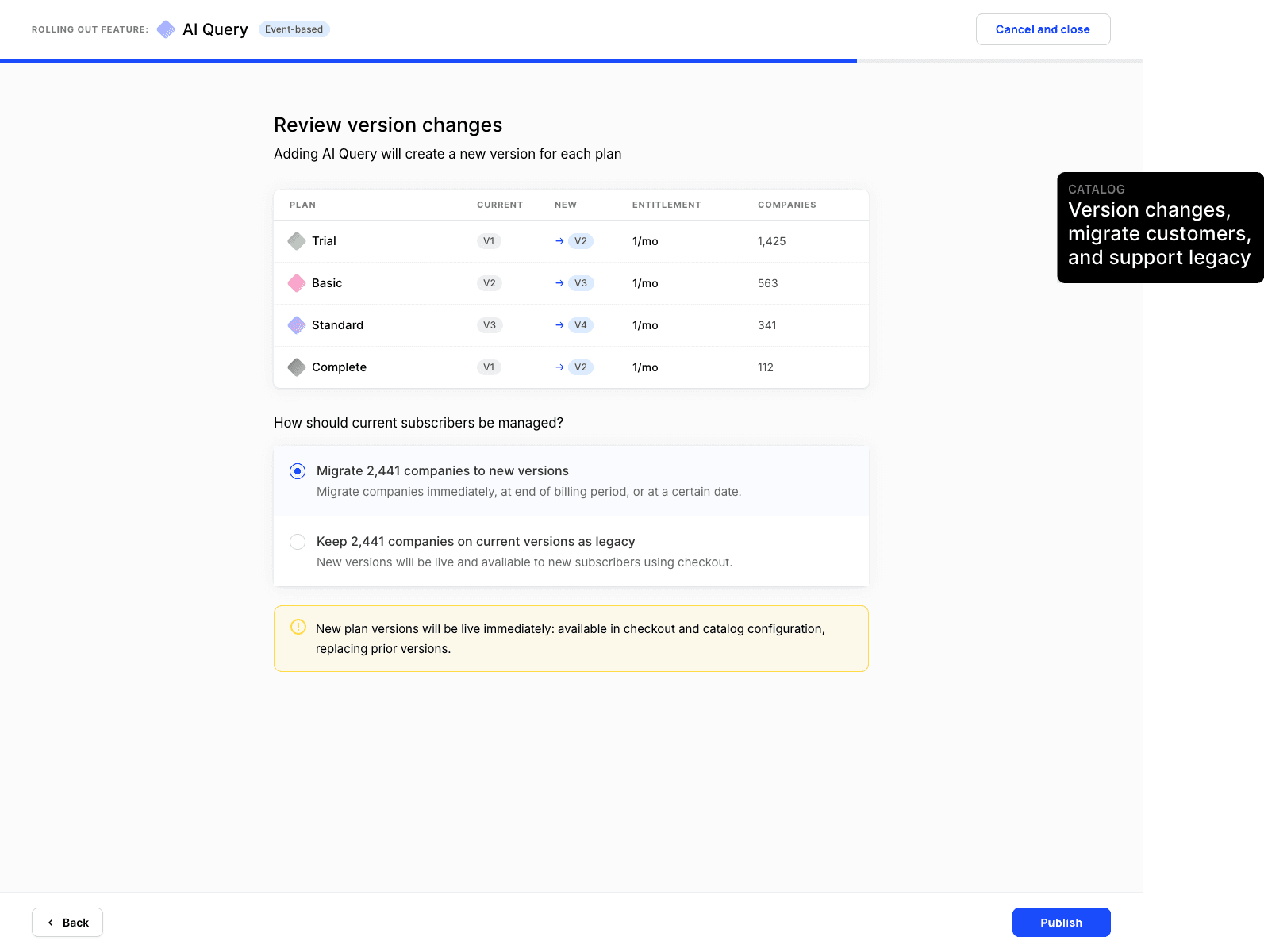
Teams can version plans, migrate customers, update packaging, and preview it without filing an engineering ticket or shipping code. Since pricing lives as data on a real-time ledger, a plan change becomes a config change.
Zach Hawtof from Titanet says, "Schematic gives us the ability to reconfigure plans without having to reconfigure the product itself, which is huge when we need to iterate quickly."
Schematic stands out for its real-time entitlement engine and robust enterprise credit wallets. It's the only billing platform that addresses customer trust structurally.
Show customers exactly what they use and owe. Then, give them complete control over their consumption through spend forecasts, self-service controls, and configurable spending limits.
This gives both buyers and sellers confidence that usage will stay within budget and that customers will only be charged for what they expect. The result is less friction during procurement, faster sales cycles, more predictable expansion, and higher long-term revenue.
FAQs About SaaS Pricing and Packaging
What are the most common SaaS pricing models used in modern B2B products?
Popular SaaS pricing models for B2B products include flat-rate pricing, recurring subscription models, tiered pricing, per-seat pricing, consumption billing, and credit-based models. Many platforms combine these into hybrid models that include subscriptions, usage expansion, and enterprise customization. The right model depends on how product value scales with customer behavior.
How often should SaaS pricing and packaging be updated?
Growth teams review SaaS pricing and packaging whenever product usage, customer segments, or sales motion change. Updates often follow new feature launches, shifts in usage patterns, or expansion into enterprise accounts. Mature companies usually change pricing and packaging once a year, while early-stage startups can update more often.
What is the difference between SaaS pricing and SaaS packaging?
SaaS pricing defines how customers pay, including the pricing model, value metric, and price points. SaaS packaging defines what customers receive at each level, such as features, usage limits, seats, credits, and add-ons. Pricing controls revenue mechanics, while packaging controls product access.