All posts
The Tiered Pricing Method Playbook for SaaS and AI Products
Blog· Ryan Echternacht·Feb 17, 2026
Ryan Echternacht·Feb 17, 2026
A single price point rarely reflects how customers actually use software over time.
Some customers consume more resources, adopt advanced features faster, or generate more value than others. Flat pricing struggles to account for those differences as usage scales.
Tiered pricing addresses this by introducing structured price points that scale with usage, access, or value instead of forcing every customer into the same rate.
This playbook explains how tiered pricing works, the most common tiered pricing structures in SaaS and AI products, and how to choose a tiered pricing strategy without overcomplicating your pricing model.
TL;DR
- The tiered pricing method structures pricing into multiple tiers so usage, access, and value scale together instead of relying on a single price point.
- It usually takes two forms: volume pricing and graduated pricing.
- Compared to flat PAYG, tiered pricing improves unit economics, reduces spend anxiety, and creates clearer expansion paths as customers grow usage.
- Choosing the right tiered model depends on usage patterns, customer expectations, and how discounts impact margins and lifetime value.
- Tiered pricing only works when usage, limits, and entitlements are enforced in the product, which is why teams use Schematic to keep pricing logic aligned with real access and Stripe billing.
What Is Tiered Pricing?
Tiered pricing structures usage into defined thresholds, with each tier offering a different per-unit price or fixed fee.
Instead of charging a single rate for every unit consumed, you create breakpoints. As customers move into higher tiers, the price per unit typically decreases or the included value increases.
Tiered pricing can apply to usage metrics like API calls, storage, events, or compute. It can also apply to access, where higher tiers unlock more limits, features, or service levels.
The base idea is simple: price should reflect scale
With customers using more, they expect discounts or better economics. Tiered pricing formalizes that expectation instead of handling discounts manually.
Tiered Pricing vs PAYG Pricing
Pay-as-you-go pricing (PAYG) charges a single per-unit rate based on how much a customer uses. Tiered pricing also bills by usage, but applies different price points as volume increases, either by charging all usage at the highest tier reached or by applying rates per tier.
Both models follow the “only pay for what you use” principle. The difference is how costs feel as customers scale. Tiered pricing introduces built-in bulk discounts, which lower per-unit cost at higher volumes and makes spend easier to predict.
Teams often move from flat PAYG to tiered pricing once customer behavior starts to diverge. High-usage customers expect pricing to reflect their scale. Without tiers, increased usage can feel penalized instead of rewarded, even when value rises.
Where Tiered Pricing Wins
- Better unit economics at scale - Effective per-unit cost falls as usage increases, supporting profitable pricing tiers without renegotiating contracts for every large account.
- Smoother adoption - Clear usage limits and different pricing tiers reduce spend anxiety during trials and early expansion, improving customer satisfaction.
- Stronger GTM alignment - Multiple price points support hybrid selling. Self-serve upgrades stay simple, while sales anchors enterprise deals to higher tiers and premium plans.
Where Flat PAYG Wins
- Tiny or sporadic usage - A single rate minimizes cognitive load when customers never approach higher tiers.
- Highly unpredictable workloads - Bursty traffic avoids tier boundary debates and keeps billing explanations simple.
- Ultra-simple implementation - Fewer rating rules reduce edge cases in usage tracking, Stripe billing, and entitlement enforcement.
Flat PAYG vs Tiered Pricing Table Comparison
The table below helps you decide when a single price point is sufficient and when a tiered pricing structure gives you more control as usage, deal size, and customer preferences diverge.
Flat PAYG | Tiered (bulk discounts) | |
|---|---|---|
Pricing complexity | One number to remember | volume-based discounts; a simple calculator is typically enough to forecast cost |
Cost at scale | Constant per-unit cost can become expensive at high volume | Effective per-unit cost declines as usage grows, which matches a typical customer expectation |
Predictability | Risk rises with usage; no natural guardrails | Clear breakpoints and usage limits reduce surprise spend |
Expansion & sales levers | Limited; discounts are ad hoc | Built-in volume levers; easier ARPU growth |
Implementation & operations | Easiest to rate and invoice | More rules around tiers, proration, and service levels |
Pricing agility | One rate; changing it means re-pricing everyone | Adjust thresholds with versioning; easier to tune pricing for large customers |
A Deeper Dive (With Math)
Most tiered pricing examples fall into three common models:
Volume Pricing (Per Unit)
With volume pricing, the per-unit price for all usage is determined by the final tier reached during the billing period.
This model works best when customer segments cluster clearly by scale and sales, and want a single entity to anchor enterprise deals for different customer groups.
It also simplifies quoting and forecasting, since customers can reason about cost using one per-unit price tied directly to their expected volume.
Volume Pricing (Flat Fee)
With flat-fee volume pricing, customers pay a fixed charge once usage crosses a defined threshold, regardless of total consumption.
This approach fits teams prioritizing predictable revenue growth and simple quoting for premium plans with defined service levels.
It is commonly used when feature access or service guarantees matter more than precise usage measurement, especially in higher tiers sold through sales-led motions.
Graduated Pricing
With graduated pricing, each unit of usage is charged at the rate of the tier it falls into, resulting in a blended effective price.
Graduated pricing works best when customer preferences vary widely, and you want lower tiers to feel safe while higher usage unlocks a lower price without sudden jumps.
That structure improves customer satisfaction by aligning cost with actual consumption and reinforces perceived value as customers scale.
Example of Pricing Tiers
Below is a simple illustration of how usage-based tiers can be structured for the same metric.
Usage | Per Unit Price | Fixed Price (alternate option) |
|---|---|---|
0-100 | \$1 per unit | $100 |
101-200 | \$0.90 per unit | $150 |
201-300 | \$0.80 per unit | $175 |
301+ | \$0.70 per unit | $200 |
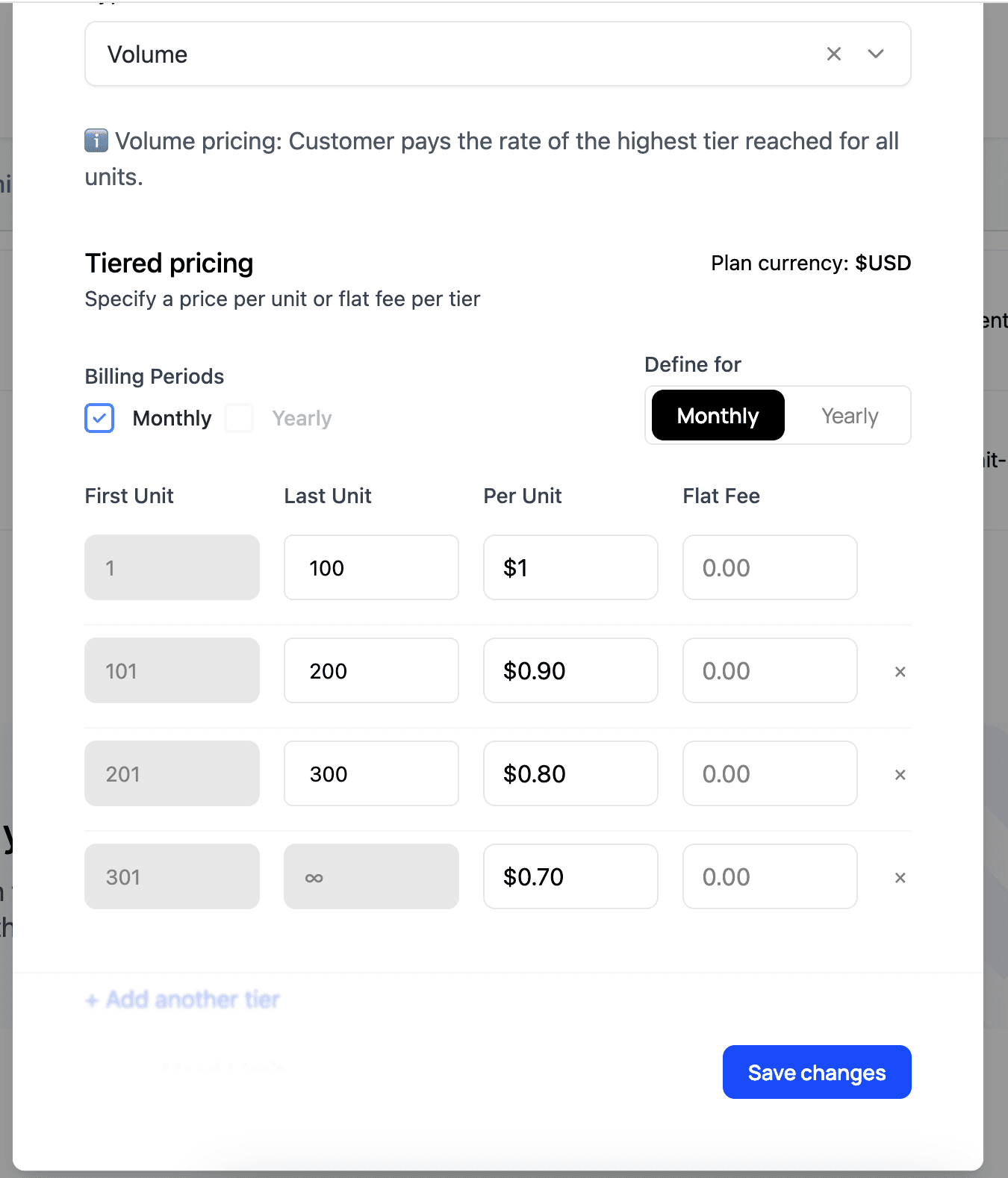
These pricing tiers illustrate how usage-based tiers introduce varying price points without forcing customers into a higher price too early.
Example of Costs by Model
The table below shows how the same usage produces different total costs depending on how pricing tiers are applied.
Usage Amount | Volume (per unit) | Volume (flat fee) | Graduated |
|---|---|---|---|
50 | $50 | $100 | $50 |
150 | $135 | $150 | $145 |
500 | $350 | $200 | $410 |
For graduated pricing, the 150 units = 100 x $1 + 50 $.90 = $145
In these tiered pricing examples, higher usage customers pay less per unit than a fixed rate would allow.
That pricing behavior encourages continued adoption, helps encourage customer loyalty, and avoids eroding trust, especially when feature access, limits, and entitlements are enforced consistently in the product.
Decision Guidelines
An effective tiered pricing strategy starts with readiness. Tiered pricing works best when your usage data, entitlements, and billing state stay consistent between self-serve and sales-led flows.
Check These Conditions First
- You already have usage-based in place - Usage data must already drive billing, and in-product limits, or tiers become guesswork instead of enforcement.
- Established customers or large prospects ask for usage discounts - Listen to customer feedback. Discount requests show what customers are willing to pay at scale and where your pricing stops matching customer needs.
- Your pricing loses competitiveness at high usage levels - Flat rates break down as volume grows, which compresses margins and shortens customer lifetime value.
Each condition protects your profit margins by ensuring discounts only apply where value and usage actually increase.
Choosing the Right Tiered Model
Different tiered pricing models solve different problems. Your decision should reflect usage patterns, sales motion, and how customers evaluate cost as they scale.
Situation | Pick | Why |
|---|---|---|
Customers fear runaway bills | Graduated | Falling effective per-unit cost and no price cliffs means customers view increased usage as unlocking savings |
Customer usage is clustered at different volume tiers | Graduated | Smoother boundaries |
Sales wants simple quotes and big-order incentives | Volume | One rate to point to; strong threshold nudge |
Enterprise deals with revenue predictability needs | Volume + Commit discounts | Forecastable for both sides |
Whichever model you choose, these tiered pricing best practices help you avoid operational drag:
- Limit plans to 3-4 tiers to keep pricing understandable
- Publish per-unit pricing so customers can calculate tiered pricing without sales help
- Monitor margins continuously as volume increases to avoid silent erosion
Run Tiered Pricing in Product With Schematic
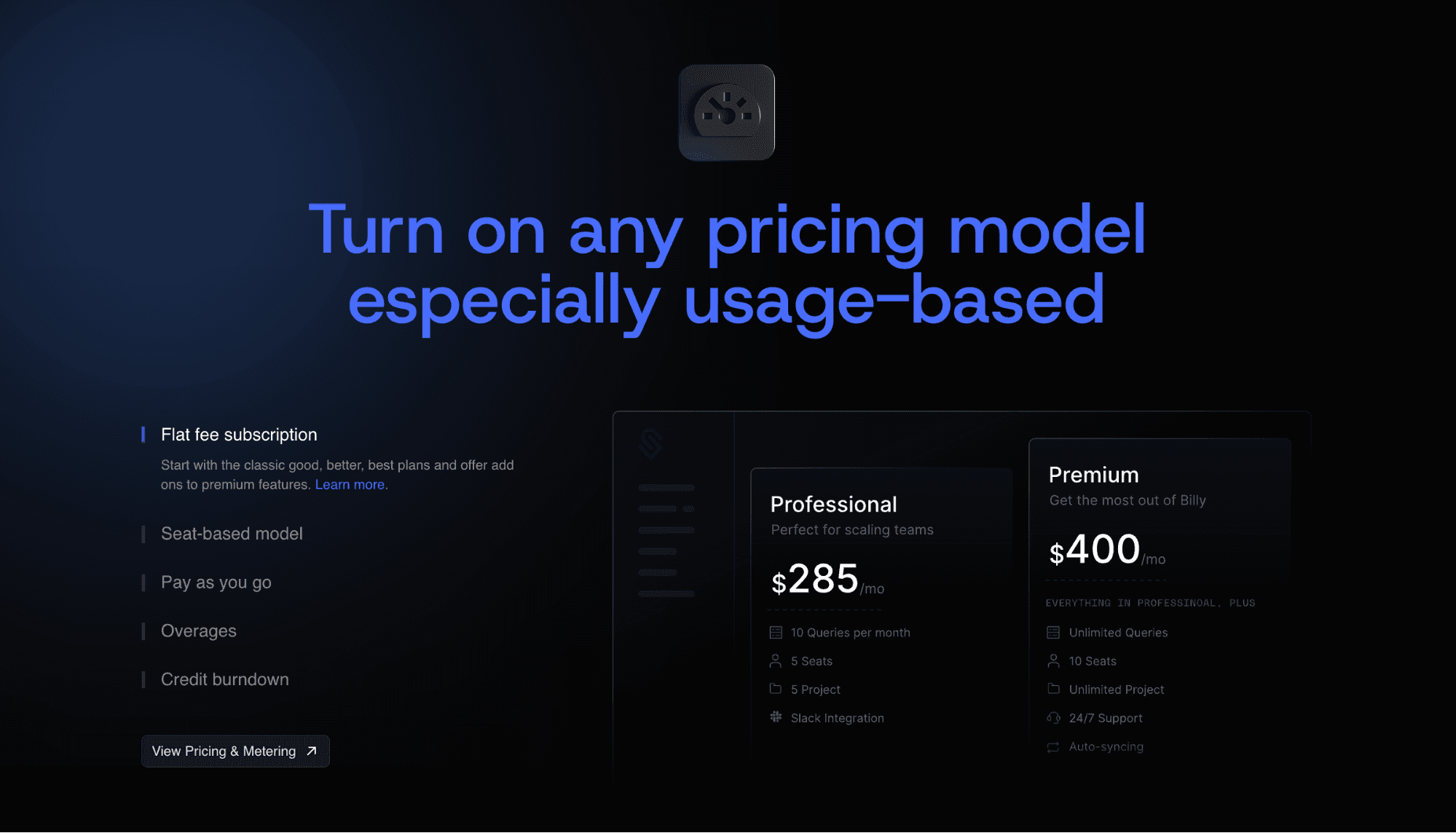
Tiered pricing works when pricing logic matches how your product actually enforces access. Flat PAYG still fits tiny or sporadic usage. Tiered pricing delivers clearer value, stronger retention, and better margin control when usage grows, and customers expect discounts.
Most pricing systems stop at invoices. Products still need to decide what happens when a customer crosses a tier, hits a limit, or qualifies for an exception. That gap is where tiered pricing breaks down in practice.
Schematic is the entitlement layer that keeps tier thresholds, usage limits, and plan access aligned between your product and Stripe. It acts as the system of record for plans, software entitlements, and usage, then evaluates access inside the product at runtime.
With Schematic, you can:
- Define plans, add-ons, and pricing tiers as a single source of truth
- Enforce usage limits and tier thresholds inside the product at runtime
- Support hybrid pricing with self-serve upgrades and sales-led exceptions
- Apply temporary overrides, trials, and credits without code changes
- Sync Stripe subscriptions to real product access and usage state
- Convert usage signals into upgrades, expansions, or sales outreach
Tiered pricing benefits only materialize when customers see limits, prices, and access updates in real time. That consistency strengthens your value proposition, helps attract customers at different scales, and supports maximizing revenue without engineering becoming the constraint.
FAQs About Tiered Pricing Method
What is a tiered pricing method?
Tiered pricing groups customers into predefined tiers with different limits, features, or usage thresholds. Products are often structured with multiple pricing tiers to reflect how customers actually use the software. As usage increases, customers move into higher tiers where the per-unit price is lower, while total spend grows with value received. This model is common in SaaS products that serve customers with very different usage patterns.
What are the 4 methods of pricing?
The four common pricing methods used in SaaS and software products are flat pricing, usage-based pricing, tiered pricing, and per-seat pricing. Flat pricing charges a single rate, while usage-based pricing charges per unit consumed. Tiered pricing groups usage or features into tiers and is often discussed as volume pricing, where all usage is billed at one discounted rate after a threshold. Per-seat pricing charges based on the number of users or licenses.
Is tiered pricing good?
Tiered pricing is effective when customers scale usage over time and expect pricing to reflect that growth. One of the key benefits of tiered pricing is that it balances predictability with flexibility, giving customers clear upgrade paths while protecting margins as usage increases. It works best when tiers align closely with real product usage and access enforcement.
What is tier 1 and tier 2 pricing?
Tier 1 and Tier 2 pricing refer to the lower levels within a tiered pricing structure. Tier 1 typically includes basic access or lower usage limits at a lower price, while Tier 2 offers higher limits, expanded access, or additional value. In SaaS products, these tiers are often designed as feature-based tiers, where higher tiers include more capabilities or higher usage allowances rather than simply charging more for the same access.