 Ryan Echternacht
Many SaaS businesses still rely on flat fees, seats, and tiered pricing. But these models don’t always match the value customers get. That gap leads to sales pushback and higher churn.
An outcome-based pricing model fills this gap.
Instead of charging users per seat or tier, you bill for successful outcomes. Customers pay based on measurable and tangible results, such as the number of resolved support tickets or qualified leads generated.
This guide discusses how outcome-based pricing works, its components, its benefits, and how to apply it in your SaaS company.
TL;DR
- Outcome-based pricing means you charge customers based on the results your product delivers.
- It works by defining a clear outcome, tracking it with shared data, and linking pricing directly to that result.
- Main components include key performance indicators, tracking systems, pricing structure, contracts, and shared accountability.
- Outcome-based pricing offers better alignment with customers, higher revenue upside, stronger retention, continuous product improvement, competitive advantage, and improved efficiency.
- Schematic is the complete monetization platform for software and AI companies that want to implement outcome-based and usage pricing models. Meter events, bill for successful results, enforce limits at runtime, and give customers spend predictability.
What Is Outcome-Based Pricing?
Outcome-based pricing is a SaaS pricing model where customers pay based on the results your product delivers. It's also known as performance-based or success-based pricing.
You don't bill for usage, product access, or certain features. Instead, you charge for a specific customer outcome that's usually linked to a clear business goal, for example, revenue increases, leads captured, or completed tasks.
Pure outcome pricing ties directly to measurable results. If the desired outcome is achieved, the customer pays based on that success. If not, the cost may be lower or adjusted.
In this pricing model, your SaaS company gets paid for the value you deliver and not just for providing the software.
How Does Outcome-Based Pricing Work?
In outcome- or success-based pricing, both the provider (your SaaS company) and the customer should first agree on an outcome unit. This could be increased sales, more signups, or fewer support tickets. Make sure this outcome is clear and easy to track.
Next, define how you will measure that outcome. You may need to set up tracking through the product and other connected tools, such as your billing system. Both sides need to see the same data to attribute accurately.
Then, link pricing to that result. For example, you may charge a percentage based on the customer's revenue, a fee per qualified lead, or a bonus when a target is reached.
Put the agreed-upon outcome definition, success criteria, price, and attribution rules in a contract. This helps prevent disputes and keeps both sides aligned from the start.
As the customer uses your product, you need to track performance. At the end of a billing cycle, you calculate the outcome and charge based on the results achieved.
Outcome-Based Pricing Example: Intercom's Fin AI Agent
Intercom’s Fin AI agent is a clear example of a SaaS company using outcome-based pricing. Instead of charging for a seat or usage, Intercom ties pricing directly to results delivered.
Intercom offers a cloud‑based helpdesk platform that enables businesses to provide customer service across email, chat, and social media. Fin AI is Intercom’s AI-powered chatbot that answers customer questions and resolves complex customer service queries without human intervention.
You pay $0.99 per successful outcome that Fin AI delivers. There must be a minimum of 50 outcomes per month.
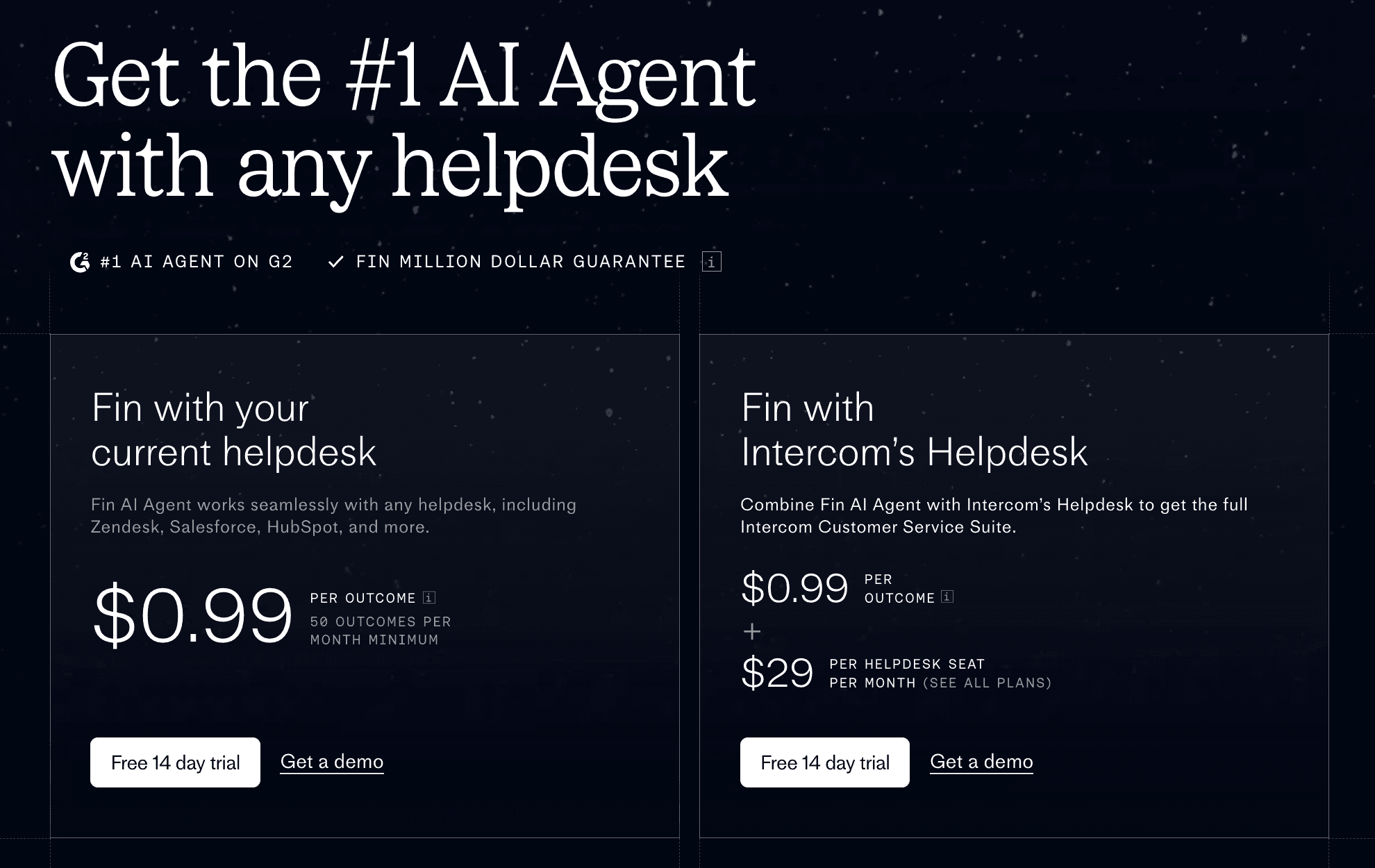
Source: Fin.ai
You only pay when Fin's AI agent delivers either of the following outcomes:
- Resolutions: The customer confirms the issue is solved or does not seek further help once Fin's AI agent resolves the problem.
- Procedure handoffs: Fin completes a task that ends with a handoff to a human agent.
You are charged once per conversation, even if Fin AI answers several customer questions.
Intercom also offers the Fin Million Dollar Guarantee to build customer trust and improve vendor accountability. If you're not fully satisfied with Fin in the first 90 days, you can get up to $1M of your money back.
Main Components of an Outcome-Based Model
Your SaaS company needs several components to make an outcome-based pricing structure work. Each one keeps pricing clear, fair, and easy to manage.
- Defined outcomes: Also known as key performance indicators (KPIs), these are the specific and quantifiable results that customers should achieve with your SaaS product.
- Tracking systems: They make sure that results are closely tied to the product. These robust systems should log events, accurately measure outcomes, and provide shared dashboards for internal alignment.
- Pricing structure: The charge per outcome should reflect the true value the customer receives from a product, not the vendor's production costs.
- Contractual guardrails and risk management: Contracts include agreed-upon KPIs, billing terms, limits, edge cases, and performance guarantees.
- Shared accountability: Both sides share responsibility for results. Your SaaS product must deliver, and the customer should follow best practices. This balances risk and keeps expectations aligned throughout the engagement.
6 Key Benefits of the Outcome-Based Pricing Model
Outcome-based pricing helps SaaS companies connect pricing to customer value. It improves trust, grows revenue, and increases net revenue retention when done right. Let's discuss the main benefits below:
1. Aligned Incentives and Trust
Unlike other pricing models, outcome-based pricing aligns your goals with your customer’s business goals. You only get paid when they see successful results. This removes tension during sales and onboarding.
Customers trust your product more because pricing feels fair. They are not paying upfront for features, seats, AI credits, or API calls they may not use. Instead, they pay for measurable outcomes.
This alignment also transforms internal workflows. Sales, product, and customer success teams focus on helping clients win. Over time, this builds stronger relationships and reduces friction across the subscriber lifecycle.
2. Increased Customer Retention and Satisfaction
Customers stay longer when they see clear value. Outcome-based pricing ties cost directly to results, so customers feel confident in what they are paying for.
This reduces buyer’s remorse after purchase. Customers are less likely to churn because pricing reflects actual product performance.
It also encourages ongoing engagement. Customers want to keep using your product to achieve better results. As outcomes improve, customer satisfaction increases.
3. Higher Potential for Revenue Growth
Outcome-based pricing offers higher potential upside compared to subscription-based or seat-based pricing. Instead of fixed limits, your revenue scales with the results you deliver.
For example, if your product drives more sales or leads, you can charge higher prices to top-performing customers. Your profits are not capped by seats or plans.
Over time, this model can lead to stronger revenue growth than traditional pricing approaches. It's also easier to justify internally.
4. Continuous Improvement
When your revenue depends on customer outcomes, you have a strong reason to keep improving your SaaS product.
Teams focus on features and updates that drive measurable results for customers. This leads to better product decisions over time.
You also get clearer feedback. If outcomes drop, you know something needs to be fixed. It creates a feedback loop that pushes your product forward and keeps it aligned with customer needs.
5. Competitive Advantage
Outcome-based pricing helps you stand out in crowded markets. Many SaaS companies still rely on traditional revenue models that feel disconnected from value.
By charging for results, you position your SaaS product as low risk and high impact. This can be a strong selling point during competitive deals.
It also shifts the conversation from price to outcomes. Instead of comparing features or plan inclusions, customers focus on results.
If your product has a higher success rate, you can easily win deals even if your pricing is higher.
6. Efficiency Gains
Outcome-based pricing pushes your team to focus only on what drives results. You avoid spending time on work that does not impact customer outcomes.
This pricing model encourages better use of resources and smarter financial planning. Teams work more efficiently to meet business goals and protect profit margins.
By improving operational efficiency, you benefit from better cost control, reduced waste, and improved resource management. This leads to better outcomes for both you and your customers.
Challenges and Limitations of Outcome-Based Pricing
Despite clear benefits, outcome-based pricing is still out of reach for 95% of the market, based on the 2025 State of B2B Monetization report. That's because it poses challenges for SaaS businesses.
You need to understand the adoption risks below before fully implementing this pricing model.
Difficulty in Defining and Measuring Outcomes
Defining outcomes sounds simple, but it is often hard in practice. Multiple factors impact business results indirectly. This makes it difficult to determine what your product actually delivers.
You also need clear and consistent value metrics. If outcomes are vague or change over time, pricing becomes unclear. Different customers may define success in various ways, which adds another layer of complexity.
The ability to measure and control outcomes is also difficult. Data gaps, delays, or inconsistencies create confusion and cause outcome-based pricing to break.
Attribution Issues
Attribution is one of the biggest challenges in outcome-based pricing. Your product is rarely the only factor driving results for customers.
These clients pay for marketing campaigns, sales teams, and external tools, all of which play a role in their success.
That makes it hard to prove how much value your product creates. Customers may question your impact. Disagreements can arise over what should count toward outcomes.
In multi-touch environments, attribution becomes even more complex. You may not have full visibility into all contributing factors. This creates uncertainty in pricing and packaging your SaaS product.
Unpredictable Revenue
Pure outcome pricing introduces revenue volatility. You no longer have a fixed income from recurring subscriptions or usage-based pricing.
If customer outcomes drop, your revenue is also affected. This can happen due to market changes, seasonality, or customer behavior.
Finance teams may also struggle to predict future income due to revenue unpredictability. This makes forecasting and financial modeling more difficult. It creates pressure to boost profits during periods of low performance.
Longer Sales Cycles
Outcome-based pricing often requires more discussion before a deal is successfully approved and closed. Customers want to understand how outcomes are defined and measured in your SaaS product.
Both you and the customer should agree on metrics, data sources, and pricing terms. This adds more steps to the sales process.
Legal reviews can also take longer. Contracts are more detailed and require more negotiation. Each deal may be slightly different, which can slow down implementation timelines.
How to Implement Outcome-Based Pricing
Follow the steps below to apply outcome-based pricing to your SaaS product.
Step 1: Identify a Measurable Outcome
Start by choosing one outcome that reflects real customer value. This should connect directly to why customers use your product. Common examples include revenue generated, leads captured, time saved, or automated resolutions.
Avoid too many outcomes. Focus on one that is easy to understand and track.
Make sure the outcome is within your product’s influence. If too many external factors affect it, measurement becomes unreliable.
A clear and measurable outcome sets the foundation for the entire pricing strategy.
Step 2: Define Success Metrics
Next, define how you will measure that outcome. Choose clear metrics that both you and the customer agree on. Popular key performance indicators include conversions, revenue, successful resolutions, and usage milestones.
Be specific. Define how you collect data, when it is measured, and what counts toward the result.
Consistency also matters. If metrics change often, pricing becomes unclear and leads to more risk.
Both sides need to rely on the same numbers. Clear success metrics reduce confusion and help maintain trust over time.
Step 3: Set Pricing Based on Agreed Outcomes
Decide how pricing will connect to the outcome.
Below are the most common outcome-based pricing models you can use:
- Pay-per-outcome: Set a fixed fee for each result achieved, such as per lead, conversion, or transaction.
- Hybrid model: Combine a lower base subscription fee (which should cover operational expenses) with a variable fee per outcome. This reduces vendor risk while still tying revenue to results.
- Milestone payments: Charge customers when they hit specific targets, like reaching a revenue goal or usage threshold.
- Bonus-penalty structure: Add rewards for exceeding targets and lower fees if outcomes fall short.
- Gain-share: Take a percentage of the value created by your product, such as a share of revenue generated or cost savings.
Step 4: Build the Technical Infrastructure
Set up a robust billing infrastructure that captures outcomes and usage patterns. Use product logs, analytical tools, API integrations, or IoT sensors to track results as they happen.
Make sure data is accurate and consistent across systems. Gaps or delays can create billing issues and reduce trust.
You should also provide clear reporting. Use dashboards or regular reports so customers can verify the numbers themselves.
Transparency is important to avoid disputes. Both sides should see how outcomes are calculated and how pricing is applied.
Step 5: Align Internal Teams
Outcome-based pricing affects multiple teams. Finance, sales, product development, and customer success should all work together.
For example, finance teams should plan for variable revenue, set minimum fees, and adjust forecasting models. Sales needs to explain pricing clearly. Product managers determine which features drive outcomes.
Lastly, customer success teams should help clients achieve results and improve the overall customer experience.
Step 6: Test and Iterate on Pricing
Do not roll out outcome-based pricing to all clients. Instead, start with a pilot phase using a small group of customers. This helps you test how the model performs while keeping risks low.
Track successful outcomes, revenue impact, and customer behavior closely. Look for gaps in measurement or pricing logic.
Consider keeping a flexible pricing model, such as a retainer fee plus outcome charges. The software industry moves fast, so your pricing should quickly adapt to customer data and feedback.
Iterate on outcome-based pricing continuously to improve results and build internal confidence before scaling.
Ship Outcome-Based Pricing With Schematic
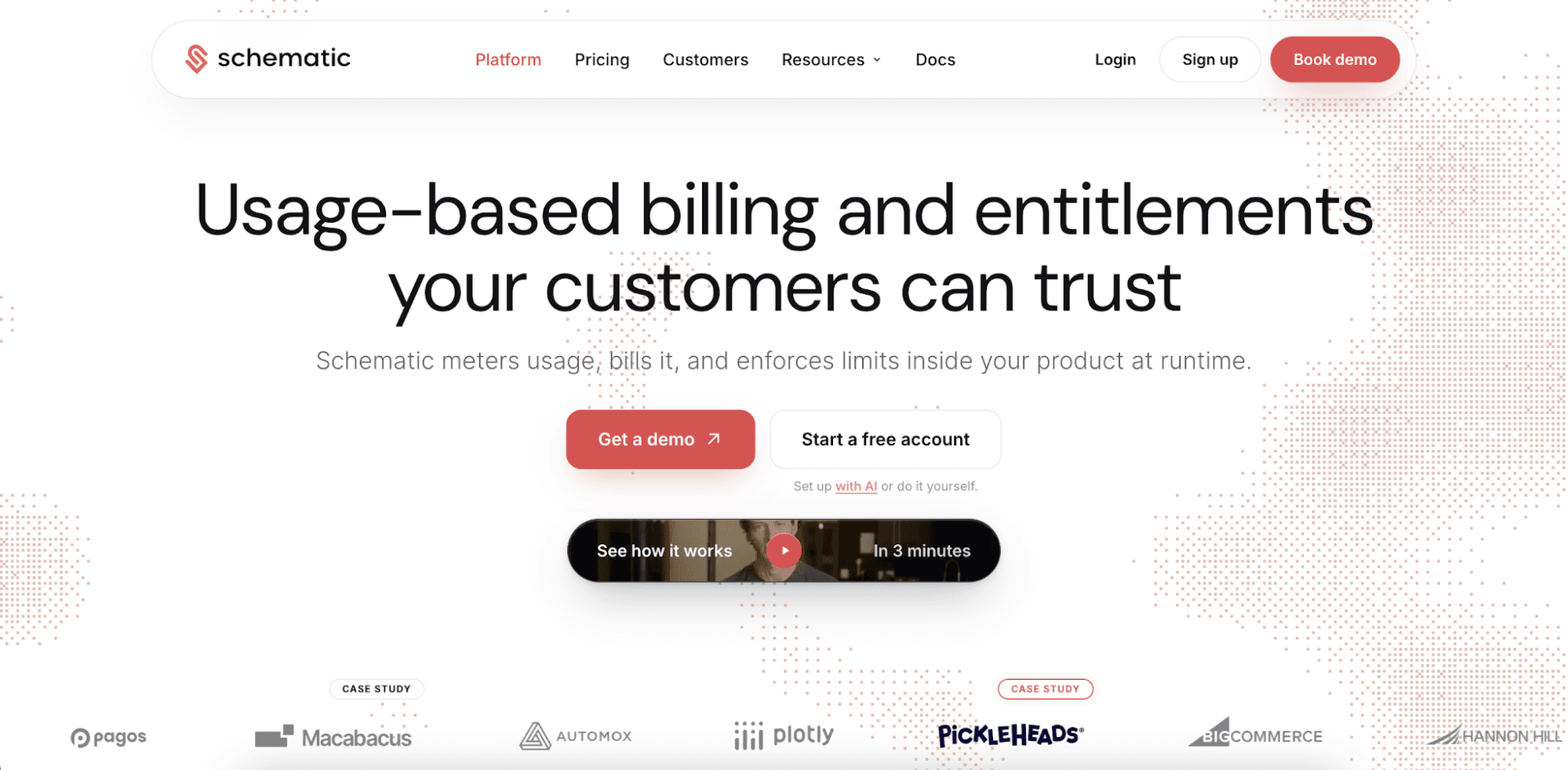
Schematic provides the complete monetization platform that can help software and AI companies launch any pricing model, including outcome-based pricing.
Define plans, meter events, enforce limits inside the product, and give enterprise customers real-time visibility and control over their spend.
What sets Schematic apart is its robust enterprise credit wallets and real-time entitlement engine. Buyers can instantly see what they use and owe, set usage caps, configure auto top-ups, forecast spend, and decide what happens at the limit.
They can even see when the next bill is due, how much each SaaS entitlement is used, how much remains, and when it resets.
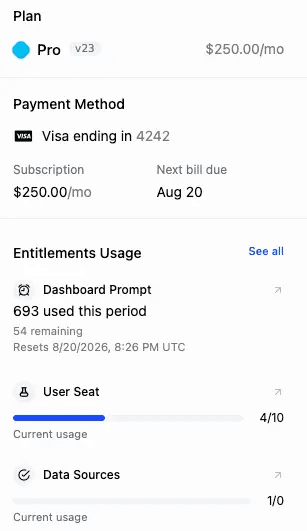
Policies take effect the moment the customer or your team saves them. One flag check works in React, Node, Python, and Go to ensure the UI and the API can never disagree.
Buyers and sellers gain confidence that usage will stay within budget and that customers will only be charged for what they expect.
Rahul Gill from Macabacus shares, "Schematic's ability to offer usage caps, bundles, and top-ups gave our customers the cost predictability they need."
The result is less friction during procurement, faster sales cycles, more predictable expansion, and higher long-term revenue.
FAQs About Outcome-Based Pricing
What is the difference between value-based pricing and outcome-based pricing?
Value-based pricing sets prices based on perceived customer value. It focuses on what customers believe your product is worth. Outcome-based pricing goes further. It ties pricing directly to measurable results, such as revenue or conversions, and not just perceived value.
What is an example of outcome-based pricing?
A common example is a marketing SaaS platform charging customers per qualified lead generated. Another example is an AI agent that bills per completed task. In both cases, customers pay only after outcome attainment.
What are the pros and cons of outcome-based pricing?
The main advantage is alignment with customer results, which builds trust and increases revenue if clients see positive outcomes. However, outcome-based pricing can be resource-intensive to set up and manage. Major challenges include unclear metrics, attribution issues, and less predictable revenue compared to other pricing models.