 Ryan Echternacht
A go-to-market (GTM) strategy is an actionable plan that outlines how to launch and sell a SaaS product to a target market. It gives your company the best chance of success instead of leaving you guessing what works.
A clear SaaS GTM strategy helps you attract the right customers, convert them, and avoid wasted budget. It creates a clear path to steady and scalable revenue growth.
This guide shares the key steps to building a successful GTM strategy for SaaS businesses. We'll also explain the definition, importance, and types of go-to-market strategies.
TL;DR
- A SaaS go-to-market strategy is a comprehensive plan for launching a software product to market.
- SaaS companies need a GTM strategy to minimize risks of failure, accelerate time-to-revenue, reduce costs, increase conversion rates, and improve scalability.
- Build your SaaS GTM strategy by following these key steps: define your audience, set your value proposition, analyze competitors, and choose pricing and channels.
- Then, focus on execution: develop your acquisition funnel, align cross-functional teams, track metrics, gather feedback, and continuously test and improve.
- Schematic helps you execute your SaaS go-to-market strategy by giving GTM teams control over pricing, packaging, and entitlements without relying on engineering.
What Is a SaaS Go-to-Market Strategy?
A SaaS go-to-market strategy is a comprehensive blueprint for launching and scaling a software product. It clearly outlines the key decisions your SaaS business needs to make before going to market.
A SaaS GTM strategy answers the following questions:
- Who are your ideal customers?
- What problem does your SaaS product solve?
- Why should customers choose your product over others?
- Where will you reach your audience (marketing channels and platforms)?
- How will you convert them into paying customers?
- When should you launch or scale your marketing and sales efforts?
The main goal of a SaaS go-to-market strategy is to ensure product-market fit, gain a competitive advantage, and maximize revenue. It helps internal teams stay aligned behind one strategy, make better decisions, and bring your SaaS solution to the right customers.
Why Do SaaS Companies Need a GTM Strategy?
A SaaS go-to-market strategy is important for several reasons:
Minimize the Risk of Failure
Many B2B SaaS companies fail because they launch products in the market without a clear plan. Some move too fast without validating demand through market research. Others wait too long or target the wrong audience.
A SaaS go-to-market strategy helps you avoid these mistakes. It encourages you to define your target customers, clarify your value proposition, choose a pricing model, select a distribution channel, and align cross-functional teams before the initial launch.
You make informed decisions instead of guessing. You know what problem you solve and who will benefit.
By developing a comprehensive GTM strategy, you significantly reduce the risk of failure and improve your chances of success.
Accelerate Time-to-Revenue
A SaaS go-to-market strategy can accelerate time-to-revenue by helping you reach the right audience from the start. Instead of spreading effort across many options, you focus on what works.
You know who to target, what messaging strategy to use, and where to show up. Doing so reduces delays in your product launch.
You also create a smoother buyer’s journey. Each step, from first touch to purchase, is aligned with your GTM strategy.
This reduces friction in the decision process. Prospects can easily understand your SaaS product and move through the sales funnel faster.
Deals close sooner when you have clear positioning and messaging. You spend less time guessing and more time converting.
You generate revenue quickly without wasting sales and marketing efforts.
Reduce Customer Acquisition Costs (CAC)
A SaaS GTM strategy helps you make smarter decisions in your customer acquisition efforts. Rather than trying every marketing channel or messaging strategy, you focus on the ones that reach your target audience.
This improves how you allocate budget. You avoid spending on marketing campaigns that don’t bring results.
Over time, this leads to lower user acquisition costs.
Increase Conversion Rates
An effective SaaS go-to-market strategy can turn prospects into paying customers.
That's because you can speak directly to your target audience and their needs, which helps them understand your product's value faster.
Clear targeting reduces unqualified leads. Your sales reps and marketing teams spend time on prospects with buying intent.
A SaaS GTM strategy also helps you remove friction in key decision points. You address common objections early and make it easier for buyers to take action.
When you communicate clearly, target better, and reduce friction, you can see an increase in conversion rates.
Improve Scalability
SaaS companies should be able to keep up with growing customer and market demand.
A SaaS go-to-market strategy helps you build for scale from the start. It gives you a clear structure for how you acquire, convert, and support customers throughout their lifecycle.
When demand increases, you don’t need to rethink your approach. You can expand what already works, whether it’s distribution channels, campaigns, pricing models, or sales processes.
You can also adjust your strategy faster when market conditions change. For example, you can target new customers or test other SaaS pricing and packaging structures.
Common Types of SaaS Go-to-Market Strategies
SaaS companies use different go-to-market strategies based on their product, target audience, and business model. Let's break down each type below:
Product-Led Growth (PLG)
Product-led growth is a SaaS GTM strategy where the product drives user acquisition and expansion.
Users can sign up, try, and experience the SaaS solution with little or no help from sales teams. Free trials or freemium are popular pricing models to highlight the value that customers get.
The product itself acts as the main driver of growth. Features like easy onboarding, in-app guidance, and self-serve upgrades support this approach.
PLG works best for SaaS products that are simple to use and deliver value quickly. It allows users to see results before committing to a paid plan.
Sales-Led Growth (SLG)
A sales-led approach relies on a sales team to acquire and convert customers. It involves guiding leads through a structured sales process, which often includes demos, calls, and proposals.
The sales team plays a key role in building relationships and handling customer objections. Deals usually take longer but result in higher contract values.
Sales-led growth is common for complex SaaS products that require explanation and customization. Buyers need more support before making a decision.
Account‑Based Marketing (ABM)
Account-based marketing is a SaaS GTM strategy focused on winning specific high-value accounts instead of targeting a broad market.
Sales and marketing teams work together to engage enterprise customers with personalized outreach. Each campaign is tailored to the needs, goals, and pain points faced by those enterprise companies.
ABM is often used by enterprise B2B SaaS companies to close large deals that involve multiple decision-makers.
Hybrid Approach
A hybrid approach combines multiple SaaS go-to-market strategies, such as product-led and sales-led motions.
For example, you use self-serve for startups and route larger accounts to sales. Doing so helps you capture revenue from different customer segments.
This approach gives you more control over how you acquire and convert users. It's suitable for growing SaaS companies that want to expand their reach and scale faster.
How to Build a Successful SaaS GTM Strategy
Here are the key steps to building a winning go-to-market strategy for your SaaS business.
1. Know Your Target Audience and Customer Segments
The first step is knowing your target audience by conducting in-depth market research. Understand your customers' pain points, preferences, and needs. Look for gaps and opportunities that your SaaS solution can address.
Next, develop an ideal customer profile or a buyer persona. Segment your target buyers by:
- Industry
- Company size
- Geographic location
- Job role (e.g., decision-makers, end users, or influencers)
You should also decide whether you are targeting a new or existing market. Each demands a different approach. For example, entering a new market requires you to focus on educating potential customers.
It's important to understand exactly who you are targeting. This informs product development decisions, marketing plans, pricing strategies, and sales approaches.
2. Determine Your Unique Value Proposition
Your unique value proposition explains what makes your SaaS product different. It shows how you solve a problem better than other options. This is what helps you stand out in a crowded SaaS market.
Focus on the outcomes and tangible value your product delivers. Be clear and specific. Avoid vague claims.
Let’s say you sell a project management tool to remote teams.
A weak value proposition might be: "Manage your projects more efficiently."
A stronger value proposition would be: “Help remote teams track projects, meet deadlines, and reduce missed tasks with real-time collaboration tools.”
See the difference between the two? The second example speaks directly to your customer base. It highlights the outcomes they care about most.
A unique value proposition helps you attract customers who are actively looking for solutions in the market. It also gives your team a consistent messaging strategy to use across all distribution channels.
3. Analyze Your Competition
After defining your value proposition, you need to see how it compares to others in the market.
Competitor analysis helps you understand your current positioning. It shows what works, what doesn’t, and where you can stand out. It also helps you avoid copying what everyone else is doing.
Focus on these key areas:
- Product features and core offerings
- Pricing and packaging
- Market positioning
- Marketing and sales strategies
- Distribution channels
The goal is to identify gaps you can fill and refine your GTM strategy before launching your product.
4. Think About SaaS Pricing
Many SaaS companies set prices just to cover their costs. However, you should also think about the value you deliver. If your product saves time or increases revenue, your pricing should reflect that.
It's also important to consider your target market and competition. Pricing should match what your customers expect and how similar products charge.
Here are common SaaS pricing models you can implement:
- Flat-rate subscriptions: You set a fixed price for full access to your product.
- Tiered pricing: Offer multiple pricing tiers with varied features or limits to serve different customer segments.
- Seat-based pricing: Charge based on the number of users using your product.
- Usage-based pricing: Bill customers depending on their usage. Heavy users pay more, while light users pay less.
- Credit-based pricing: Users buy AI credits to access features or complete specific actions.
- Value-based pricing: Price based on the value delivered to the customer.
- Freemium: Offer a free version with limited features.
- Success-based pricing: Charge based on results or outcomes generated, such as leads or tasks completed.
The right choice depends on your product, target audience, and growth goals.
5. Choose Your SaaS Go-to-Market Channels
Select the right mix of GTM channels to reach your target market.
The majority of SaaS businesses rely on events, conferences, and direct customer interactions. According to High Alpha, 45% of SaaS companies with less than $1M in annual recurring revenue use events as their GTM channel.
Many organizations also invest in SEO and content marketing, which allows them to reach potential customers who are actively searching for solutions.
You can also build a strong social media presence to engage your audience. Share insights, product updates, and use cases to stay visible.
You can even form strategic partnerships with other companies to reach new audiences and expand distribution.
Test different distribution channels to see what works and what doesn't. Then, focus on the ones that drive consistent results.
6. Develop a Customer Acquisition Funnel
A customer acquisition funnel shows how prospects move from first contact to becoming paying customers. It helps you understand each stage of the buying process and where you may lose potential users.
Without a clear funnel, your efforts can feel scattered. You may attract prospects but fail to convert them.
You should develop an acquisition funnel that touches on the following stages:
- Awareness: Introduce your SaaS product to potential buyers through search, ads, social media, cold calls, or direct mail.
- Interest: Engage prospects by highlighting how your product addresses their problems.
- Consideration: Offer free trials, schedule demos, or write product comparisons to encourage prospects to closely evaluate your solution.
- Decision: Convert prospects into customers by overcoming final objections.
Map out the actions users take at each stage. Identify where they drop off and improve those touchpoints to increase conversion rates.
7. Align Teams Behind Your GTM Strategy
To execute your GTM strategy successfully, you need all teams aligned behind the same goals.
Marketing, sales, and product development should work together with a shared understanding of your target audience and messaging. Each team supports a different part of the selling process, but they should stay in sync.
Marketing drives product awareness and generates leads, while sales engages prospects and closes deals. Product development builds features that meet customer needs.
Customer success teams also play an important role after the sale. They help customers get value from your product, which can improve retention.
When you keep cross-functional teams aligned, you ensure everyone's working towards the same goals and deliver consistent results.
8. Track Success Metrics
How do you know if your SaaS go-to-market strategy is working? You need to track the right data.
Set key performance indicators (KPIs) to measure progress. These metrics show if you are meeting your goals or need to adjust your approach.
Focus on these core metrics:
- Annual/monthly recurring revenue (ARR/MRR): Tracks predictable revenue over time.
- Customer acquisition cost: Measures how much you spend to acquire each customer.
- Conversion rate: Shows how many leads turn into paying customers.
- Churn rate: Tracks how many customers stop using your product.
- Customer lifetime value (LTV): Estimates total revenue from a customer over time.
Regularly review these success metrics to spot issues early and stay on track with your objectives.
9. Establish Customer Feedback Loops
Create feedback loops to understand your customers’ needs and guide ongoing product improvements.
Collect customer feedback through surveys, in-app forms, interviews, support tickets, and product usage data. Pay attention to common issues and feature requests.
Share these insights across teams. Product, marketing, and sales should all learn from customer input.
Then, act on the feedback to refine messaging, improve product performance, and provide a better overall customer experience.
10. Test and Optimize Your GTM Strategy
Success in the SaaS industry requires continuous improvement. Developing your GTM strategy is not a one-time effort. It should be an ongoing process.
Closely monitor market trends, competition, and customer feedback. You should also analyze the effectiveness of messaging, channels, pricing, and offers.
Use these data-driven decisions to refine your go-to-market approach. Small changes can lead to better results and help you remain competitive as the market changes.
How Schematic Fits Into Your SaaS Go-to-Market Strategy
Many SaaS companies struggle to go to market, not because of their product, but because of pricing. Pricing, packaging, and billing logic often live in code. That makes it hard to launch new plans, test changes, or support different sales motions.
Schematic solves this by decoupling business logic from product code. Developers can implement monetization once. After that, your GTM teams can control pricing, packaging, and entitlements without code changes.
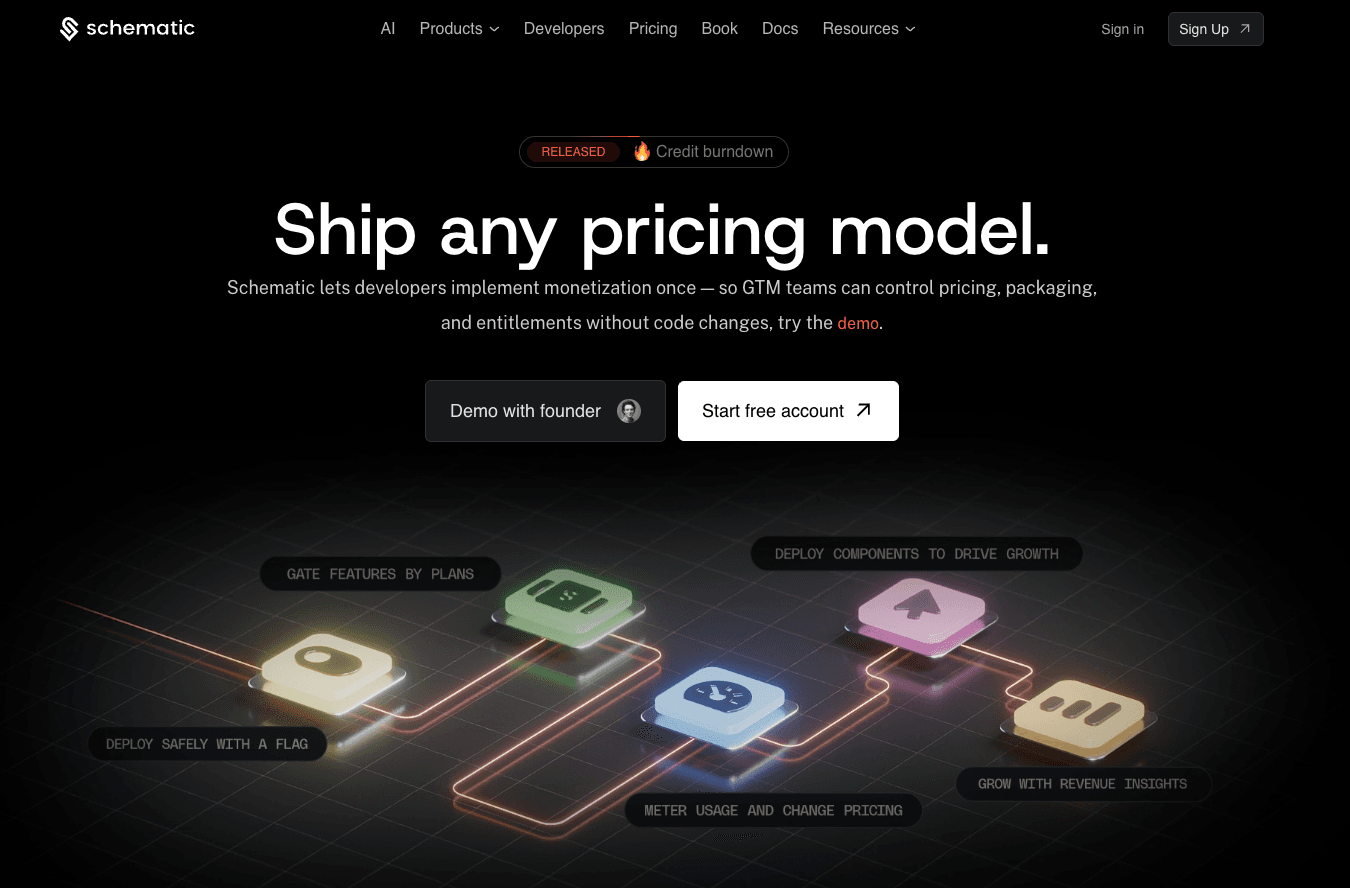
Schematic, built on Stripe, is the system of record for your product catalog, plans, software entitlements, limits, add-ons, and exceptions. Stripe handles invoicing and payments, while Schematic enforces access in-product at runtime.
GTM teams can sell flexibly while staying within product constraints. Developers stop writing billing code and maintaining complex entitlements systems.
SaaS businesses can refine their go-to-market strategy without relying on engineering every time they need to make a change.
FAQs About SaaS Go-to-Market
What does GTM mean in business?
GTM stands for go-to-market. It's the structured plan a company uses to launch and sell a product. It defines who you target, what problem you solve, why customers should choose you, where to reach them, how to turn them into customers, and when to scale efforts.
What is the difference between GTM and sales?
GTM is the comprehensive plan for bringing a product to market. Sales is just a part of that plan. GTM includes marketing, pricing, positioning, and channels, while sales focuses on closing deals.
What is a good GTM strategy?
A good SaaS go-to-market strategy is clear, focused, and based on actual customer needs. It targets the right audience, uses the most effective channels, implements the right pricing model, and delivers a strong value proposition that drives consistent growth.