 Ryan Echternacht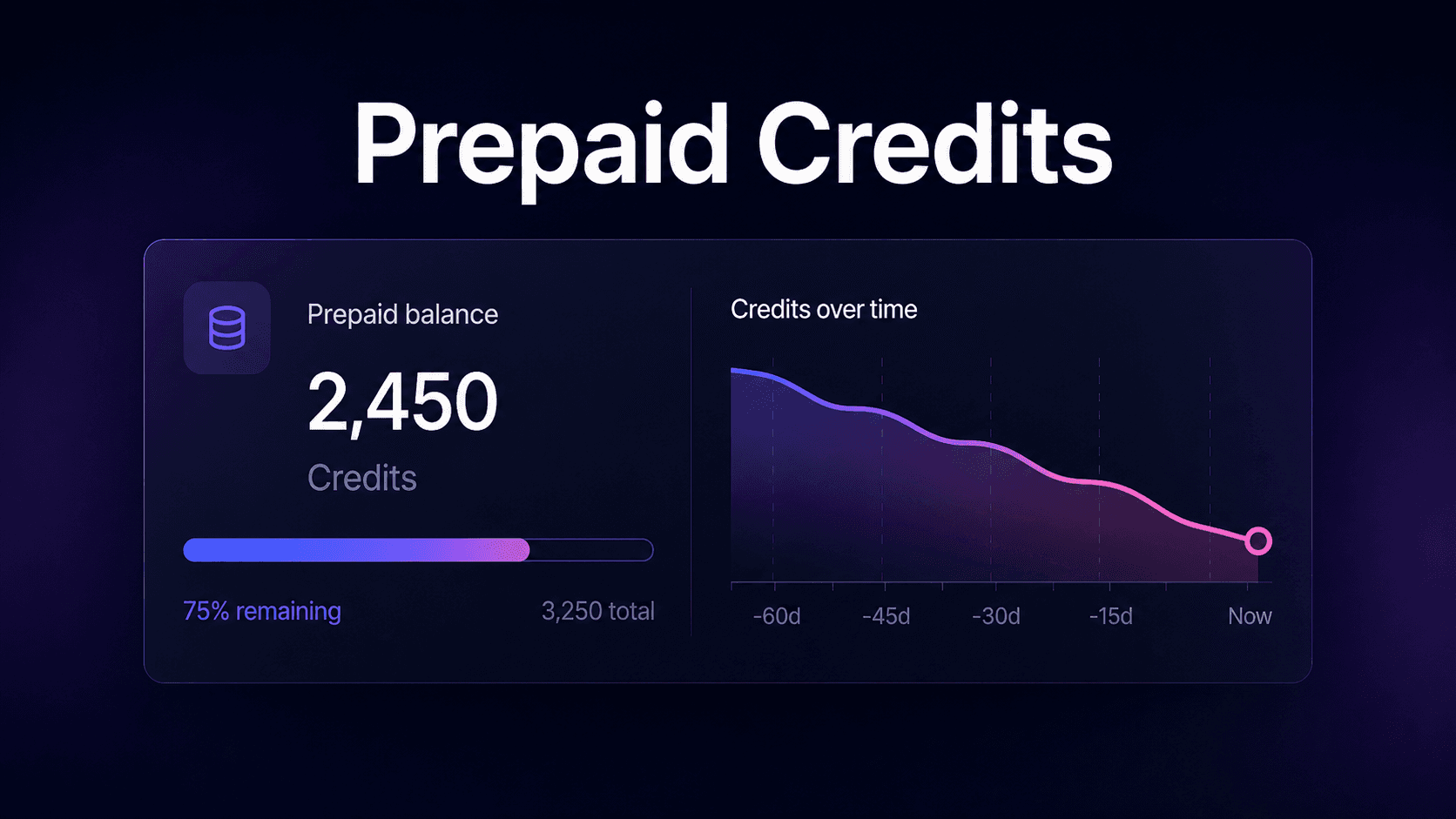
AI and SaaS companies are turning away from static pricing. Many organizations now charge customers based on usage, value, or both. That shift makes prepaid credits a strong option for products with changing costs and customer demand.
In this pricing model, customers pay upfront for AI credits that they consume over time. Each action or request inside the product deducts a set number of credits from the current balance.
A prepaid credit model makes complex usage metrics easier to understand while giving customers budget predictability and greater control over their spending.
For vendors, prepaid credits can improve cash flow and reduce the risk of unpaid usage. They can also support different products, customer types, and growth models.
This guide explains the meaning of prepaid credits and how they work. We'll also discuss why they fit modern SaaS platforms and AI products.
TL;DR
- Prepaid credits are usage units that customers purchase and consume over time.
- Each billable action reduces the available credit balance. Once credits run out, the billing system can block access, throttle usage, or enable overage pricing.
- Prepaid credits suit modern SaaS and AI products because they offer an abstraction layer, revenue predictability, cost control, flexible pricing, and support for different go-to-market motions.
- To implement credits successfully, teams need clear pricing rules, a real-time credit ledger, usage visibility, limits, and proactive alerts.
- Schematic provides a complete usage-based billing platform that includes enterprise credit wallets and a real-time entitlement engine. Give customers full visibility and control over their credit usage.
What Are Prepaid Credits?
Prepaid credits are a type of usage-based pricing where customers pay upfront before using a product.
The credits act as a common usage unit for pricing AI features, software tools, and other services.
Each credit has a set value within the product, although this value may vary by action. For example, exporting a single high-resolution image costs one credit, while transcoding a five-minute video consumes more credits.
This pricing model is becoming more common in AI and SaaS markets because it offers predictability for both buyers and sellers. According to the 2026 State of B2B Monetization report, around 33% of companies plan to charge for AI credits within the next six to 12 months.
Prepaid Credits vs. Other Pricing Models
Software pricing was mostly based on seats and static subscriptions. AI is changing SaaS monetization because costs can rise with each task, model call, or workflow.
Many companies now adopt prepaid credits, and for good reason. They protect profit margins, deliver revenue predictability, and offer cost controls. Here's how prepaid credits differ from other SaaS pricing models.
- Pay-as-you-go: A PAYG model bills customers after they use the product. Charges reflect actual usage (e.g., API calls, tokens, data storage, etc.), while prepaid credits require payment before use.
- Flat-rate subscription: It charges the same recurring fee regardless of the customer's actual consumption. In a prepaid credit system, spending is tied directly to product usage and may restrict platform access when the credit balance reaches zero.
- Seat-based pricing: This pricing model is where customers buy seats for each person who needs software access. Prepaid credits focus on product activity, which can fit AI agents and automated workflows that do not depend on human users.
- Tiered feature-based pricing: Tiered pricing groups features into subscription plans. Customers can use only what is included in each tier and should upgrade to use premium features. Prepaid credits let companies assign different credit costs to various actions without placing every feature inside a fixed tier.
How Do Prepaid Credits Work?
In a prepaid credit model, the workflow starts when a customer purchases credits through a one-time pack, subscription plan, or custom contract.
Each paid action inside the product uses a set number of credits. A simple task may cost one credit, while a multi-step process consumes more credits.
The credit system tracks credit usage in real time and updates the balance after every action.
When a customer runs out of credits, the product may block account access, throttle usage, or allow credit overages. Users may need to add credits or enable automatic top-ups to resume access.
SaaS and AI businesses should also set strict rules for refunds, top-ups, and expiration. Depending on the customer's plan, unused credits can expire or roll over to the next billing period.
Why Prepaid Credits Fit Modern SaaS and AI Products
Prepaid credits make sense for SaaS and AI products for several reasons. Let's break them down below.
Simplify Complex Billing Scenarios
AI and SaaS companies may charge for API calls, tokens, models, generated content, data processed, storage, and monthly active users (MAUs).
Pure usage-based pricing can work if you're selling to developers or technical teams. However, most commercial buyers cannot understand raw usage metrics.
In addition to a confusing customer experience, separate pricing units can lead to complex billing scenarios and disputes if you're not careful.
Fortunately, prepaid credits turn different actions into a single unit that customers can easily track. These credits may cover several products, AI models, or service types.
Each action deducts from a shared pool of credits.
Customers do not need to learn the raw cost of tokens, compute time, or model calls. Finance teams can communicate the product's value through a simpler unit.
Deliver Budget Predictability
Customers pay for prepaid credits before they use the product. This gives them a clear spending amount at the start of a month, quarter, or custom contract term.
Users know how many credits they have already paid for and can plan their usage around that balance.
Vendors can also benefit from the cash received upfront before they take on the full cost of serving customers. This can reduce the risk of large unpaid bills after a sudden increase in AI consumption.
Give Customers Cost Control
Prepaid credits give customers the ability to set a clear limit on product spending. They can buy a fixed amount of credits, track their account balance over time, and decide when the prepaid balance gets refilled. This minimizes the risk of an unexpected bill after a period of heavy usage.
Account owners can also set limits for specific users, projects, or AI agents. Autonomous agents can consume credits rapidly and introduce concurrent usage risks if limits are not enforced.
The product should block requests, throttle usage, or ask for approval when the credit balance reaches a threshold.
Customers can then adjust their activity before costs increase significantly. They may switch to a lower-cost model or reduce request volume.
Support Different Go-to-Market Motions
Prepaid credits can support product-led growth and sales-led go-to-market strategies at the same time.
Self-serve customers can choose a credit pack, pay online, and start using the product without speaking with sales teams.
Enterprise accounts, on the other hand, may need custom plans, contract-level credits, or annual payment schedules. They also expect volume discounts for larger commitments, which usually involves negotiating with sales.
Prepaid credits give the vendor a single pricing unit for small businesses, growing teams, and enterprise deals. These eliminate the need to create a separate billing model for each customer group.
Enable Flexible Pricing
Prepaid credits act as an abstract pricing unit. Customers see one credit balance, while the company controls how many credits each action consumes.
Revenue operations (RevOps) teams can easily adjust pricing strategies as product usage or underlying costs change. They can continuously iterate on AI monetization without overhauling the entire credit-based pricing model.
Challenges in Using Prepaid Credits for Monetization
Despite their benefits, prepaid credits can introduce several challenges when it comes to AI and SaaS monetization.
Customers May Not Understand Credit Value
Buyers might struggle to tell what one credit is worth or how long the credit will last.
If prepaid credits expire at the end of each period, customers fear losing what they paid for. As a result, they negotiate harder and purchase less.
Customers may also be confused when each feature has a different credit cost. They can even question an invoice if the credit amount does not match their willingness to pay.
SaaS and AI companies should clearly explain credit costs, surface estimated usage, and show the value included in each package. Without that clarity, credit pricing can reduce trust and affect sales.
Poor Credit Pricing Can Erode Margins
Teams should set credit costs based on product value and the cost of serving each action.
If a costly AI request uses too few credits, power users may drain your profit margins. However, if a simple action costs too many credits, customers feel that pricing is unfair and may avoid using the feature.
Discounted or promotional credits also introduce risks. Teams might lower the price per unit too far for large credit purchases, which can erode gross margins.
Businesses should regularly review credit pricing as model fees, cloud infrastructure costs, and usage patterns change. Old rates can decrease profitability over time.
Prepaid Credits Require a Reliable Billing Infrastructure
A prepaid credit model needs more than a checkout page. It requires a real-time credit ledger to ensure that every action draws the balance down accurately.
Teams should also meter usage accurately and enforce access inside the product at runtime. The problem? Most legacy billing systems were not designed for these tasks.
Choose a modern SaaS billing solution that includes a credit ledger, metering, and enforcement. Without these controls, customers may see incorrect balances or receive access they did not pay for.
The billing platform should also connect usage records to accounting. Purchased credits may represent future performance obligations until customers use them or the credits expire. This affects revenue recognition and financial reporting workflows.
Customers Could Quickly Burn Through Credits
AI features have costs that vary by model, input size, output length, or processing time.
Customers may use far more credits than expected during complex projects or automated workflows. Autonomous agents, in particular, can cause usage to scale rapidly.
However, no one wants to consume an entire year or quarter’s worth of credits in like two days. If customers burn through their credit balance quickly, they might have the impression that the company charges too much, even when pricing is fair.
Real-time credit enforcement and controls are important to avoid runaway spending. Proactive usage alerts are also useful, so buyers can adjust activity before their credits run out. Alternatively, customers can enable automatic credit refills to ensure uninterrupted service.
How to Successfully Implement Prepaid Credits
Follow these tips to address the previous challenges and implement prepaid credits successfully.
Define Billable Actions and Credit Costs
Start by listing every product action that should draw from the credit balance. These may include model calls, generated images, processed files, API requests, or completed AI tasks.
Next, calculate the cost of each action and compare it with the value customers receive. Assign more credits to costly or high-value actions and fewer credits to simpler tasks. The goal is to cover your operational costs while setting a price that customers will accept.
Communicate the pricing clearly. Show how many credits common actions use to help customers estimate their costs before they purchase.
Set Up a Real-Time Credit Ledger
You need a real-time credit ledger that updates the customer’s balance as each billable action happens, not hours later. It should record every purchase, top-up, refund, expiration, or manual plan changes.
The ledger must also hold or reserve credits before an action starts. Once the task is successfully completed, it can commit the final charge. If the workflow fails, the ledger can release unused credits to prevent unfair charges and billing disputes.
While the idea of a credit ledger might be enticing for leadership teams, engineering doesn't want to build it due to its complexity. Most businesses buy because they prefer a specialist to maintain and scale it.
Establish Clear Rules for Credit Expirations and Rollovers
Decide whether unused credits expire, roll over, or remain available until customers spend them. Establish these rules before customers purchase a package.
Create separate terms for purchased and promotional credits when needed. For example, promotional credits may expire sooner than credits that the customer bought at a regular price.
Make sure all these credit rules are reflected in the billing system, product, and customer agreement. These help finance teams track unused balances and account changes correctly.
Show Credit Usage Inside the Product
Display the current credit balance inside the product. Show how many credits each action will use before they confirm it, especially for advanced AI features.
After the task is complete, display the number of credits deducted and the new balance. Consider adding a usage history with dates, actions, and credit costs so that customers can check past activity.
This visibility improves the customer experience and makes abstract credits easier to understand. It also helps support teams answer billing questions without reviewing product logs.
Enable Customers to Set Usage Limits
Give account owners controls for monthly credit use, project spending, team limits, and AI agent activity. Let them pause usage when spending reaches a predetermined amount.
Enterprise customers may also need approval rules before a team member or an autonomous agent can spend more credits. These controls help them stay within budget and prevent runaway spending.
You can choose between soft and hard limits. A soft limit can throttle usage or allow overage pricing when the customer hits a threshold, while a hard limit can completely block further paid actions.
Regardless of your choice, enforce credit limits at runtime so the product responds as soon as a customer reaches the set threshold.
Send Proactive Alerts
Send alerts before the credit balance becomes too low. Do not wait until the product blocks a request or slows a workflow.
Let customers choose alert points, such as 50%, 25%, and 10% remaining. Send notices through the product, email, or API based on how each customer works.
Alerts should state the current balance, recent use, and expected time until the credits run out. These give customers enough time to plan their future usage and support fraud prevention efforts.
Monitor Credit Balance and Encourage Users to Top Up
Track each customer’s remaining balance and usage patterns. Use this information to show refill prompts before credits reach zero.
Make credit top-ups simple. Customers should be able to add credits inside the product without contacting sales.
You can also offer automatic credit refills when the balance drops below a chosen level. Let customers set the refill amount and maximum monthly spending.
Schematic Lets You Monetize SaaS and AI Products With Prepaid Credits
Schematic provides a complete usage-based billing platform for software and AI companies selling to enterprise customers.
Commercial teams use Schematic to sell prepaid credits, meter usage, enforce limits at runtime, manage software entitlements, and give users visibility and control over their usage.
Enterprise credit wallets can track every grant, credit rollover, automatic top-up, and burn down so that teams aren’t surprised by runaway bills.
With self-service controls and configurable spending limits, customers can set usage caps per seat or per agent, increase the top-up policy, and decide what happens at the limit. They can trust that usage will stay within budget.
Schematic automatically enforces the policy buyers have set without code redeployment or support tickets. This leads to faster sales cycles, more predictable expansion, and higher long-term revenue.
FAQs About Prepaid Credits
What are prepaid credits?
Prepaid credits are units that customers buy before using a product. Each credit represents a set amount of access to AI features or other paid actions. SaaS and AI companies may sell them in packs or include them in recurring subscription plans.
How does a prepaid credit work?
Customers buy a credit balance in advance. Each billable action deducts a set number of credits from the account. The credit billing system tracks the remaining balance and may block usage when credits run out or expire.
Do prepaid credits expire?
Yes, prepaid credits may expire. However, they can also roll over to the next billing period or remain valid until used. The exact rule depends on the provider, plan, and contract. Companies should explain expiration dates clearly before purchase to avoid billing disputes and customer frustration.
What is the difference between prepaid credits and usage-based pricing?
Prepaid credits are a type of usage-based pricing. Customers pay upfront and spend credits as they use the product's features or tools. A prepaid credit model is different from traditional pay-as-you-go, where customers are charged after the billing period based on actual usage.