 Ryan Echternacht
AI monetization differs significantly from traditional SaaS.
In traditional SaaS, pricing is simple. You usually charge per seat or a flat fee to cover operational costs, which are stable. Customer usage is also easy to predict.
AI changes that because it incurs variable costs per task, and usage is unpredictable. One customer can drive high costs and high usage.
That’s why AI SaaS monetization requires a different pricing playbook. Failing to adapt means leaving money on the table.
In this article, we'll break down key principles you can follow to price smarter, protect margins, and grow revenue.
TL;DR
- AI SaaS monetization is how companies price and generate recurring revenue from AI products or features.
- Businesses follow 8 key principles: tie pricing to value, consider costs, balance predictability, redefine metrics, align with go-to-market strategy, drive expansion, simplify pricing, and iterate continuously.
- AI changes monetization by shifting from fixed pricing to usage-driven, variable models with unpredictable costs.
- Popular monetization models include usage-based pricing, outcome-based pricing, credits, tiers, and hybrid approaches.
- Schematic helps AI companies control pricing, packaging, and entitlements without hard-coded logic.
How AI Changes Monetization in the SaaS Industry
AI significantly changes monetization in SaaS companies.
Most SaaS platforms have per-seat pricing and subscription billing. This works because of predictable workflows. Costs remain steady, and margins are easier to control.
However, AI capabilities run on usage. Every prompt, request, or API call has an actual cost. Workflows are also probabilistic, which means outputs and usage can vary each time.
Unlike traditional software companies, AI businesses have very unpredictable gross margins. One customer may use very little, while another may generate heavy usage in a short time. That makes it difficult to match pricing with cost.
AI also shifts how customers perceive value. It’s no longer about access to the software product, but also the outcomes the platform delivers.
Monetizing AI will look more like telecoms, not SaaS, where the pricing strategy depends on usage, consumption, and variable demand.
8 Principles to Follow for AI SaaS Monetization
Here are the key principles you need to follow when monetizing AI in SaaS.
1. Tie Pricing to Value Delivered
Traditional SaaS pricing was mostly subscriptions and seats.
However, these monetization models break with AI because you're no longer selling access. An individual user can now produce a large amount of output in minutes.
This creates a gap between price and actual value.
AI-native companies should price based on what their AI product delivers. Examples include reports generated, workflows completed, or tasks automated.
When pricing is tied to real customer value, it becomes easier to justify the higher cost. Customers can clearly see what they are paying for. This builds trust, improves conversions, and reduces pushback during upgrades or renewals.
Value-based pricing also helps you grow revenue as usage scales. If your product delivers more value, you can charge more.
2. Consider AI Costs
AI products come with real and ongoing costs.
Every request runs on infrastructure. This includes compute costs from model inference, API calls, and GPU usage. The more your product is used, the more you pay.
You also need to consider expenses for storage, data processing, and model tuning. These add up over time, especially as your product scales.
If pricing does not account for these material unit costs, margins can shrink fast. High usage without the right pricing model and access control can lead to significant losses or negative margins.
3. Balance Predictability With Upside
AI companies need stable revenue, but they also need room to grow with usage.
Recurring subscriptions give predictability. You know how much revenue comes in every month or year. But they limit upside, especially when customers use more AI features.
On the other hand, pure usage-based pricing can grow revenue fast. However, it makes billing less predictable for both you and your customers.
The solution is to combine both.
In a hybrid model, a subscription fee covers operating expenses and gives customers cost predictability. Then, usage-based charges apply as customers scale their usage.
This approach creates a balance. You get predictable revenue from subscriptions while still capturing upside from heavy usage.
4. Redefine Success Metrics
Legacy SaaS metrics, such as annual recurring revenue (ARR) and customer acquisition costs (CAC), still matter. But they do not fully reflect AI’s actual value. These metrics assume stable usage and predictable costs.
AI introduces a fundamental shift in how you track success. Revenue earned can vary widely due to customer usage. And costs can change with every request. Value is often tied to output rather than software access.
This makes it harder to understand performance using only traditional metrics. You need to evaluate success through new lenses.
Focus on the following metrics:
- Task completion rate
- Turnaround time
- Output accuracy
- Time saved for users
- Customer feedback score
Use this data to refine pricing, adjust plans, and redefine service-level agreements (SLAs) that go beyond traditional SaaS vendors.
5. Align AI Pricing with Go-to-Market Strategy
While sales-led go-to-market (GTM) motions remain popular, many SaaS companies are now using hybrid or product-led strategies.
According to ICONIQ's State of AI report, around 60% of businesses combine product and sales-led growth.
This changes how companies should approach go-to-market, pricing, and value delivery.
If there is a gap between pricing and your GTM strategy, growth will slow down. For example, a complex pricing model can block self-serve adoption. At the same time, simple pricing may not work for enterprise deals.
Look at how customers buy and use your product. Then, shape pricing around that behavior.
You should align monetization with your product strategy. If your platform is built for fast adoption, pricing should be easy to understand and low-friction.
However, pricing may include custom plans and usage limits if you target enterprise clients.
6. Optimize for Expansion Revenue
AI usage does not stay flat. Customers may start using your product once a week, then rely on it more often as they see results. They generate more requests, run additional workflows, and use more AI features.
Your monetization strategy should capture that growth. If it doesn’t, revenue leakage happens. Customers get more value, but your profits do not increase.
To avoid this, design pricing that scales with usage or value. You can offer higher tiers with premium features, set usage caps, or charge overage fees.
You should also make upgrades simple and visible inside the product.
When done right, revenue grows naturally as product usage increases.
7. Keep Pricing Simple and Transparent
AI pricing can quickly get complex. You may deal with credit systems, usage limits, tiers, and add-ons. However, too many different approaches can confuse customers.
Buyers hesitate when pricing is difficult to understand. They don’t know how much they will pay or what they will get. This slows down adoption and sales.
It also creates problems for your internal team. Sales cycles get longer. Customer success teams spend more time explaining pricing than driving value.
Simple pricing removes this friction. Customers can quickly understand how pricing works and what to expect as they use your AI product.
To keep pricing clear, define a single value metric and stick to it. Show pricing examples based on real usage so customers can estimate costs.
In consumption-based pricing, you can build dashboards that provide real-time usage visibility.
Set soft or hard limits and send alerts to prevent surprise bills.
8. Test and Iterate on SaaS AI Monetization
Monetizing AI is not a one-time decision.
Your pricing will change as your product evolves. New AI offerings, usage patterns, and customer segments can impact how you charge in the future.
This is why pricing agility matters.
You need to test different models, pricing tiers, and value metrics over time. What works today may not work in six months. The faster you can adjust, the greater your competitive advantage.
To move fast, someone needs to own pricing. Without clear ownership, pricing decisions get delayed or ignored. This leads to revenue leakage and slow response to changes.
Product teams are best suited for this role. They understand usage, value, and how AI features drive growth.
In addition to clear pricing ownership, you also need the right systems in place. Rigid or DIY billing systems can slow you down.
A modern monetization platform lets you update pricing, manage software entitlements, and configure existing plans without heavy engineering work.
Popular AI Monetization Models
SaaS companies use several monetization models to make money from AI. Here are the most popular ones.
Usage-Based Pricing
Consumption or usage-based monetization is a pricing model that charges customers based on how much they use your product. This can include API calls, tokens, queries, or tasks completed.
Light users pay less, while heavy users can expect a higher bill.
Usage-based models work well for AI products because costs scale with usage. It also captures value from high-usage customers.
For customers, usage-based pricing offers greater flexibility, increased transparency, and lower initial costs.
However, it can make billing less predictable. Customers may worry about rising costs as their usage expands.
To address this, many SaaS companies add usage limits or spending caps.
Outcome-Based Pricing
In outcome-based pricing, customers pay for specific results achieved (e.g., closed deals and resolved support tickets) instead of AI usage, seats, or feature access.
This approach aligns costs directly with value delivered, which can improve customer satisfaction and trust. It also drives product adoption since clients only pay when they see results.
However, SaaS companies take on more risk. If the product fails, they do not get paid.
An outcome-based model can also be difficult to manage. You need to clearly define and track outcomes. This often requires a rigorous, transparent tracking system.
Outcome-based pricing can also create disputes if customers question whether your product actually delivered the result.
Credit-Based Pricing
Credit-based pricing charges product usage through AI credits. For example, generating content or running a query may consume credits.
A credit system simplifies pricing by translating different types of usage to a single unit that's easy to track and bill.
Customers purchase a set number of AI credits and spend them across various features or products. They only need to track one number instead of multiple usage metrics.
For SaaS companies, credit-based pricing improves cash flow and retention. That's because customers prepay for credits and are incentivized to use them over time.
It also provides greater flexibility in AI monetization. Businesses can offer bundles or volume discounts without constantly renegotiating contracts or rebuilding the entire billing system.
However, you should clearly explain how credits work in your AI product. Otherwise, surprise overages and credit expirations can lead to frustration.
Revenue recognition can be challenging with credit-based pricing. You collect payment upfront, but revenue is only recognized once credits are used. This requires careful tracking and accounting.
Hybrid Pricing
Hybrid pricing means combining two or more monetization models. Most SaaS companies charge subscription fees for access to core offerings in addition to overages for metered consumption.
This model balances stable revenue with growth. You get predictable income from subscriptions and upside from extra usage.
A hybrid model also lowers barriers to entry. Customers can start small without a high upfront cost. Once they see your product's value, they can naturally increase usage over time.
By adopting hybrid pricing, AI companies can also appeal to more customers. Smaller teams can stay on lower plans, while enterprise clients can scale usage as needed.
Tiered Pricing
Tiered pricing is a monetization strategy that offers AI products or services at different price points or tiers. Each tier caters to a specific customer segment with varying budgets and expectations.
Most AI products have three tiers:
- The lowest tier sets strict limits to protect baseline revenue
- The middle tier captures growth as usage scales
- The top tier offers custom terms and overrides
Tiered plans can capture revenue from budget-conscious users and high-value enterprise customers willing to pay more for advanced features.
Tiered pricing also brings clarity. Customers can quickly understand what each plan offers and choose based on their needs.
Plus, it encourages upgrades when customers hit limits and move to the next tier.
The challenge lies in defining value between each tier. Customers may not see a reason to upgrade if the difference between tiers isn't clear.
Ship Any Pricing Model With Schematic
Schematic is a monetization operating system designed for modern SaaS and AI companies. It acts as the system of record for your product catalog. This lets you manage plans, entitlements, limits, trials, credits, add-ons, and exceptions in one place without hard-coded logic.
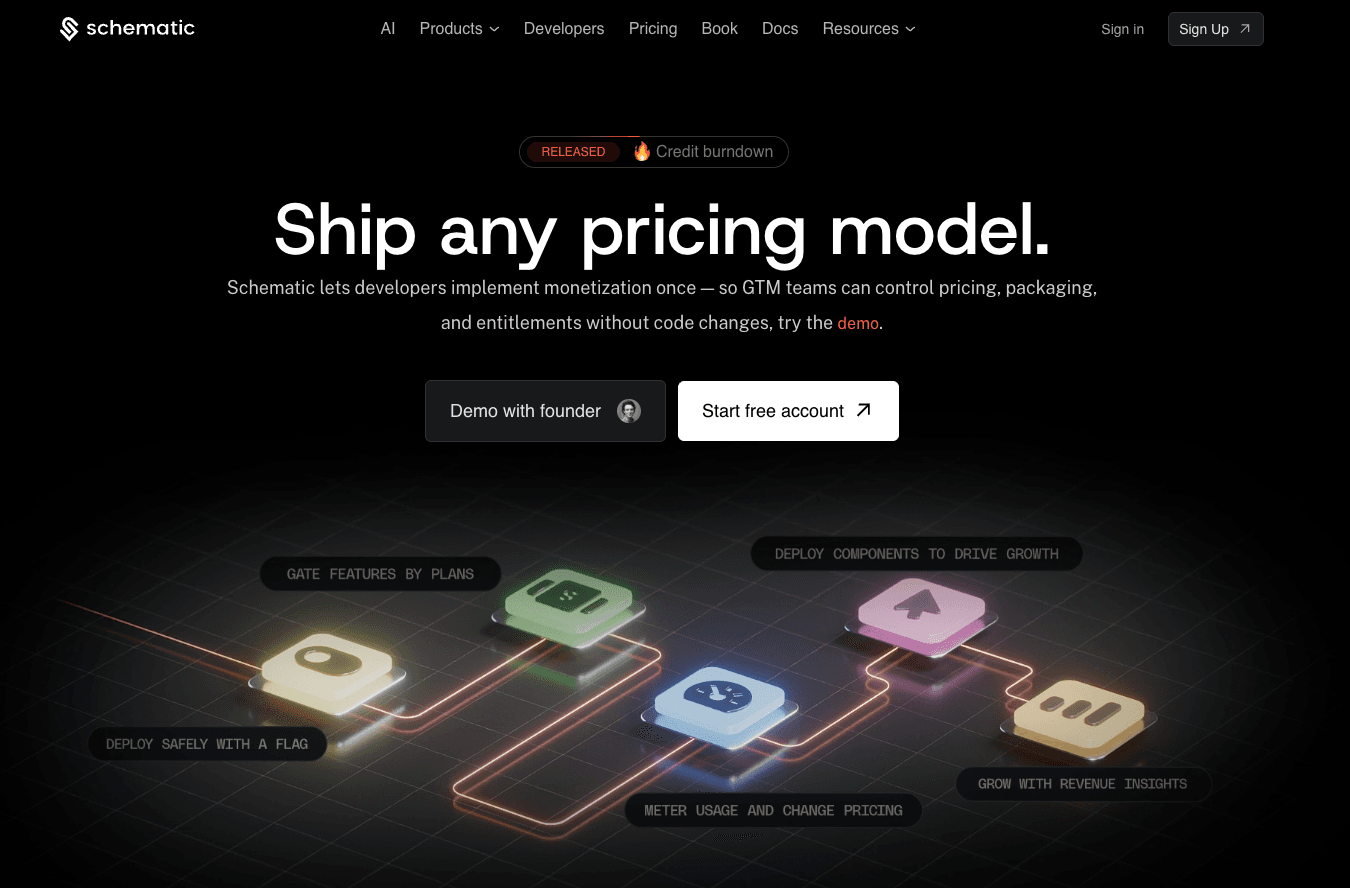
Schematic, built on Stripe, helps you launch any pricing model without rebuilding your billing stack. Stripe continues to handle invoicing and payments, while Schematic enforces access in-product at runtime.
Engineering stops writing and maintaining billing logic. GTM teams can sell across self-serve and sales-led models. Product teams can continuously iterate on pricing, packaging, limits, and enforcement without waiting on developers.
FAQs About AI SaaS Monetization
What is AI SaaS monetization?
AI SaaS monetization refers to how AI companies price and generate revenue from their products. The goal is to align pricing with value, usage, and cost while maintaining profitable margins.
Do traditional SaaS pricing models work for AI products?
Traditional SaaS pricing models, such as per-seat pricing and subscriptions, fail to consider the variable cost dynamics and usage introduced by AI capabilities. When usage increases, compute costs also grow. AI requires hybrid models that combine fixed and flexible pricing to protect margins.
How do AI companies make money?
AI companies make money through direct and indirect monetization. Direct AI monetization means charging directly for AI usage or outputs. On the other hand, indirect monetization involves bundling AI features into existing plans.