 Ryan Echternacht
AI is changing how companies price their products. According to ICONIQ's 2025 State of AI report, 38% of businesses now use hybrid pricing. They combine a basic subscription fee with usage-based billing.
This shift makes pricing more flexible but also harder to manage. Traditional billing systems struggle to track variable AI usage and adapt quickly to fluctuating infrastructure costs. That leads to revenue leakage and negative margins.
To avoid these risks, many teams are switching to AI monetization platforms. These tools can handle the complexity of monetizing AI agents, features, and products.
Below, we'll review the eight best AI monetization platforms you can use.
TL;DR
These are the leading AI monetization platforms:
- Orb
- Maxio
- Chargebee
- Stigg
- Alguna
- Metronome
- Paid.ai
8 Best AI Monetization Platforms in 2026
We'll break down the best AI monetization software to help you choose the right platform for your needs.
1. Schematic + Stripe
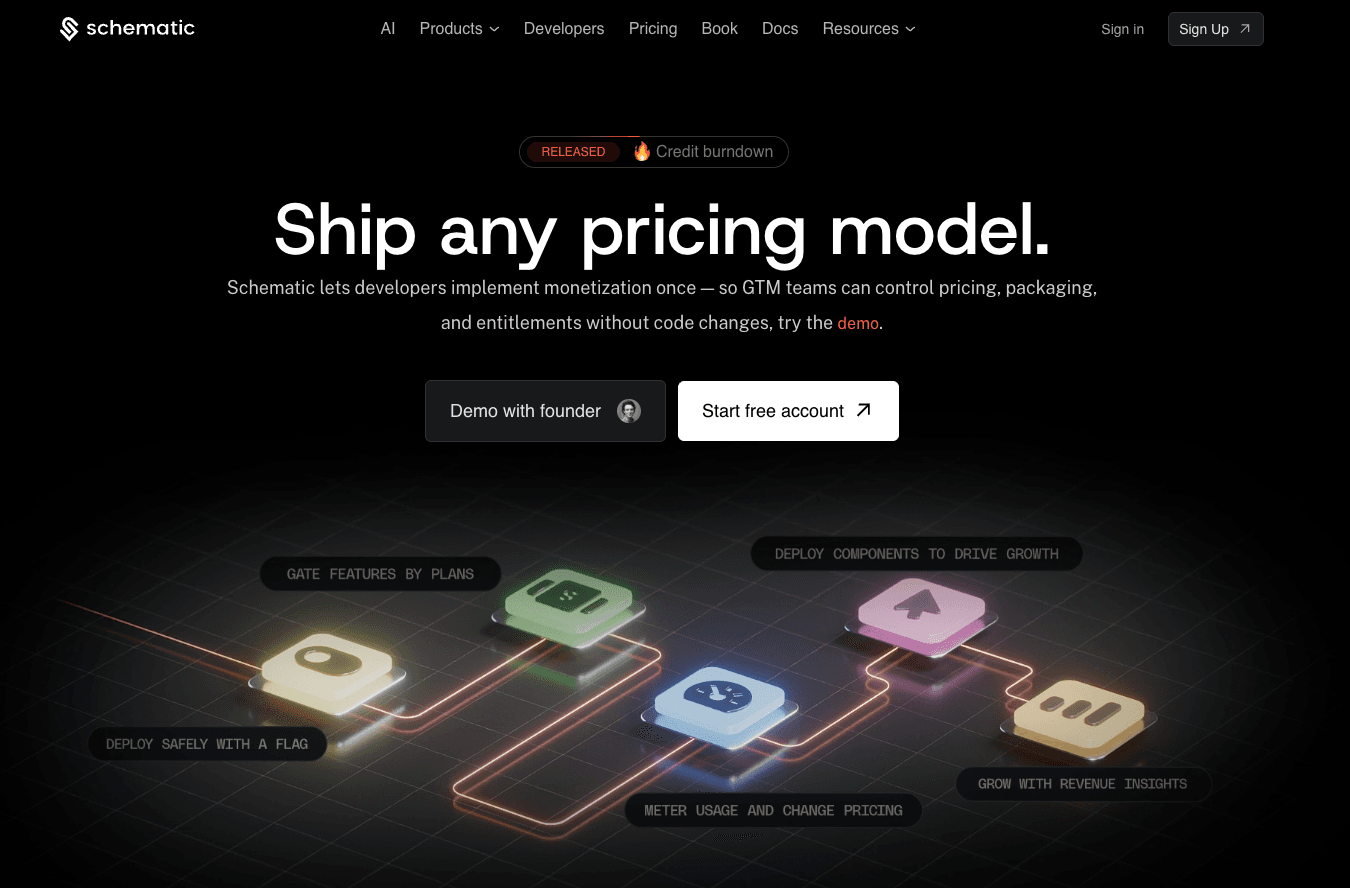
Schematic is an AI monetization operating system that empowers modern SaaS and AI companies to ship any pricing model, especially usage-based pricing, without rebuilding their billing infrastructure.
It acts as the system of record for your product catalog. Manage pricing plans, software entitlements, limits, trials, credits, add-ons, and exceptions in one place without hard-coded logic or one-off messes.
Schematic, built on Stripe, decouples pricing logic from application code to enable flexible monetization. Stripe continues to handle payment and invoice processing. Schematic extends Stripe by evaluating and enforcing access in-product at runtime.
Engineering teams no longer need to maintain billing and entitlement code. They can focus on what makes your AI product great, rather than pricing and packaging.
Product and GTM teams can continuously iterate on packaging, limits, and enforcement without waiting on developers. They can turn AI usage into actions that drive upgrades and expansion.
Schematic even offers drop-in billing components that help you control monetization everywhere it exists in your product. Add pricing tables, customer portals, usage dashboards, and more to increase conversion.
2. Orb
Source: withOrb.com
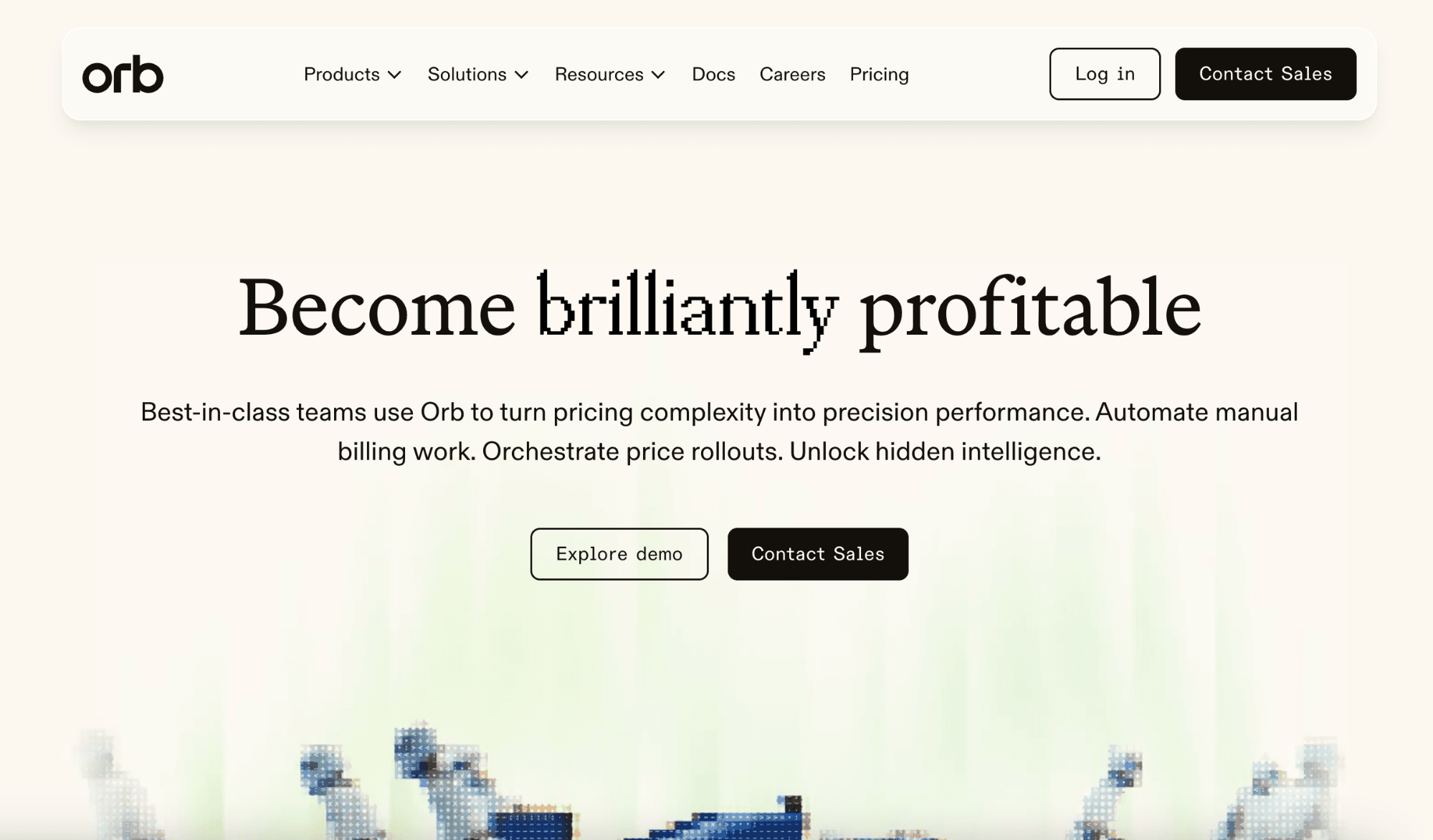
Orb is a billing platform designed for AI monetization. Engineering, product, and finance teams use it to turn product usage into revenue.
Orb can implement usage-based billing without lengthy implementation. It meters usage at scale and handles AI credits, tokens, and per-action pricing at the same time.
The platform bills for any metric that you can query, such as billing cycle overages, minimums, and maximums.
It also provides the necessary tools to ship new pricing, run experiments, compare models, and tailor plans to individual customers.
In addition to pricing simulations, SDK support for Python, TypeScript, Go, Java, Kotlin, and Ruby is available in Orb. This makes it easier to integrate Orb's billing and usage-tracking platform into applications.
Plus, Orb has revenue recognition features to accelerate the month-end close. Finance and RevOps teams can instantly see financial information without waiting for engineering to reconcile data across systems.
3. Maxio
Source: Maxio.com
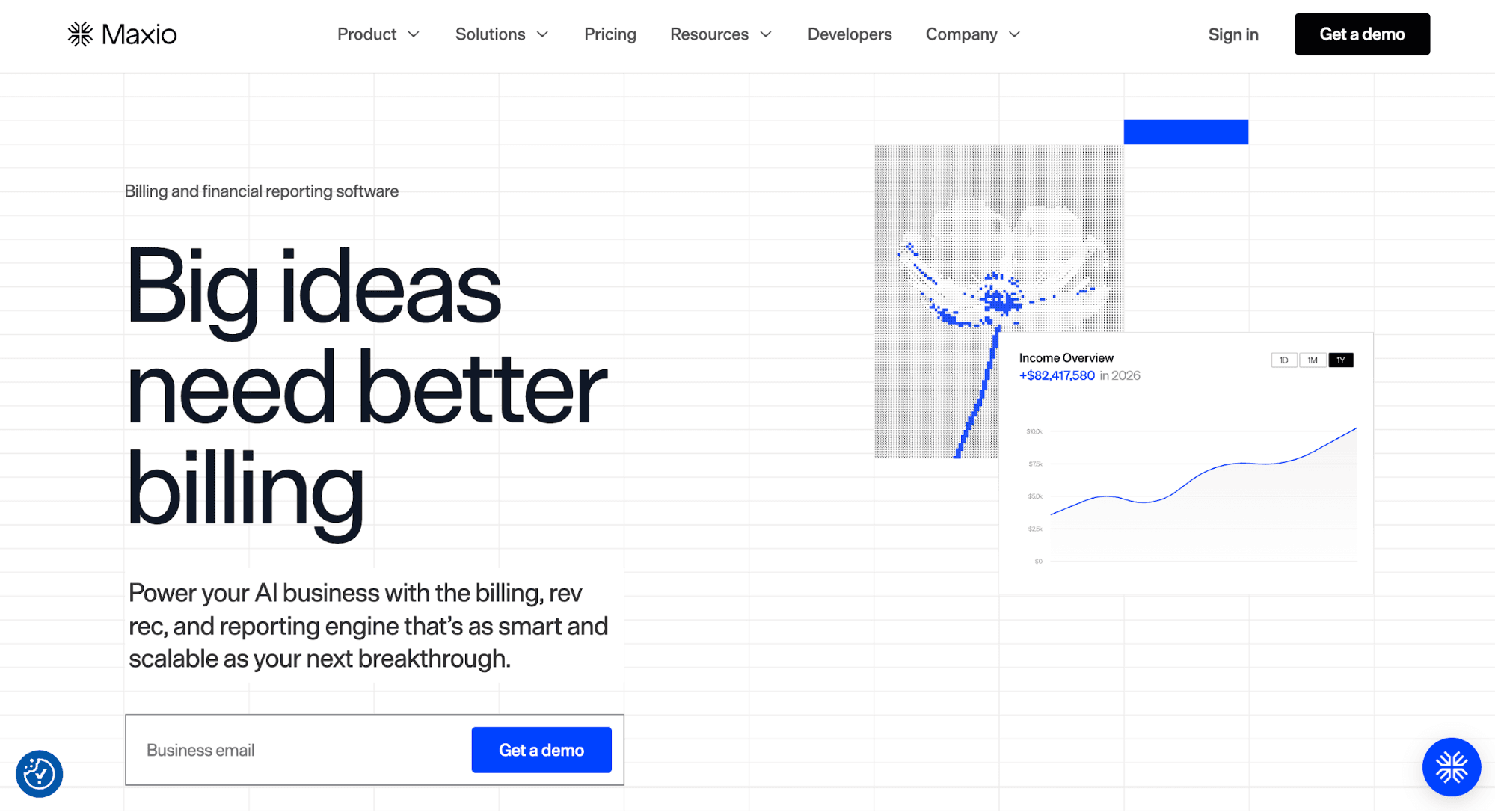
Maxio helps SaaS companies manage AI billing, revenue recognition, and financial reporting from one monetization platform.
It supports flexible billing models, including usage-based, hybrid, and tiered pricing. Maxio's dynamic pricing engine can also charge based on any value metric, such as API requests, tokens, tickets, and other custom attributes.
With Maxio, teams can automate subscription and usage data collection, invoicing, and subscription management. These automated workflows address AI monetization challenges, reduce errors, and save time.
Maxio also provides powerful reports and insights into key metrics to improve decision-making. It integrates with your customer relationship management (CRM) and accounting software to consolidate all relevant data in one system.
4. Chargebee
Source: Chargebee.com
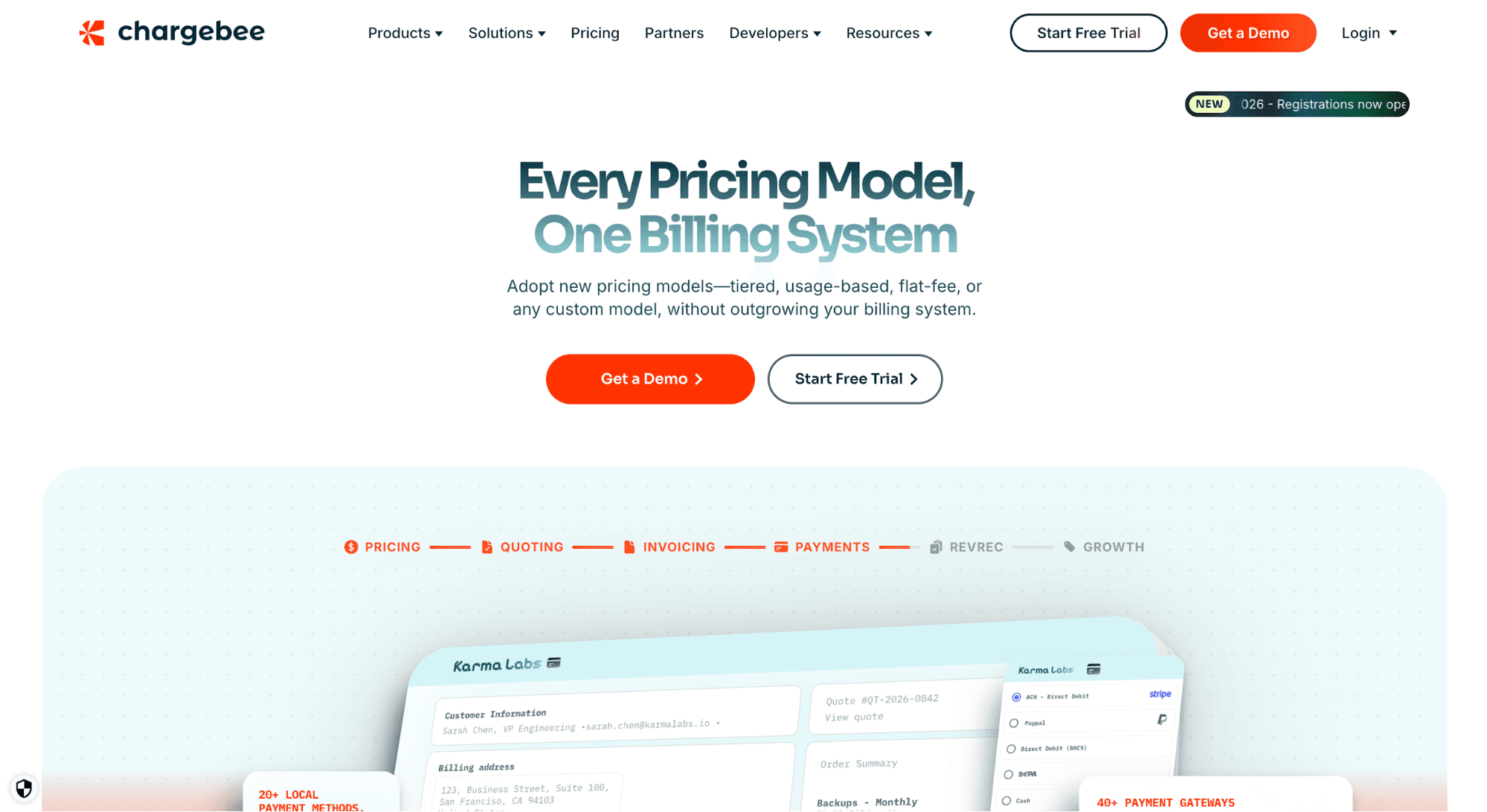
Chargebee offers a scalable billing and monetization infrastructure for AI companies. It translates AI agents, actions, images, outcomes, or anything you sell into revenue.
It supports several pricing models, such as usage-based, outcome-based, tiered, hybrid, and overage pricing.
Chargebee helps you experiment with pricing, meters, models, and even go-to-market (GTM) motions without engineering support. This allows you to iterate on AI monetization.
The platform also automates dunning and payment retries to recover revenue quickly. Meanwhile, the built-in entitlements management system can control feature access to protect margins and prevent overruns.
Subscription lifecycle management is another core capability of Chargebee. It can handle upgrades, downgrades, renewals, and prorations for mid-cycle changes.
Chargebee even helps you meet complex revenue recognition requirements (ASC 606/IFRS 15) by automating rev rec across different pricing models.
5. Stigg
Source: Stigg.io
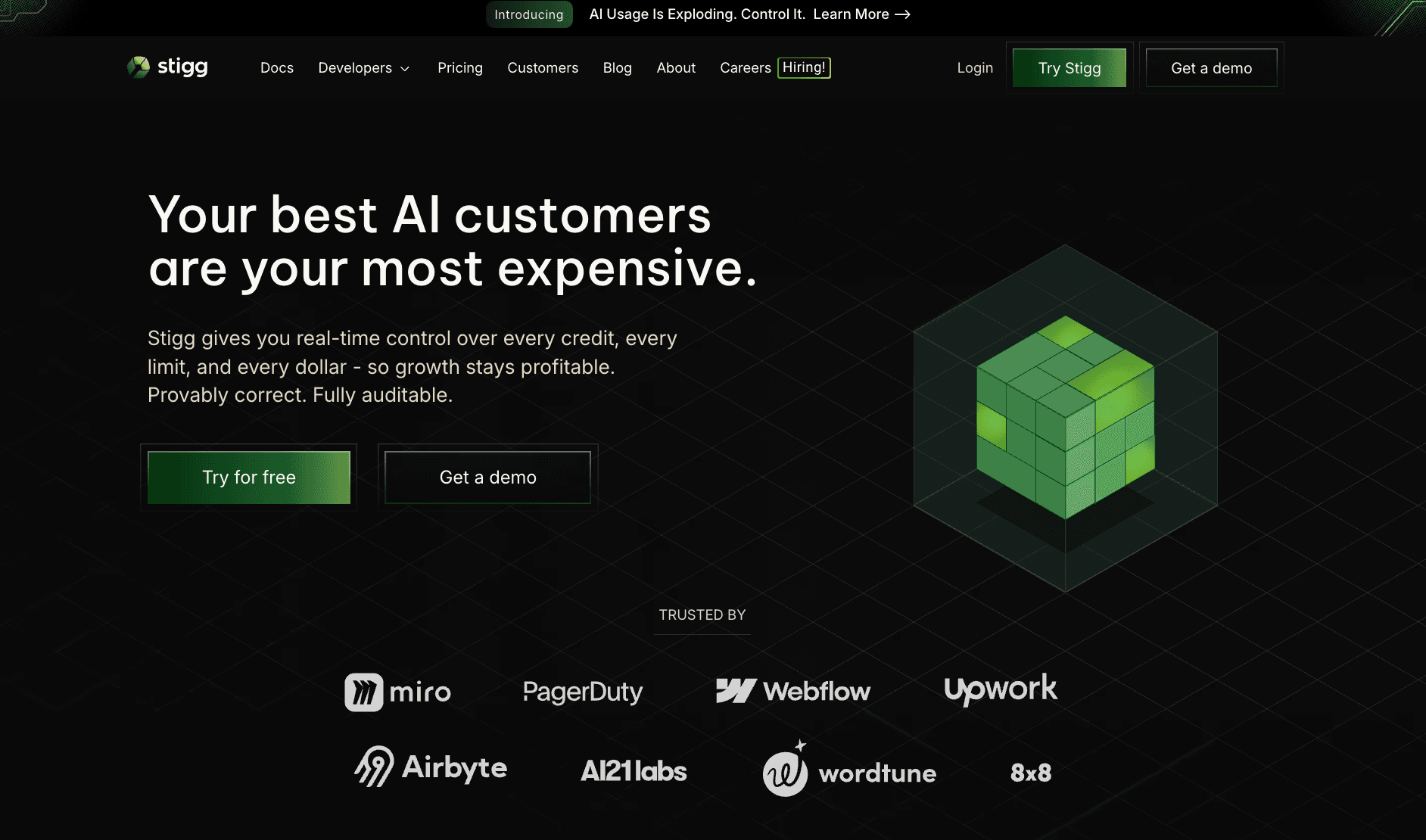
Stigg is an AI monetization platform built around entitlements. It focuses on controlling what customers can access, how much they can use, and how they are charged.
Stigg defines features, limits, usage, and credits for each plan. Instead of hardcoding this logic, teams can manage it in a flexible and programmable system of record.
This approach works well for developer-led SaaS companies that need fast iteration. Teams can adjust pricing, packaging, and feature access without rewriting code.
Stigg also enables usage-based billing. It tracks consumption, applies limits, and updates balances instantly, which is important for AI cost tracking.
The platform even includes embeddable UIs, such as pricing tables, customer portals, and checkout widgets. You can quickly launch monetization features without building from scratch.
Stigg is designed to extend traditional billing tools. It integrates with your existing billing stack to avoid risky and costly migrations. This also provides better control over subscription and usage data.
6. Alguna
Source: Alguna.com
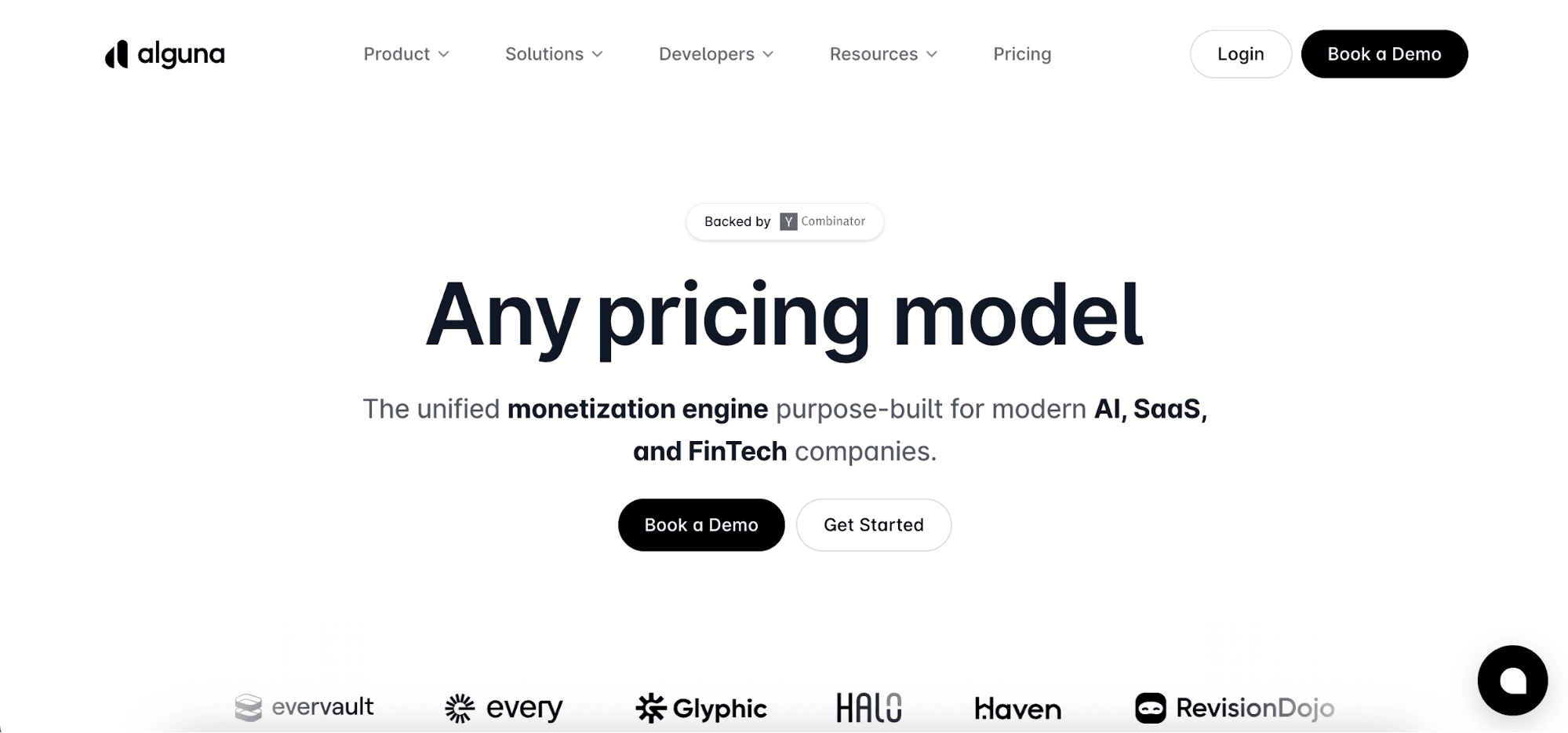
Alguna is a unified AI monetization engine designed to help AI and SaaS companies launch complex pricing models.
It supports hybrid, token-based, credit-based, and seat-based pricing, among other models. It also tracks how customers consume existing AI models by ingesting streaming event data, from API calls to data throughput.
With Alguna, teams can handle the entire quote-to-revenue process flow in one place instead of using multiple systems. This includes pricing deals, sending quotes, tracking usage, invoicing, and collecting payments.
Alguna is known for its no-code billing approach. Non-technical teams can create and update plans without relying on engineering. It reduces back-and-forth communication and speeds up GTM execution.
Plus, Alguna offers native integrations with CRMs, accounting software, and the largest global payment processors like Stripe. Quotes, payments, and invoices remain in sync.
7. Metronome
Source: Metronome.com
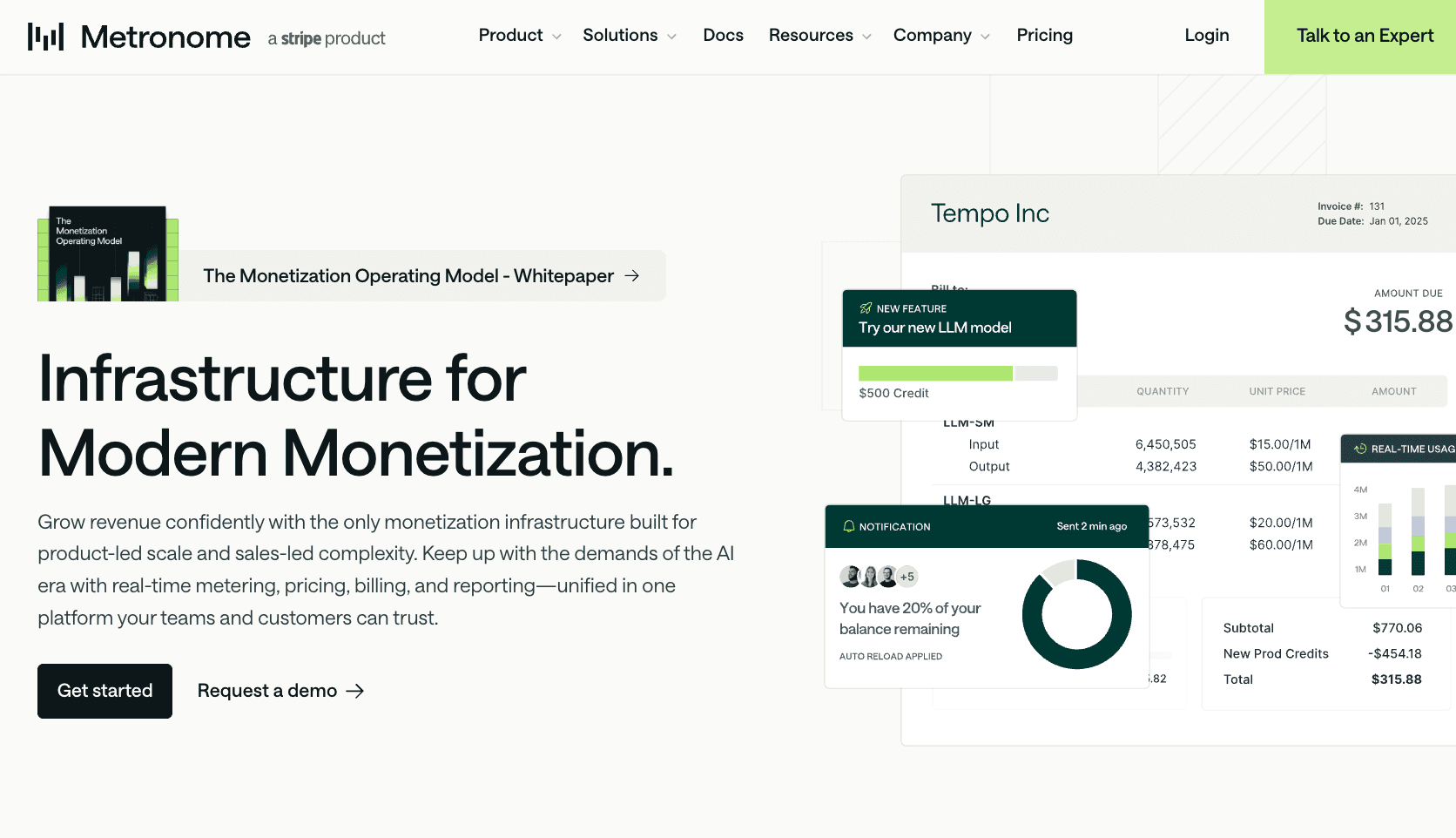
Metronome is an AI monetization infrastructure built for product-led scale and sales-led complexity. It can manage usage-based pricing while supporting enterprise deals and custom contracts.
The platform enables SaaS and AI companies to experiment with new pricing models that align with actual value. Launch new packages or sales initiatives to meet market and customer demands.
It also maintains a single source of truth for your main pricing models. Teams can iterate on monetization without introducing complexity.
As a scalable enterprise billing platform, Metronome ingests large volumes of usage data and turns it into billable metrics. It supports ultra-low latency alerting to prevent AI abuse and fraud.
Metronome can even generate reports about profit margins, consumption, and revenue forecasts. These valuable insights help teams make smarter pricing decisions.
8. Paid.ai
Source: Paid.ai
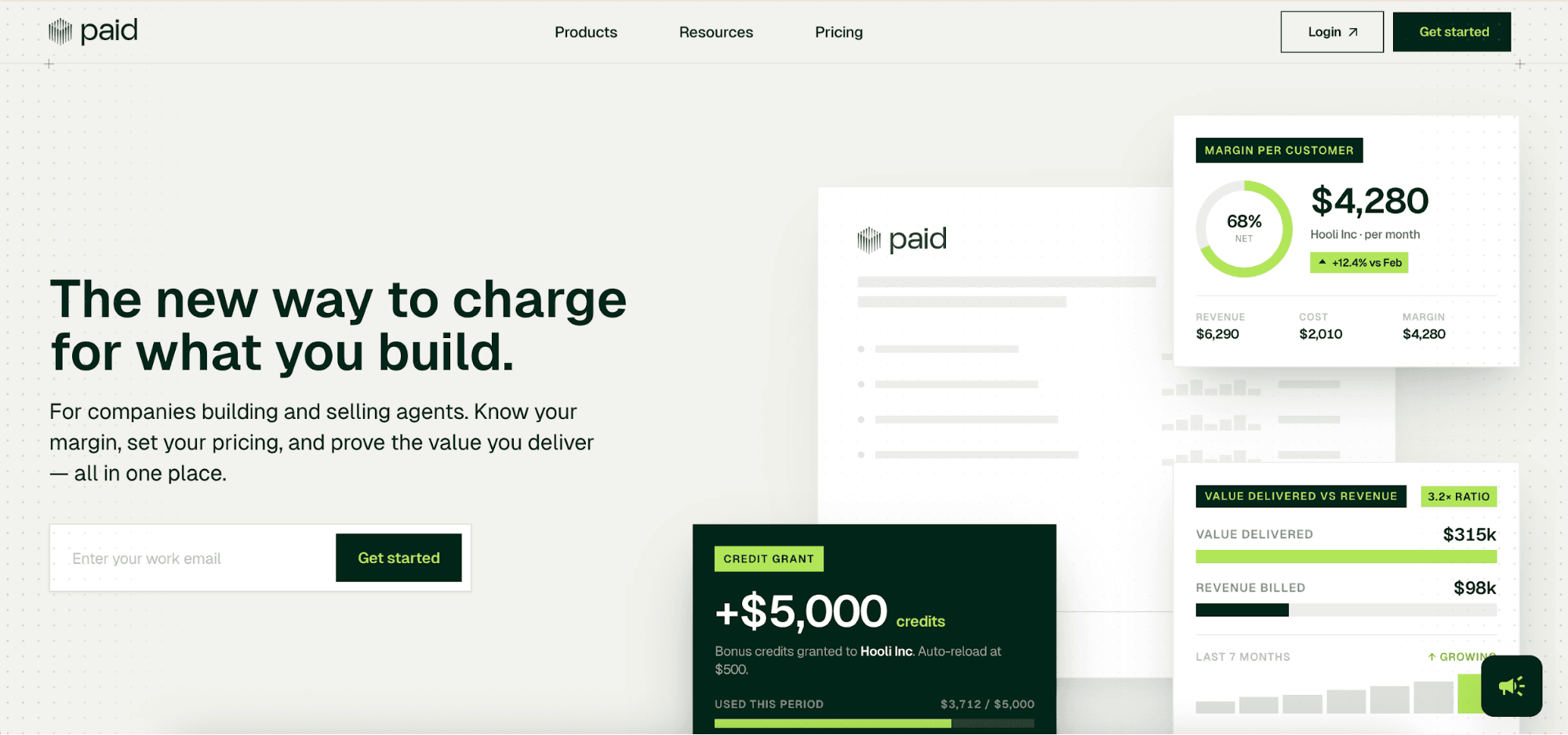
Paid.ai is a specialized AI agent monetization platform built for companies that monetize agents directly.
Pricing and cost tracking can be difficult since AI agents operate autonomously. Paid.ai addresses this with an AI agent usage billing system that handles complex metering out of the box. It captures cost, latency, and token usage without requiring manual instrumentation.
The platform can also break down revenue, costs, and margins from agent to agent. This data helps AI developers understand where the money goes.
Paid.ai supports flexible pricing models, such as credits, outcome-based, usage-based, and hybrid pricing. Teams can give agents usage credits that burn down over time or charge based on completed tasks or results.
Paid.ai also provides detailed receipts, not just invoices, that show the clear value of AI agents to customers.
Whether it's time saved, revenue generated, or cost savings, the most successful AI agent businesses can prove ROI during pilots and renewals. It's easier to justify pricing and retain customers.
Key Features to Look for in an AI Monetization Platform
Below are the core features you should consider when evaluating AI monetization platforms.
Support for Flexible Pricing Models
Traditional seat-based pricing and flat-fee subscriptions don't work for AI. You need flexible pricing models to match how customers use your product.
The best AI monetization platform should support:
- Usage-based pricing: Customers pay based on actual consumption, like API calls, tokens, or compute time.
- Credit-based pricing: Users prepay for a set number of credits that they can consume as they use your product.
- Outcome-based pricing: Charge customers when your product achieves results, such as resolved tickets or time saved.
- Value-based pricing: Capture the customer's perceived value of the AI instead of pricing based on infrastructure costs or competitors.
- Tiered pricing: Offer different plans with set limits, features, or usage levels.
- Hybrid pricing: Combine subscriptions with usage-based elements to address AI workloads that vary over time.
This flexibility helps you adapt pricing as your customers and product change.
Usage-Based Billing and Metering
AI pricing mostly depends on usage. This includes API calls, tokens, compute time, or agent actions.
The platform should track usage in real time and convert it into billable units. This is important because AI agents trigger hundreds of micro-activities behind the scenes. You need to measure and price each action correctly. Otherwise, you risk revenue loss and billing errors.
Usage can also be complex. A single conversation might involve multiple LLM calls or API requests, which can significantly increase costs.
Robust metering supports trackable recurring billing by linking usage data to invoices and established subscription models. This helps you match pricing with actual consumption and avoid undercharging.
Payment Processing
You need a reliable way to collect payments from customers from different regions.
Check if the platform supports multiple payment methods, currencies, and tax rules. It should handle recurring billing, one-time payments, and invoicing without added complexity.
Many rely on providers with global coverage & established trust to improve payment success rates and reduce risk. This becomes more important as you expand into new markets.
Payment failures can lead to lost revenue and poor customer experience. A reliable payment processing layer reduces these risks and protects cash flow.
Billing and Revenue Operations
AI monetization involves more than accepting payments. You need a system that manages the entire billing process from start to finish.
This includes invoicing, subscriptions, renewals, discounts, and dunning for failed payments. It should also provide revenue recognition and margin recovery capabilities to help finance teams report income accurately.
The best monetization platform connects billing with the product experience. Customers should see clear usage, limits, and charges inside your product.
It should also support outcome-based revenue operations, where billing aligns with the value your product delivers.
Without end-to-end billing support, teams rely on manual work and disconnected tools.
Security and Compliance
AI monetization platforms handle sensitive data, payments, and pricing logic across systems.
Choose a system that follows strict security standards and supports audit-ready processes. Make sure it has clear records of every transaction, usage event, and pricing decision.
It should also support a zero-trust reconciliation model, where every charge is verified against usage data and exact pricing rules. This prevents billing errors and disputes.
Security and compliance features are especially important for large companies. Many deals involve enterprise procurement teams requiring audit-ready transparency before approving spend.
Revenue Insights
You need clear visibility into how AI agents generate profit for your company.
The platform should show metrics like monthly or annual recurring revenue, usage, churn rate, and customer lifetime value.
It must also break down which pricing plans or models are growing your business.
Revenue insights help you adjust AI monetization strategies and improve margins. Without them, it is hard to make informed decisions.
This is especially useful for developers prioritizing cost analytics. They can compare infrastructure costs with revenue and understand margins at a detailed level.
How to Choose the Right AI Monetization Platform
Not every AI monetization platform is the same. Some focus on billing and revenue recognition. Others handle pricing, packaging, entitlements, and product access in one system.
The right choice depends on how you want to monetize AI-powered products. If your pricing is simple, a traditional usage-based billing tool may be enough. But if you use hybrid pricing, credits, or agent-based models, you may need an end-to-end monetization software.
When choosing between platforms, you should consider how well the system supports your pricing model, GTM strategy, and growth plans. The goal is to enable profitable transactions, not just send invoices.
Ask these questions before making a decision:
- Can the platform ship any pricing model, including hybrid, usage-based, and outcome-based pricing?
- How does it calculate and meter AI usage?
- Does it handle complex scenarios, like free tiers, overage billing, rollover credits, or agent payment capabilities?
- Can non-technical teams configure pricing changes, or will you need to rely on engineers?
- Does it manage entitlements and product access at runtime?
- Is the platform API-first, and can you self-configure most features via no-code/low-code tools?
Flexible AI Monetization With Schematic
Schematic gives AI and SaaS companies a flexible way to manage monetization by decoupling pricing logic from application code.
Instead of hardcoding plans, entitlements, limits, and exceptions, teams can control everything from a central system of record. Ship any monetization model, update pricing, and roll out feature access without code changes.
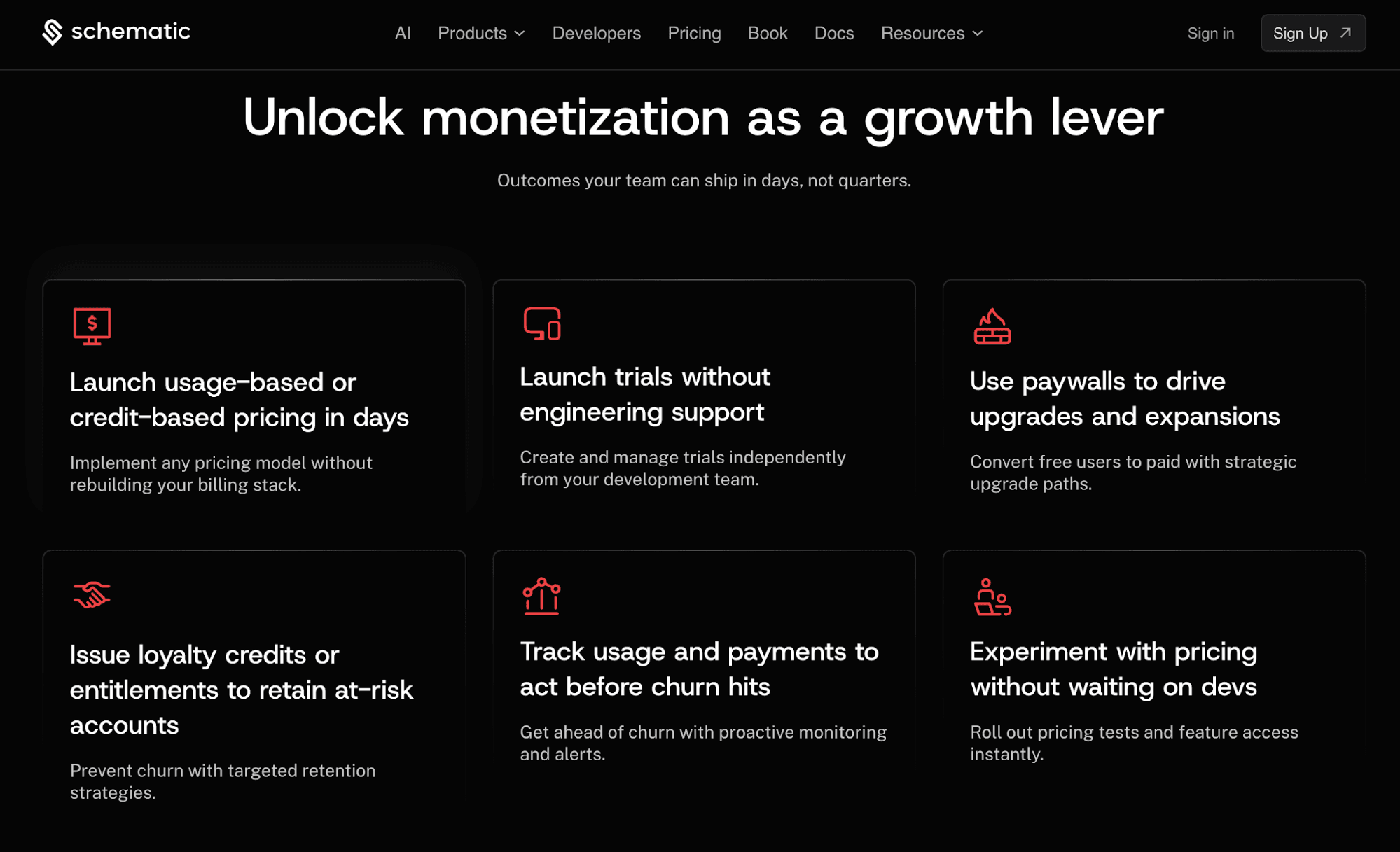
Schematic, built on Stripe, manages the entire customer lifecycle. It can track usage against limits and ensure access in the product matches the subscription and billing state in Stripe.
Stripe manages payments and invoices, while Schematic extends those capabilities with real-time access control and usage enforcement.
Engineering implements monetization once. Go-to-market teams can quickly adjust pricing, packaging, and entitlements without waiting on developers.
FAQs About AI Monetization Platform
What is an AI agent monetization platform?
An AI agent monetization platform is a subtype of AI monetization software. It is built to serve AI agent builders by pricing and billing autonomous agents. Instead of charging for AI-powered features or usage, it tracks the actions, tasks, and outcomes that agents deliver.
What pricing models should AI monetization platforms support?
AI monetization platforms should implement flexible pricing models, such as usage-based, outcome-based, credit-based, and hybrid pricing. This is important because AI pricing is more dynamic than what traditional SaaS companies rely on.
What makes AI agent monetization different from traditional software billing?
AI agent monetization is based on actions and outcomes. Traditional software billing focuses on seats and fixed subscriptions. Since AI agents perform tasks on their own, a monetization system should track usage, results, and changing costs in real time.