 Ryan Echternacht
Software licenses and software entitlements are not the same thing, even though many SaaS companies still treat them that way.
A license gives customers the legal right to use a product. Entitlements control what they can actually use inside the product, from feature tiers and add-ons to API calls and usage limits.
Older software licensing models handled those responsibilities together because access rarely changed after purchase. Modern SaaS products do not work that way anymore.
Once pricing becomes more dynamic, hardcoded rules start creating problems between billing, packaging, and product behavior.
This guide explains the difference between software entitlements and licenses, what each one controls, where licensing starts to break down, and why SaaS companies move toward entitlement systems.
TL;DR
- Software licenses define the legal right to use a product, while entitlements control what customers can actually access inside the product in real time.
- Traditional licensing works well for stable products with fixed access, but modern SaaS products often need more dynamic control over features, usage limits, AI credits, and add-ons.
- Entitlements help SaaS companies manage runtime access, usage-based pricing, feature gating, enterprise exceptions, and customer-specific packaging without constantly updating product code.
- Schematic helps SaaS and AI companies manage plans, entitlements, usage limits, and runtime product access from a centralized monetization infrastructure.
What Is a Software License?
A software license is the contract that gives customers permission to use a product.
Most licensing agreements between a software vendor and a customer explain how the licensed software can be used, what restrictions apply, and which contractual obligations come with the purchase.
Traditional software licensing models were built for predictable software usage. Customers purchased access, received license keys, and used the product within a fixed set of terms.
Those terms usually cover things like the number of users, approved devices, subscription length, and installation limits.
Once the legal agreement is signed, customer permissions usually stay consistent unless the customer upgrades, renews, or changes plans.
Updating those permissions often requires manual approvals, provisioning work, or additional license enforcement behind the scenes.
Common SaaS Licensing Models
Most SaaS products use a few common licensing models to structure pricing and product access.
- Seat-based licenses – Pricing depends on the number of users or seats tied to the account. Common in collaboration and B2B SaaS products.
- Tiered plans – Customers choose between plans with different limits, features, or service levels. Higher tiers usually unlock additional functionality or usage capacity.
- Usage-based pricing – Customers pay based on actual consumption, such as API calls, AI credits, storage, or transactions. This model is common in AI and infrastructure products.
Traditional licenses still work well for products with stable access requirements and fewer runtime changes. Their main purpose is to define whether customers can legally use the product.
What Is a Software Entitlement?
A software entitlement defines what a customer can actually use inside a product in real time. It controls the features, usage limits, services, and functionality assigned to a plan, contract, or account status.
Unlike traditional licenses, entitlements can change in real time. Customer access may expand or shrink based on upgrades, billing status, trial periods, usage thresholds, or enterprise agreements without forcing teams to rewrite contracts every time.
Modern SaaS products rely on entitlements to connect pricing, packaging, billing, and product behavior in one system. A customer may technically have permission to use the product, but entitlements determine which features, services, or limits apply to it.
As plans, feature tiers, and usage models become more complex, many SaaS companies turn to an entitlement management solution to keep access rules clear and consistent.
Common Examples of Entitlements
Most SaaS entitlements define feature availability, usage rules, or plan-specific functionality.
- API limits – Restrict how many API calls a customer can make within a billing cycle.
- AI credits – Control access to AI-powered functionality based on monthly usage allowances.
- Feature access – Unlock specific capabilities depending on the customer’s plan or subscription tier.
- Usage caps – Limit how much of a product or service customers can consume before upgrades or overages apply.
- Enterprise exceptions – Support custom limits, pricing terms, or access rules for larger accounts.
- Add-ons – Give customers access to extra functionality outside their base subscription plan.
Entitlements become especially important once products introduce dynamic pricing, usage-based billing, or customer-specific packaging.
Software Entitlement vs License: Key Differences
Software licenses and entitlements solve two very different problems, even though many teams still group them together.
A license focuses on legal access. An entitlement focuses on product access. One defines what customers purchased. The other determines what they can actually use inside the product.
That distinction becomes much more important once SaaS companies introduce usage-based pricing, feature gating, add-ons, or enterprise overrides.
Teams may still handle licenses through contracts and billing systems, but entitlements control the day-to-day product experience in real time.
Side-by-Side Comparison
Here’s how they differ in practice:
Category | Software License | Software Entitlement |
Purpose | Defines legal usage rights | Controls runtime product access |
Controls | Permission to use the product | Features, usage limits, and services |
Flexibility | Usually static | Dynamic and adjustable |
Best For | Traditional software | SaaS and AI products |
Connected To | Contracts and purchases | Product behavior and billing state |
Updates | Often manual | Real-time updates |
Usage-Based Pricing | Difficult to support cleanly | Built for usage-based models |
Enterprise Overrides | Limited flexibility | Easier to customize |
Runtime Enforcement | Minimal | Core functionality |
Primary Focus | License terms and compliance | Access rules and customer experience |
Traditional licenses work well when access rarely changes. Entitlements become more important once products introduce dynamic pricing, feature tiers, AI credits, or customer-specific packaging.
Many SaaS teams now use entitlements to manage access and usage in real time while licenses continue handling the contractual side of the relationship.
That separation gives product, engineering, and go-to-market (GTM) teams more flexibility without constantly rewriting access logic.
Licenses define the commercial agreement, but entitlements shape the actual product experience. They control the value customers receive inside the product after the sale.
When Software Licenses Still Work Well
Software licenses still work well when product access stays relatively fixed after purchase.
That is common in desktop software, internal enterprise tooling, or products with stable seat counts and limited packaging complexity.
A company may purchase software for 50 employees, install it on approved devices, and keep the same access setup for long periods of time.
Licenses also fit products where the customer experience does not depend on dynamic usage rules, feature gating, or frequent plan changes.
For example, many internal tools only need basic provisioning, periodic renewals, and straightforward license compliance tracking. Teams can usually handle access updates manually because changes happen less often.
Traditional licensing models also fit organizations with formal procurement processes and recurring internal audits where consistency is more important than runtime flexibility.
In these cases, the end user usually does not need dynamic entitlement controls to use the product effectively.
Where Licenses Start Breaking Down in Modern SaaS
Traditional software licenses work best when access stays relatively stable. Modern SaaS products rarely operate that way.
Customers upgrade plans, start trials, purchase add-ons, exceed usage limits, or negotiate enterprise exceptions regularly. Product access changes constantly, especially in SaaS products built around usage pricing or feature-based packaging.
That is usually the point where static licenses start falling apart operationally.
A customer may purchase “10,000 AI credits per month,” while another receives advanced analytics access with capped API usage. Enterprise customers may request temporary feature access, onboarding exceptions, or custom usage thresholds tied to contract negotiations.
Those kinds of runtime changes are difficult to manage with static licensing rules. Traditional licensing systems were built for relatively fixed access, not product behavior that changes in real time based on usage, billing, or customer-specific packaging.
Feature access volatility creates even more operational friction. Product teams often end up manually maintaining feature gating rules, usage tracking logic, and plan-specific access controls directly inside the product.
The limitations become more obvious once SaaS products introduce usage-based pricing, hybrid plans, or customer-specific packaging. Licenses can still define the commercial agreement, but they were not designed to handle real-time changes inside the product.
How Licenses and Entitlements Work Together
Software licenses and entitlements usually handle different parts of the same customer agreement.
The license defines the commercial and legal terms between the parties involved. It confirms what the customer purchased, how the product can be used, and which permissions granted come with the contract.
Entitlements take those terms and apply them inside the product.
For example, a customer may purchase a Pro plan with 1 million API calls, advanced analytics access, and custom enterprise limits. The license documents the agreement. The entitlement system enforces feature access, usage caps, and upgrade rules connected to the account.
That separation helps product, billing, and engineering systems stay aligned without manually updating permissions every time a contract changes.
It also improves security, reduces inconsistent customer data, and supports more reliable automation for provisioning and account updates.
When You Need an Entitlement Management System
Most SaaS teams do not start with a dedicated entitlement management system. The need usually appears once operational complexity starts slowing teams down.
Early on, teams can often manage plans, feature access, and customer exceptions manually. That approach becomes harder to maintain as the business scales.
Product teams begin relying on internal workarounds to support enterprise deals or custom packaging. Engineering teams spend more time updating access rules and handling edge cases linked to customer accounts.
GTM teams need faster ways to support pricing changes, contract exceptions, and new packaging requests without waiting on product releases.
The coordination overhead increases quickly from there.
Different teams start depending on different systems to manage billing, provisioning, upgrades, support access, and customer changes. Manual updates become more common. Access rules become harder to track. Operational gaps create additional risk as the organization scales.
That is usually when manual workflows stop scaling, and teams need entitlement management systems for more effective management of plans, access rules, and customer-specific exceptions.
Schematic for Modern Product Access and Entitlements
Many SaaS products start with simple plans and basic feature gating. Over time, pricing gets more complex. Teams add usage-based pricing, AI credits, add-ons, enterprise overrides, and custom packaging.
At that point, engineering often ends up updating access logic every time pricing changes.
Billing rules, runtime permissions, and plan configuration often become scattered between different services and internal tools. Keeping everything consistent gets harder as the product expands and market demands continue changing.
That is usually when dedicated entitlement infrastructure becomes necessary.
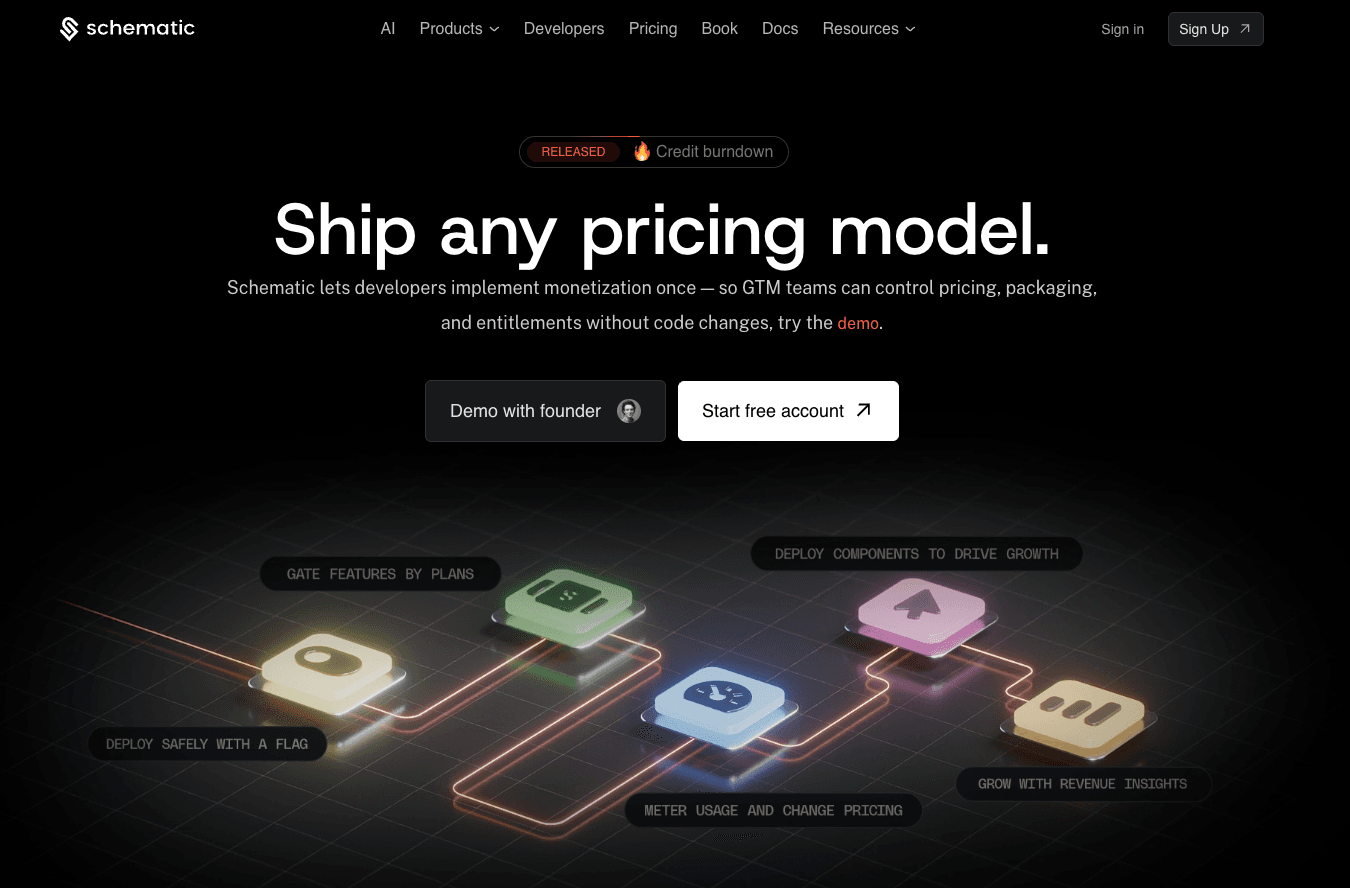
Schematic helps SaaS and AI companies manage plans, SaaS entitlements, usage limits, and runtime access from a centralized system instead of hardcoding monetization logic throughout the product.
It acts as the monetization operating system and system of record for plans, entitlements, usage limits, add-ons, trials, credits, and exceptions.
Key Benefits of Using Schematic
Schematic helps teams:
- Launch usage-based pricing and AI credits without rebuilding billing logic
- Manage plans, add-ons, enterprise overrides, and packaging changes in one place
- Enforce runtime access based on billing state, trials, subscriptions, or usage limits
- Support hybrid pricing models with seat-based, usage-based, and credit-based access
- Give GTM teams more flexibility when testing new pricing strategies
- Keep pricing, packaging, and product access aligned as the organization grows
Instead of maintaining scattered entitlement logic between services, teams can manage entitlements and monetization through a centralized entitlement orchestration layer connected directly to the software product.
As pricing models become more dynamic, entitlements play a much larger role in how SaaS companies manage runtime product access, packaging, and monetization operations.
FAQs About Software Entitlement vs License
Can a customer have a license without entitlements?
Yes. A customer can legally purchase software through a license agreement without using a separate entitlement system for runtime product access. This is common in traditional software products with fixed access rules and limited user access changes after purchase.
What happens when a customer exceeds entitlement limits?
Most SaaS products automatically respond when customers hit entitlement limits. The system may restrict certain features, apply overages, suggest plan upgrades, or notify internal user groups responsible for the account.
Do entitlement systems replace software licenses?
No. Licenses and entitlements solve different problems. Licenses define legal usage rights, while entitlements control runtime user access, permissions, and feature availability inside the product.
How do entitlements support usage-based pricing?
Entitlements help SaaS companies enforce usage limits, AI credits, feature access, and customer-specific access rules in real time. That gives teams more flexibility when testing new pricing and packaging strategies without manually updating product logic for every customer.
Can SaaS companies offer free plans with entitlements?
Yes. Many SaaS companies use entitlements to manage access for free plans, trials, and self-serve onboarding. Entitlements help control which features, usage limits, or services customers can access before upgrading to a paid plan.