All posts
Trial Pricing Strategies and Implementation Tips for SaaS
Blog· Ryan Echternacht·Oct 13, 2026
Ryan Echternacht·Oct 13, 2026
Trial pricing is one of the most important growth levers for SaaS companies. It shapes how users first experience your product and decide if it’s worth paying for.
A well-designed trial can turn free users into paying customers. On the other hand, a poor one can damage your product's perceived value and reduce conversion rates.
SaaS businesses should carefully rethink their approach to trial pricing. While free trials remain popular, many have also adopted discounted and paid trials to improve results.
In this guide, you’ll learn what trial pricing means, the top strategies you can use, and practical tips to apply them.
TL;DR
- Trial pricing allows users to try a SaaS product for a limited time, either for free or at a low cost.
- Popular strategies include free trials (with or without a credit card), freemium trials, premium plan trials, discounted trials, and paid trials.
- To implement trial pricing successfully, choose the right model, set the right trial length, know your audience, align with value, simplify sign-ups, enforce limits, and track performance.
- It can increase conversion rates, improve lead quality, provide valuable insights, and encourage word-of-mouth referrals.
- Schematic is the complete monetization platform that helps software and AI companies launch trials, version plans, and enforce limits through configuration.
What Is Trial Pricing?
Trial pricing is a SaaS pricing model that lets users try a product at a discounted or free price. The goal is to give trial users access to the product so they can experience its value before paying the full price.
Trial pricing usually includes a time limit, such as 7, 14, or 30 days. During this trial period, users can test the product's features, complete tasks, and decide if the platform fits their needs.
SaaS businesses use trial pricing to turn interest into paying customers while learning from actual user behavior. It helps them evaluate product-market fit and adjust their pricing and packaging strategies to better meet user needs.
Top 6 Trial Pricing Strategies
SaaS companies use different trial models to attract potential customers and grow revenue. Below are the most popular strategies and how they work in practice.
1. Free Trial With a Credit Card
This strategy requires users to enter payment information upfront before starting the trial offer.
Since users submit their card details, they are more likely to take the trial seriously. They invest time in testing your SaaS product and are less likely to abandon it. This often leads to a higher chance of converting trial users and more revenue per user (RPU) when the free trial period ends.
A free tier with a credit card also creates a smoother transition to paid plans. Billing can start automatically (unless the user cancels) because your company already has their payment information. That reduces drop-off at the point of upgrade.
It works best for SaaS products with clear value, strong brand trust, or a specific target audience willing to take on the financial commitment.
However, this approach can lower sign-up volume. Many users might hesitate to share payment details early.
2. Free Trial Without a Credit Card
In this free trial strategy, new customers can sign up and try your SaaS product without entering payment details. In most cases, only an email address is required.
The lower barrier to entry leads to more sign-ups. At the same time, it builds trust. Users feel safe exploring the product without any risk of being charged when the trial ends.
A free trial strategy without a credit card is useful for early-stage SaaS companies that want to break into the crowded market and increase their user base.
However, it can be difficult to convert trial users into paying customers, which leads to less revenue per user. You need a well-trained sales team to encourage these users to upgrade to a paid subscription plan.
3. Free Trial With Freemium Plans
This approach combines a time-limited trial with a permanent free plan.
Customers start with a trial. Once they reach the trial expiration, they can continue using a limited version of your product for free. This version comes with basic features and usage limits.
Trial users can upgrade to paid plans if they want to unlock the full version of your product with paid features and greater usage limits.
A freemium model keeps accounts active in your ecosystem. Even if individual users don’t pay right away, they can continue with free access. This leads to eventual conversion as they experience the core value of your product.
According to a pricing study by SaaS Research Lab, 54.1% of SaaS products offer freemium pricing.
This strategy fits SaaS platforms with low marginal costs and high scalability. Free users can still generate value and help grow the product.
The risk is that some users stay on the basic plan without upgrading. Strong feature limits and clear upsell paths are needed to drive freemium-to-paid conversions.
4. Free Trial With Premium Plans
It gives users full access to the highest-tier plan for a limited time. During the trial period, users can access all premium features without restrictions or caps.
The goal is to show your SaaS product at its best. Users can explore advanced tools, test different use cases, and get the most value for a limited time.
When the trial expires, users must choose a paid plan to keep those features. If they downgrade, they lose access to the advanced capabilities they used during the trial period.
Combine a free trial model with paid plans if your product’s value is tied to premium features and requires hands-on experience to fully understand.
It's also an effective way to increase free-to-paid conversions by showing users exactly what they would lose without upgrading.
5. Discounted Trial
In a discounted trial model, users pay a reduced price for a limited trial period. Instead of a free trial, they get access to key features at a low cost.
This small payment creates commitment. Users who pay, even a small amount, are more likely to engage and complete onboarding.
It also filters out low-quality leads. Only those who see value are willing to pay, which improves conversion rates after trial expiration.
Discounted trials are useful for SaaS products with higher price points. They help position the product as valuable from the start.
6. Paid Trial
A paid trial strategy requires users to pay upfront to access the product for a limited time. It introduces the highest friction, which results in fewer sign-ups.
On the upside, you get much higher-quality users in return. Those who pay are already invested and more likely to convert to long-term customers.
Paid trials work well for B2B SaaS companies with complex products or long sales cycles. Their target customers often need thorough testing before making a purchase decision.
A paid trial model also generates revenue upfront. It can offset customer acquisition costs and improve cash flow.
However, users should clearly understand what they will gain during the trial. Without a strong value proposition, they won’t try your product at all.
How to Implement Trial Pricing Effectively
Here are some tips to follow to adopt trial pricing successfully.
Choose the Right Trial Model
First, select a trial model that fits your product and goals. Each model attracts a different type of user. For example, requiring a credit card brings fewer but higher-intent users, while removing it increases sign-up volume.
You should also consider product complexity. Simple tools often perform well with free trials. SaaS products with a more complex setup may benefit from paid trials.
Choosing the right model depends on how users experience value. If users need time to understand the product, offer a more flexible trial.
Determine the Ideal Trial Length
Trial length plays a big role in conversion. If it’s too short, users may not see enough value. But if it’s too long, they may lose urgency to upgrade.
Most SaaS companies start with 7, 14, or 30 days. The right length depends on how long it takes users to reach their first meaningful outcome.
Short trials create urgency and push users to act quickly. Longer trials give users more time to explore, but they may reduce momentum.
The key takeaway is balance: give users enough time to see value, but not enough to delay the decision.
Know Your Target Audience
Define your ideal customer profile. Understand their goals, budget, willingness to pay, and how they evaluate SaaS products.
For example, enterprise customers often need more time and support. They may prefer guided trials or paid access. Smaller teams may prefer fast, self-serve trials with no friction.
When your trial pricing plan matches your target audience, users move faster from sign-up to payment.
Align Trial Pricing Strategy With Value Proposition
Trial pricing should reflect how your product delivers value. Users need to see clear benefits during the trial period.
Focus on helping users reach their “aha” moment as quickly as possible. This is when they understand how your platform solves their pain points.
If your product’s value comes from advanced features, highlight them early. If it comes from daily use, guide users into regular activity.
Avoid giving too little access. Prospective customers cannot value what they cannot experience. At the same time, avoid overwhelming them with too many features at once.
The trial should clearly answer one question: "Is this worth paying for?"
Simplify the Sign-Up Process
Users should be able to start the trial in minutes. Any delay increases drop-off.
Keep sign-up forms short. Ask only for what you need.
Many SaaS companies remove credit card requirements to reduce friction and increase sign-ups.
You should also remove technical barriers. Make onboarding smooth across devices and browsers. The faster customers start, the faster they can see value.
Enforce Trial Limits at Runtime
Make sure that trial limits are clear and controlled in real time. This includes trial length, feature access, and usage caps.
You need entitlement management systems that prevent users from gaining access beyond the set limits and trial period. These reduce long-term free-riding and protect your intellectual property.
Clear limits also help guide user behavior. For example, usage caps can encourage users to upgrade once they reach a threshold.
Track and Analyze Key Metrics
Keep a close eye on your trial pricing strategy's performance. Tracking the right metrics helps you understand what is working and what is not.
Analyze the following metrics:
- Free-to-paid conversion rate
- Activation rate
- Time-to-value
- Customer engagement during the trial
- Drop-off points
Use these data-driven insights to improve your trial pricing strategy. Run experiments on pricing models, trial length, and onboarding flows.
Consider using another approach if you aren't reaching your goals with a particular strategy. Just make sure that you clearly communicate trial changes to maintain customer trust.
The Importance of Using Trial Pricing in SaaS
Here are the top reasons why SaaS businesses use trial pricing.
Increase Conversion Rates
Trial pricing helps users experience the product before making a purchase decision. This reduces uncertainty and builds confidence.
It also shortens the gap between sign-up and purchase. Instead of relying on sales teams alone, users can try the product without friction. Once they see your product's value during the trial, they are more likely to upgrade.
A well-structured trial leads users toward clear outcomes, which increases the chances of converting them into paying customers.
Improve Lead Quality
Not all sign-ups are equal. The right trial pricing strategy can effectively filter out users who are not serious about buying.
For example, requiring a payment method or offering paid trials attracts users with stronger buying intent.
That leads to better engagement during the trial. High-quality users are more likely to explore features, complete onboarding, and reach value.
Collect Valuable Feedback
Trial pricing provides valuable insights into how your product is used. You can track usage, identify drop-off points, and see which features are valuable during the trial period.
Use this data to improve product development, pricing, and even marketing strategies. For example, consider introducing new features, changing trial models, or adjusting messaging based on user feedback.
Encourage Word-of-Mouth Referrals
Users who have a positive trial experience are more likely to recommend your product. When they see value quickly, they share it with others in their network.
Word-of-mouth referrals can reach potential users better than traditional marketing efforts. Over time, this reduces reliance on paid channels.
Launch Trials Through Configuration and Enforce Limits With Schematic
Schematic provides a complete monetization platform for software and AI companies selling to enterprises. Pricing lives as data on a real-time ledger.
You can create plans and run trials through configuration instead of deploying code. When launching plans, decide whether they have a trial or not. You can also require upfront payment before customers use the product.
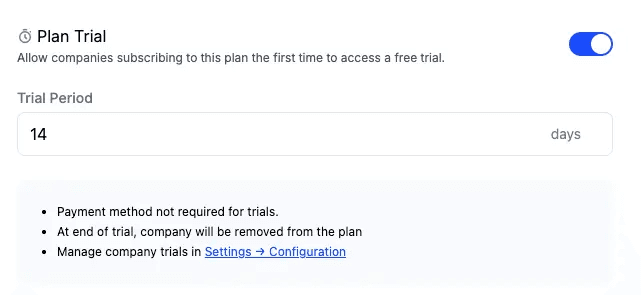
Once trials are configured, you can surface trial state directly in the UI. Use Schematic’s React and Vue SDKs to expose the customer’s plan name, trial status, and trial end date without any additional API calls.
You can also use the Schematic MCP to list plans with trials, add features to plans, check entitlements, and find customers nearing their limits.
Max Ade from Pickleheads shares, "The Schematic MCP is fantastic, and we now do most of our work in Claude, accessing plan and billing information directly without leaving our workflow."
But what really sets Schematic apart is its ability to solve customer trust structurally. Native credit wallets give enterprise buyers full visibility and control over their consumption so they never fear a surprise bill.
The runtime entitlement engine ensures that balances, limits, and usage stay current everywhere your product reads them.
FAQs About Trial Pricing
How do free trials work?
Free trials let users access a SaaS product for a limited time without paying. Users can explore features and test the product before deciding to upgrade. At the end of the trial, they either convert to a paid plan or lose access.
What are the four types of trial pricing?
The four common types of trial pricing are free trials with a credit card, free trials without a credit card, a freemium model with trials, and paid trials. The right choice depends on your business goals, growth strategy, and customers' perceived value of your product.
What are the five C's of pricing?
The five C’s of pricing are company, customers, competitors, costs, and channels. These factors help SaaS businesses set pricing that matches their business objective, value, market positioning, operational expenses, and distribution partners.