All posts
7 Best Metered Billing Software for SaaS Companies in 2026
Blog· Ryan Echternacht·Jun 28, 2026
Ryan Echternacht·Jun 28, 2026
Metered billing software tracks customer usage, applies pricing rules, and converts that usage into charges inside a billing system.
Instead of a flat subscription, companies bill for measurable consumption such as API calls, storage, compute, AI tokens, or text messages.
For example, a SaaS product may include 100,000 API calls in a plan and charge per request once the limit is exceeded during the billing cycle.
This approach supports modern usage-based pricing without embedding billing logic into application code.
It matters most for SaaS, AI, and infrastructure products where revenue depends on accurate usage data, not just access.
In this blog, we break down how metered billing works and which platforms handle it best in 2026.
TL;DR
These are the best metered billing software tools in 2026:
- Schematic + Stripe
- Metronome
- Orb
- Lago
- Stripe
- Maxio
What Is Metered Billing?
Metered billing is the infrastructure that measures product consumption and converts it into charges during a billing period. It extends subscription billing with tracked usage instead of charging only for access.
A plan may include defined usage metrics such as API requests, storage, compute, or active user counts.
The billing system records usage events, applies pricing rules, and generates charges tied to a contract. Many SaaS businesses use it to support a usage-based pricing model or overages inside existing plans.
Metered billing becomes more important when tiered pricing, volume pricing, or custom terms introduce complex billing scenarios. At that point, manual work increases and revenue leakage risk rises.
The Four Layers of Metered Billing
Every billing platform handles four core layers:
- Metering - Capturing raw usage events from REST APIs or application logs
- Aggregation - Calculating totals based on usage patterns over a billing period
- Rating - Applying complex pricing logic to those totals
- Invoicing - Generating charges, reporting, and revenue recognition
Most traditional systems focus on rating and invoicing after usage is reported.
Other platforms expose metering and rating logic in real time. The product can evaluate limits, credits, or overages before the billing cycle closes.
Top 6 Metered Billing Platforms in 2026
The tools below support different layers of metered billing, from usage capture and rating to invoicing and product enforcement.
The right choice depends on how tightly billing needs to connect to your product and runtime access decisions.
1. Schematic + Stripe
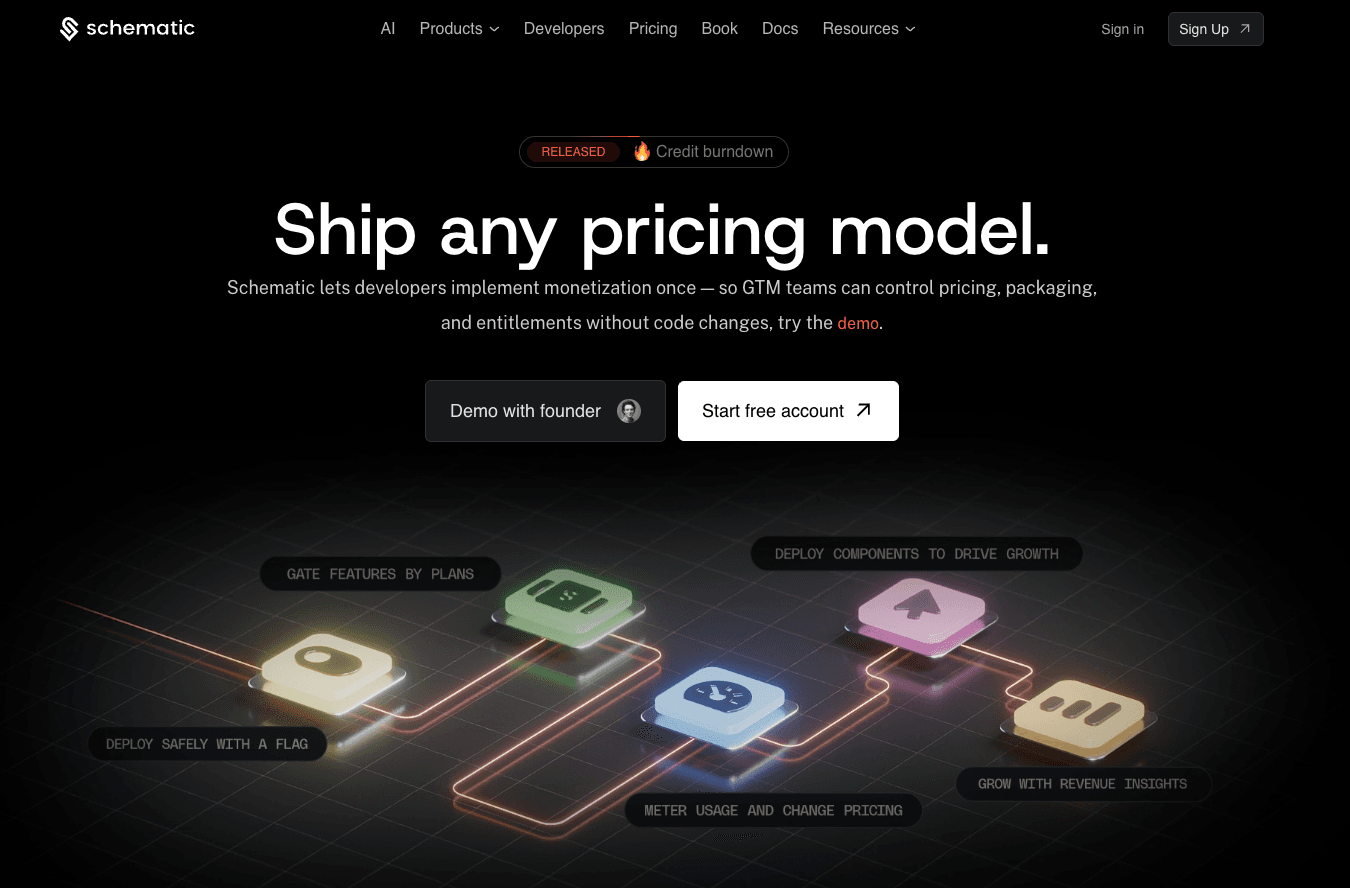
Schematic combines metered billing with in-product enforcement. It is built on Stripe for billing and payments, then extends that foundation into plans, limits, credits, and runtime access control.
Schematic acts as the system of record for your product catalog. Plans, SaaS entitlements, seat-based access, usage limits, trials, add-ons, and overrides live in one place. Stripe billing data syncs bi-directionally, so product access lines up with subscriptions.
Where most billing tools stop at rating and invoicing, Schematic evaluates usage and software entitlements inside the product in real time. Limits can block access when exceeded. Credits can burn down dynamically. Trials can convert automatically without manual updates.
Schematic also supports hybrid pricing models, including seat-based, pay-as-you-go, overages, credit burndown, and consumption-based models.
Engineering implements monetization once. Product and revenue operations teams can then manage packaging and pricing without rewriting billing code.
For SaaS and AI companies running hybrid self-serve and sales-led motions, that runtime control is the key difference.
Key Features
- Usage metering tied directly to plans and entitlements
- Real-time entitlement enforcement inside the product
- Bi-directional Stripe subscription sync
- Support for seat-based, credit-based, overages, and usage-based billing
- Enterprise overrides without code forks
- Embeddable React billing components
- Centralized product catalog for plans, limits, and add-ons
2. Metronome
Source: metronome.com
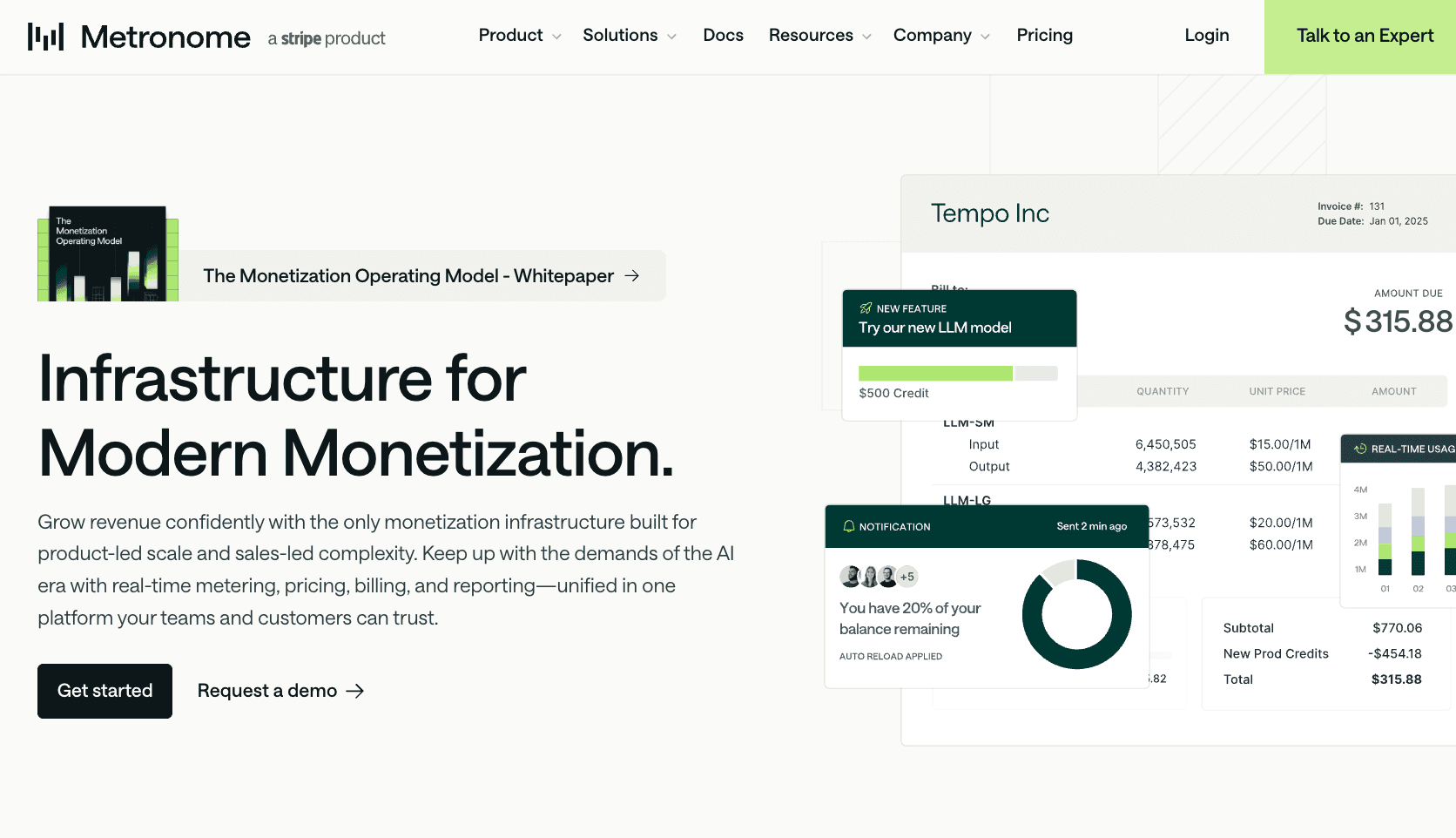
Metronome is a high-volume metered billing and rating engine designed for product-led and sales-led companies.
It handles real-time metering, pricing logic, invoice generation, and reporting inside a centralized billing platform.
Engineering teams use Metronome for complex pricing structures, such as credits, tiered usage, and custom enterprise contracts. Finance teams rely on detailed analytics and revenue reporting to monitor costs and customer value as usage grows.
Metronome is suited for companies with large event volumes and sophisticated billing operations. Pricing updates and contract changes can be managed centrally without rebuilding core billing calculations.
Its strength lies in usage calculation and invoice accuracy. Application-level limit enforcement and entitlements are typically handled outside the billing engine.
Key Features
- Real-time usage event digestion
- Modular pricing engine
- Dynamic rate cards
- In-app reporting dashboards
- Low-latency alerts
3. Orb
Source: withorb.com
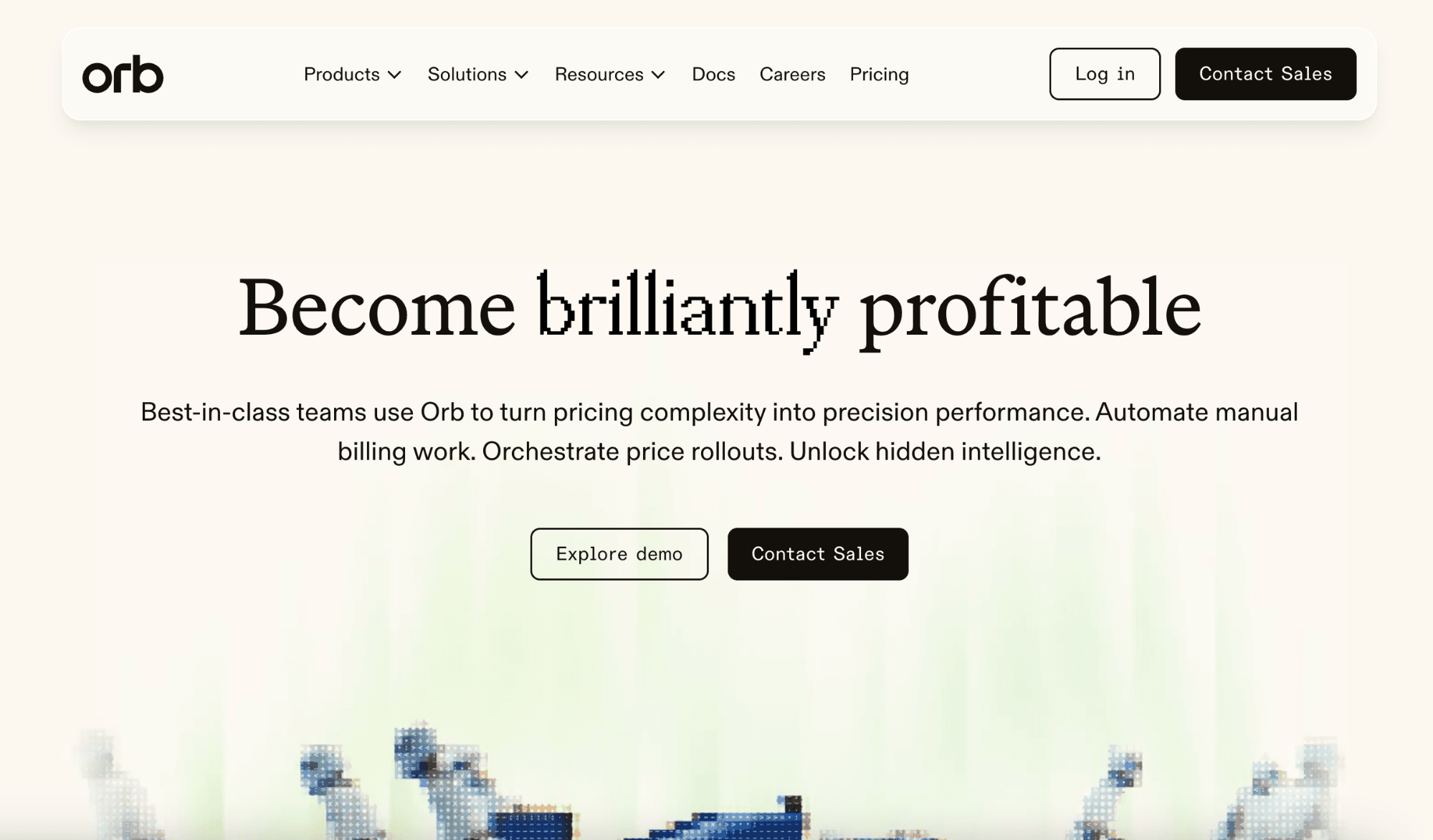
Orb is a usage-focused metered billing platform built for companies with complex pricing and high event volume.
It captures granular usage events, aggregates them over a billing period, and applies flexible rating logic before generating invoices. Credit systems, tiered pricing, and contract-based pricing rules are supported within the billing engine.
Orb connects usage data to CRM contracts and automates revenue recognition workflows. It also provides detailed analytics and pricing simulations so finance teams can test pricing changes before rollout.
Customer dashboards expose real-time spend and usage totals, which can reduce billing disputes because transparency builds trust.
Orb focuses on metering, rating, and invoicing inside the billing platform. Product-layer enforcement of limits and entitlements typically lives outside the system.
Key Features
- Usage billing and metering at scale
- Flexible pricing and packaging
- Accurate invoicing
- User experience kit with pricing calculators, checkout flows, and usage dashboards
- Automated revenue recognition and dunning management
4. Lago
Source: getlago.com
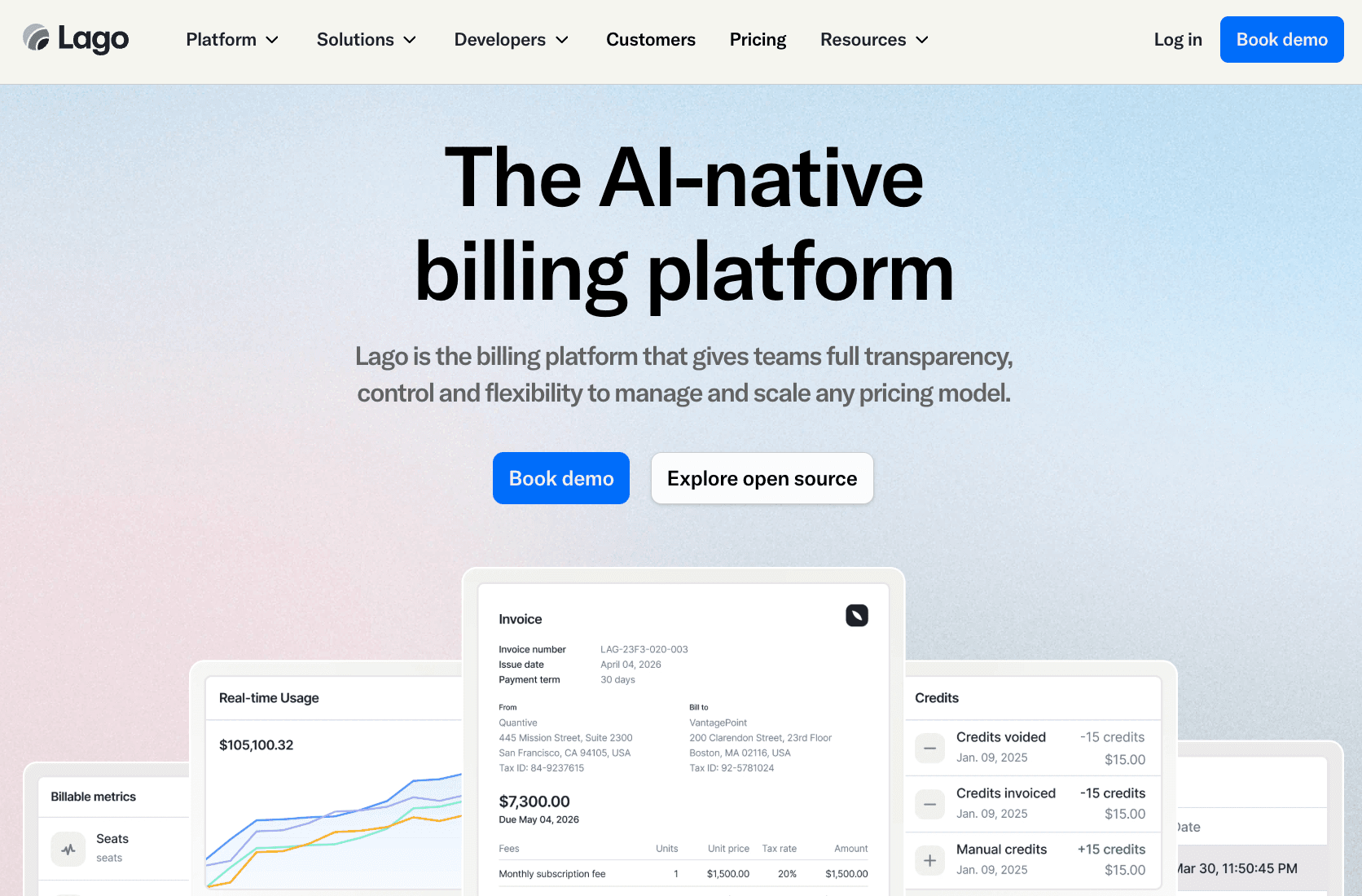
Lago is an open-source metered billing infrastructure designed for teams that want control over their billing stack.
It processes usage events, calculates totals over the billing period, applies pricing rules, and generates invoices. Hybrid plans, prepaid credits, tiered pricing, and enterprise contracts are supported within the billing layer.
A key difference is deployment choice. Lago can be self-hosted or deployed in a managed environment. That flexibility appeals to engineering teams that want deeper control of their billing platform or need to integrate closely with internal systems.
It focuses on metering, rating, invoicing, and extensibility. Runtime product enforcement of limits and entitlements typically lives outside the platform.
For companies prioritizing infrastructure control and open-source flexibility in metered billing software, Lago is a billing-layer solution.
Key Features
- Usage data ingestion and aggregation
- Support for different usage-based billing models, including prepaid credits and usage allowances
- Automated and fully compliant invoicing
- Open-source deployment
- Extensive platform integrations
5. Stripe Billing
Source: stripe.com/billing
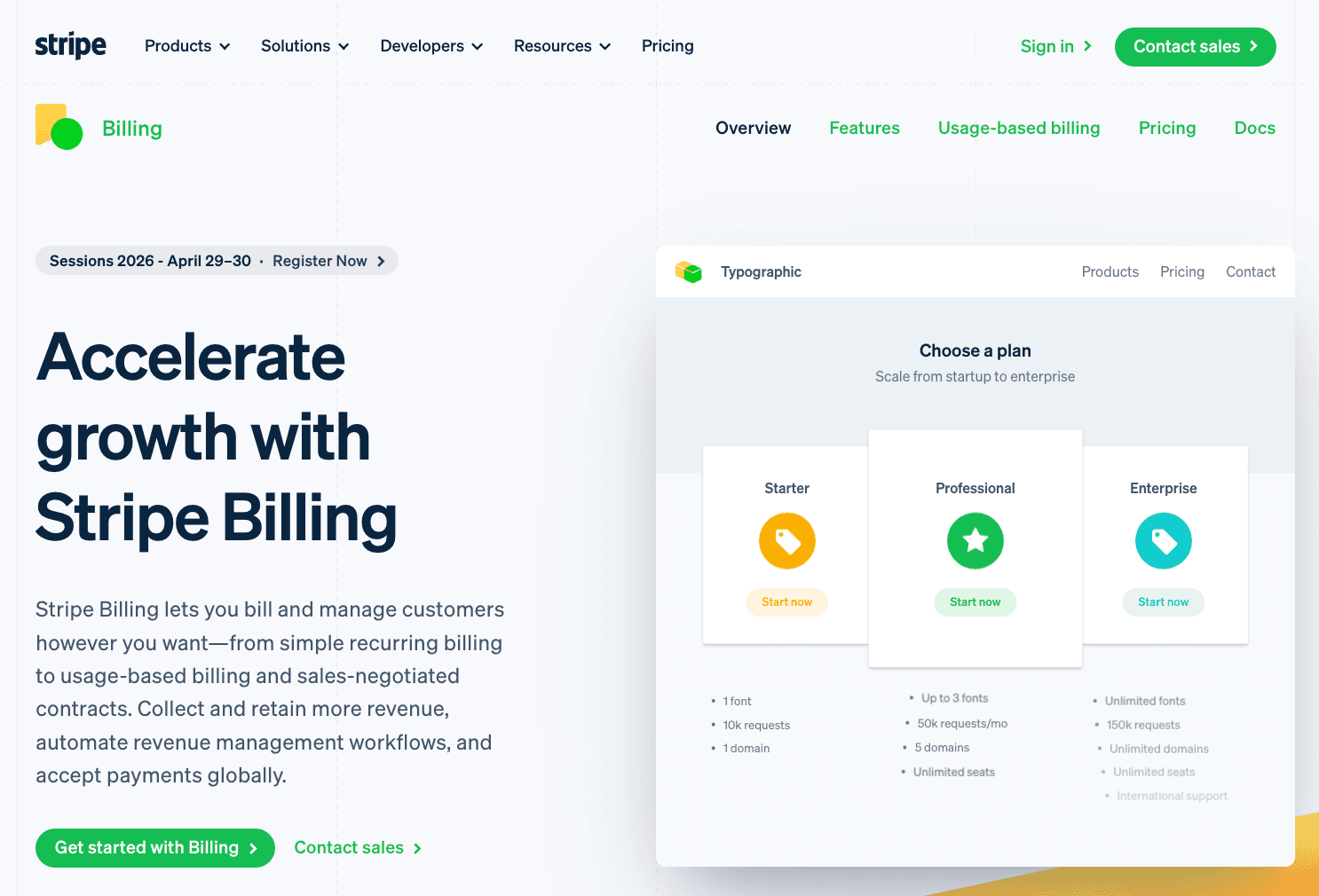
Stripe Billing is often the starting point for teams implementing metered billing and subscription management in one system.
It allows the definition of pricing structures, such as usage-based billing, tiered, flat fee plus overage, and per-unit pricing. Usage events are reported during the billing cycle and converted into invoice line items.
For example, a basic tier can include a fixed number of API calls, with per-unit charges applied once usage exceeds the threshold.
Stripe supports subscriptions, meters, trials, coupons, add-ons, prorations, and revenue reporting. It also manages invoicing, payment retries, and customer self-service.
Stripe centers on billing execution and payment collection. Product-layer limit enforcement and entitlement decisions require additional systems when those checks must happen before invoicing.
Key Features
- Usage metering and data aggregation
- Support for flexible subscription and usage-based pricing models
- Online checkout and payment links
- Smart payment retries and recovery
- Billing analytics and benchmarks
6. Maxio
Source: maxio.com
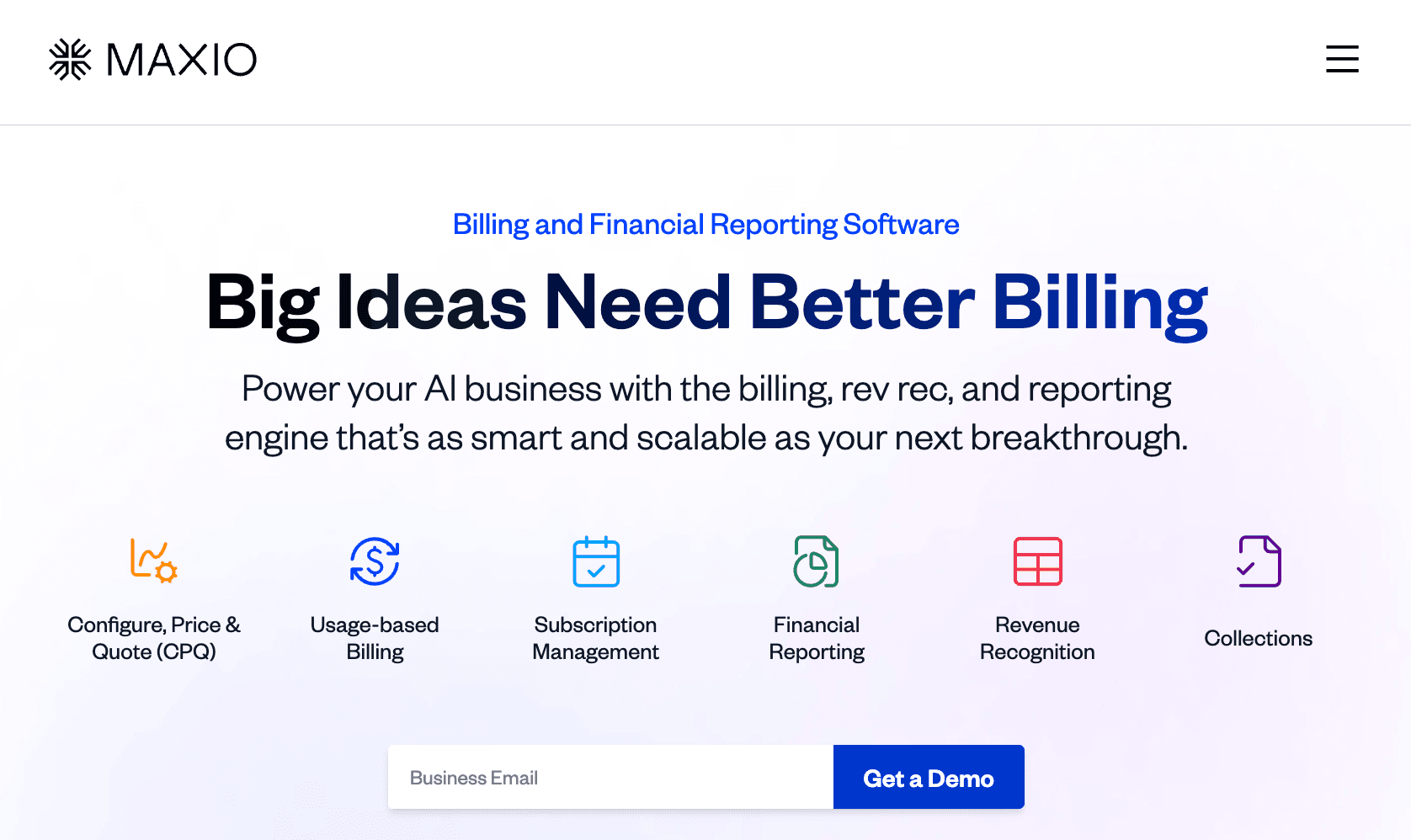
Maxio is a billing and financial operations platform for B2B SaaS companies that combine subscriptions with usage-based billing.
Usage data is ingested via API or batch upload, aggregated, and rated according to configured pricing logic, such as per-unit, volume, tiered, or prepaid credit models.
Invoices reflect recurring charges and consumption beyond committed amounts. Minimum commitments, contract terms, and subscription migrations are supported.
Maxio also includes finance-oriented capabilities, such as SaaS metrics reporting, GAAP and IFRS-compliant revenue recognition, automated reconciliations, and ERP integrations.
Its focus is on billing accuracy and financial control. Real-time product access enforcement typically occurs outside the billing platform.
Key Features
- Usage metering and rating
- Built-in analytics and backtesting
- One-click reports and custom dashboards for audit preparation
- Payment gateway integrations
- Subscription management with self-serve billing portals
7. Zuora
Source: zuora.com
Zuora offers a flexible metered billing platform designed for AI monetization.
It can ingest, transform, and meter raw usage data in any format. A near real-time rating engine can track customer consumption, send proactive threshold notifications, and provide usage dashboards.
Usage events are instantly routed for rating and billing or stored in a data warehouse. Meanwhile, usage limit enforcement and entitlement management are handled in another system.
Zuora Billing also includes a drag-and-drop consumption-based pricing designer. This makes it easier to configure and adjust pricing models, such as volume pricing, overages, and pricing tiers.
Pre-built payment gateway connectors let customers pay using credit cards, digital wallets, bank transfers, and more. Fraud prevention across gateways and failed payment recovery can prevent revenue leakage.
Zuora is built for modern SaaS and AI companies managing complex usage-based and hybrid monetization models.
Key Features
- Raw usage data ingestion and metering
- Real-time rating engine for continuous visibility
- Global payments orchestration
- Built-in platform extensibility
- Integrated quote-to-cash workflow
Common Metered Billing Challenges
Adopting metered billing comes with several challenges.
- Lack of scalability: Metered billing becomes harder when usage events grow from thousands to millions. The system needs to capture, aggregate, rate, and sync usage without delays, data loss, or manual cleanup.
- Customer disputes: Customers need to understand what they used, how it was measured, and why they were charged. Without clear usage dashboards and alerts, billing disputes increase and negatively affect customer satisfaction.
- Unexpected costs: Usage spikes are more common when customers pay based on consumption. A single high-volume customer may use a large amount of resources before teams catch the impact on costs. A Zylo report found that 78% of IT leaders reported unexpected charges due to consumption-based pricing.
- Unpredictable revenue forecasting: Revenue becomes harder to predict when customers have variable usage across billing periods. Finance teams need accurate reporting.
- Limit enforcement: Billing tools can generate invoices after usage, but many products need to act before the billing cycle ends. Limits, credits, trials, and overages should stay aligned with what the product allows in real time.
What to Look for in Metered Billing Software
Not every metered billing tool solves the same problem. Some focus purely on invoice accuracy. Some connect billing to product behavior.
When evaluating platforms, consider how deeply billing needs to integrate with your application and existing systems.
Below are the key questions to ask:
- Does the platform support real-time usage tracking, or does it calculate totals only at invoice time?
- Can it handle custom metrics beyond simple API calls or storage counts?
- Is it built for enterprise-grade scale, contracts, and audit requirements?
- Does it reduce operational complexity by eliminating manual processes between engineering, finance, and RevOps?
If billing decisions affect runtime access, entitlements, or feature limits, your billing infrastructure must extend beyond invoice generation.
Operate Metered Billing at Runtime with Schematic
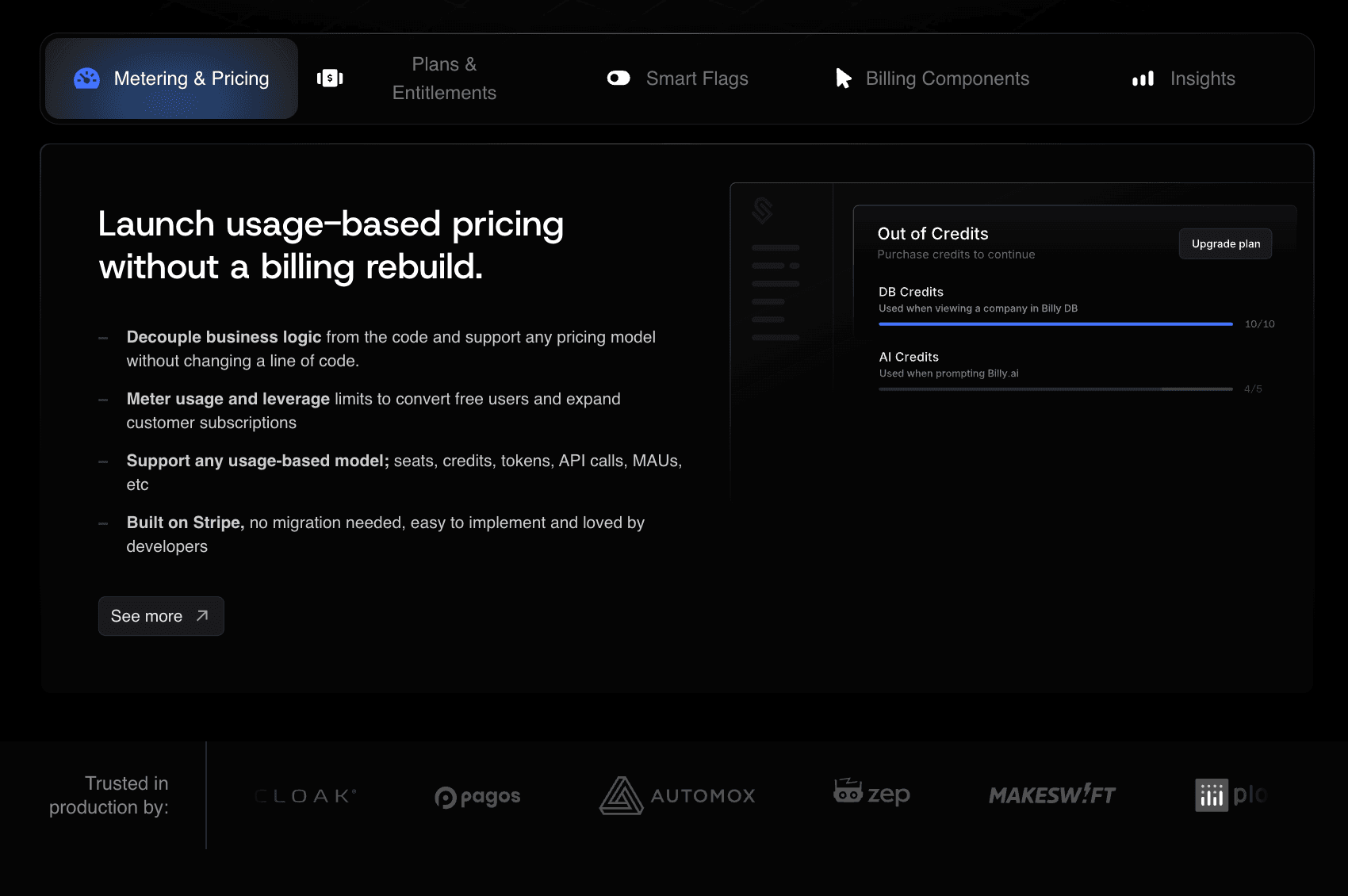
Most metered billing platforms calculate charges correctly. Fewer connect those calculations to what your product allows at the moment usage occurs.
When limits, credits, trials, and contract overrides live only in the billing system, enforcement happens after the invoice is generated. Engineers patch edge cases in code. RevOps handles exceptions manually. Product waits on billing updates before shipping packaging changes.
Schematic moves those decisions into the product layer. Usage, plans, and billing state become runtime inputs that your application can evaluate instantly. Access can change the moment a limit is reached or a contract updates.
Schematic is built on Stripe, turning billing state into application behavior. Developers write two calls instead of two hundred lines.
FAQs About Metered Billing Software
What is a metered billing system?
A metered billing system charges customers based on how much they use a product or service. It tracks events, like API calls, seats, credits, storage, or compute, and translates them into usage-based billing charges. The platform is worth considering when pricing models include overages or credits, or when manual billing processes create errors or revenue leakage.
Which billing software is best and free?
The best free option depends on your pricing model and growth stage. Schematic is often a good starting point because it lets you drop in metered billing with a few lines of code at no cost, although it comes with limited monthly events.
What is the metered billing approach also called?
The metered billing approach is also called consumption-based pricing, pay-as-you-go pricing, and usage-based billing. These models all connect what a customer pays to their actual usage instead of charging a flat subscription fee.
What is the cheapest billing software?
Both Schematic and Stripe are cost-effective billing solutions for startups and small teams. Schematic offers a free version, while Stripe lets customers pay only for what they use without recurring subscription fees.