 Ryan Echternacht
Usage-based billing becomes necessary when software companies launch AI products with variable usage patterns that can cause usage costs to spike.
Many teams rely on usage billing software to track usage in real time. However, not all usage-based billing platforms are created equal. Some only support real-time metering, but fail to handle price modeling, usage limits, and entitlement enforcement.
That’s why it’s important to look for the best usage billing software that connects usage data to pricing rules and limits.
Below are nine tools many teams use when usage needs to control limits and software entitlements during the billing cycle.
TL;DR
These are the top usage billing software options for B2B SaaS teams in 2026:
- Stripe Billing
- Metronome
- Orb
- Lago
- Chargebee
- Maxio
- Zuora
- Zenskar
What Usage Billing Means for Modern B2B SaaS
Usage billing is a pricing model where customers pay based on actual usage, not just software access alone.
Instead of charging a flat subscription, you define pricing around measurable service usage, such as API calls, active seats, AI credits, compute hours, or events processed. Each unit reflects actual consumption and delivered value instead of assumptions.
According to ICONIQ’s State of AI report, 35% of companies have implemented usage or consumption-based pricing.
A modern usage-based billing system is designed to capture usage data directly from the product and translate it into billable usage.
That data feeds pricing rules, usage-based metering, and invoicing workflows inside existing billing infrastructure. This is how SaaS teams support a usage model without manual reconciliation.
Many teams combine usage with subscriptions, pricing tiers, or volume discounts to run hybrid pricing models. The subscription sets the baseline. Usage scales the bill.
In practice, some teams apply usage only at the end of a billing cycle. Others evaluate usage in real time to control limits, credits, or trials when pricing needs to influence product behavior.
Usage billing works when usage remains accurate, pricing stays clear, and billing reflects how the product is actually used.
Common Usage Billing Implementation Patterns
Teams wire usage into billing in a few repeatable ways. These patterns define how systems exchange usage data and how closely billing reflects actual product behavior.
Understanding the pattern first helps you choose the right billing software later.
Billing-Only Usage Billing
Usage data flows into the billing system at the end of the billing cycle. Invoices show customer usage patterns, but product access stays unchanged during the cycle. Limits, trials, and feature access live entirely in application code.
This pattern fits teams that rely on a usage-based pricing model to automate billing and financial reporting. It works well when usage-based billing offers predictability, pricing stays simple, and billing operations focus on invoicing, tax, and revenue recognition. Product teams track usage for visibility, not enforcement.
Billing-only setups often align with a traditional subscription model that adds usage on top. They reduce operational risk but can lag behind real customer behavior when pricing grows more complex.
Usage Rating Platform + Payment Processors
Usage events first flow into a dedicated rating layer that handles aggregation, pricing rules, and complex calculations. Then, rated usage syncs with invoicing and payment solutions.
Teams choose this pattern when usage volume is high, pricing math is complex, or usage patterns drive a detailed pricing strategy.
It prevents billing errors caused by incorrect aggregation or late usage events. Finance teams gain confidence in invoice accuracy, while engineering avoids building custom rating pipelines.
This approach supports complex billing scenarios without changing how the product enforces access. Real-time financial data improves billing precision, but product behavior still evaluates usage separately.
Product Enforcement Layer + Payment Solutions
Usage decisions directly affect what customers can do inside the product. Limits, credits, trials, and overages are evaluated at runtime using real-time usage tracking. Billing reflects outcomes already enforced in the product.
This pattern fits teams that want to adopt usage-based billing to align pricing with actual value delivered. It supports a customer-centric approach where pricing responds to customer behavior, not billing delays.
Product and RevOps teams can tailor pricing, adjust entitlements, and handle exceptions without shipping billing code.
Product enforcement creates customer-centric billing with transparent pricing and fewer surprises. It works best when usage-based billing aligns tightly with the business model and customer experience.
9 Best Usage-Based Billing Software in 2026
Usage billing breaks down at different points in the stack. For some teams, the gap sits in billing and invoicing. For others, it appears earlier, where product usage should influence access and entitlements during the cycle.
Below are the best usage-based billing platforms to solve those problems:
1. Schematic
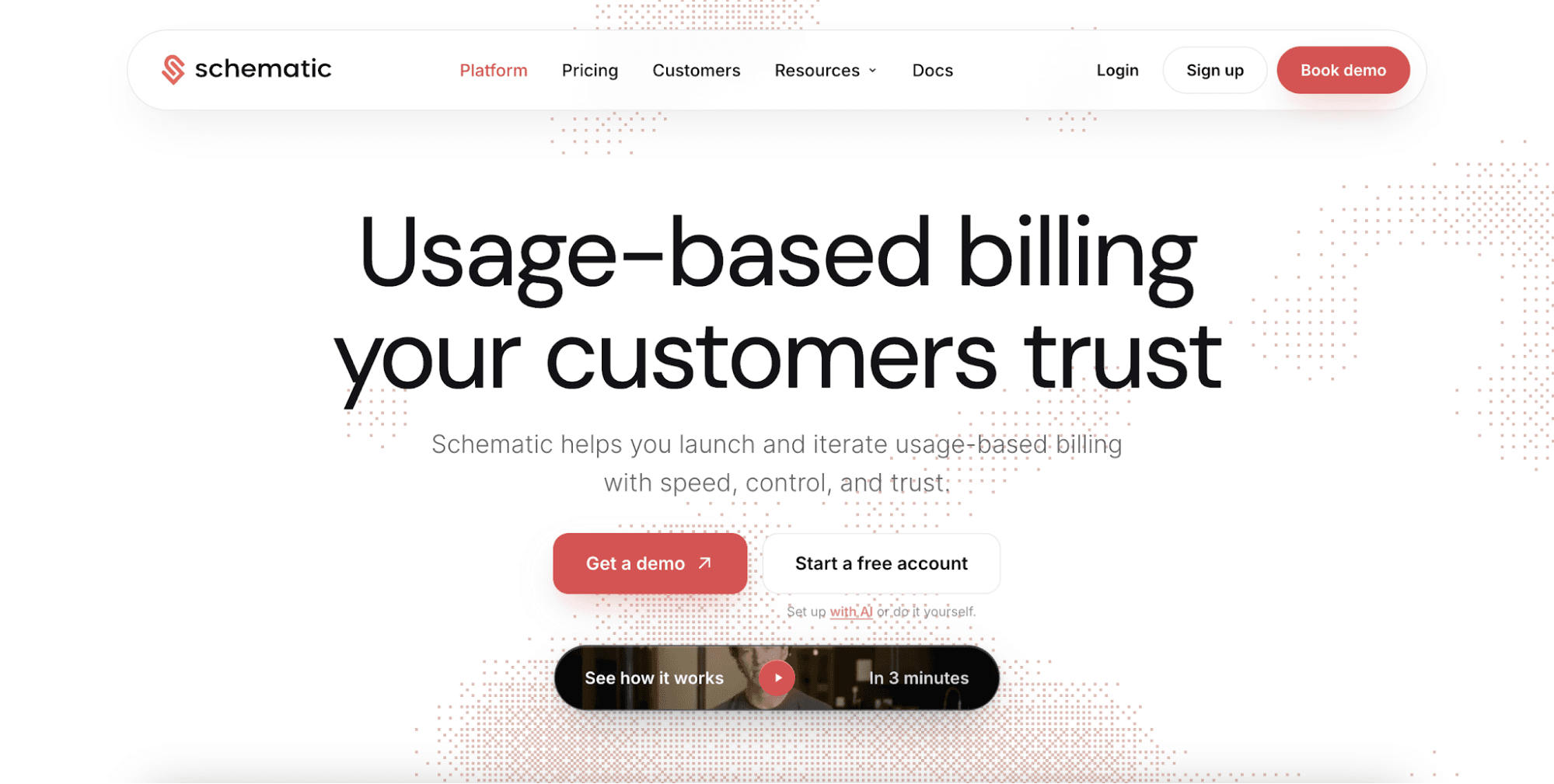
Schematic provides complete usage-based billing software for SaaS and AI companies that want to close enterprise accounts.
It’s the only usage billing software with runtime enforcement. Schematic helps teams sell usage-based plans, meter credits, and enforce usage from the same ledger that bills.
Native credit wallets give buyers complete visibility and control over their usage. Customers can set caps per company, per seat, or per agent and receive notifications before the limit. They can also adjust the credit top-up policy, forecast spend, and decide what happens at the limit.
Hard caps block access and activity, while soft limits enable continued usage and bill it in arrears. Schematic automatically enforces the policy the customer selected. The platform will then reflect current balances, limits, and usage everywhere the product reads them.
With Schematic, pricing lives as data on a real-time credit ledger. Define plans, limits, and prepaid credit bundles. Then, change pricing and packaging through configuration instead of hardcoding logic inside the product.
Schematic solves the trust problem in usage-based pricing by metering events once to power invoices, entitlements, and analytics.
This leads to faster sales cycles, less procurement friction, more predictable expansion, and higher long-term revenue.
Key Features
- Usage metering: Track and bill for usage metrics, such as API calls, credits, tokens, or monthly active users (MAUs).
- Enterprise credit wallets: Give customers real-time visibility and control over their consumption. They can set usage limits, configure top-up rules, forecast spending, and define what happens at the cap.
- Entitlement engine: Control and enforce in-product access based on a customer's current plan, usage, limits, and custom contract terms.
- Support for multiple pricing models: Implement any monetization model, especially usage-based pricing, from one engine.
- Pricing simulations: Review how usage-based pricing can impact future revenue and customer behavior before full rollout.
- Plan versioning: Version plans, migrate customers, and launch trial pricing independently from engineering.
- Credit management: Let unused credits roll over to the next period, share clear expiry dates, and set priority consumption rules to ensure old or promotional credits burn down first.
- Concurrency-safe holds: Reserve the credit before committing or releasing it once the transaction is complete. Two agents drawing the same balance cannot double-spend it.
- Real-time event log: Store credit grants and deductions in real time for fast implementation and debugging.
- Credit-based revenue recognition: Use an append-only, export-ready ledger to ensure compliance with ASC 606.
2. Stripe Billing
Source: Stripe.com
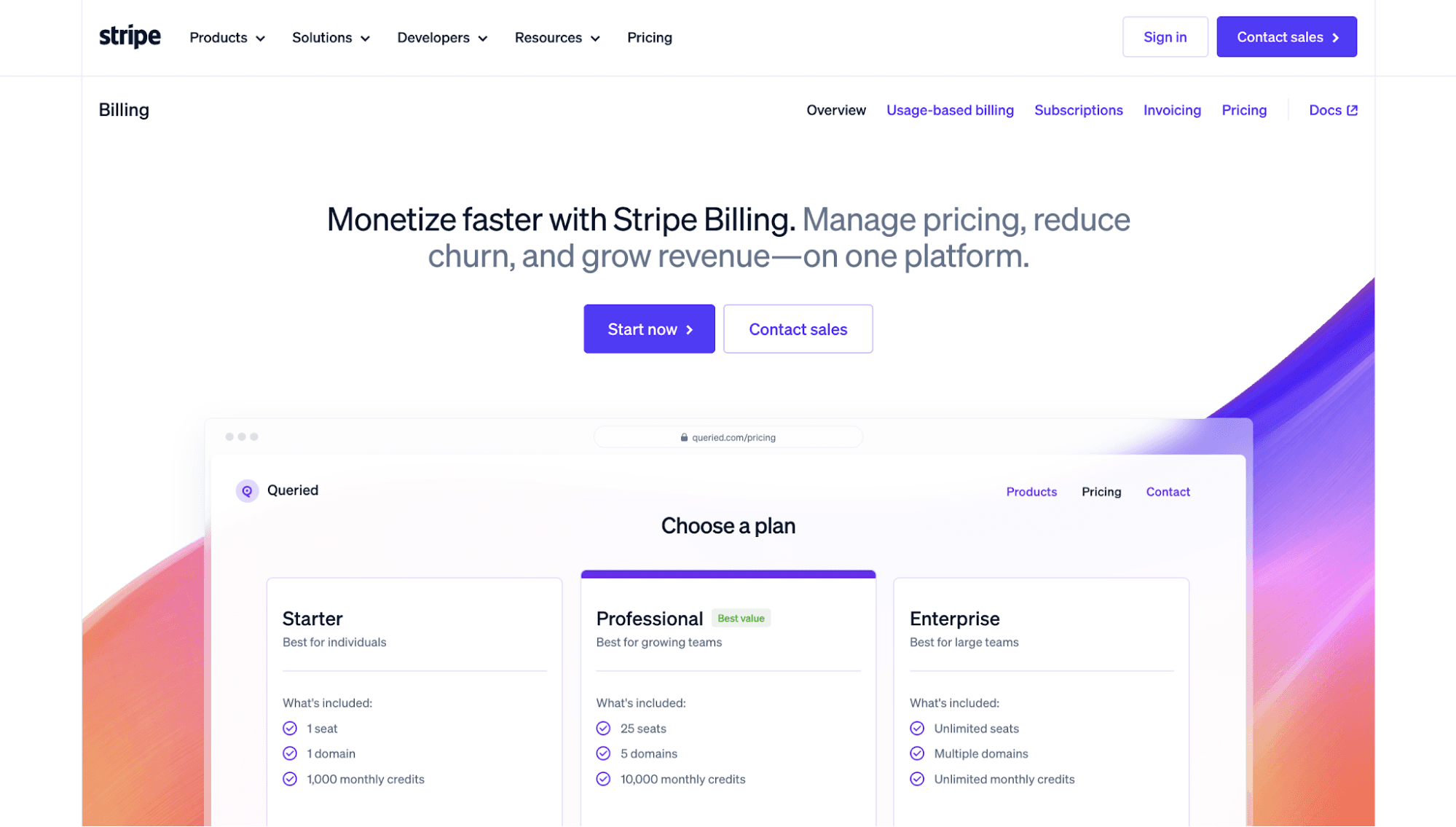
Stripe Billing sits at the center of many SaaS billing stacks, especially for teams that treat usage as an input to invoicing rather than a product control surface.
You send usage events into Stripe, define pricing rules, and let the platform calculate charges at the end of each billing cycle.
Most teams rely on Stripe for metered billing, invoicing, payments, tax, and accounting alignment. Usage limits, access rules, and enforcement typically live in application code, not inside Stripe itself.
That separation works well when billing accuracy and financial workflows matter more than real-time product decisions.
Stripe Billing fits teams that want a flexible usage-based billing platform with strong APIs, global payments, and reliable finance tooling. It also suits businesses that are comfortable owning pricing logic and entitlements elsewhere.
Key Features
- Metered billing support: Track usage metrics, such as API calls or seats, and bill per unit.
- Flexible pricing models: Configure tiered pricing, volume pricing, and hybrid plans.
- Invoicing and payments: Generate accurate invoices and handle global payments.
- Revenue recognition: Support accounting workflows tied to billing data.
- Developer APIs: Integrate usage events into existing systems with Stripe’s APIs.
3. Metronome
Source: Metronome.com
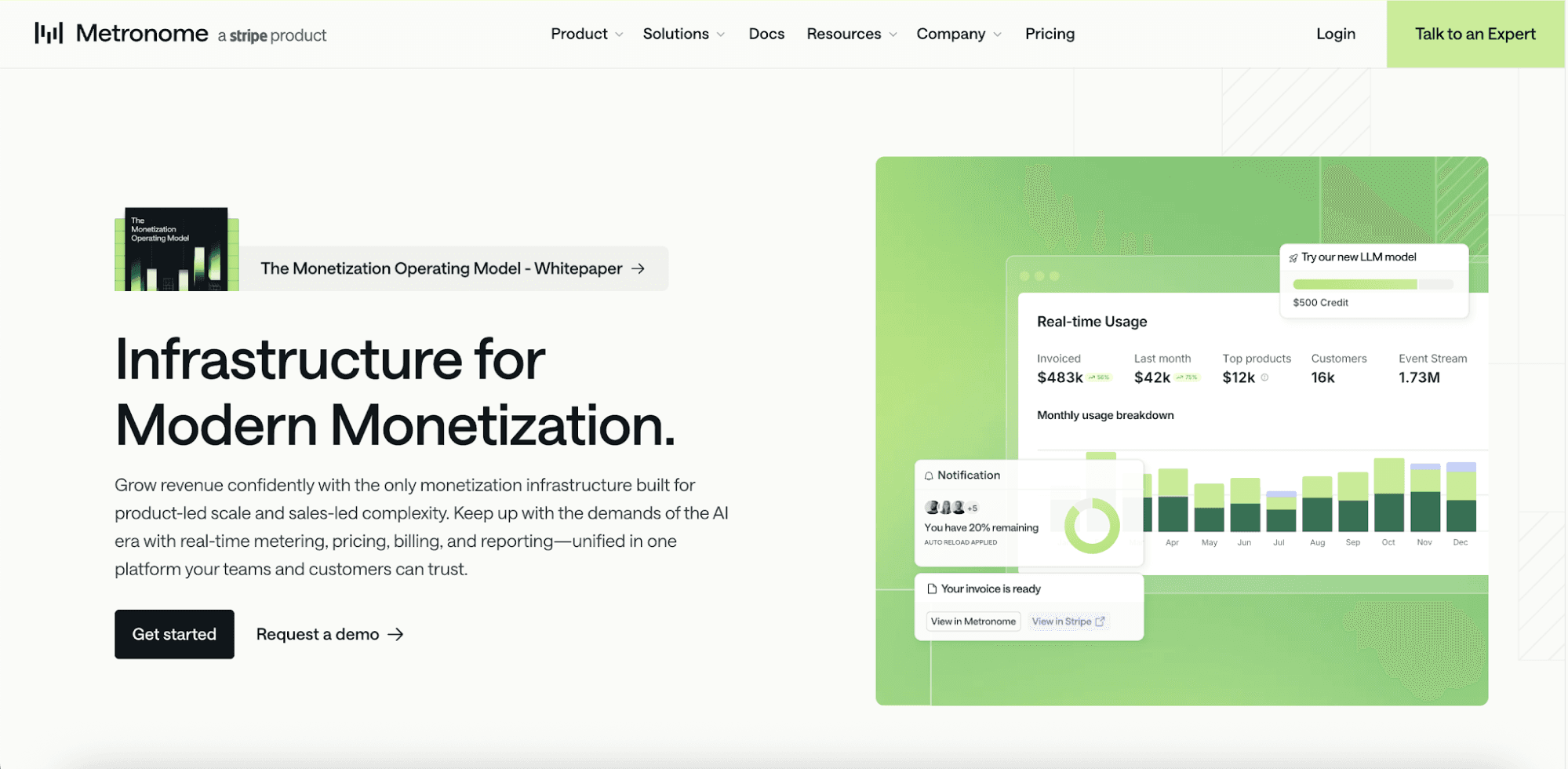
Metronome is designed for SaaS companies where billing accuracy depends on precise usage math at scale.
Instead of focusing on invoices directly, it specializes in ingesting high-volume usage events, applying rating logic, and producing clean, billable usage outputs.
Teams adopt Metronome when pricing models change often, usage dimensions are complex, or event volume is too high for basic metering setups.
Rated usage typically flows into Stripe or another billing system for invoicing and payments.
Metronome shows up frequently in AI and infrastructure companies where errors in usage calculation translate directly into revenue risk.
Feature access and enforcement remain in the product, while Metronome handles the hard parts of usage computation and reliability.
Key Features
- High-volume usage ingestion: Process large streams of usage events at scale.
- Usage rating and aggregation: Convert raw events into billable units using configurable billing logic.
- Support for complex pricing models: Handle credit-based pricing, overages, tiered rates, and custom usage dimensions.
- Stripe integration: Sync rated usage into Stripe for invoicing and payment processing.
- Usage and revenue reporting: Provide detailed visibility into consumption and billed amounts.
4. Orb
Source: withOrb.com
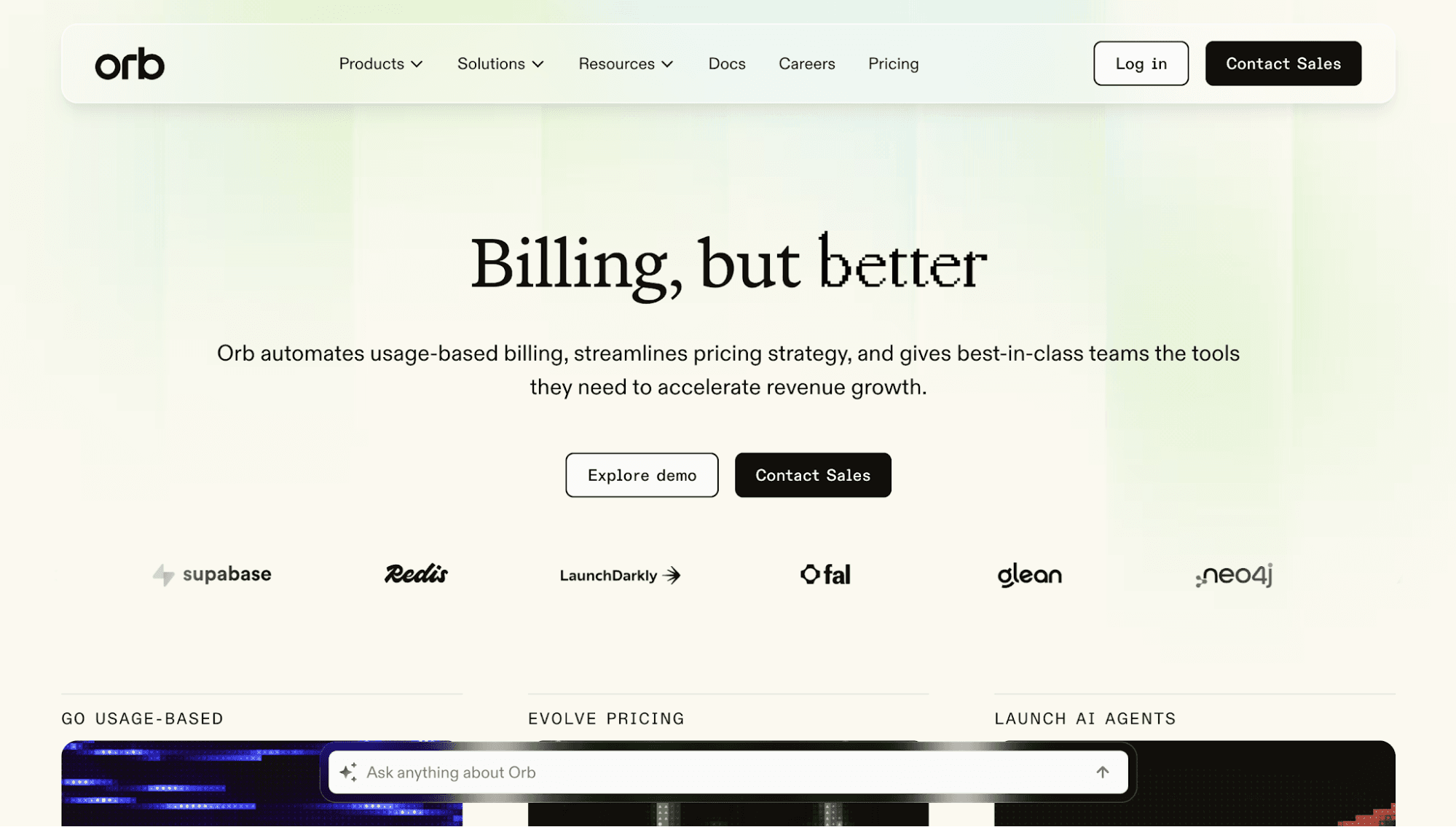
Orb approaches usage-based billing from the perspective of finance and product teams. The platform emphasizes turning detailed usage data into invoices that reflect contract terms, pricing changes, and corrections without manual cleanup.
Orb can integrate with Stripe or an existing billing stack to connect usage to contract terms and invoicing.
It supports setups where subscriptions, usage charges, and negotiated terms coexist, and where pricing changes need audit trails and financial confidence.
Orb is often chosen when billing disputes, backfills, or pricing experiments directly affect renewals and trust.
You keep entitlement enforcement separate, while Orb focuses on billing accuracy, transparency, and revenue recognition readiness.
Key Features
- Usage metering: Ingest and aggregate granular usage events for APIs, tokens, seats, or custom units.
- Flexible price modeling: Support flexible pricing structures, offer volume discounts, and sell usage-based plans with custom pricing.
- Accurate invoicing: Generate detailed invoices that reflect backfills, corrections, and contract changes.
- Revenue recognition support: Align billing data with ASC 606-ready finance workflows.
- Customer visibility tools: Provide dashboards, alerts, and pricing calculators to support transparent usage billing.
5. Lago
Source: getLago.com
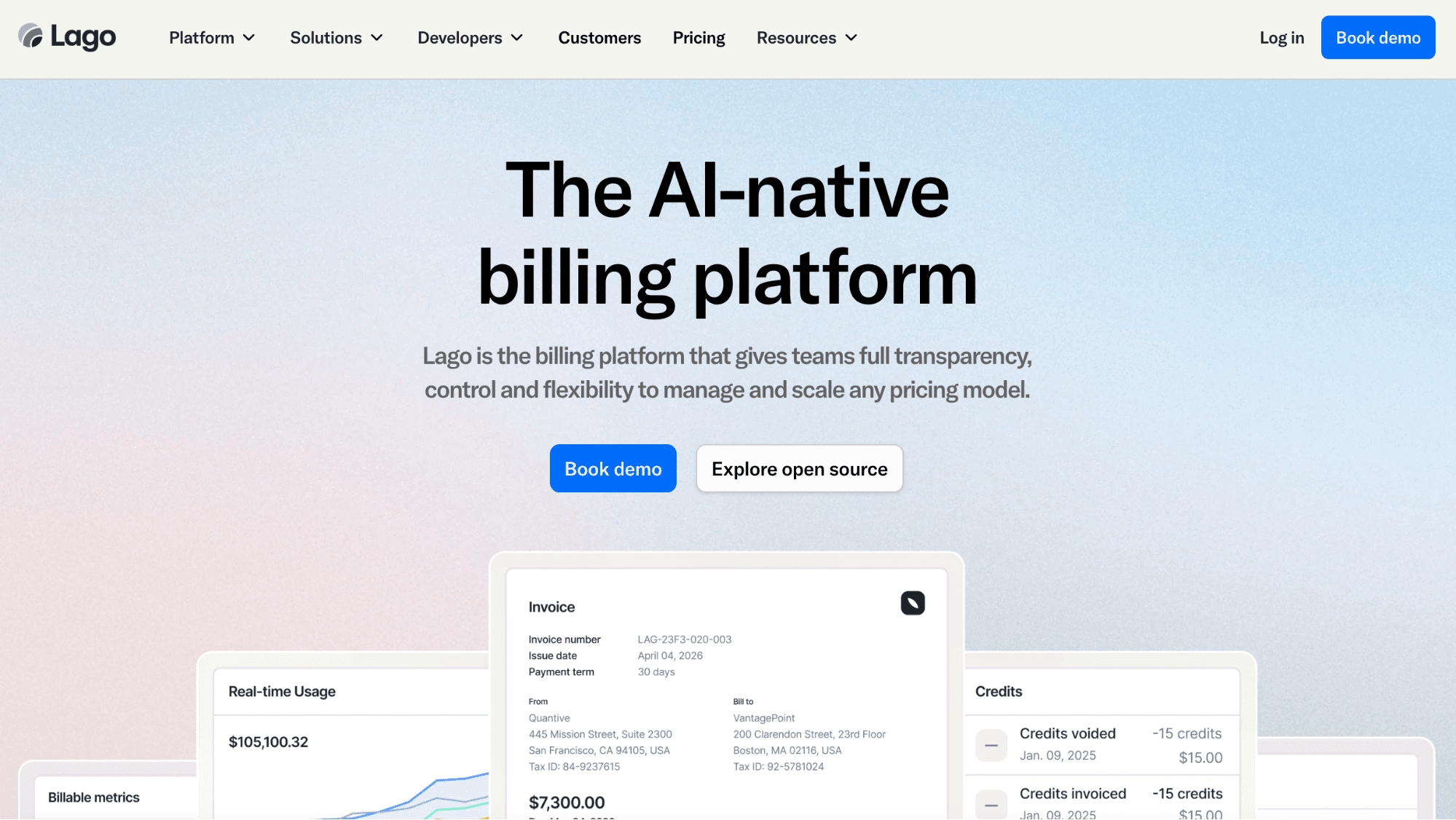
Lago converts raw product usage into invoices using pricing logic you define, without forcing a fixed billing schema.
You send events, such as API calls, credits, or compute usage. Then, Lago aggregates them into billable metrics in real time.
Usage can either accumulate toward an invoice or burn down from prepaid credits, depending on how you structure plans. Subscriptions, add-ons, and enterprise thresholds all live in the same billing flow.
Teams often pick Lago when they want control over usage calculation and invoice logic, plus flexibility in how and where the system runs.
Open-source and self-hosted options make it attractive in environments with strict deployment or compliance needs.
Key Features
- Usage metering: Ingest and aggregate raw usage events into billable metrics with custom logic.
- Hybrid billing models: Combine usage-based pricing with subscriptions, credits, and add-ons.
- Billing and invoicing: Generate accurate invoices with support for end-of-period and prepaid billing.
- Open-source deployment: Run Lago self-hosted or in managed environments for compliance needs.
- Finance integrations: Sync billing data with Stripe, tax tools, and accounting systems for accurate financial reporting.
6. Chargebee
Source: Chargebee.com
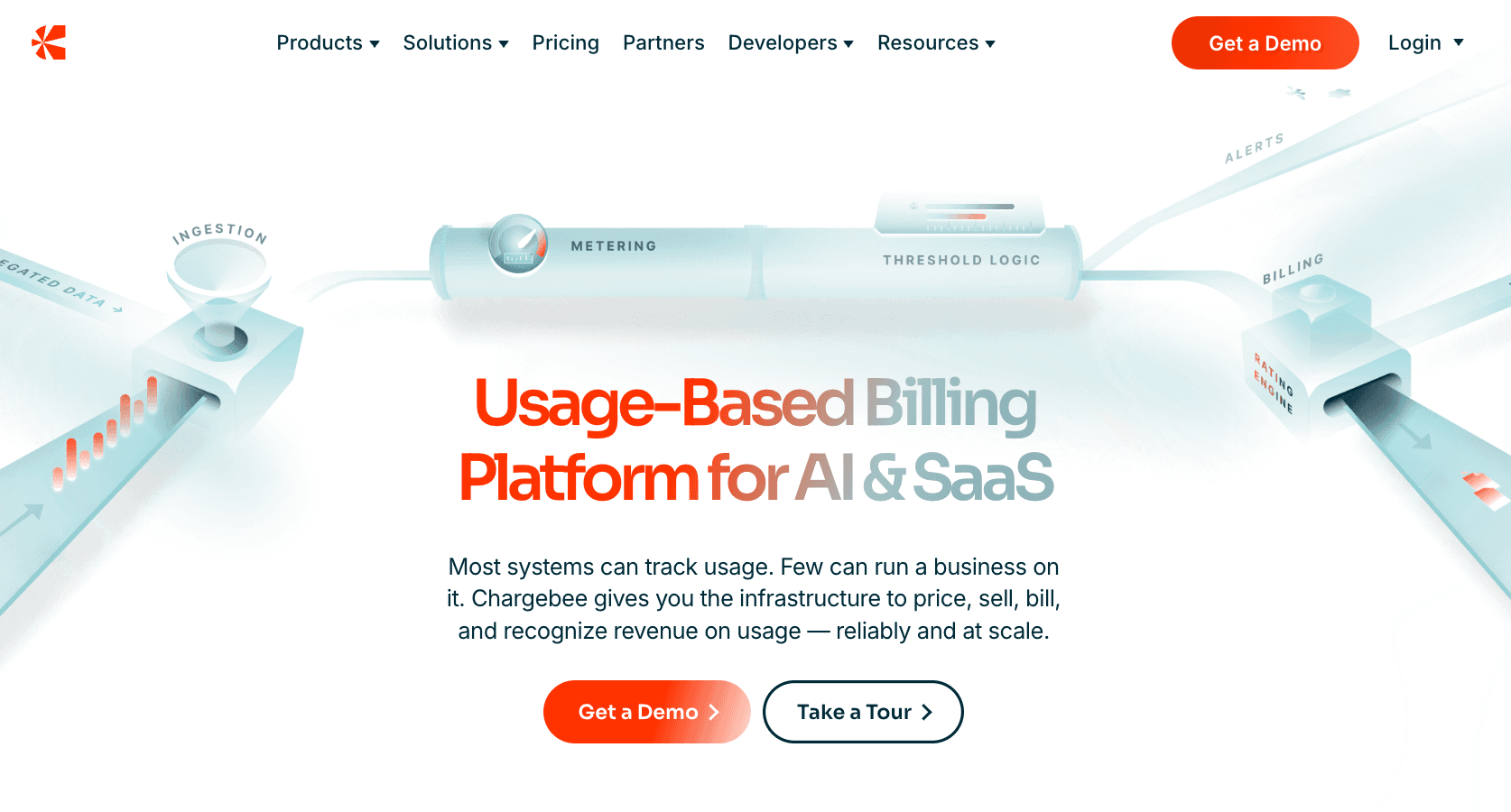
Chargebee layers usage-based billing into a full subscription and revenue management platform.
Usage data enters the system through APIs and supported integrations, then gets rated using pricing rules that support tiers, credits, and included allowances.
Invoices combine recurring charges and usage, which makes Chargebee a common choice for businesses running both self-serve plans and negotiated enterprise contracts.
Sales quoting, amendments, renewals, and revenue recognition live in the same system.
Chargebee is suitable when billing, invoicing, and finance workflows need to stay tightly coordinated, and when usage pricing complexity exceeds what basic subscription tools can handle.
Key Features
- Usage-based pricing: Rate usage with tiers, overages, included units, or credit models.
- Subscription billing: Combine recurring plans with usage charges in one invoice.
- Usage ingestion: Accept raw or aggregated usage data from multiple sources.
- CPQ and contracts: Quote and manage usage terms in sales-led deals.
- Revenue recognition: Automate revenue recognition workflows based on IFRS 15 and ASC 606 requirements.
7. Maxio
Source: Maxio.com
Maxio treats usage billing as part of a broader finance-first billing system. Pricing models, usage ingestion, invoicing, payments, and reporting all live in one platform designed for SaaS revenue operations.
It’s easy to use Maxio. You simply define your pricing model, whether per-unit, prepaid, tiered, volume, or hybrid. Then, you can import usage data through APIs or batch files.
Maxio handles the rest, turning consumption into invoices and recognized revenue without custom pipelines.
Finance teams often drive Maxio adoption when predictability, compliance, and reporting consistency matter as much as pricing flexibility.
Product teams still iterate on pricing, but enforcement typically stays outside the platform.
Key Features
- Usage metering and rating: Capture and rate API calls, seats, events, or custom units.
- Flexible pricing models: Support per-unit, tiered, volume, prepaid, and hybrid plans.
- Automated invoicing: Translate usage data into invoices with minimal manual reconciliation.
- Subscription management: Handle upgrades, downgrades, trials, and proration with usage.
- Revenue reporting: Provide GAAP and IFRS-ready reporting tied to usage revenue.
8. Zuora
Source: Zuora.com
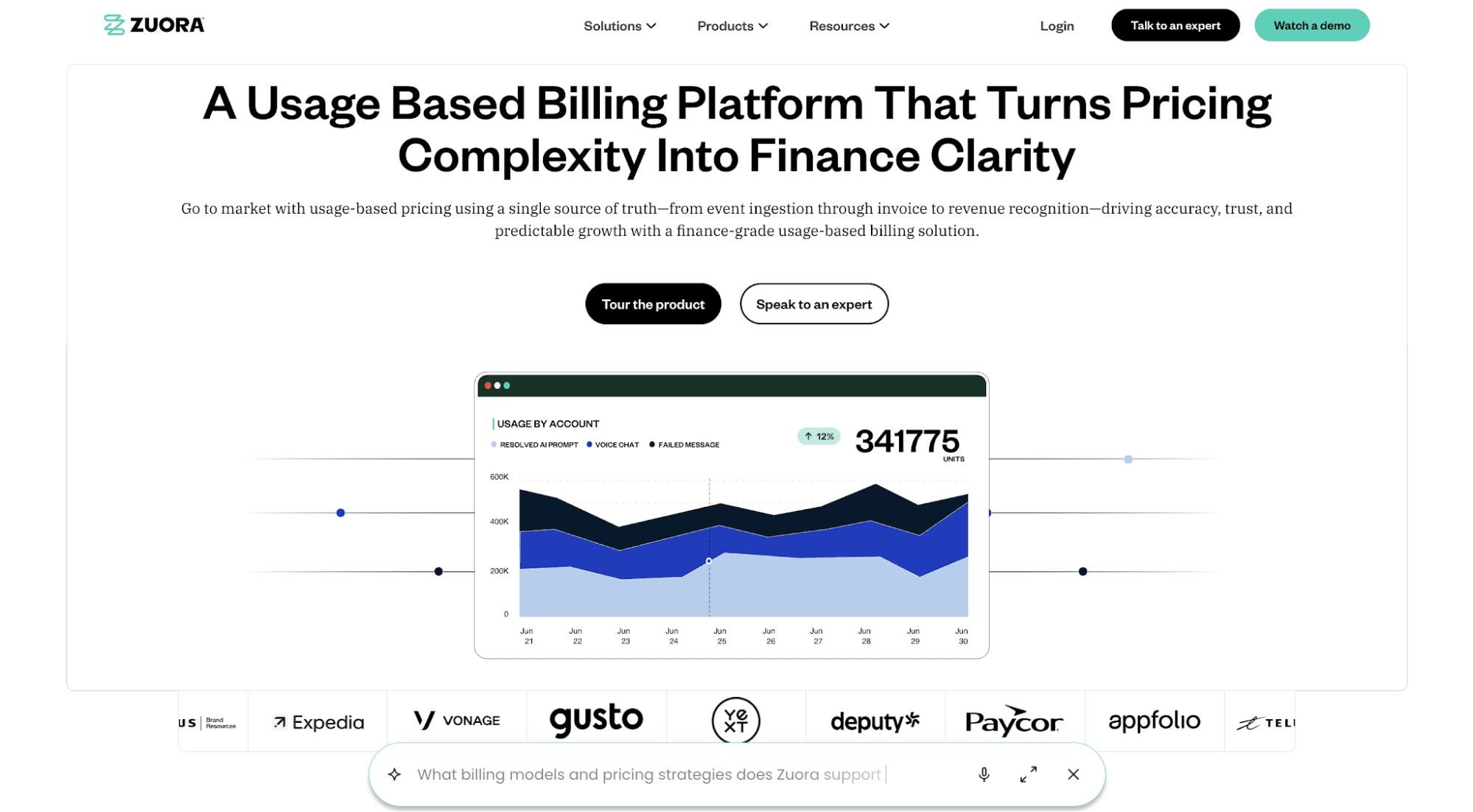
Zuora is designed for complex enterprise revenue workflows where recurring, one-time, and usage-based charges must be accurately reconciled.
The platform handles high transaction volume, complex customer lifecycles, and frequent contract changes without breaking downstream accounting or payments.
Usage pricing runs alongside recurring billing, with mediation and rating built into the same system that manages quoting, invoicing, and renewals.
Account hierarchies and mid-cycle amendments support long sales cycles and negotiated contracts without manual intervention.
Companies typically turn to Zuora when billing needs to connect to internal systems while supporting audits, international payments, and compliance requirements.
Product access and usage enforcement typically remain outside the platform, while Zuora focuses on scale, reliability, and financial ownership.
Key Features
- Usage metering and rating: Mediate and rate usage events for usage-based billing.
- Flexible billing models: Configure subscriptions, one-time charges, and multi-attribute pricing for recurring billing.
- Enterprise order and account management: Support account hierarchies, amendments, renewals, and multi-entity billing flows.
- Payments and tax tooling: Connect payment gateways and support e-invoicing and tax compliance workflows.
- CPQ and integrations: Integrate with CRM and CPQ systems to connect quoting to billing execution.
9. Zenskar
Source: Zenskar.com
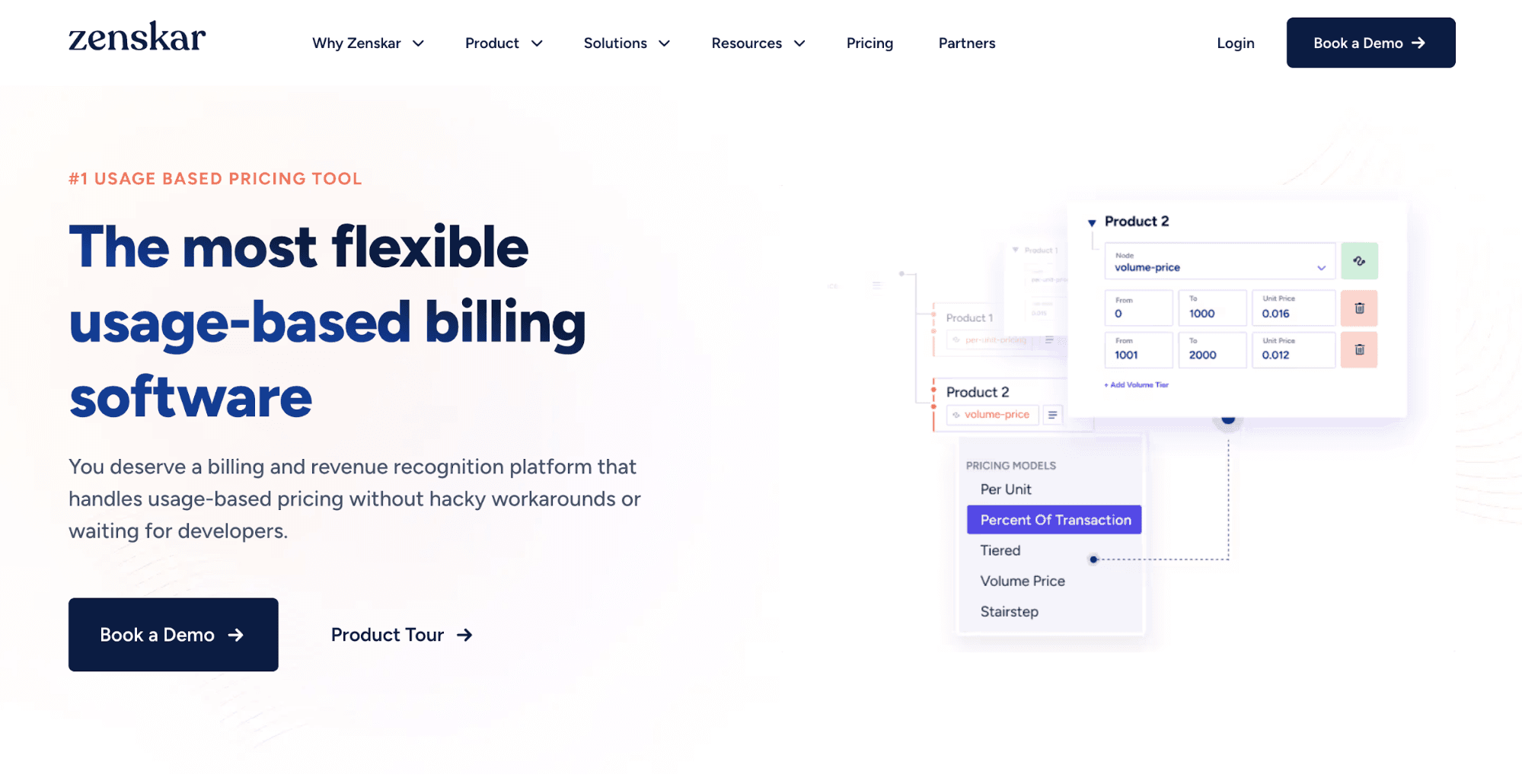
Zenskar combines usage-based billing and revenue recognition in one platform. It suits SaaS companies that want to adjust pricing and revenue schedules anytime.
Zenskar’s metering layer can capture usage data from sources like APIs, CSV uploads, integrations, and remote connections. The platform then transforms that data into billable events.
This makes it useful for companies that need to bill based on seats, API calls, usage credits, SKUs, overages, and freemium plans without waiting for developers.
The platform also supports any usage-based pricing model. Teams can configure pay-as-you-go, prepaid usage, metered billing, and consumption-based pricing.
Use pre-made templates to send accurate invoices and collect payments faster without manual data entry.
You can even create revenue recognition rules, generate journal entries for revenue, and support ASC 606 and IFRS 15 reporting based on usage and billing events.
Key Features
- Flexible usage-based pricing: Support pay-as-you-go, usage tiers, volume pricing, prepaid usage, consumption-based pricing, and more.
- Decoupled metering: Capture usage data from native integrations, APIs, CSV uploads, or remote connections.
- Customizable invoices: Choose from pre-made invoice templates that you can customize for usage-based billing.
- Automated revenue recognition: Close books faster by automatically recognizing revenue, generating journal entries, and creating ASC-compliant reports.
- Reporting and usage analytics: Track recurring revenue, churn, customer retention, and lifetime value through detailed reports.
How to Choose Usage Billing Software Based on Ownership
Most usage billing problems come from ownership, not tools. After comparing features, decide who controls pricing and usage decisions inside your organization. That choice determines how your usage-based billing model operates daily.
Engineering-Owned Pricing
Engineering-owned pricing works when pricing logic ships through code. Usage tracking and enforcement live inside the application. Engineers decide how usage events translate into limits, overages, or blocks for pay-as-you-go features or a tiered pricing model.
In this setup, the usage-based billing system focuses on invoicing, taxes, and accurate billing. Pricing changes follow release cycles. This model fits stable pricing and established existing customers, but it slows iteration when plans, trials, or complex pricing structures change often.
Teams rely on reporting tools to review accurate usage data after the fact and generate invoices at the end of the cycle.
Product and RevOps-Owned Pricing
Product and RevOps-owned pricing removes pricing changes from deploys. Plans, limits, credits, and exceptions are updated through configuration. Usage rules stay outside application code.
Teams choose no-code pricing when usage-based billing works as part of packaging, sales motion, and experimentation. Flexible billing options make it easier to align pricing with customer value and maintain predictable revenue as usage grows.
Billing integrates with a product-side decision layer, which keeps enforcement and invoicing in sync.
Launch Usage Billing Your Customers Trust With Schematic
Usage billing works when pricing matches what your product allows and measures.
Some teams only need accurate invoices from usage at the end of the cycle. Others meter usage to enforce plan limits and access inside the product.
The right usage billing software depends on where that gap appears in your stack and who owns pricing decisions. Billing-first tools work when usage only impacts invoices after the cycle closes. Product-side systems become necessary when usage needs to control behavior in real time.
Schematic suits software and AI companies that want to close large enterprise accounts. It provides a complete usage-based billing platform for modeling, usage metering, and credits.
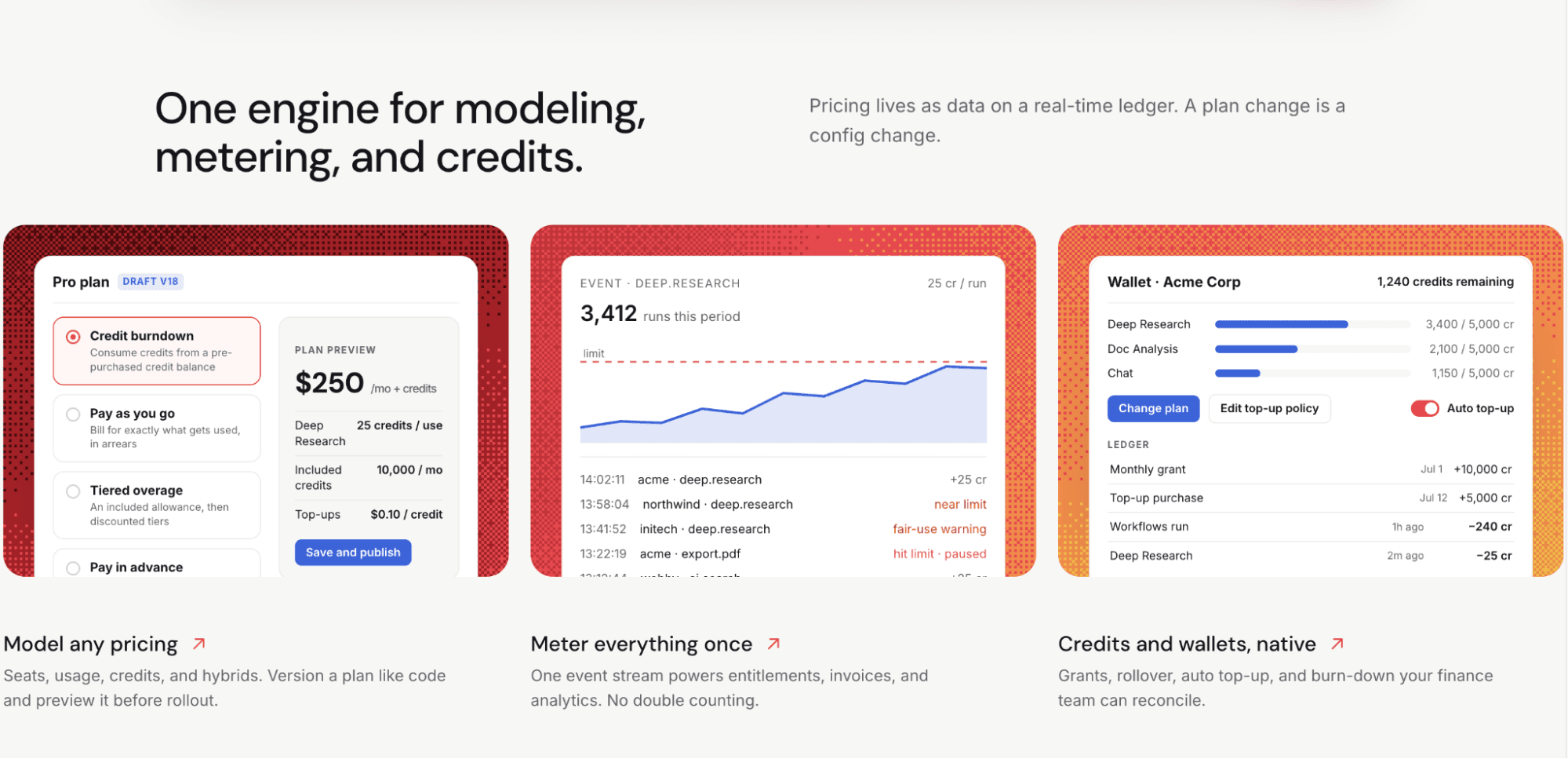
When pricing data lives on a real-time ledger, a plan change only requires configuration instead of hardcoded logic.
Schematic stands out for its real-time entitlement engine and robust enterprise credit wallets. These give enterprise customers usage visibility, spend forecasts, self-service controls, and configurable spending limits.
Usage policies take effect the moment the buyer saves it without forcing commercial teams to file an engineering ticket.
Schematic gives both buyers and sellers confidence that usage will stay within budget. This prevents runaway bills or unexpected access throttling.
FAQs About Usage Billing Software
What software is commonly used for billing?
Popular billing software solutions include Schematic, Stripe, Metronome, Orb, Lago, and Chargebee. These platforms can meter usage events, aggregate usage data, and monetize software products using different pricing models.
What is a usage-based billing platform?
A usage-based billing platform enables SaaS companies to bill customers based on product or service consumption. Instead of charging a flat monthly fee, it tracks usage data, such as API calls, seats, credits, transactions, storage, or compute hours. Then, the platform turns that usage into accurate invoices.
How does usage-based billing work?
Usage-based billing charges customers based on actual consumption inside the product. Usage-based billing software tracks metrics, such as API calls, seats, credits, transactions, or compute hours. Then, the platform applies pricing rules and converts raw usage metrics into billable charges or invoices.
What is the best billing software?
There is no single best billing software. The right option depends on how pricing affects your product. Billing-first tools work when usage only generates invoices. Product-aware systems work when usage needs to control limits or entitlements. Teams should choose based on ownership and required usage-based billing capabilities.