All posts
B2B SaaS Subscription Management as a Product Infrastructure
Blog· Ryan Echternacht·Oct 14, 2026
Ryan Echternacht·Oct 14, 2026
Recurring billing alone does not control your product. Customers upgrade, downgrade, exceed usage, and negotiate exceptions. Your application still needs to decide what happens next.
That decision belongs to B2B SaaS subscription management. It governs how your product enforces access, limits, and entitlements based on subscription plans and real-time customer state.
As SaaS pricing models expand, access control cannot wait for a billing cycle. Usage-based pricing, trials, and sales-led overrides require runtime enforcement inside the product.
Traditional billing solutions handle payments and invoices. Subscription management software focuses on product behavior. It keeps access consistent between self-serve and sales-led flows and protects long-term customer lifetime value.
This article defines B2B SaaS subscription management as a product layer. It stays intentionally separate from billing tools and finance workflows, and focuses on how modern SaaS teams manage access at scale.
TL;DR
- B2B SaaS subscription management is the product layer that enforces feature access, limits, and entitlements at runtime based on plan, usage, and customer state.
- Billing systems handle invoices and payments, but they typically do not control in-product access, trials, credits, or contract exceptions in real time.
- Your subscription logic usually spans the stack: product enforcement for entitlements, billing for charges, and RevOps inputs for contracts and renewals.
- Schematic is the complete monetization platform that combines subscription management and usage-based billing. One engine carries a customer from first checkout to renewal, meters consumption, enforces limits, and gives buyers self-service controls.
What “B2B SaaS Subscription Management” Really Means
B2B SaaS subscription management refers to how your product controls access based on the customer's state. It governs what users can see and use inside the application as plans, usage, and terms change.
In a modern SaaS subscription, access rules cover subscription plans, subscription models, usage limits, trials, add-ons, and exceptions. These rules apply in real time as customer subscriptions move through the subscription lifecycle.
Pricing decisions need to translate into immediate product behavior. When usage reaches a threshold, a trial expires, or a temporary override applies, the product must respond without waiting for the end of a billing cycle.
A dedicated subscription management tool connects subscription data and customer state to in-product enforcement.
This supports hybrid pricing models, typically subscription pricing with usage-based billing, and keeps access consistent throughout the entire subscription lifecycle.
The focus stays on runtime access control and entitlement enforcement, not billing workflows or payment handling.
Subscription Management Lives Inside the Product
Subscription management belongs with product teams because access decisions happen where users interact with the software, not where invoices are processed.
As pricing evolves, your product must react immediately to customer state changes. That includes upgrades, usage limits, trials, overrides, and failed payments, depending on your access policy.
Product-owned subscription management supports:
- Pricing strategies that include hybrid and multiple pricing models, where usage, plans, and exceptions change often
- Consistent access between self-serve and sales-led motions, even with multiple subscriptions per account
- Real-time enforcement that protects customer experience and prevents accidental over-access
- Alignment throughout the entire subscriber lifecycle, from trial to renewal, without manual fixes
- Better customer retention and net revenue retention through predictable access rules
Billing systems are still important for subscription billing, revenue recognition, and payment collection. But effective subscription management ensures the product reflects customer reality at all times.
That clarity supports a predictable revenue stream, higher annual/monthly recurring revenue (ARR/MRR), stronger long-term customer satisfaction, and lower churn rates.
Subscription Management Solutions vs. Billing Systems
Billing systems and subscription management solve different problems inside a subscription business.
A billing system answers what a customer owes. It runs billing processes, handles recurring payments, supports automated invoicing, manages payment gateways, and enforces tax compliance.
It focuses on accurate billing, secure payment processing, and maintaining financial health for global payments and multiple payment methods.
Subscription management answers what a customer can do. It governs access to features, usage limits, trials, and exceptions based on real-time customer state.
A SaaS subscription management platform uses customer data and subscription details to enforce entitlements inside the product, not at the end of a billing cycle.
Both systems are required. Billing supports revenue management, revenue forecasting, and annual recurring revenue tracking.
Subscription management software automates subscription lifecycle management, protects product access, spots churn risk earlier, and helps teams identify at-risk customers before access issues appear.
For SaaS companies running hybrid pricing and selling motions, subscription management is important because product behavior cannot wait for billing systems to catch up.
Where Does Subscription Logic Fit in a Modern SaaS Stack?
Subscription logic sits between your product and your billing infrastructure. Each stack has a clear role, and mixing them creates gaps that show up as access bugs.
- Product stack: This is where plans, software entitlements, limits, trials, and exceptions get enforced. Runtime checks decide access based on usage and the current subscription state. It also protects the customer experience during upgrades, downgrades, and overrides.
- Billing stack: A recurring billing platform handles invoices, direct debit, and payment retries. It supports recurring revenue streams and the underlying model, but it operates on billing cycles rather than in real time.
- CRM and RevOps inputs: Sales and revenue operations manage customer relationships, contract terms, billing schedules, and subscription renewal data. These inputs shape pricing but should not gate access directly.
Access cannot wait for billing cycles. In complex billing scenarios, delayed enforcement leads to confusion, churn, and missed key metrics.
Clear separation keeps a B2B SaaS company predictable, supports self-serve motions, and reduces involuntary churn without blocking teams that need to automate billing and collect payments.
Types of Subscription Models Modern SaaS Products Support
Modern SaaS products rarely rely on a single subscription model. Access logic needs to support multiple models at the same time as pricing and go-to-market strategies change.
Common subscription models your product may need to enforce include:
- Flat plans: A fixed set of features and limits tied to a plan. Access rules must remain consistent as plans change or expand.
- Seat-based access: Feature availability and limits depend on active users or roles. Access should update as seats are added or removed.
- Usage-based pricing: Access changes when customers reach usage thresholds. Limits, overages, and metered paywalls must apply at runtime.
- Credits and overage pricing: Customers consume credits through features or actions. Access depends on the remaining balance and reset periods.
- Tiered pricing: Buyers choose from multiple pricing tiers, with each one having a different set of features, limits, and add-ons.
- Hybrid models: Plans combine base access with usage limits, add-ons, trials, and sales-led exceptions. According to the State of Go-To-Market 2026 report, 48% of B2B software companies use hybrid pricing models.
These models shape how access decisions work inside the product. Good subscription management software can enforce them in real time without relying on billing cycles to catch up.
Managing Subscription State Throughout the Customer Lifecycle
Subscription management is not a one-time setup. Instead, subscription management covers the entire customer lifecycle and responds to changes as they happen inside your product.
When a customer upgrades or downgrades, access needs to be updated immediately. When usage crosses a threshold, limits must apply without waiting for a billing event. Trial pricing needs clear start and end points, and expirations should remove access at the right moment.
Overrides and exceptions add another challenge. Sales-led deals often include temporary access, custom limits, or a tiered discount. Your product needs to respect those rules without manual fixes.
Mid-cycle changes are especially sensitive because they affect existing customers and active workflows.
Clear state management delivers key benefits for product, engineering, and RevOps teams. Engineering avoids brittle logic. Product keeps access predictable. RevOps relies on accurate subscription analytics to guide decisions. Support teams improve customer communication by trusting what the product enforces.
When handled well, the subscription state stays aligned with real usage, protects predictable cash flow, and keeps payment details from driving access decisions inside the product.
How Modern Teams Approach B2B SaaS Subscription Management
Most teams land on B2B SaaS subscription management through one of three approaches. Each reflects how much subscription logic lives inside the product versus outside it.
Billing-First Subscription Management
In this model, teams rely on a billing platform to manage SaaS subscriptions efficiently. Access changes follow the billing cycle, not real usage or contract state.
This approach works for simple subscription models, but it struggles with usage limits, mid-cycle changes, and sales-led exceptions for custom contracts.
Product access often lags behind billing updates, which creates gaps between what customers pay for and what they can use.
Feature-Flag-Driven Access Control
Some teams use feature flags to gate product access by plan or account. This adds short-term flexibility, especially during launches or experiments.
Over time, access rules spread through code paths, flags, and overrides. Usage tracking, trials, and upgrades become harder to reason about as pricing models change.
Feature flags were built for software releases, not long-term SaaS subscription management.
Entitlement-Driven Product Control
Entitlement-driven teams define access rules explicitly.
Plans, limits, trials, and exceptions live as entitlements and are enforced at runtime using live subscription billing data. This approach keeps access consistent between self-serve and sales-led flows.
As products scale, teams move toward this model to support effective subscription management without scattering logic across the stack.
When Should You Consider a Comprehensive Subscription Management Platform?
You should consider a dedicated subscription system when access logic no longer fits cleanly inside billing systems or custom code.
This usually happens as pricing and selling motions expand. Usage-based pricing introduces limits that must apply in real time. Trials and credits need clear start and end dates. Sales-led deals add overrides that traditional billing platforms cannot enforce inside the product. Selling to international customers requires global payment orchestration and automated tax compliance.
You may also notice declining subscription performance and growing friction across teams. Engineering spends time maintaining access rules instead of shipping features. Product cannot change plans or limits without code updates. RevOps relies on manual fixes to keep customer access aligned with contract terms.
At this stage, subscription logic becomes shared infrastructure. It needs to sit close to the product, evaluate the state as it changes, and enforce access at runtime.
The goal is not to replace billing infrastructure, but to separate payment processors from product behavior and entitlement enforcement. This way, access reflects customer reality at all times.
Schematic Combines Subscription Management and Usage-Based Billing
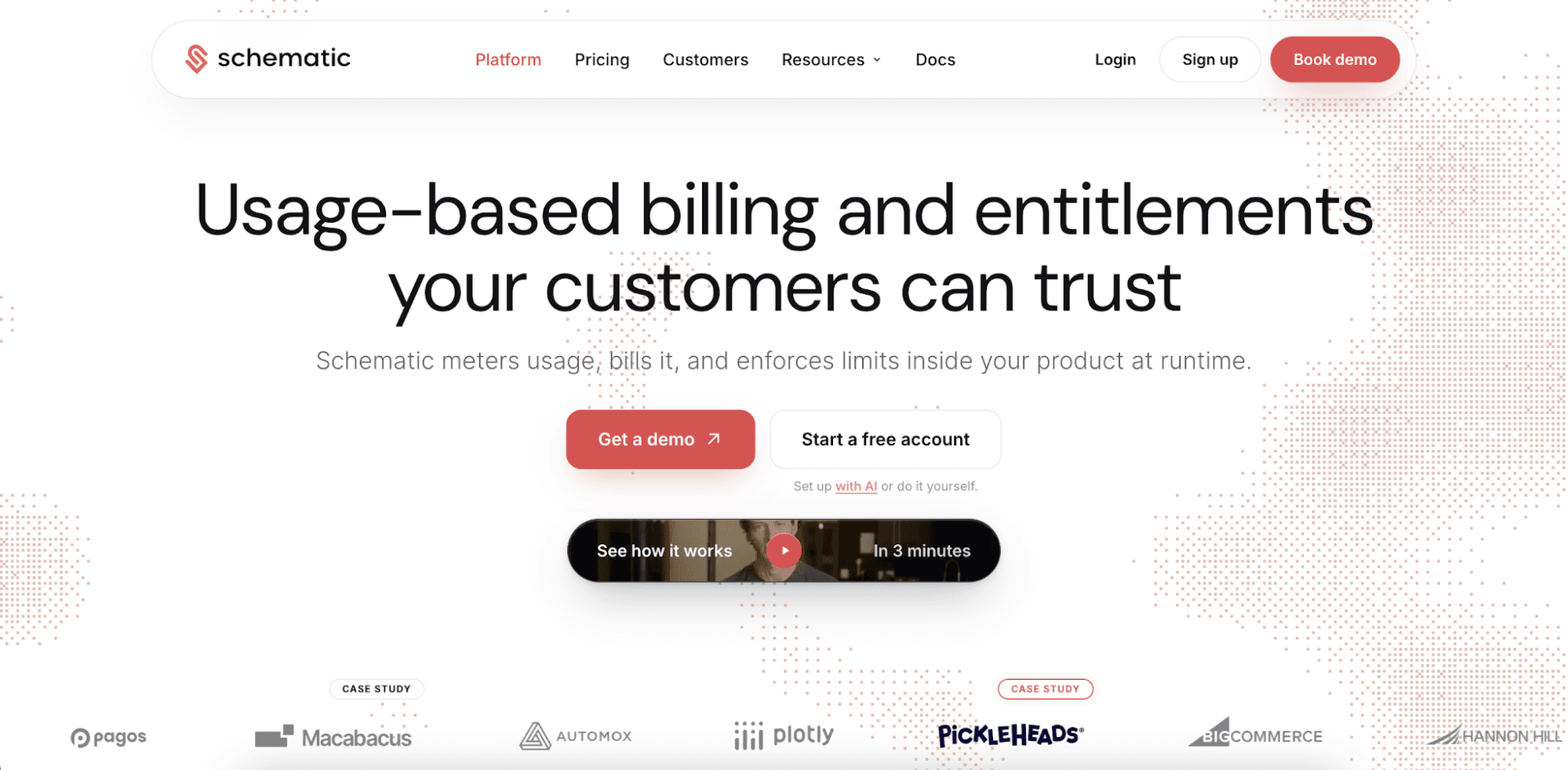
Schematic is the complete monetization platform that helps software companies manage subscriptions and launch usage-based billing that enterprise buyers can trust.
One engine handles the entire customer lifecycle from checkout through plan renewal. The same engine supports modeling, metering, credits, and SaaS entitlements. That makes it easier to support any pricing model, version plans, migrate customers, and simulate changes before full implementation.
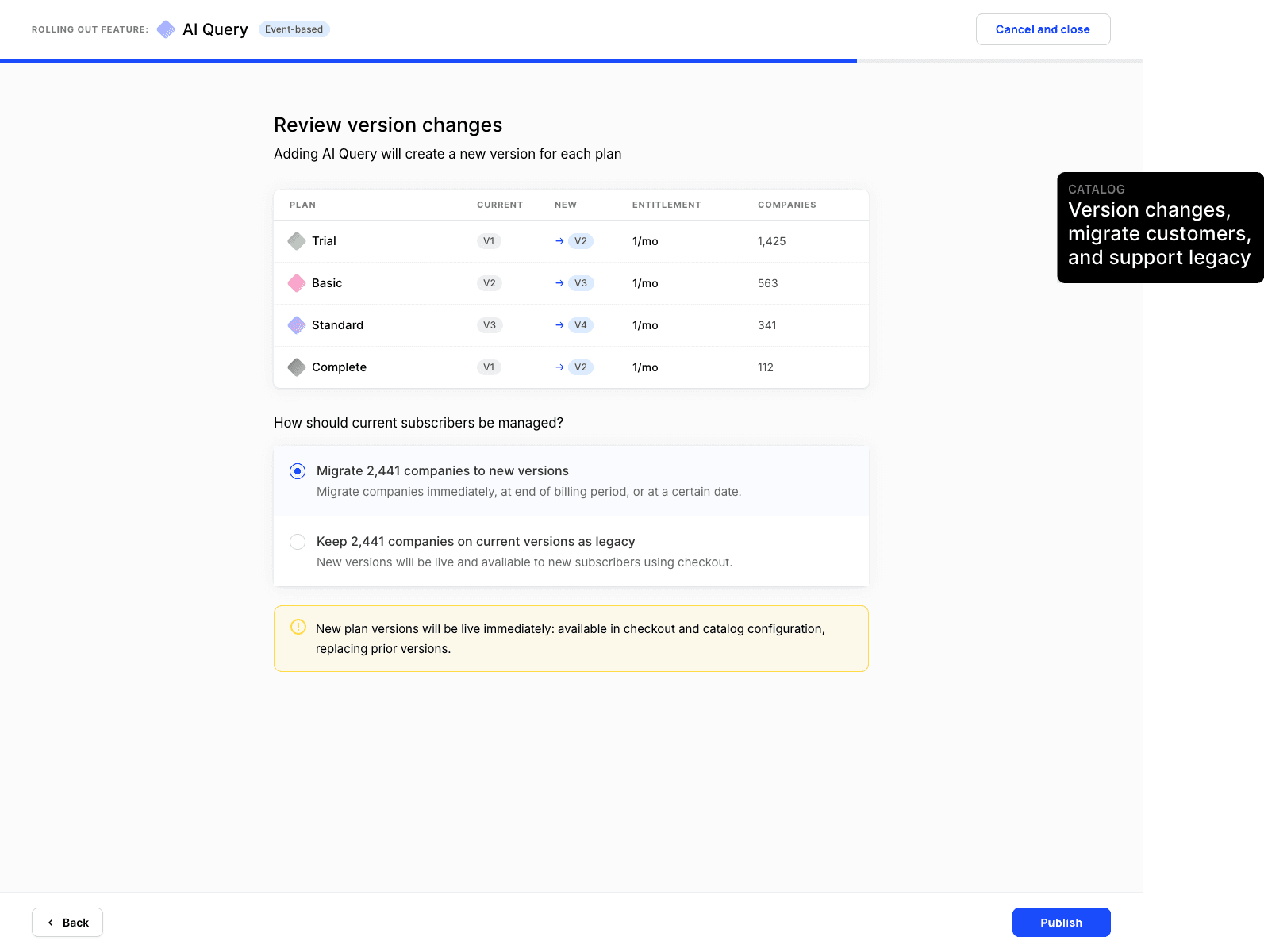
With Schematic, pricing lives as data on a real-time ledger. Changing plans and packaging can happen through configuration instead of a code deployment. Commercial teams, not engineering, can own monetization and iterate frequently on pricing.
Max Ade from Pickleheads shares, "With Schematic, pricing changes and experiments are really easy to execute, and we iterated on our pricing model in the first week after launch."
Schematic also includes native credit wallets that give enterprise customers real-time visibility and control over their consumption. Buyers can set spending caps, configure auto top-ups, and decide what happens at the limit.
The runtime entitlement engine applies the policy as soon as your team or your customer saves the settings. A single flag check works in React, Node, Python, and Go so that the user interface and the API always agree.
FAQs About B2B SaaS Subscription Management
What is the difference between B2B and B2C subscription management?
B2B subscription management focuses on account-level access, contracts, usage limits, and exceptions between teams. It must support sales-led deals, custom plans, trials, and mid-cycle changes enforced inside the product. B2C subscription management typically focuses on individual users, simpler plans, and standardized billing cycles with fewer exceptions.
Which subscription model is best for a SaaS business?
There is no single best subscription model for all SaaS businesses. The right model depends on how customers use your product, how value is measured, and whether you sell self-serve, sales-led, or both. Most modern SaaS products use hybrid models that combine tiered plans, usage, credits, or add-ons and require real-time access enforcement inside the product.
Do I need subscription management if I already use a billing platform?
Yes, you need a subscription management system if your product needs to enforce access based on plans, usage, trials, or exceptions in real time. Billing platforms manage invoices and payments, but they do not control feature access or usage limits inside the application. Subscription software bridges that gap by connecting customer state to in-product access decisions.