All posts
Billing Infrastructure Explained for Fast-Growing Companies
Blog· Ryan Echternacht·Sep 1, 2026
Ryan Echternacht·Sep 1, 2026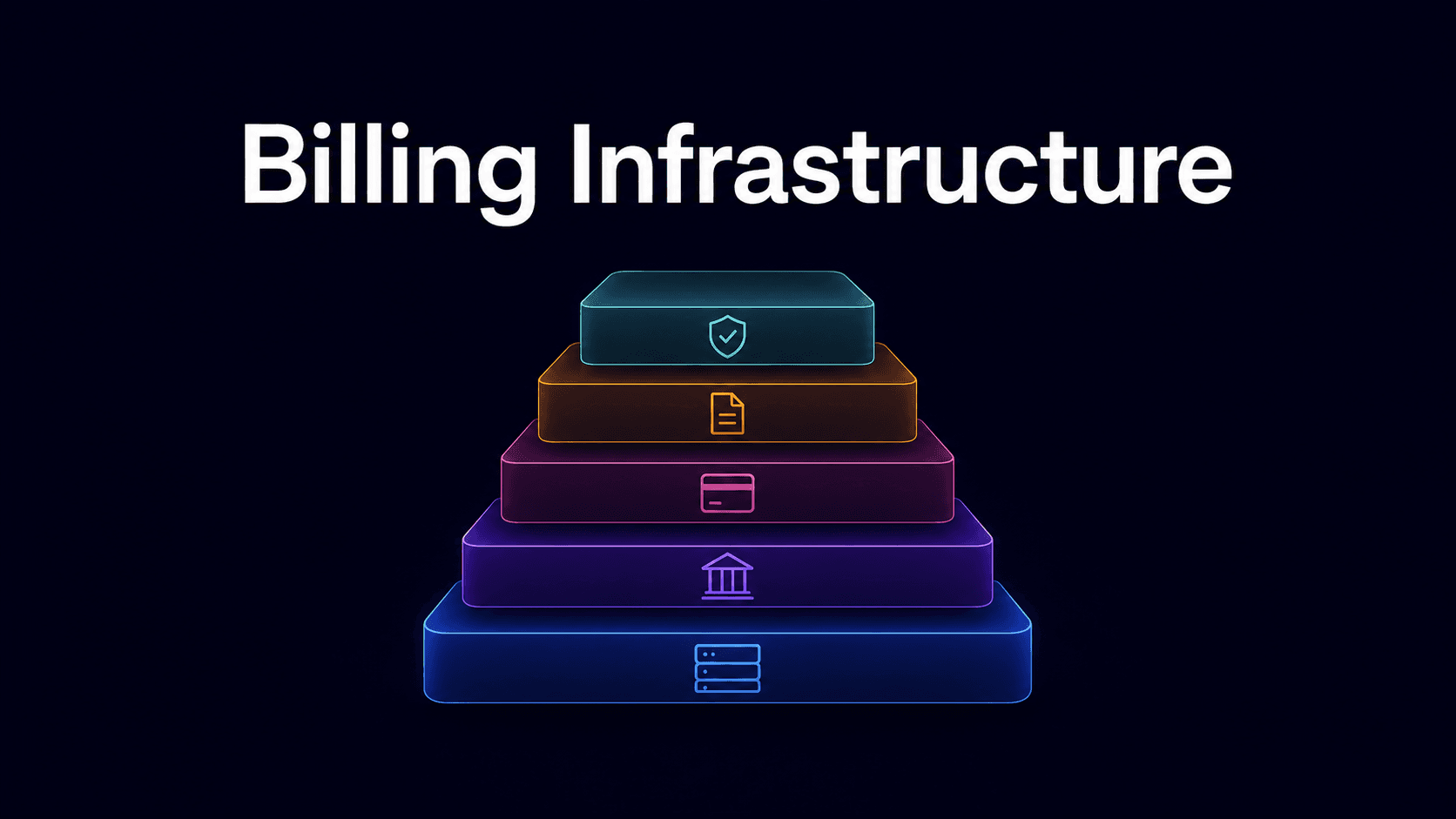
Billing infrastructure refers to a set of systems that turns pricing plans into accurate invoices and collected revenue. Think of it as the engine that makes it possible for SaaS and AI companies to charge customers.
A payment solution is just one part of that tech stack, which handles payment processing. Organizations need separate systems for metered billing, subscription management, revenue reporting, and entitlement management.
Many teams end up building these systems on their own. That works when pricing is simple. However, as software monetization becomes hybrid and complex, buying commercial solutions is worth considering.
This article discusses billing infrastructure, why it breaks at scale, and how a flexible architecture solves the problem.
TL;DR
- Billing infrastructure is the system that connects product usage, pricing, invoicing, payments, and finance records so that companies can bill customers correctly.
- It often breaks at scale because of hardcoded billing logic, fragmented data, grandfathered pricing, and complex monetization scenarios.
- Flexible billing infrastructure helps SaaS and AI companies support different pricing models, reduce manual work, launch pricing changes faster, and scale operations efficiently.
- Core components of this system include a product catalog, usage metering, rating engine, entitlements, payment processing, subscription management, revenue recognition, and integrations.
- Schematic offers a complete billing platform for companies that want to sell usage-based plans, meter credits, manage entitlements, enforce limits, and give customers real-time visibility into consumption.
What Is Billing Infrastructure?
Billing infrastructure is the complete system that connects pricing, real-time metering, invoicing, payment data, and revenue accounting. It turns subscription plans and customer activity into billable totals.
Billing infrastructure helps AI and SaaS companies implement monetization so that they can generate revenue from their product.
The system handles five main tasks:
- Subscription and usage tracking: Manage a customer's subscription plan and track how much they consume (e.g., API calls, tokens, prepaid credits).
- Rating: Convert raw usage data into billable charges and apply specific pricing rules depending on contract terms and exceptions.
- Invoice generation: Create invoices and send charges to payment processors.
- Payment processing: Collect digital payments and charge cards automatically each billing cycle.
- Compliance and revenue recognition: Aggregate transaction data for financial reporting and revenue recognition.
Why Billing Infrastructure Breaks at Scale
Traditional billing infrastructure usually works for the first pricing model. The system only needs to handle a few plans, Stripe integration, some tables to track subscriptions, and middleware to grant software access.
However, that existing platform breaks when subscription businesses add new tiers, implement usage-based pricing, launch pricing experiments, and expand into new markets.
The infrastructure cannot handle all these changes due to the following reasons.
Hardcoded Pricing and Billing Logic
Many early-stage SaaS companies put billing and pricing logic directly into product code. This works when pricing stays simple. But it becomes a problem when the organization adds custom plans, discounts, credit-based pricing, and enterprise contract terms.
A small pricing update may require an engineering sprint that involves code changes, testing, deployment, and checks for billing errors.
Product, sales, and finance teams cannot make changes on their own. They often need to file an engineering ticket to provision an overage exception for a strategic account, launch trial pricing, and adjust usage limits. This setup significantly affects pricing agility because every update depends on developers.
Old rules also remain buried in the codebase long after plans change. As exceptions grow, teams spend more time fixing billing issues and maintaining the system. That creates more operational overhead and slows down pricing experiments.
Fragmented Billing Data
Billing data is often stored in several systems that are disconnected from one another.
The customer relationship management (CRM) software usually stores enterprise contract terms. The product catalog keeps SKUs, plans, and their associated software entitlements. Meanwhile, the billing system records subscriptions, preferred payment methods, and billing schedules.
Problems start when those systems show different information. A customer is assigned one price in the CRM software but another price in the SaaS billing solution.
Companies often try to fix these gaps through spreadsheets and manual reconciliation. That process is slow and can lead to missed charges or incorrect invoices.
Without one platform or a connected source of billing data, teams may struggle to know which record is correct when systems disagree.
Grandfathered Plans
Every pricing change can introduce a new customer cohort.
Customers often stay on their old plan because keeping their original terms seems fair and avoids forcing a sudden price change.
However, these plans accumulate over time and lead to billing complexity. Engineering teams usually need to write custom code that accounts for different prices, limits, features, discounts, and renewal rules for each group.
This makes it difficult to ship new pricing changes because teams must carefully check how each update affects older plans.
It can also limit revenue growth and leave money on the table. Users keep paying the old rate even when the product delivers much more customer value.
For growing subscription businesses, too many grandfathered plans can turn a simple billing setup into a long list of exceptions that developers must maintain.
Hybrid Monetization Complexity
Hybrid monetization combines more than two pricing models (e.g., a base subscription plus usage-based pricing) and selling motions (e.g., self-serve and sales-led).
Early-stage companies often start with simple self-serve plans. Customers choose a plan, pay using their preferred payment method, and start using the product without talking to sales.
When the business attracts enterprise buyers, it may layer a sales-led motion on top of product-led go-to-market strategies. Sales teams usually create custom plans, negotiate rates, provide discounts, grant prepaid credits as part of a plan, and offer add-ons.
AI products introduce another layer of complexity. Teams often build outcome-based pricing for autonomous agents, where customers only pay when the AI has delivered successful outcomes. Credit burndown is another popular choice for pricing AI agents because it offers cost predictability.
Traditional billing infrastructure often fails to support standard plans, custom deals, and complex monetization models at the same time.
The Importance of Flexible Billing Infrastructure
Modern systems give SaaS and AI companies the flexibility to change pricing and billing logic through configuration instead of code. Here are the reasons why flexible billing infrastructure matters.
Support Multiple Pricing Models
Fast-growing companies often use more than one pricing model to charge different customers. They usually combine SaaS subscriptions with usage-based components, prepaid credits, or outcome-based charges.
Legacy infrastructure can only support one model well. That's why businesses need a flexible billing system that can implement hybrid models.
Pricing flexibility gives product and RevOps more options when testing how customers should pay. Teams can introduce new pricing models without rebuilding their billing setup.
Reduce Manual Work
Flexible billing infrastructure moves billing logic out of application code and spreadsheets.
Instead, commercial teams manage them through configurable systems that are easier to update. Sales, product, finance, and RevOps managers have direct control over pricing and packaging.
Meanwhile, engineers stop writing billing code for every new plan, tier, or discount. They can focus on core product development.
Modern systems also reduce manual handoffs because everything is stored in one place. Teams can see the same billable events and generate accurate invoices. The finance department spends less time correcting wrong charges or fixing missing data.
Launch New Pricing Changes Faster
Fast-growing companies are updating their pricing more often than many billing systems can support. According to Growth Unhinged, more than 1,800 pricing changes were made in 2025, which is roughly 3.6 per company.
Teams need flexible billing infrastructure to keep up with other businesses frequently iterating on monetization.
A flexible system stores billing logic in configurable platforms. That means the people closest to the customer relationship, not engineering, have full control over pricing.
Sales reps, customer success teams, and product managers can quickly launch new pricing changes without waiting on developers. They can combine subscriptions with AI credits, offer volume discounts, and enable overage pricing for accounts that often exceed plan limits.
Scale Operations Efficiently
As SaaS and AI companies grow, billing ends up supporting thousands of customers, several regions, and multiple payment methods.
Traditional billing systems may work for 100 accounts. But they aren't built to handle 10,000 customers, each one with custom terms, usage limits, add-ons, and exceptions.
Flexible billing infrastructure can adapt to larger customer bases, higher purchase volumes, multi-currency transactions, and country-specific billing rules. It can also support different tax, invoicing, and compliance needs as companies expand into new markets.
Business operations can scale efficiently even when billing becomes more complex. Companies can manage more accounts and regions without adding operational overhead.
Key Components of Flexible Billing Infrastructure
Flexible billing infrastructure is made up of several connected systems. Each handles a different part of the billing process, from defining products and measuring usage to collecting payments and recording revenue.
1. Product Catalog
The product catalog defines what a company sells and how each offer is packaged. These products are also called SKUs, plans, tiers, or add-ons.
The catalog stores important details, such as product names, prices, billing schedules, included features, usage limits, and pricing rules. It can also hold different versions of a plan when a company changes its offers over time.
For SaaS and AI companies, the product catalog acts as a central source for billing configuration. When a new plan or add-on launches, teams can update the catalog rather than hardcoding those details into the product.
2. Usage Metering
Usage metering tracks how much of a product, feature, or service each customer consumes. It is a core part of usage-based billing.
Metering works by collecting raw usage events, connecting them to the correct customer, and grouping them for billing. That usage data can then be transferred to the rating engine to calculate charges.
Metered usage in AI products might include credits, tokens, API calls, compute hours, or completed tasks. A SaaS company, on the other hand, might track seats, transactions, storage, or monthly active users.
3. Rating Engine
A rating engine turns measured usage into billable charges. It applies the pricing rules linked to a customer’s plan or contract.
Those rules may include per-unit rates, volume tiers, included allowances, minimum commitments, discounts, or overage fees.
For example, an AI company may sell a subscription plan with a set number of tokens each month. If the customer exceeds the limit, the vendor charges a different rate per unit.
A rating engine can also help software companies connect pricing to the real costs of delivering a service. This is useful when compute or model usage changes based on customer behavior.
4. Software Entitlements
SaaS entitlements are the missing infrastructure between billing and product. They define which features, limits, or services a customer can access based on their plan or contract terms.
For example, a customer on the Free tier can only use limited features. Meanwhile, Pro subscribers have access to more capabilities, higher usage limits, and additional services.
When a customer upgrades, downgrades, or changes contracts, the entitlement system updates what that account can use. This keeps product access tied to billing terms without forcing developers to build separate access rules for every plan.
5. Payment Processing
Payment processing handles the movement of money after calculating the bill and generating an invoice.
Billing infrastructure sends the amount owed to a payment gateway, which then works with acquiring banks, card networks, and other payment services to complete the transaction.
A flexible setup may support cards, bank transfers, and digital wallets. It can also handle multiple currencies, allowing SaaS companies to sell in different countries.
Payment gateways may also run security checks that help identify potential fraud before approving a transaction. They return payment status information to the billing system. Teams can then track successful charges, failed payments, refunds, and payment retries.
6. Subscription Management
Subscription management controls the billing events tied to recurring plans. It tracks when subscriptions start, renew, change, pause, or end.
One of its main jobs is handling proration. If a customer upgrades halfway through a monthly billing period, the subscription management platform calculates the unused value of the old plan and charges users for the new plan. The same logic applies to downgrades and other mid-cycle changes.
Subscription businesses can handle recurring billing without calculating charges by hand.
7. Revenue Recognition
Revenue recognition controls when to record billed revenue in financial statements. The timing may differ from when a customer receives an invoice or makes a payment.
For example, an annual subscription may be paid upfront, while the related revenue is recorded over the service period (12 months in this case).
Revenue recognition systems can create schedules that help finance teams apply the correct timing.
For SaaS companies following ASC 606 and IFRS 15, flexible billing infrastructure can automate parts of the revenue process and reduce manual reconciliation.
It also stores records of adjustments, contract changes, and audit trails that finance teams can review when closing the books or preparing for an audit.
8. Integrations With Existing Stack
Billing infrastructure rarely works by itself. It needs to exchange real-time data with the systems that SaaS and AI companies already use.
Look for integration with CRM software, enterprise resource planning (ERP) systems, data warehouses, accounting software, and tax management tools.
Native integrations reduce manual data entry and keep billing records in sync automatically.
Should You Build or Buy Billing Infrastructure?
Fast-growing companies eventually reach a point where billing infrastructure can no longer keep pace. At that stage, the build-versus-buy decision becomes urgent because pricing changes start affecting product launches, sales deals, and daily operations.
When Building Infrastructure Makes Sense
Most early-stage companies build billing infrastructure themselves because the first version is simple. They only need a few database tables, feature flags, and middleware to provision access. This setup usually takes a week to finish.
The problem appears later on. As pricing becomes more complex and the customer base grows, that same system can turn into a full internal product. What once took a week to build can turn into a long-term engineering responsibility.
The real cost goes beyond engineering hours. Every sprint spent fixing billing is a sprint not spent building product features customers expect.
Building in-house still makes sense in specific situations, such as:
- Your monetization model is highly unique.
- Billing is part of your core product.
- You have billing experts, not engineers forced to write billing code.
- A dedicated team can own monetization systems in the long term.
When to Buy Billing Infrastructure Instead
Buying billing infrastructure is the better choice for a company that needs advanced billing features but does not want engineering to own the full system.
As mentioned, building internally takes a large amount of engineering time. It also creates ongoing work around pricing changes, usage tracking, invoices, payments, tax management, and revenue recognition.
Most SaaS and AI companies do not want to spend years maintaining infrastructure that does not directly improve the product customers buy. A dedicated billing platform can handle much of that work instead.
Buying billing infrastructure suits the following scenarios:
- Pricing changes often.
- Usage-based billing is growing.
- Enterprise contracts are becoming common.
- Finance relies too much on manual reconciliation.
- Engineering spends too much time on billing.
- The company is expanding into international markets.
Schematic Provides the Complete Billing Infrastructure
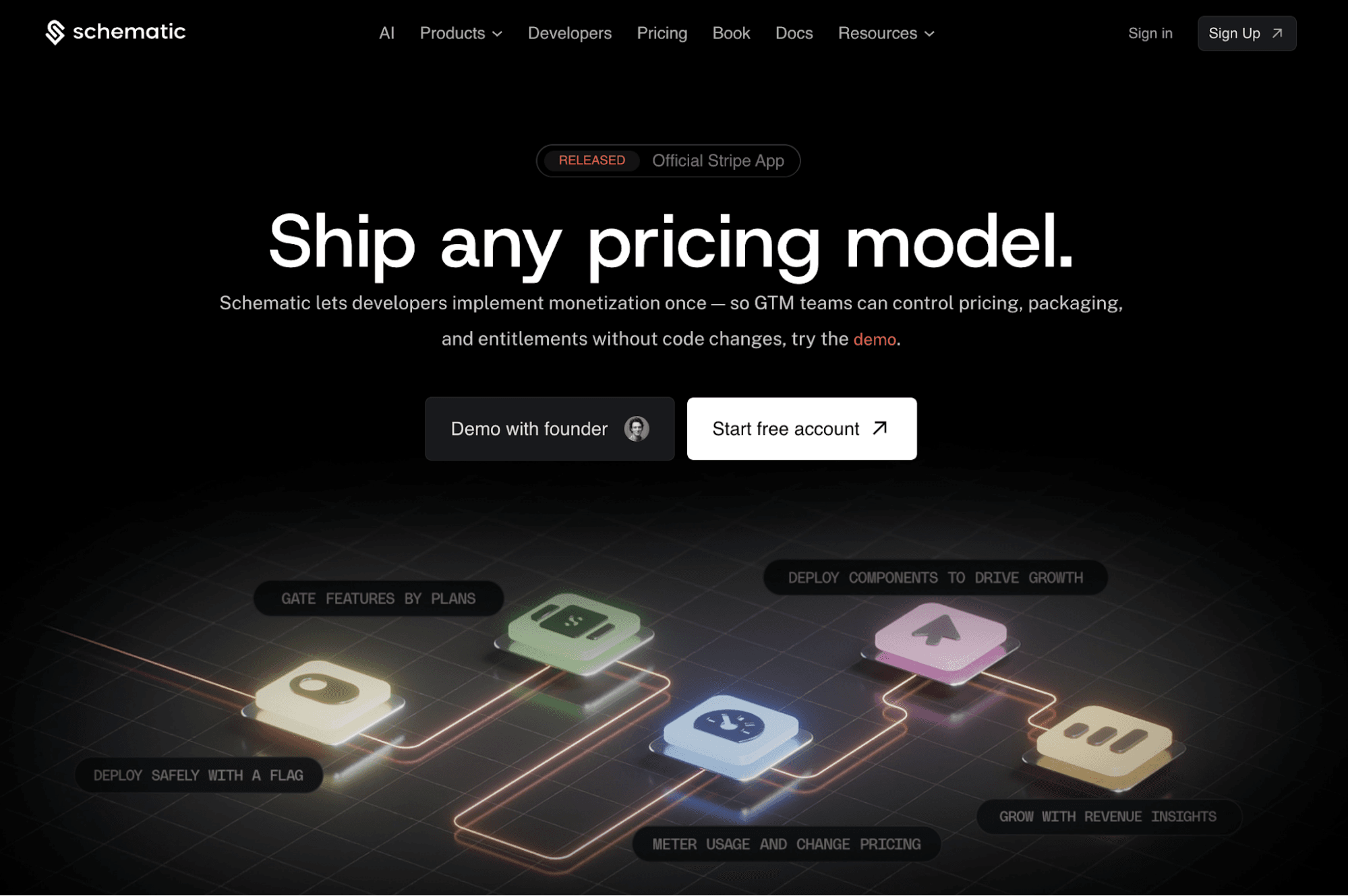
Schematic is an all-in-one billing platform for software and AI companies that want to close enterprise accounts. It serves as the system of record for the product catalog.
Commercial teams can create and manage custom plans, limits, trials, credits, add-ons, and exceptions without code changes.
Schematic also offers a metering engine, an auditable credit ledger, software entitlements, plan versioning, customer management, and real-time event logs. Meanwhile, payment processing is handled through the built-in Stripe integration.
This billing infrastructure makes usage-based pricing easier for enterprise buyers to trust. Customers can set per-seat and per-agent limits and control auto top-up rules to ensure usage will stay within budget. They can even choose what happens when they reach a limit, such as receiving a warning, stopping usage, or allowing overages.
FAQs About Billing Infrastructure
What are the three types of billing?
Three common billing models are subscription, usage-based, and hybrid. Subscription plans bill customers a fixed recurring fee for software access, while usage-based billing charges customers based on actual consumption. Hybrid billing combines both in one pricing structure.
What is usage-based billing infrastructure?
Usage-based billing infrastructure tracks raw usage events, translates them into organized records, and applies specific pricing rules in order to calculate billable totals. Companies can build this system internally or buy commercial solutions to reduce engineering work when pricing needs to constantly change.
What is a billing structure?
A billing structure defines how a company charges customers. It sets the pricing model, billing cycle, rates, usage rules, discounts, and other terms used to generate invoices. SaaS billing structures can support subscriptions, usage-based fees, or a combination of both.
Is payment infrastructure different from billing infrastructure?
Yes. Billing infrastructure decides what a customer owes, when to charge them, and how to create the invoice. Modern payment infrastructure handles the actual transfer of funds through payment gateways, banks, card networks, and other payment methods.