All posts
How to Launch Usage-Based Pricing: A Guide for SaaS Teams
Blog· Ryan Echternacht·Jul 29, 2026
Ryan Echternacht·Jul 29, 2026
Many SaaS companies are moving from flat-fee subscriptions towards usage-based pricing (UBP). This model allows customers to pay for the value they receive, rather than paying the same amount to access the product.
That shift affects more than billing and invoicing processes. It also changes how teams think about SaaS pricing and packaging, access enforcement, and sales motions.
Launching usage-based pricing is not as simple as updating your pricing page. You need the right usage metric, pricing model, metering, billing, integrations, and rollout plan.
This guide explains how to launch usage-based pricing step by step. You'll also learn what you need for a successful implementation, common problems to avoid, and the key metrics to track after launch.
TL;DR
- To launch usage-based pricing, start by choosing a value metric and pricing model that match how customers get value from your product.
- It's important to build reliable usage metering, integrate your billing software with payment processors, and set guardrails.
- Develop a migration plan before launch. Migrate new customers first, offer opt-in for existing accounts, communicate the change clearly, and monitor performance.
- You need metering, a rating engine, a product catalog, a billing system, an entitlement management platform, and customer dashboards when implementing UBP.
- Schematic helps SaaS companies launch usage-based pricing without rebuilding their entire billing infrastructure.
How to Launch Usage-Based Pricing in 8 Steps
Below are the key steps to follow when implementing usage-based pricing.
1. Choose the Right Value Metrics
A value metric is the unit of measurement that determines what customers pay for. Common examples include seats, API calls, tokens, AI credits, transactions processed, summaries generated, and monthly active users (MAUs).
A 2026 SaaS and AI pricing report reveals that 59% of software companies use more than one metric. This allows pricing to be more closely aligned with the value your product delivers.
When choosing value metrics, make sure they have the following properties:
- Scalable: The metric should scale with customer value and increase revenue as customer usage grows. For example, an account that uses 500 monthly credits pays more than an account that burns through 20 credits.
- Measurable: You can give customers a clear breakdown of how their charges are calculated.
- Clear: Users can estimate their bill without asking for extra details before signing up.
Avoid metrics that are confusing, hard to track, or disconnected from the value customers perceive, as these can create friction and mistrust. You should also steer clear of metrics that fluctuate unpredictably or are outside the customer’s control.
Instead, stick with predictable metrics. This makes your usage-based pricing structure easier to understand for both your team and your customers.
2. Select a Usage-Based Pricing Model
The next step involves determining how to charge customers for your chosen value metric.
Many software companies adopt usage-based models that reflect operational costs while still offering flexibility to meet diverse customer needs.
Here are the most popular SaaS usage-based pricing models you can implement.
- Pay-as-you-go: Customers pay based on actual consumption, with no upfront costs. Pay-as-you-go pricing works well when you have a single metric that captures value.
- Credit burndown: Customers purchase credits in advance, then spend them as they use the product over time. Credits can represent tokens, compute time, AI prompts, or other units. This model is best when you have multiple billable actions or model tiers.
- Subscription tiers with included usage: This is a hybrid model that combines a fixed subscription fee with a set amount of included usage. Customers can predict baseline costs, while SaaS companies benefit from more stable recurring revenue.
- Overage pricing: Customers who exceed their included usage limits pay an additional fee for the extra consumption. Overages support usage-based expansion without requiring plan upgrades or sales intervention.
3. Outsource Usage Metering
Metering is the foundation of usage-based billing. Teams can only charge the right amount if actual product usage is measured correctly.
SaaS companies usually approach this by writing custom code to log activity, storing usage data in a separate service, reconciling usage against active subscriptions, and manually syncing pricing logic between systems.
However, it takes weeks to build a reliable usage metering infrastructure and even longer to troubleshoot as customer usage grows.
Instead of building everything in-house, consider outsourcing metering by using a dedicated usage billing system.
Look for a platform that can map usage-based features to a metered product, ingest usage at scale, and automatically sync billable events to your payment solution.
It helps reduce engineering burden and improve billing accuracy, especially when dealing with complex or high-volume usage data.
4. Integrate With Payment Processors and Other Existing Systems
Make sure your usage billing system can connect to the tools your team already uses. This step is important because usage-based pricing affects invoices, payments, subscription management, revenue recognition, and account access.
Check if the software can integrate with your payment processor, customer relationship management (CRM) system, data warehouse, and accounting tools. These connections allow different teams to work from the same usage and billing data, which significantly reduces manual data entry.
5. Set Customer Guardrails
Usage-based pricing can feel risky when users cannot see their actual usage or predict how much they will pay at the end of the billing period.
Provide spending caps, usage alerts, and in-product usage dashboards to help customers stay in control. Spending caps can prevent surprise invoices, while alerts warn them before they reach a limit. Dashboards show how much they have used in the current billing cycle.
These guardrails are also useful because customers may have different usage patterns. Some use the product daily, while others have usage spikes during busy periods.
For example, a team might rely on your product heavily during a product launch or seasonal campaign, then scale back afterward. Without real-time visibility and limits, these fluctuations can lead to unexpected costs that reduce trust.
By providing flexible controls, you give customers the confidence to use your product when they need it most without worrying about runaway spending.
Over time, this transparency helps customers better understand their own usage trends and plan their budgets more effectively, which can improve customer satisfaction.
6. Develop a Launch Migration Plan
This next step applies when you are switching an existing product to usage-based pricing, not when you are launching consumption-based pricing for an entirely new product.
The order of migration is important because different accounts carry varying risk levels.
Start with new customers, so usage-based SaaS pricing is the default from day one. Then, migrate existing customers who choose to opt in because they want more pricing flexibility.
After that, roll out pricing changes by segment based on contract type, subscription plan, and account size.
Move your highest-risk accounts last, such as enterprise customers on annual contracts. Keep them on their current software entitlements and subscription pricing for now. Once the contract ends, you can decide to migrate them or continue honoring their existing pricing.
7. Communicate Pricing Changes With Customers
Most buyers are cautious about pricing changes. They want to know why it is happening, how it affects them, and whether it will provide a better experience.
Prepare an announcement email that explains the new usage-based pricing model, the rollout timeline, and actions customers need to take.
Next, update your pricing page so it clearly reflects the new plans and usage rules. Include a frequently asked question (FAQ) section that addresses customer concerns.
Then, create a script that customer success teams and sales reps can use to handle objections related to the new pricing structure.
If you have sales-negotiated contracts, review those agreements carefully to confirm how and when to introduce pricing changes.
8. Roll Out and Monitor Performance
The final step involves launching the new usage-based pricing model in phases.
Start with a small group of accounts, review the results, then expand to more customers when feedback is positive.
Track how the pricing rollout affects revenue, usage trends, upgrades, downgrades, customer retention, and churn.
Product, finance, engineering, sales, and customer success teams should review the data together. If customers are confused or dropping off, use a different value metric, explain the change clearly, and address any objections.
Usage-based pricing strategies should improve over time based on actual customer behavior, not guesses made before launch.
Checklist for Launching Usage-Based Pricing
Here are the main components you need for reliable usage-based pricing.
Metering and Event Ingestion
Metering and event ingestion collect product usage as it happens. These systems record events such as API calls, credits spent, transactions processed, seats added, or tokens used.
Since the product can generate millions of billable events every second, the metering pipeline should scale efficiently. Make sure it can process events exactly once and aggregate usage metrics (e.g., treating each API call as a single unit) without losing data.
Rating Engine
A rating engine turns raw usage into billable charges. It applies pricing rules to each customer’s usage, then calculates what the customer should owe for that billing period.
Rating can take three common forms:
- Per-unit pricing: The customer pays the same price for each unit used, such as $0.01 per API call or $0.10 per image generation.
- Tiered pricing: Pricing varies based on the usage tier a customer falls into. For example, processing 1k-10k events has one price ($0.002/event), while 10k-50k events have another ($0.0015/event). It supports volume discounts.
- Graduated pricing: Each block of usage is billed at its own rate. Higher rates apply only to the units within each block, not to all usage.
Choose the rating model that fits how value grows in your product. For example, use a per-unit rate to keep billing simple. Consider tiered or graduated pricing when you want volume discounts to support expansion.
Product Catalog
A product catalog stores your company's products, also known as SKUs or plans, and their associated features. It tells your billing system what it can sell and how much to charge for each item.
For usage-based pricing, the product catalog should connect each plan to its included usage limits, prepaid credits, and feature access. It keeps pricing rules in one place instead of spreading them across your application code, CRM software, and spreadsheets.
Billing Platform
The billing platform generates invoices, applies pricing rules, collects payments, and manages customer records. It should receive rated usage from your metering and rating systems, then turn that usage into accurate invoices.
Make sure it's flexible enough to handle different usage metrics and implement various SaaS pricing models.
Flexible billing systems should also support both product-led growth and sales-led deals.
Entitlement Management System
An entitlement management system controls what each customer can access based on their plan, current usage, add-ons, and any custom terms. It helps the product know who can use a feature, how much they can use, and when access should change.
In UBP, entitlements help enforce monthly or annual usage caps, include a certain amount of usage in a plan, and support hybrid pricing models (e.g., fixed subscription models with overages).
Customer Usage Dashboard
A usage dashboard shows how much customers have used, what they have left, and what they may owe. This reduces billing disputes and helps customers better plan their future spending.
Dashboards may also include alerting systems and budget controls. These are useful for customers with variable usage patterns, since their costs can change from one billing period to the next.
Challenges When Launching Usage-Based Pricing and Ways to Solve Them
SaaS companies may face several challenges when launching usage-based pricing.
Revenue Unpredictability
Usage-based pricing makes it difficult to predict revenue because customer spending depends on product usage. An account may use more (and thus, spend more) during busy months but use less during slower periods. This creates less stable revenue than fixed pricing.
The solution is to combine subscriptions with usage allowances and overages. The recurring fee from subscription plans introduces predictability, while usage charges can capture upside from power users.
You can also offer prepaid credits to guarantee upfront cash flow and maintain usage flexibility at the same time.
Data Complexity
Usage-based pricing depends on two data sets: product usage data and commercial data. Product data comes from your app. Commercial data refers to plans, accounts, contracts, discounts, and pricing rules.
The challenge is bringing both together in near real time to calculate accurate running totals and invoices.
You can solve this by investing in a billing system that connects your product, CRM, finance tools, and payment processor.
Avoid spreadsheet-based workflows once usage grows. Your system should meter events, apply pricing rules, show current spending, and send accurate charges to billing.
Poor Customer Experiences
Customers can easily lose trust in your SaaS company when they don't understand how actual usage turns into a billable amount.
A monthly invoice is not enough for usage-based pricing. Customers need to see current usage, limits, overages, and likely month-end cost inside the product.
Provide access to clear usage dashboards, set usage caps, and send alerts when consumption is near the limit. Show customers what they used, how each unit was priced, and what they can do next. Doing so reduces surprise charges and billing disputes.
Sales Compensation
Usage-based pricing can break traditional compensation rules in the sales process. Sales reps are used to earning commission when they close a deal.
However, in UBP, revenue often comes in slowly after the customer starts using the product. Paying a large commission upfront can be risky if the customer’s total spend stays low. This creates a mismatch between sales incentives and actual revenue earned.
You can solve this by tying compensation to committed spending, usage thresholds, active consumption, and expansion. Sales teams should still be rewarded for closing deals, but the payout model should reflect when your company receives revenue.
Key Metrics to Measure the Success of Your Usage-Based Pricing Strategy
Below are the metrics to track to see if UBP is helping customers grow while keeping revenue, costs, and support issues under control.
- Net revenue retention (NRR): NRR shows how much revenue you keep and grow from existing accounts after upgrades, downgrades, and churn.
- Expansion revenue: This refers to additional profits earned from current customers as they increase usage, buy add-ons, or move to higher plans.
- Customer acquisition cost (CAC): It calculates how much you spend to win a new customer through sales, marketing, and related go-to-market costs.
- Free-to-paid conversion: It measures how many free users become paying customers after reaching value, usage limits, or upgrade prompts.
- Customer churn rate: This is the share of customers who cancel, downgrade, or stop paying during a set period.
- Number of support tickets: Usage-related support tickets reveal whether customers are confused about usage totals, overages, alerts, limits, dashboards, or unexpected charges.
Schematic Implements Usage-Based Pricing Without Hardcoded Logic
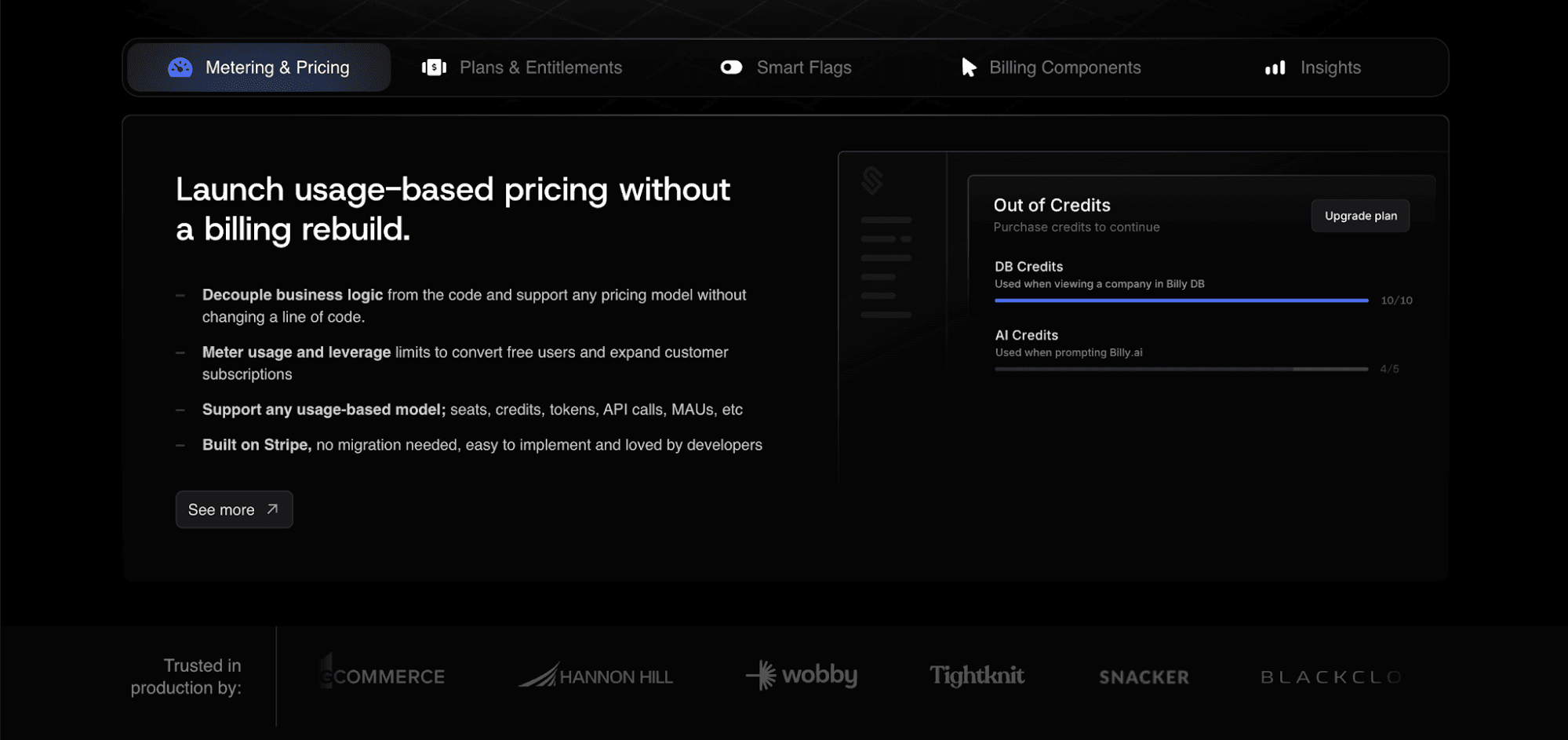
Schematic is the monetization operating system that helps modern SaaS and AI companies launch usage-based pricing without a billing rebuild. Built on Stripe, it decouples billing logic from application code to enforce pricing at runtime.
Schematic adds the product-side controls necessary to meter usage, define limits, enforce access, and sync billable events back to Stripe in real time.
It supports several usage-based models, including pay-as-you-go, pay-in-advance, credit burndown, fixed fee with overages, and volume pricing.
Schematic also provides a centralized product catalog. Commercial teams can create custom plans, offer credits, launch trials, and grant overrides in one place.
Every change in Schematic reflects in the product, the billing system, and the customer portal. Engineers stop writing custom code or building integration glue.
FAQs About Launching Usage-Based Pricing
What does usage-based pricing mean?
Usage-based or consumption-based pricing means customers pay based on how much of a product they consume. Instead of charging only a flat subscription fee, the bill changes as users consume more features, credits, tokens, API calls, or other usage units.
How does usage-based pricing work?
Usage-based pricing works by tracking customer usage, rating that usage against pricing rules, and calculating the final charge. It's a flexible pricing model that lets customers start small and pay more as their product usage grows.
Can I bill customers based on usage?
Yes. SaaS companies can bill customers based on usage if they can track usage events, connect those events to pricing rules, and send billable charges to a payment processor. This approach aligns pricing with variable costs and perceived product value, making it easier to scale revenue alongside customer usage.
What are usage-based pricing examples?
Common usage-based pricing examples in SaaS include charging by API call, token, credit, seat, or feature usage. Meanwhile, cloud service providers usually bill customers based on bandwidth, server usage, data storage, compute time, and other infrastructure-related usage units.