8 Best Enterprise Billing Software Solutions in 2026
8 Best Enterprise Billing Software Solutions in 2026: 1. Schematic 2. Metronome 3. Zuora 4. Maxio 5. Orb 6. Chargebee 7. Zoho Billing 8. Paddle.
 Ryan Echternacht
On this page
- Overview
- TL;DR
- 8 Best Enterprise Billing Software Tools for SaaS and AI Companies in 2026
- 1. Schematic
- 2. Metronome
- 3. Zuora
- 4. Maxio
- 5. Orb
- 6. Chargebee
- 7. Zoho Billing
- 8. Paddle
- What Enterprise Software and AI Companies Need From a Billing Platform
- Support for Flexible Pricing Models
- Automated Invoice Generation and Tax Management
- Usage Metering and Billing
- Global Payments Orchestration
- Revenue Recognition Capabilities
- Entitlement Management
- Self-Service Portals and Other Customer-Facing Systems
- Built-In Integrations
- Reporting and Analytics
- Security and Compliance Features
- Schematic Handles Enterprise Billing and Entitlements for Companies Selling Usage-Based Plans
- FAQs About the Best Enterprise Billing Software
- What is the best billing software for enterprises?
- What is the best billing software for a small business?
- What is the difference between billing and invoicing software?
Enterprise billing involves more than collecting subscription payments. Many established SaaS and AI companies face challenges when enterprise customers need usage-based pricing, custom plans, prepaid credits, and overrides.
According to DigitalRoute's report, 67% of businesses manually fix usage invoices before sending them to customers. This shows how difficult billing processes can become as usage and pricing models grow more complex.
The best enterprise billing software helps companies manage these demands with less manual intervention. It can support flexible pricing, automate billing tasks, and give enterprise customers real-time visibility into their spending.
This guide lists the top eight enterprise billing solutions designed for AI and SaaS companies. We'll also break down the features teams should consider when evaluating different platforms.
TL;DR
These are eight best billing software options for enterprises:
Metronome
Zuora
Maxio
Orb
Chargebee
Zoho Billing
Paddle
8 Best Enterprise Billing Software Tools for SaaS and AI Companies in 2026
Let's review the best enterprise billing platforms and their key features below.
1. Schematic
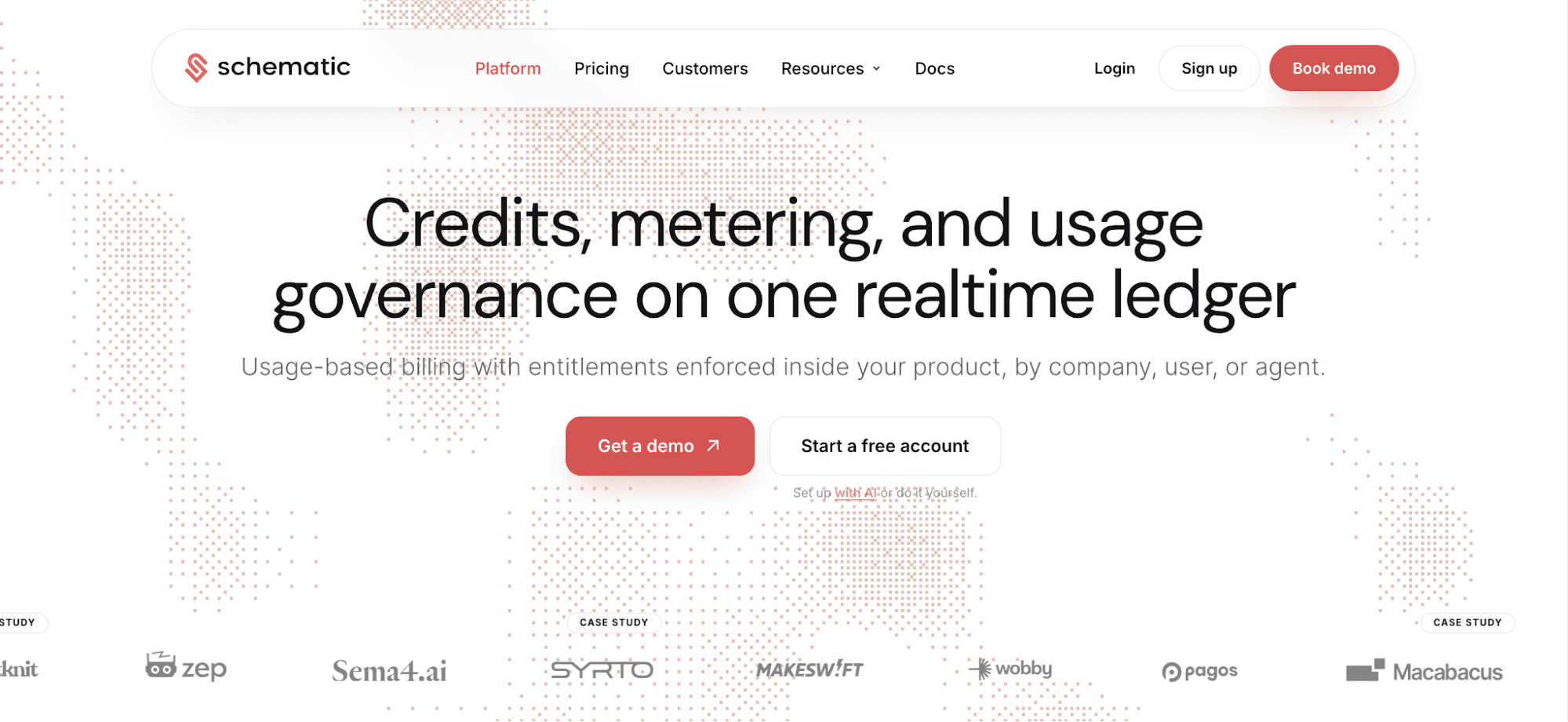
Schematic is the best enterprise billing platform for software and AI companies that want to close large accounts.
It's the only usage-based billing solution that addresses customer trust structurally. Enterprise credit wallets give buyers real-time visibility and control over their consumption.
By using Schematic's configurable spending limits, customers can set caps per company, seat, or agent. They can also change auto top-up rules and define what happens once they've reached the limit.
The runtime entitlement engine tracks usage against caps and enforces policies the moment they are saved. This prevents runaway bills and unexpected access throttling.
Customer experience lead Rahul Gill from Macabacus shares, "Schematic's ability to offer usage caps, bundles, and top-ups gave our customers the cost predictability they need."
Unlike other platforms that hard-code pricing logic into the application, Schematic's real-time ledger stores pricing as data. Commercial teams (sales, RevOps, and product managers) can update plans through configuration without needing engineering help.
The people closest to the customer relationship can grant overrides, add credit grants, audit the ledger, and close the books.
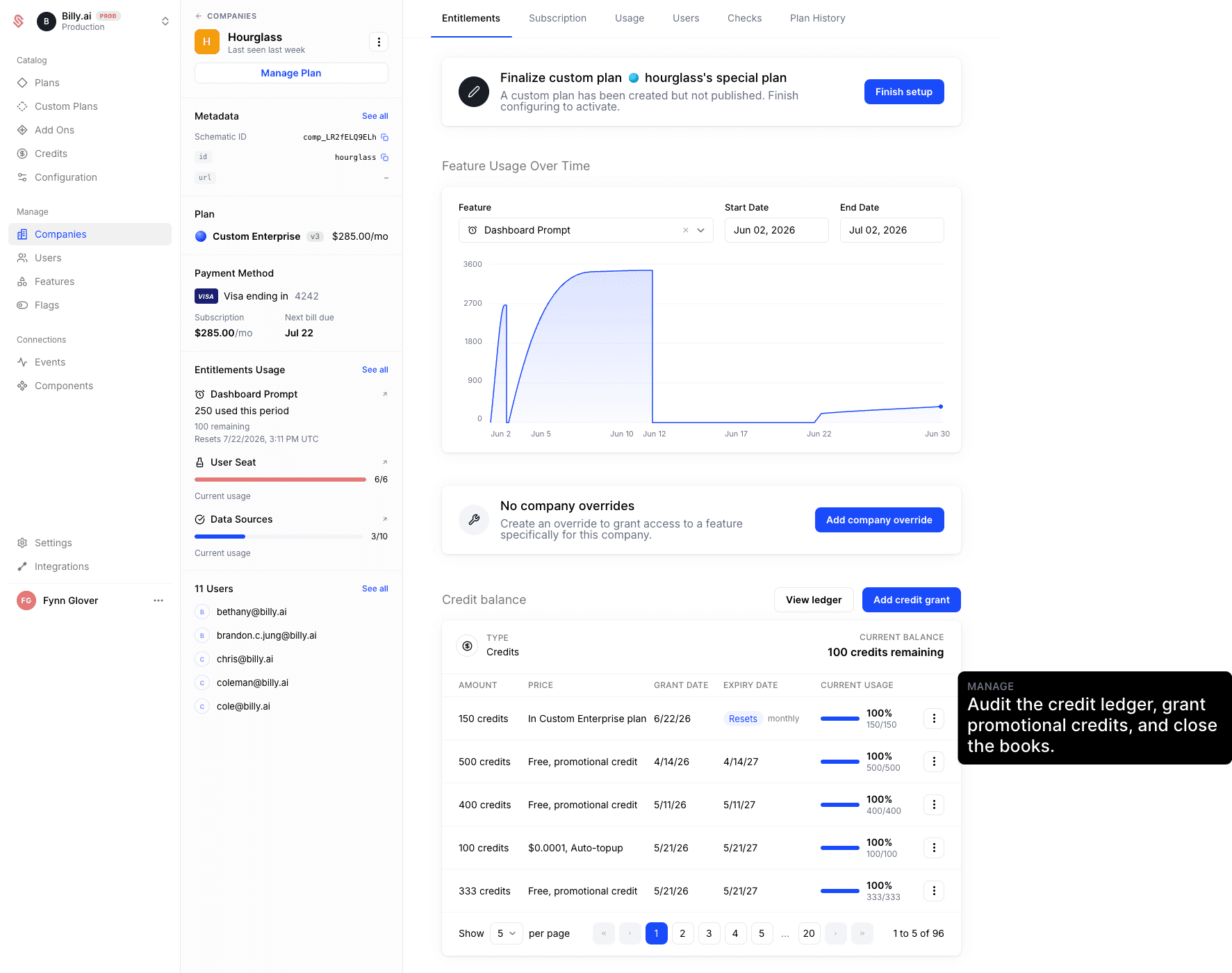
Plus, out-of-the-box billing tools support AI monetization. These include metering, credit rollovers, concurrency-safe holds, plan versioning, and a real-time event log, among others.
Key Features
Enterprise credit wallets: Record every grant, top-up, rollover, expiry, and burn-down in one place. You can also show customers their live credit balance.
Runtime entitlement engine: Every entitlement tracks against its cap so that the billing system can enforce limits at runtime.
Usage metering and billing: Meter consumption events once and support usage-based pricing models (pay-as-you-go, pay-in-advance, or fixed fee with overage pricing).
Credit-based pricing: Configure rollover policies, manage expiry windows, change priority consumption rules, and reserve credits before an action starts.
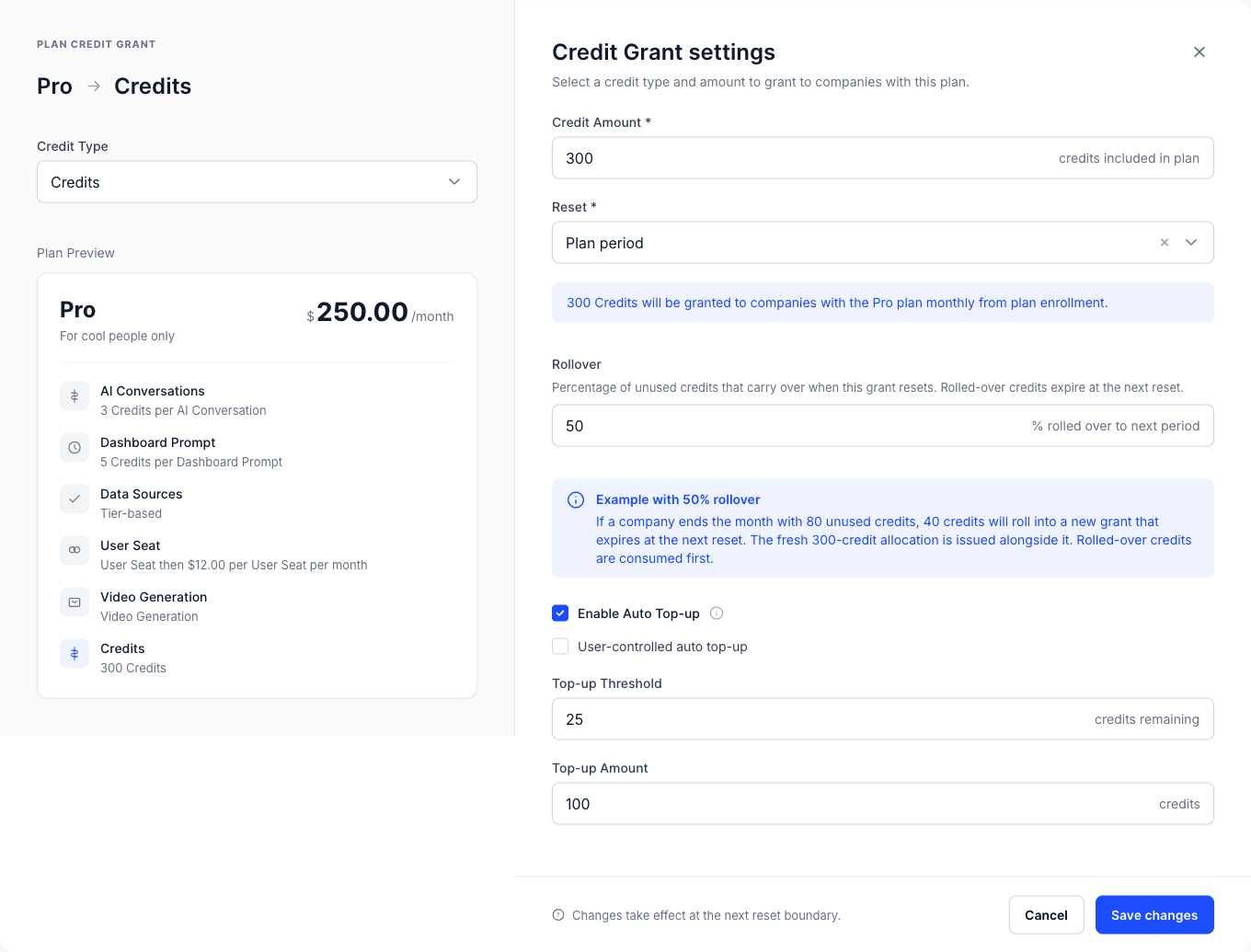
Configurable spending limits and self-service controls: Customers can set usage caps, forecast future spending, manage credit top-ups, and decide what happens at the limit.
Plan versioning and customer migration: Version plans, migrate customers, and implement trial pricing without filing an engineering ticket.
Append-only ledger: Track and recognize credit-based revenue in an append-only, export-ready ledger for ASC 606 compliance.
Schematic MCP: Use Claude, Codex, or your own agent to read billing data from Schematic and run automations.
Max Ade from Pickleheads shares, "The Schematic MCP is fantastic, and we now do most of our work in Claude, accessing plan and billing information directly without leaving our workflow."
2. Metronome
Source: Metronome.com
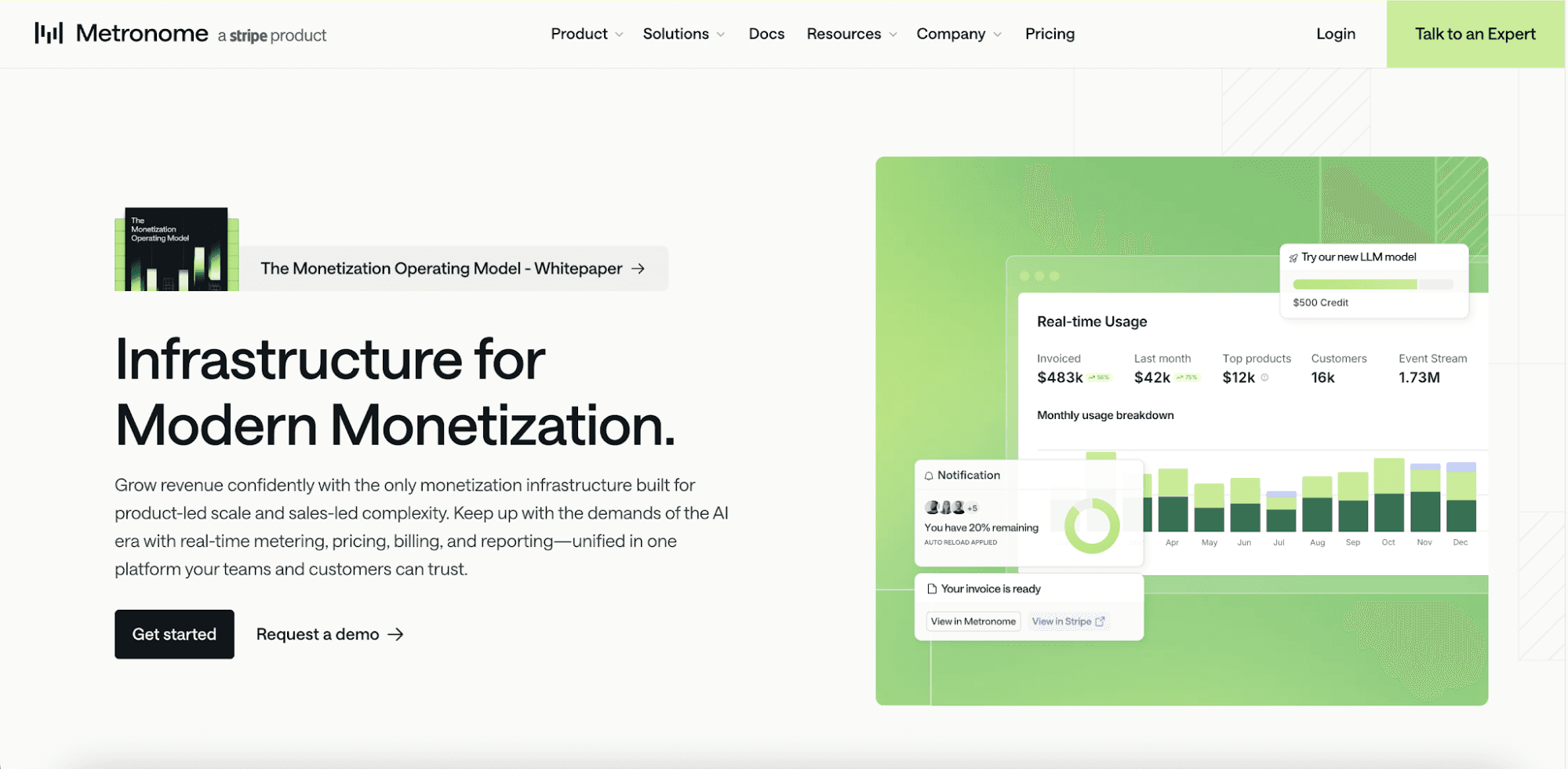
Metronome provides a modern monetization infrastructure that unifies enterprise billing, pricing, metering, and financial reporting.
The platform supports both product-led growth and sales-led go-to-market strategies through its pricing levers.
Metronome focuses on usage metering and aggregation. It captures raw events directly from applications and converts them into billable metrics. Teams can then use these metrics to calculate charges and generate invoices for metered billing.
The built-in product catalog lets businesses define what they sell, while centralized rate cards manage pricing rules, rates, and customer-specific terms. This setup supports different pricing models, including usage-based, tiered, credit-based, and hybrid pricing.
It also offers native integrations with Stripe Billing to help AI and infrastructure companies manage high-volume usage billing and complex enterprise contracts.
Metronome provides other integration options to connect a company's existing tech stack and simplify billing operations. It connects to cloud marketplaces, customer relationship management (CRM) software, invoicing solutions, and accounting software like QuickBooks Online.
Key Features
Pricing levers: Implement usage-based, subscription, seat-based, credit-based, hybrid, tiered, and custom pricing models while aligning with your GTM strategy.
Usage tracking and aggregation: Ingest product events, measure billable usage, and translate raw activity data into billable metrics.
Modular pricing engine: Use centralized rate cards, manage pricing templates, and maintain a single source of truth for pricing.
In-app billing dashboards: Give customers real-time visibility into usage and spending controls inside the product.
Financial reporting: Give teams access to live usage and revenue data for margin analysis, revenue tracking, and accurate forecasting.
3. Zuora
Source: Zuora.com
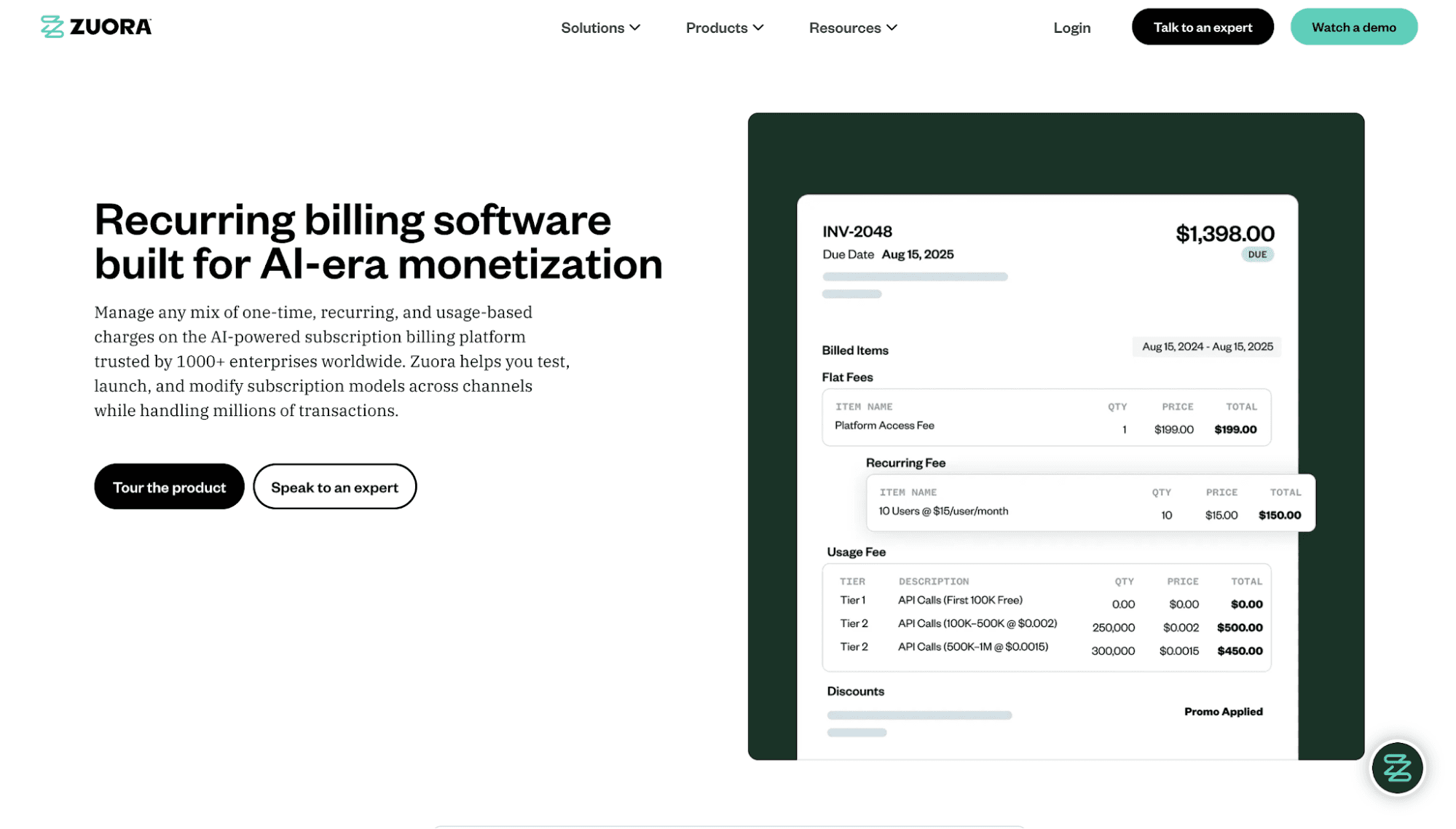
Zuora is a recurring billing software solution designed for enterprise companies selling AI products. It supports one-time fees, recurring subscriptions, usage-based pricing, and hybrid billing models.
It offers built-in mediation and rating tools that collect usage events and convert them into billable charges. Meanwhile, AI-powered insights can detect anomalies and emerging consumption trends that companies can take advantage of.
Sales reps can create multi-year agreements and combine fixed subscription fees with variable usage charges. On the other hand, finance teams can track revenue and support compliance with ASC 606 and IFRS 15 accounting standards.
In addition to recurring billing, Zuora also handles subscription management, automated invoicing, payment processing, and revenue recognition.
It connects to multiple payment gateways to accept payments online. It then sends automatic payment reminders and retries failed charges to prevent revenue leakage.
Plus, Zuora offers seamless integration with CRM software, enterprise resource planning (ERP) systems, tax engines, and finance systems to unify quote-to-cash processes.
Key Features
Support for flexible pricing: Implement subscription, usage-based, hybrid, and tiered pricing models through a low-code/no-code pricing designer.
Usage metering and billing: Collect usage events and calculate billable charges in one place.
Global payments orchestration: Accept online payments and different currencies through connected payment gateways.
E-invoicing and tax compliance: Automate recurring invoice generation, apply tax rules, and support local e-invoicing requirements through built-in integrations.
Subscription management: Manage customer subscriptions and adjust billing mid-cycle without disrupting downstream financial processes.
4. Maxio
Source: Maxio.com
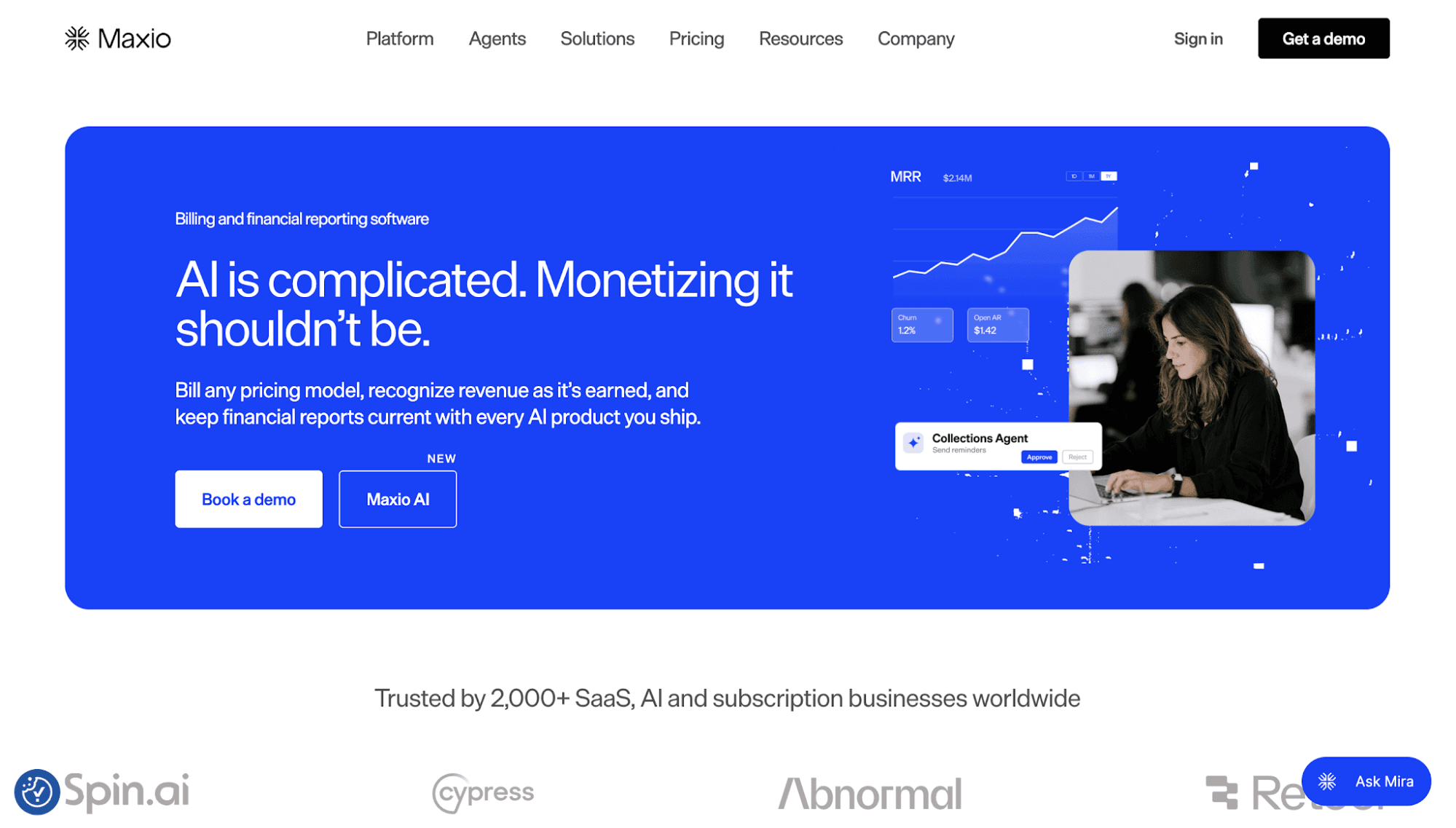
Maxio provides enterprise billing and financial reporting software for B2B SaaS and AI companies. It offers out-of-the-box tools for usage metering, invoicing, revenue recognition, and subscription management.
Businesses can bill customers by license, usage, or overage fees. Maxio instantly syncs product usage data directly with billing records. This helps finance teams automate invoicing and billing without manual spreadsheets.
The platform also creates professional invoices based on customer contracts, billing or payment scheduling, usage data, enterprise plan renewals, add-ons, and other attributes.
It connects to your preferred payment processor, including Stripe, Braintree, and Authorize.net. Alternatively, Maxio's own payment solution can handle payment processing and recover credit card processing fees through built-in surcharging.
Maxio automatically connects cash earned to accurate reports so that accounting can close the books faster. These reports could be filtered by customer, contract, product, or custom field.
Key Features
Metered billing and usage rating: Track product usage, calculate charges, and bill customers based on licenses, overages, or consumption.
Automated invoicing and dunning management: Maxio automatically sends invoices and automated payment reminders to recover payments from overdue invoices.
Payment processing: Accept online payments through Maxio's built-in payment solution or connect to gateways like Stripe, Braintree, and Authorize.net.
Revenue recognition and reporting: Recognize revenue under ASC 606 and IFRS 15 while tracking financial metrics through custom reports.
Subscription management: Create custom contracts, manage plan renewals, and configure pricing from a user-friendly interface.
5. Orb
Source: withOrb.com
Orb automates usage-based billing to help enterprises solve billing complexity at scale. It provides flexible billing infrastructure for SaaS and AI companies managing large customer accounts, custom contracts, and high usage volumes.
Orb's APIs let teams create complex pricing structures and manage billing for different GTM motions. Meanwhile, customer hierarchies support parent-child accounts, multiple organizations, and shared billing under a single enterprise customer.
Orb also supports AI monetization through hybrid pricing, token-based charges, and per-action billing. Commercial teams can test different pricing models before launch and make changes without rebuilding their billing infrastructure.
The platform generates audit-ready, customized invoices that reflect actual product usage and contract terms. Companies can review invoice drafts, make billing adjustments, and track changes through detailed audit records.
Plus, Orb offers role-based access controls, backdated billing corrections, and revenue recognition controls. These features help enterprises maintain billing accuracy and meet internal financial requirements.
Key Features
Enterprise billing engine: Manage complex pricing models, custom contracts, and shared billing for large customer accounts.
Pricing simulations: Test different pricing plans against historical usage data to forecast revenue before launch.
Customizable invoices and dunning workflows: Display key invoice data, edit drafts, and send automated reminders and follow-ups to avoid payment delays.
Backdate and backfill corrections: Add missing usage events or override data, while Orb recalculates affected invoices and updates customer-facing dashboards.
Revenue recognition: Turn raw metered usage data into numbers that RevOps teams can trust and operate in real time.
6. Chargebee
Source: Chargebee.com
Chargebee brings enterprise pricing, quoting, subscription billing, entitlement management, accounts receivable, and revenue recognition into one system.
The platform helps sales teams close complex enterprise deals with custom quotes, discounts, and multi-year contracts.
Integrated configure-price-quote (CPQ) tools connect approved quotes to billing records. That reduces manual work when converting deals into active subscriptions.
Chargebee also supports flexible pricing models, including subscriptions, usage-based pricing, prepaid credits, and hybrid billing. Product teams can test new pricing structures and launch new revenue streams without relying on engineering.
The billing system helps the finance department manage invoices, calculate taxes, automate invoice tracking, and record revenue based on contract terms.
It even supports multiple payment methods and currencies for global billing. Teams simply need to connect to payment gateways using production-ready integrations. This eliminates custom middleware and engineering sprints.
Key Features
Unified pricing infrastructure: Manage subscription, usage-based, credit-based, and hybrid pricing models from one billing system.
Enterprise-ready quotes: Create custom quotes with pricing, discounts, and contract terms that match billing rules. The billing software automatically converts approved deals into subscriptions.
Global payments orchestration: Connect to different payment gateways and support multiple payment methods in over 150 countries.
Automated financial compliance: Use the built-in invoicing tool to calculate multi-jurisdiction taxes and manage ASC 606 and IFRS 15 compliance.
Consolidated revenue reporting: Track subscription billing revenue, usage-based charges, and multi-year contracts with revenue recognition workflows and financial reports.
7. Zoho Billing
Source: Zoho.com
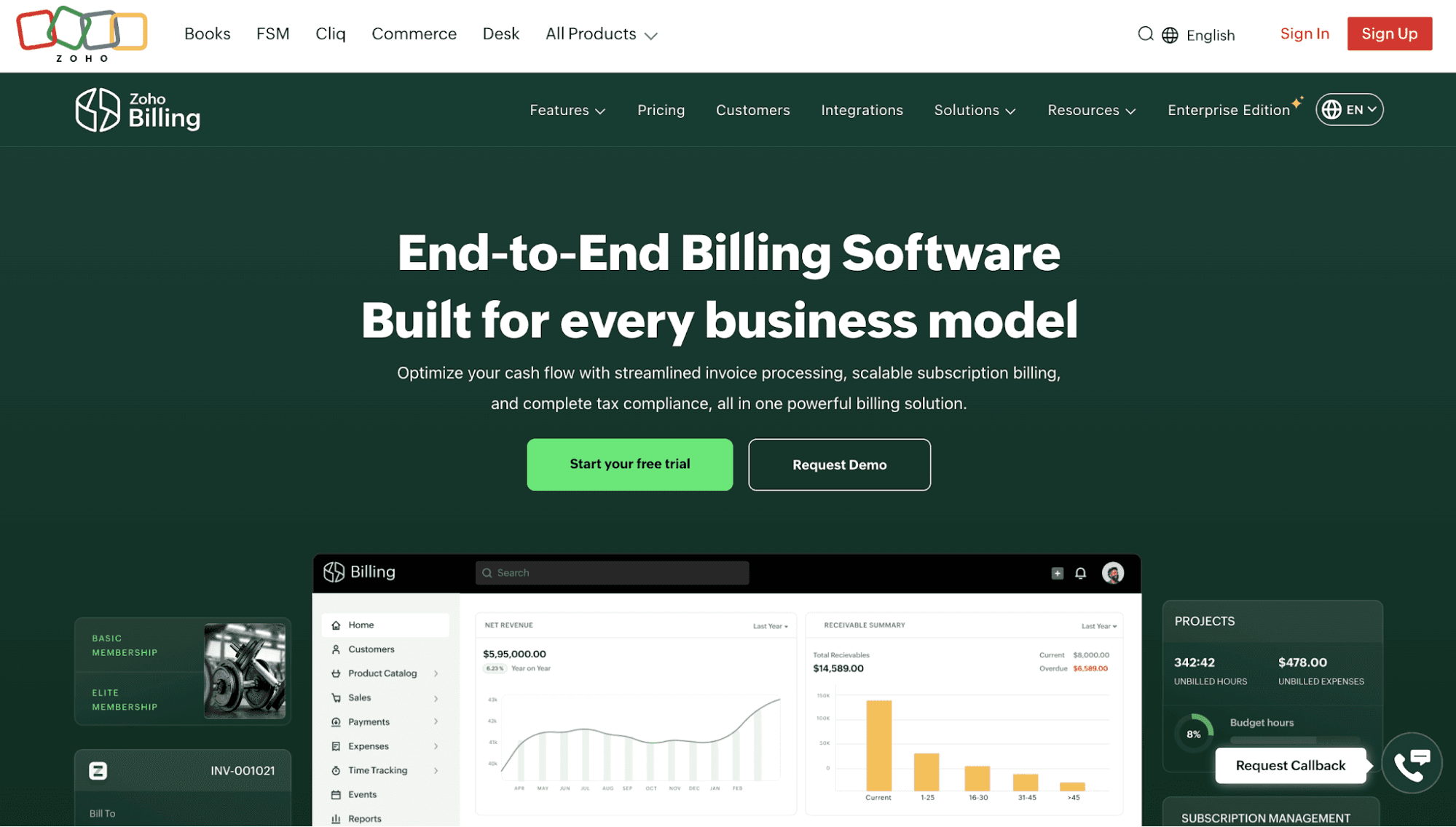
Zoho Billing is a cloud-based enterprise billing software solution that helps SaaS and AI companies manage subscriptions, payments, and financial operations.
It provides the necessary tools for invoice processing, tax compliance management, and scalable subscription billing.
Teams can create custom quotes, send invoices to enterprise customers, and handle projects and timesheets that meet compliance regulations.
The billing platform accepts partial and bulk payments through payment links and hosted payment pages. It also sends automated payment reminders to avoid missed revenue and improve cash flow.
For financial reporting, Zoho Billing breaks down key metrics like sales, receivables, revenue, and customer churn. These insights help business leaders make better-informed decisions.
Zoho Billing can even provide customer portals and pricing tables to gain customer trust and enhance the billing experience.
Key Features
Customizable quotes and invoices: Create branded quotes and invoices with custom branding, logos, and messages through a flexible invoicing system.
Flexible payment processing: Accept partial and bulk payments through multiple payment methods, payment links, and hosted checkout pages.
Financial insights: Track sales, receivables, revenue, and customer churn through dashboards and built-in reports.
Customer-facing systems: Give customers a self-service portal and pricing tables to view quotes, manage transactions, and make online payments.
Product management: Organize products, services, pricing plans, add-ons, and discounts from a central product catalog.
8. Paddle
Source: Paddle.com
Paddle is a Merchant of Record (MoR) that handles enterprise billing, global payments, and tax compliance for SaaS and digital product companies.
It manages billing operations in over 300 markets to help established businesses sell internationally without handling local tax requirements themselves.
The platform includes tools for subscription management, automated invoicing, payment processing, tax management, and fraud protection.
Paddle can handle subscription upgrades, cancellations, prorated charges, and one-time purchases. The built-in customer portal lets customers manage their subscriptions without contacting support.
To automate invoicing, Paddle uses advanced features and APIs. It also provides a full cost breakdown, not just the monthly fee for the subscription plan.
Plus, Paddle chooses the right payment gateway for companies, protects transactions from fraud, and applies the correct sales tax to ensure compliance. This reduces complexities when dealing with enterprise billing.
Key Features
Subscription management: Handle subscription billing, upgrades, downgrades, cancellations, and prorated charges from one platform.
Automated invoicing: Use Paddle's invoice billing software to generate recurring invoices, send invoices, and automate billing processes.
Done-for-you payment routing: Paddle selects the right gateways for your business, so you don't have to build a payments stack from scratch.
Tax compliance: Sales tax registration, calculations, filing, and remittance are automatically handled.
Payment analytics: Monitor revenue, transactions, and subscription performance with real-time payment tracking and reporting tools.
What Enterprise Software and AI Companies Need From a Billing Platform
With so many enterprise billing systems on the market, it can be overwhelming to choose the right software. Fortunately, companies can make the decision-making process easier by looking specifically for ten features.
Let's break down each one below.
Support for Flexible Pricing Models
Enterprise SaaS and AI companies need billing software that supports different pricing models.
Some customers prefer a flat monthly fee, while others want to pay based on actual usage, seats, AI credits, or a combination of these billable metrics.
Choose a platform that lets you configure pricing rules and billing logic without changing your application code. Make sure you can easily implement tiered pricing, volume discounts, minimum commitments, prepaid credits, and overage charges.
The software should support customer-specific pricing and plan changes without disrupting existing agreements. That's because enterprise customers often negotiate custom rates and payment terms based on their contracts.
This flexibility helps businesses offer pricing that matches customer needs while supporting new products and revenue streams.
Automated Invoice Generation and Tax Management
Enterprise billing platforms need automated invoicing capabilities to handle complex billing scenarios. The system should instantly calculate charges mid-cycle, generate itemized invoices, and send them to customers on schedule.
For usage-based billing, invoices must reflect actual consumption, discounts, credits, and overage fees. Your company should define whether usage follows a per-unit rate or a tiered structure, where each unit costs less as you consume more resources.
Tax management tools are equally important, especially if you sell internationally. The software should calculate applicable taxes based on the customer's locations and local tax rules.
Some advanced billing platforms even support electronic invoicing and connect to tax services to help you meet regional requirements.
Evaluate these features carefully because they can significantly reduce manual billing work, prevent calculation errors, and help finance teams collect payments on time.
Usage Metering and Billing
Software and AI companies selling to enterprises usually implement usage-based pricing because it aligns with customer value.
Invest in enterprise billing software that can collect usage events, aggregate data, and apply the correct pricing rules. Make sure it can handle large event volumes without losing records or counting the same event twice.
By metering usage in real time, you can monitor consumption trends before the billing period ends. If an account uses less than the previous cycle, you can take proactive measures to prevent churn.
Accurate usage tracking reduces billing disputes, prevents lost revenue, and gives customers confidence that their bill reflects actual product consumption.
Global Payments Orchestration
Selling to customers in different countries requires an enterprise billing platform that supports multiple currencies and localized payment options.
Global payments orchestration helps you route transactions through supported gateways and manage collection from one system.
You can accept credit card payments, direct debit, digital wallets, ACH, and other payment methods. You can then connect invoicing and billing records to payment results, which help finance teams track outstanding balances.
Another feature to look for is dunning management. The enterprise billing system should automatically track failed transactions, retry failed payments, and record payment statuses.
Some platforms also handle payouts and vendor payments, although these features may require separate financial tools.
Revenue Recognition Capabilities
Revenue recognition determines when a business records income from its products and services. This becomes more complex when enterprise plans and custom contracts include prepaid credits, minimum commitments, usage-based charges, and multi-year agreements.
The best enterprise billing software should connect customer transactions to revenue recognition rules. It must track deferred revenue, contract changes, and revenue earned during each reporting period.
For example, a customer might pay $120,000 upfront for a yearly subscription. Your company generally recognizes that revenue as it delivers the contracted service, rather than recording the full amount immediately.
Look for billing systems that support ASC 606 and IFRS 15 accounting requirements. These features help finance teams prepare accurate financial statements, manage audits, and reduce manual revenue calculations.
Entitlement Management
Entitlement management controls which features, services, and usage limits customers can access based on what they've purchased.
For enterprise SaaS and AI products, these controls are important because different customers may have custom contracts, feature packages, and usage allowances.
A billing platform with entitlement management can connect pricing plans directly to product access rules. For example, it can limit API calls, control autonomous agent usage, or restrict advanced features to higher subscription tiers.
Runtime entitlement checks can also enforce spending caps and usage limits while customers use the product.
When a customer upgrades or changes plans, the system should update their software entitlements automatically to avoid unexpected access throttling.
Self-Service Portals and Other Customer-Facing Systems
Enterprise customers need real-time information about their subscriptions, usage, invoices, and spending.
Self-service portals give them direct access to this information without contacting support. Make sure these portals display billing history, current plans, payment methods, and overdue invoices.
For usage-based products, they should also show consumption data, credit balances, and projected charges.
The best enterprise billing solutions even let customers set spending limits, configure usage alerts, purchase additional credits, or manage automatic top-ups. These capabilities solve the trust problem in usage-based billing.
Built-In Integrations
Invest in enterprise billing software that offers seamless integrations with your existing tech stack.
Make sure it connects to payment solutions, CRM software, data warehouses, inventory management solutions, ERP platforms, and financial systems.
Built-in integrations help teams share billing information without manually moving data between applications.
For example, connecting billing software to accounting software, such as QuickBooks Online, can help finance teams sync invoices, payments, and transaction records.
Developer APIs, monetization SDKs, and webhooks are also important for companies building custom billing workflows. They allow applications to send usage events and receive billing updates.
These connections reduce manual data entry and help teams work with consistent financial records.
Reporting and Analytics
Enterprise billing software should provide detailed reports on revenue, customer activity, and billing performance. Finance and product teams need this information to understand how customers use their services and how usage affects revenue.
Key metrics to track include monthly recurring revenue, annual recurring revenue, churn rates, outstanding invoices, and payment collection trends.
For usage-based products, analytics should also cover consumption patterns, credit balances, and revenue generated by each product or customer segment.
Some billing solutions even provide dashboards for revenue forecasting, expense tracking, and customer profitability analysis to help business leaders make informed decisions.
Security and Compliance Features
Enterprise billing software often deals with sensitive customer information, financial records, and payment data. You need enterprise-level security controls that protect this information from unauthorized persons and bad actors.
Look for data encryption, role-based access, audit logs, and secure API authentication. These security features help teams control who can view, change, or export billing records.
Payment security is another important requirement. If you process credit card data, you should carefully review your payment provider's PCI DSS responsibilities and compliance status.
You may also need SOC 2 reports, GDPR support, and data retention controls, depending on where you operate.
Schematic Handles Enterprise Billing and Entitlements for Companies Selling Usage-Based Plans
Schematic is a complete billing platform for software and AI companies selling to enterprises. It combines credits, metering, and usage governance controls to address customer trust structurally.
Teams use Schematic to manage usage-based pricing, meter events once, enforce limits at runtime, and give customers full control over their consumption.
Pricing lives as data on Schematic's real-time ledger, so commercial teams can update plans through configuration instead of writing new code.
Native credit wallets show customers exactly what they use and owe to prevent surprise invoices at the end of the billing period.
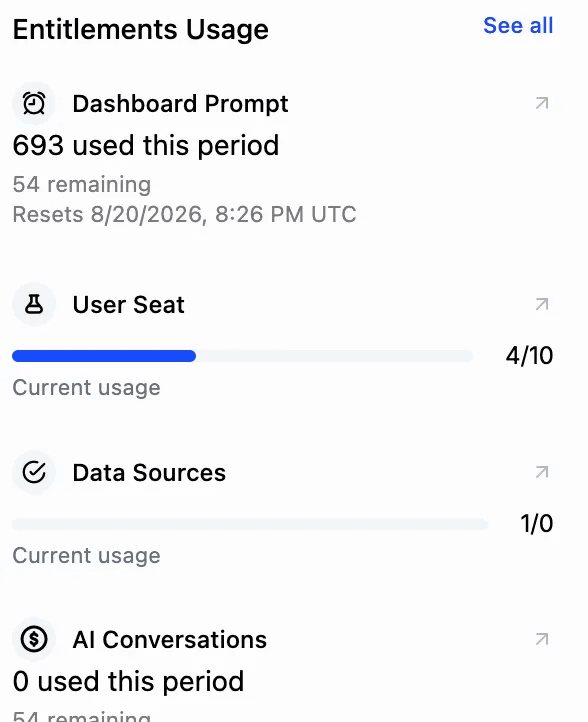
The runtime entitlement engine enforces limits and access controls instantly without hardcoding logic inside the application.
Zach Hawtof, CEO and co-founder of Titanet, explains, "Stripe's features were too Boolean to handle complex entitlement systems, so we turned to Schematic to solve that problem."
By showing customers real-time visibility and control over their usage, you can close enterprise deals faster, drive expansion, and earn more revenue.
FAQs About the Best Enterprise Billing Software
What is the best billing software for enterprises?
Schematic is one of the best enterprise billing software options for SaaS and AI companies selling to large accounts. It supports usage-based pricing, credit management, hybrid billing, runtime entitlements, and self-service control. Other options include Metronome, Zuora, Maxio, Orb, and Chargebee.
What is the best billing software for a small business?
Small businesses need billing software that has a user-friendly interface and configurable options. Schematic is a popular choice among small teams selling usage-based plans. Its Starter plan is free to use and provides access to unlimited plans, features, flags, companies, and environments.
What is the difference between billing and invoicing software?
Billing software manages the entire payment cycle, including pricing, subscriptions, usage tracking, and payment processing. Invoicing systems focus on creating and sending invoices. However, some of the best invoicing software may also include tools for payment processing, tax calculations, and dunning management.