Metronome vs. Lago: Which Is the Better Billing Platform?
Read our Metronome vs. Lago review and find out how the two platforms compare. Discover what makes Schematic the superior alternative to both.
 Ryan Echternacht
On this page
- Overview
- TL;DR
- Metronome vs. Lago: What's the Key Difference?
- Metronome Features and Advantages
- Lago Features and Advantages
- Metronome vs. Lago: A Side-by-Side Comparison
- Usage Metering and Billing Engine
- Credit-Based Pricing
- Invoicing and Payment Collection
- Spend Controls
- Revenue Analytics
- Deployment Model and Developer Experience
- Integration Options
- Pricing Plans
- Where Metronome and Lago Fall Short
- Why Should SaaS and AI Companies Consider Schematic
- Switch to Schematic for a Complete Usage-Based Billing Platform
- FAQs About Metronome vs. Lago
- Which is the better billing system if you are billing at an enterprise scale: Metronome or Lago?
- Do Metronome and Lago provide credit wallets?
- Is Lago an open-source billing infrastructure?
Many businesses now charge customers for tokens, API calls, compute, AI credits, or any variable usage metric instead of fixed subscription fees. According to an IDC study of 300 companies, 44% of vendors rank usage-based pricing (UBP) among their top three pricing models.
Despite its popularity, UBP introduces new challenges in billing. SaaS and AI companies need reliable systems that can handle high event volumes, hybrid pricing models, and custom enterprise contracts. Poor billing can lead to surprise charges, lost revenue, and unhappy customers.
That is where Metronome and Lago come in. Both platforms help teams meter usage, manage credit balances, and bill enterprise customers based on actual consumption.
But which is the better usage-based billing platform?
This guide compares the key features, advantages, and pricing plans of Metronome and Lago to help you decide.
TL;DR
Metronome and Lago help SaaS and AI companies meter usage, manage credits, and bill customers using different pricing models. But they differ when it comes to flexibility and control.
Metronome focuses on high-volume usage metering, complex enterprise contracts, custom rate cards, and real-time revenue reporting.
Lago is an open-source billing platform that offers flexible deployment options, prepaid credit wallets, automated invoicing, and multiple payment integrations.
Both platforms fall short in runtime entitlement enforcement and advanced credit management. Developers need to build application-side controls to enforce limits and prevent concurrent credit spending.
Schematic is the better choice for SaaS and AI companies selling to enterprises. It combines usage billing, metering, software entitlements, enterprise credit wallets, and usage governance controls in one platform.
Metronome vs. Lago: What's the Key Difference?
Metronome provides a flexible billing infrastructure for modern monetization. It combines real-time usage metering, pricing, billing, and financial reporting in one platform.
Metronome also includes levers for different pricing and go-to-market strategies. It even supports custom enterprise contract management by offering flexible discounts, overrides, and amendments.
It's a good fit for large companies handling custom rate cards, minimum commitments, complex enterprise deals, and revenue operations.
Lago is an AI-native, open-source billing platform that supports the entire quote-to-cash process, from the first sales quote to prepaid credits and final invoices.
Lago's self-hosted option allows companies to host the billing system on their own servers for full control over monetization. Meanwhile, Lago Cloud is the cloud-hosted premium option that lets teams meter usage, generate invoices, and ship hybrid pricing without building billing from scratch.
The main difference between Metronome and Lago is flexibility and control.
Metronome simplifies enterprise contract complexity with out-of-the-box tools. Lago gives businesses more control over their billing infrastructure. However, configuring and maintaining a self-hosted Lago setup may require significant engineering time.
Metronome Features and Advantages
Metronome unifies real-time metering, pricing, billing, and reporting to design a flexible billing infrastructure. It provides a single source of truth for finance, GTM, and product teams.
With Metronome, SaaS and AI companies can implement new pricing models while managing complex contracts. Non-technical teams can also surface usage data and make better financial decisions based on revenue insights.
Below are Metronome's key features.
Pricing levers: Support usage-based pricing, hybrid billing, prepaid credits, volume discounts, and plans with committed spend to match different customer needs.
Real-time metering: Collect and store raw usage events, then turn them into billable metrics for accurate invoicing.
Modular pricing engine: Support flexible pricing using centralized rate cards, credit models, and spending commitments without extensive engineering work.
Granular customer configuration: Customize enterprise contracts with discounts, overrides, and amendments. Then, schedule pricing changes without affecting existing customer terms.
In-product billing dashboards: Show customers their real-time usage and spending. Set up configurable alerts and limits to help them control costs.
Revenue reporting: Filter and export billing data to track daily revenue, monitor customer consumption, analyze profit margins, and forecast future earnings.
Lago Features and Advantages
Lago is primarily known for its open-source platform, but it also provides a cloud-hosted option. It combines the flexibility of a custom-built billing system with the features of enterprise billing software.
Lago supports AI monetization through real-time event ingestion, subscription management, custom pricing models, and an integrated quote-to-cash platform.
Here is a closer look at Lago's key features.
Open-source control: Deploy Lago's core platform on your own infrastructure to maintain full control.
Usage-based billing and invoicing: Turn raw events into billable metrics. Then, combine subscriptions, prepaid credits, and usage-based fees into accurate invoices.
Negotiated quotes: Create custom quotes from the product catalog. Convert approved quotes into order forms and set up billing using the agreed terms.
AI-powered pricing assistant: Use AI to automate routine billing tasks, generate reports, and test different pricing strategies.
Flexible cash collection: Integrate Lago with different payment solutions to collect cash. You can also retry failed payments and generate receipts.
Built-in revenue recognition: Help finance teams track recognized and deferred revenue, create revenue reports, and generate journal entries from billing data.
Metronome vs. Lago: A Side-by-Side Comparison
This section compares Metronome and Lago's billing tools, features, and pricing plans to help companies make an informed choice.
Usage Metering and Billing Engine
Both Metronome and Lago can meter usage and turn consumption into billable charges.
Metronome collects and stores raw data from usage events. Engineering teams can create SQL-based metrics and apply different pricing models without changing their data pipeline. Its streaming metrics also support low-latency alerts to detect costly usage spikes, fraud, or abuse.
Metronome can handle high billing volume while supporting custom rate cards, tiered pricing, and complex enterprise contracts.
Lago has a different approach to usage metering. Applications send events through the platform's API or monetization SDKs. Lago validates and processes each event using configurable aggregation logic. It then applies the customer's pricing plan to calculate usage charges.
Plans can include usage-based fees, subscription models, and prepaid credits. Enterprise terms are also customizable, such as pricing, usage budgets, and more, to meet customer needs.
Credit-Based Pricing
Metronome supports credit-based pricing through its built-in pricing levers. Companies can sell prepaid credits or grant product-specific credits to customers.
The platform also offers automatic recharge, spending commitments, and credit balance previews. However, it requires engineering teams to send webhooks to connected payment systems to confirm purchases and update billing records.
This can introduce delays between payment and credit availability.
On the other hand, Lago offers prepaid credit wallets with near real-time balance updates. Customers can see exactly how many credits they have left, while finance teams can collect cash before usage happens.
With Lago, commercial teams can also set thresholds for wallet balances, grant free tier credits, refill paid credits, and confirm payments.
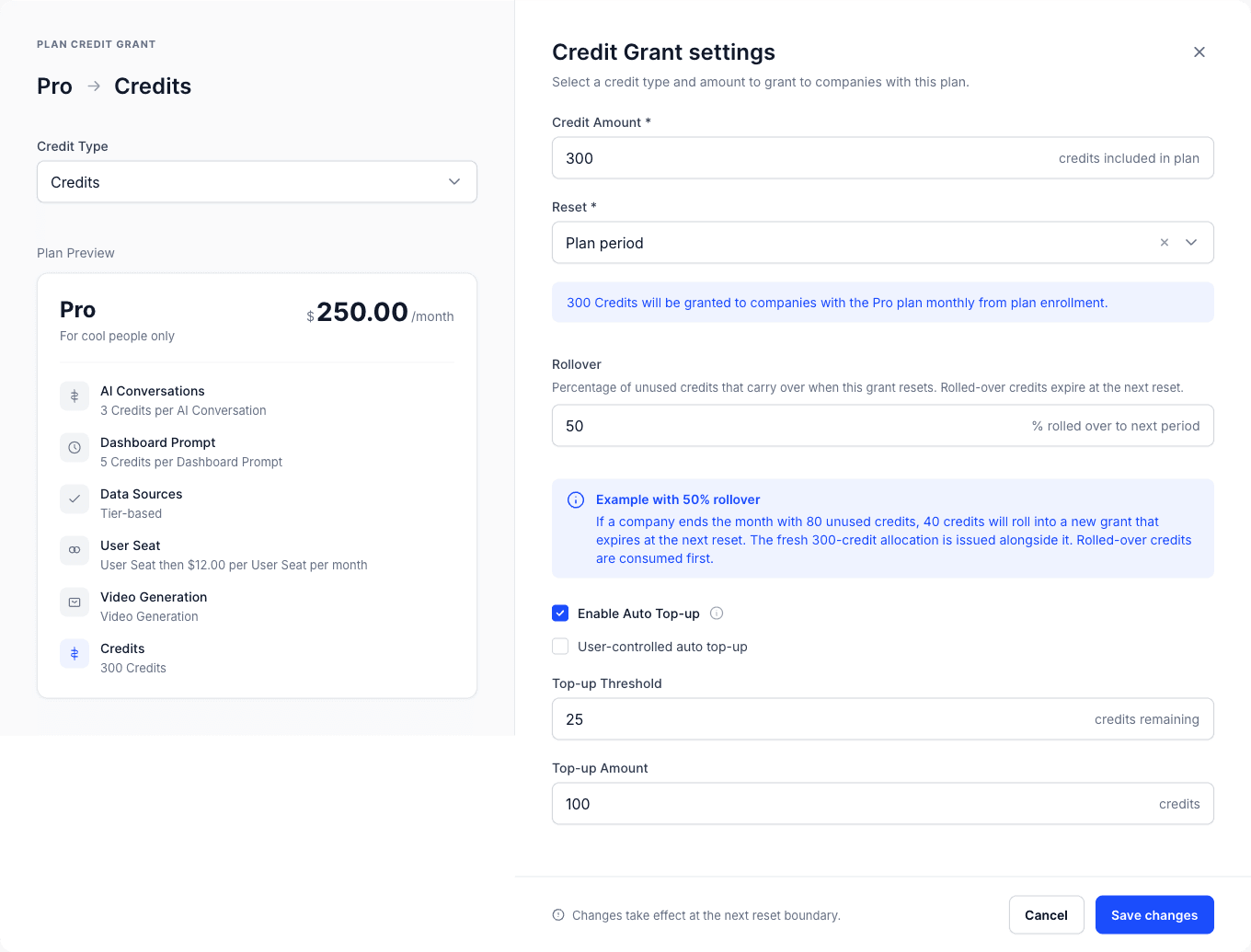
Although both Metronome and Lago can launch credit-based pricing, they lack advanced credit management features. They lack concurrency-safe holds, credit rollover policies, priority consumption rules, and real-time credit enforcement.
Invoicing and Payment Collection
Metronome generates two types of invoices: usage invoices and scheduled invoices. The former records what customers consume during a billing period. The latter covers subscription charges, prepaid commitments, and other recurring fees.
However, Metronome doesn't process payments directly. Instead, it integrates with Stripe Payments to collect customer charges and calculate dynamic sales taxes.
Lago generates itemized invoices that combine subscription fees, usage charges, and prepaid credits. It also calculates taxes using its native tax engine or integrations with Anrok and Avalara.
For payment collection, Lago supports Stripe, Adyen, GoCardless, and other payment providers through built-in integrations. It can also retry failed payments and send automated reminders for overdue invoices.
Both billing platforms calculate invoice amounts based on usage and enterprise contract terms. Lago provides more payment provider options, while Metronome works closely with Stripe.
Spend Controls
Metronome provides real-time usage and spending data through its APIs and webhooks. Engineering teams can build an in-product billing dashboard or customer portal. This is where users can monitor consumption and receive alerts in real time.
The billing system also features configurable spending thresholds to help customers review costs and avoid surprise invoices.
Lago offers prepaid credit wallets, spending alerts, and auto top-ups. Companies can assign each AI agent its own credit balance or budget.
For example, an AI agent can receive a fixed credit allowance for LLM tokens. Lago sends alerts when the balance runs low or reaches zero.
However, the application must act on these alerts to pause the agent or block further usage. This means developers should build entitlement and billing logic.
Metronome also requires engineering teams to write custom code to enforce product access limits at runtime.
Revenue Analytics
Metronome features in-app reporting tools that help teams track daily revenue, monitor customer consumption, analyze margins, and forecast future earnings.
Businesses can also filter and export data to their data warehouses for deeper revenue analysis. They can even generate custom reports and export them in a CSV format.
Similar to Metronome, Lago provides built-in revenue dashboards that break down revenue streams, monthly recurring revenue (MRR), or usage by customer, month, or plan.
The key difference is that Lago also uses AI assistants to generate reports based on billing data and customize dashboards depending on your needs.
Lago even supports syncing data to a warehouse, forecasting future usage, and sending billing updates to other point solutions through webhooks.
Deployment Model and Developer Experience
Metronome is a managed, cloud-hosted billing engine. Developers use its APIs to send usage events, define metrics, configure contracts, and set alerts.
Metronome provides in-app billing dashboards, but teams may still need to build feature gates, custom upgrade flows, and customer-facing controls.
Built-in pricing levers make it easier to run pricing experiments, but changes that affect product access may still require custom code. This makes Metronome suitable for established companies with extensive engineering resources to handle high event volumes and billing complexity.
Lago offers more flexible deployment options. Companies can self-host the platform on their own servers or in a virtual private cloud (VPC). They can also use Lago Cloud for quicker setup and faster pricing configuration.
Lago provides APIs, SDKs, and webhooks for custom integrations. However, self-hosting the platform requires significant engineering time for setup, updates, and maintenance.
Integration Options
Metronome integrates with Stripe Billing for invoicing and payment collection. It also connects to Salesforce, NetSuite, QuickBooks, and cloud marketplaces, such as AWS, Microsoft Azure, and Google Cloud.
For companies already using these systems, Metronome keeps billing and financial data connected within the same stack.
Metronome also supports data exports to Snowflake, Amazon S3, SingleStore, Redshift, and other data warehouses.
Lago offers more payment provider options, including Stripe, Adyen, GoCardless, and MoneyHash.
It also integrates with Anrok and Avalara for tax management, NetSuite and Xero for accounting, and Salesforce and HubSpot for customer relationship management (CRM).
Lago even connects to OpenAI, Anthropic, Google Gemini, and other AI gateways to capture AI product usage data.
Pricing Plans
Metronome offers two pricing plans:
Starter: Charges 0.8% of billing volume plus $0.04 per 1,000 ingested events. Includes real-time metering, usage alerts, flexible pricing models, Stripe integration, and embeddable billing dashboards.
Custom: Custom pricing is available for growing companies. This plan adds enterprise invoicing integrations, data exports, dedicated account management, enhanced service-level agreements (SLAs), and priority support.
Lago offers an open-source product that companies can self-host without paying a recurring software license fee. However, infrastructure and maintenance costs still apply.
Lago Cloud's pricing is not publicly listed as a fixed rate. Meanwhile, Lago Premium requires a custom quote and supports both cloud and self-hosted deployment. Some advanced features are available as paid add-ons.
The total cost of Lago depends on usage volume, hosting requirements, support, and engineering resources.
Where Metronome and Lago Fall Short
Although Metronome and Lago can implement usage-based billing, they do not support runtime entitlement enforcement natively.
Metronome can track usage and send alerts, but developers still need to build feature gates and access controls. Lago provides native entitlements for managing feature access, but the application must enforce limits as usage happens.
Engineering teams end up writing custom entitlement logic inside the application. This code requires regular maintenance and updates, especially when product teams constantly change a plan's usage allowance or grant customer overrides.
Credit-based pricing also requires careful planning inside Metronome and Lago. Both platforms support prepaid credits and spending controls.
However, companies monetizing AI agents may need more advanced controls to prevent overspending.
One key consideration is concurrency-safe holds. These reserve credits before an AI action begins, then commit or release them based on the result.
Without such controls, two agents drawing from the same balance could spend more credits than the customer has available.
Neither Metronome nor Lago clearly documents a built-in reserve, commit, and release workflow for this use case.
Why Should SaaS and AI Companies Consider Schematic
Schematic is the complete usage billing platform that enforces software entitlements at runtime and provides advanced credit management capabilities.
It works by checking entitlements against caps set by your team or customers. Policies take effect as soon as they are saved, without code deployments.
By enforcing limits at runtime, Schematic helps companies protect margins before heavy usage eats into profits.
Schematic also stands out for its enterprise credit wallets. Record every grant, auto top-up, and credit deduction that finance teams can reconcile.
Product managers or RevOps can configure rollover rules, expiry windows, and priority consumption so promotional or older credits are spent first.
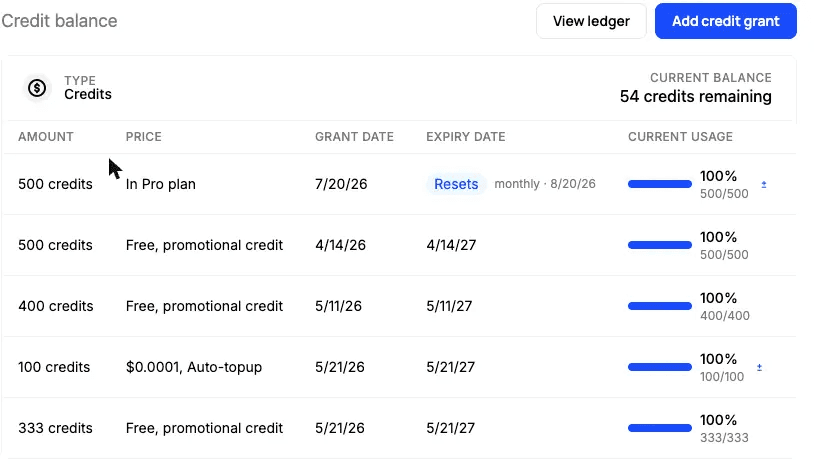
The billing software even supports concurrency-safe holds. Credits are reserved before an AI action starts, then committed or released based on the actual result. This prevents multiple agents from spending the same balance twice.
Rahul Gill, customer experience lead at Macabacus, says, "Schematic's ability to offer usage caps, bundles, and top-ups gave our customers the cost predictability they need."
Book a demo today to learn more about Schematic!
Switch to Schematic for a Complete Usage-Based Billing Platform
Schematic is the best billing platform for software and AI companies that want to sell usage-based plans, grant credits, and enforce limits at runtime.
Unlike traditional billing solutions, Schematic gives enterprise customers real-time visibility into usage, self-service controls, and configurable spending limits.
Buyers can set spending limits, manage top-ups, and receive alerts before usage stops. These controls prevent runaway bills and unexpected access throttling, making it easier for users to trust usage-based pricing.
Schematic's runtime entitlement engine applies new policies as soon as they're saved without filing an engineering ticket.
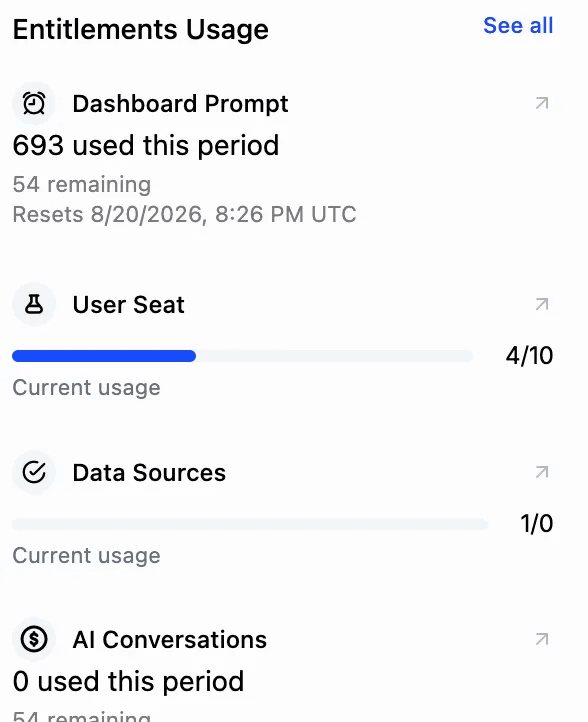
Plus, out-of-the-box tools that allow companies to:
Set when credits expire or whether they roll over to the next period.
Hold credits before committing or releasing them based on the action's results.
Version plans, migrate customers, and implement trial pricing.
Support credit-based revenue recognition and meet ASC 606 compliance.
Implement any pricing model without a billing rebuild.
Use a model context protocol (MCP) server to connect AI assistants and run automated workflows.
Max Ade from Pickleheads shares, "The Schematic MCP is fantastic, and we now do most of our work in Claude, accessing plan and billing information directly without leaving our workflow."
FAQs About Metronome vs. Lago
Which is the better billing system if you are billing at an enterprise scale: Metronome or Lago?
Metronome is a better fit for companies managing high usage volumes, complex contracts, and enterprise deals with minimum commitments. Lago suits businesses that want open-source billing infrastructure, flexible deployment options, and greater control over their billing systems.
Do Metronome and Lago provide credit wallets?
Yes, both Metronome and Lago support prepaid credit wallets. Metronome offers product-specific credits, automatic recharge, and spend previews. Lago provides credit balances, auto top-ups, and usage alerts to help customers monitor and manage credit consumption.
Is Lago an open-source billing infrastructure?
Yes, Lago is an open-source billing platform that companies can self-host. Developers can customize billing workflows, configure pricing rules, and integrate payment providers while maintaining full control over their billing infrastructure.