 Ryan Echternacht
A signed contract or a successful payment does not always mean companies can recognize revenue right away. A customer may pay upfront, receive services over time, change the contract terms after initial signing, or buy credits that they consume later.
ASC 606, or Accounting Standards Codification 606, provides a comprehensive framework based on a five-step model to standardize revenue recognition practices. The core principle is that revenue is only recorded once the promised goods or services are delivered to the customer.
This standard affects many types of companies, but it is especially important for SaaS and AI businesses that offer subscription plans, usage-based billing, and credits that burn down over time. For example, companies that sell AI credits can’t book the revenue until credits are actually consumed or once they expire.
When revenue is recognized the right way following ASC 606 guidelines, financial statements are more accurate and easier to review.
In this guide, we’ll discuss what ASC 606 means and explain how the revenue recognition process works.
TL;DR
- ASC 606 is a U.S. revenue recognition standard that tells private and public companies when and how to report revenue from customer contracts.
- The ASC 606 five-step model includes identifying the contract, identifying performance obligations, determining the transaction price, allocating the transaction price to performance obligations, and recognizing revenue.
- ASC 606 compliance helps companies report revenue more accurately, analyze financial health, build investor confidence, and reduce audit issues.
- Revenue recognition is especially challenging for SaaS and AI companies due to complex revenue scenarios, credit burndown pricing, unclear performance obligations, contract modifications, and disconnected data.
- Stripe automates revenue recognition. Schematic provides a full credit ledger on top of Stripe to track credit burndown accurately for proper accounting.
What Is ASC 606?
ASC 606 is a set of accounting rules that guides organizations on when and how to accurately report revenue from customer contracts.
It is the current revenue recognition standard used by both public and private companies that follow U.S. Generally Accepted Accounting Principles (GAAP).
The Financial Accounting Standards Board (FASB) issued ASC 606 in May 2014. The goal is to enhance the quality and consistency of revenue reporting across industries while improving the comparability of financial statements.
Before ASC 606, revenue recognition standards varied by sector. This makes it harder to compare financial performance.
ASC 606 replaces fragmented, industry-specific guidance with a universal, principle-based framework applicable to different fields.
ASC 606 vs. IFRS 15
ASC 606 and International Financial Reporting Standards 15 (IFRS 15) are standardized accounting principles that help companies report revenue more consistently.
Both standards follow the same five-step revenue recognition model, but they differ slightly in regulatory approach and specific application rules.
ASC 606 includes U.S.-specific guidance for companies, sales tax presentation, shipping and handling activities, license renewals, and noncash consideration.
As IFRS 15 was established by the International Accounting Standards Board (IASB), it does not always include the same policy requirements. There are also differences in the collectibility threshold, interim disclosures, and the incremental costs incurred in obtaining a contract.
Companies that operate in more than one country, especially outside the U.S., may need to review both standards with care.
The Importance of ASC 606 Compliance
ASC 606 compliance is important because it provides a more accurate view of a company’s financial performance and health. It sets clear rules for when and how revenue should be reported. If revenue is not reported the right way, the business may look stronger or weaker than it really is.
ASC 606 also supports transparent financial reporting. This can build trust with investors, board members, and other groups that rely on clean financial statements to make decisions.
Stakeholders can ensure that two different companies are recognizing revenue on a similar basis. Before ASC 606, an organization may artificially boost numbers to "look better" than another company.
The standard is also useful when customer contracts include discounts, refunds, usage fees, credits, or other forms of variable consideration. These terms can change how much a company or entity expects to receive from a customer. Maintaining compliance makes sure that the amount of revenue recognized reflects the overall transaction price.
Non-compliance with ASC 606 can lead to audit issues, reporting gaps, or deficiencies. These may negatively impact the company's valuation, stock price, and credit rating.
ASC 606 helps reduce those risks by ensuring accurate revenue recognition from customer contracts.
5 Steps for ASC 606 Revenue Recognition
To properly recognize revenue under ASC 606, you can follow this five-step model.
1. Identify the Contract With the Customer
The first step is to confirm that a valid customer contract exists. A contract can be written, oral, or implied through other customary business practices.
The contract needs to show that your company and the customer approved the agreement and plan to meet their obligations.
Make sure to identify each party’s rights, the goods or services provided, and the payment terms.
The contract should also have commercial substance. This means the deal is expected to change the entity's future cash flows.
A clearly defined customer contract ensures everyone is on the same page from the beginning.
2. Identify Performance Obligations
The next step is to identify performance obligations within the agreed-upon contract.
Think of performance obligations as promises to transfer goods or services to the customer.
Obligations should be distinct, meaning the customer can benefit from these goods on their own or with other resources they already have.
Most agreements only have a single performance obligation. For example, when a customer pays a basic monthly subscription fee, they receive access to the software platform in return.
However, some contracts can have multiple deliverables. A SaaS contract may include software access, custom setup, and ongoing technical support.
You should decide whether these obligations should be combined or separated. This step matters because each obligation affects how and when your company can report revenue.
3. Determine the Transaction Price
Once you've identified the performance obligations, you can set a transaction price and include it in the contract.
The transaction price is the amount your business expects to receive from the customer after delivering the promised goods or services.
It's not as simple as determining a sticker price. You should also factor in significant financing components and variable consideration, such as discounts, rebates, credits, refunds, and price changes.
4. Allocate the Transaction Price
After determining the total transaction price, allocate that amount to each performance obligation in the contract.
The allocation is usually based on the relative standalone selling prices. This involves comparing what each item would sell for on its own.
For example, a SaaS company may sell software access, onboarding, and premium support in one contract. Each part may have its own value.
If the customer receives a bundle discount, the organization should decide how to apply that discount to the items in the contract.
This step helps the company accurately report revenue earned for separate performance obligations.
5. Recognize Revenue
The final step is to recognize revenue once the entity satisfies a performance obligation and the customer has control of the good or service.
Some revenue is recognized at one point in time. For example, a manufacturer can report revenue once they have delivered the equipment to the customer.
Other revenue is recognized over time. This often applies to SaaS subscriptions because the customer receives access to the service during the contract term.
For instance, if a customer pays $12,000 upfront for a one-year software subscription, the SaaS vendor does not recognize all that revenue on day one. They usually record $1,000 per month as the customer uses the software.
Popular Revenue Recognition Methods
ASC 606 supports various revenue recognition methods. Companies can recognize revenue at a point in time or over time, depending on when the business transfers control to the customer. Let's break down each method below.
Sales-Basis Method
The sales-basis method recognizes revenue when a sale takes place, and the customer receives the product or service.
This method works well for retail transactions because the business can easily fulfill its performance obligation.
For example, an electronics store sells a laptop to a customer. The customer pays, receives the laptop, and takes control of it. The business can usually record revenue at the point of sale.
Percentage-of-Completion Method
The percentage-of-completion method records revenue as work is completed over time. This method is often used for long-term projects with clear progress markers.
Let's say a customer hires a construction firm to build a property over 18 months. Instead of waiting until the full project is done, the business may recognize revenue progressively as it completes each building project milestone.
This method can also apply to software development projects. A developer may use milestones, labor hours, or project stages to measure progress. As they reach each goal, they can recognize a corresponding percentage of the total revenue.
Completed-Contract Method
The completed-contract method reports revenue only after the contract is finished. It is often used when recognizing revenue at the point of sale isn't feasible or when progress is hard to measure.
For example, a construction business may wait to record revenue until a project is complete and handed over to the customer. This avoids estimating profits during construction.
Since this method has a single revenue recognition point, it can be simpler than recording revenue over time. The downside is that it makes revenue look uneven in different reporting periods.
A business may show poor financial performance (due to low revenue) while work is in progress, then report a large amount when the contract ends. This can make period-to-period results harder to compare.
Installment Method
In the installment method, the company recognizes revenue as it receives payment or cash from the customer over time.
For example, a business may sell equipment through a payment plan. The customer receives the equipment, then pays in monthly installments.
This method ties revenue more closely to cash flow. That can help manage working capital.
However, companies should be careful when using this method to ensure compliance with ASC 606. The core principle is that revenue is only recognized after transferring control to the customer.
Accrual Method
The accrual method records revenue when it is earned, not when cash is received.
It provides a more accurate picture of a company's financial performance. This is one reason accrual accounting is important to many ASC 606 revenue recognition processes.
For example, a SaaS vendor may bill a customer $2,400 upfront for an annual subscription to its entitlement management platform. The customer pays the full amount at the start of the contract, but the company should provide access to the software throughout the entire year.
Instead of recording all $2,400 immediately, the company would usually recognize $200 per month over the 12-month subscription period. The remaining balance stays as deferred revenue until the service is delivered.
Challenges in ASC 606 Revenue Recognition
ASC 606 can be difficult to implement when contracts, billing, and service delivery do not follow a simple pattern. Here are the challenges you may face:
Handling Complex Revenue Scenarios
Companies, especially SaaS businesses, often deal with multiple revenue streams from one customer relationship.
A single account might pay for a base subscription, premium support, user seats, AI credits, and add-on products.
Each item may have different timing, pricing, and delivery terms. Some fees are fixed, while others change based on usage or activity.
Different contract lengths can also create confusion. One customer may sign a monthly plan, while another signs a three-year agreement with annual billing.
Upgrades and downgrades even add to complexity. A customer may change plans in the middle of a billing cycle, which can affect the amount of revenue recognized in each period.
Selling Usage Credits
Usage credits are a very common billing approach for AI companies and established organizations releasing new AI-powered features.
Customers may buy credits upfront or receive a set number of credits as part of a monthly subscription plan. They use those credits over time to complete specific actions, such as AI prompts, API calls, data processing, and image generation.
However, ASC 606 can make credit burndown pricing more difficult to manage. Businesses usually cannot record the revenue until credits are consumed because that is when the customer receives the promised service.
Identifying Distinct Performance Obligations
ASC 606 requires companies to identify each performance obligation. This can be difficult when a customer contract includes several products or services in one package.
For example, in SaaS products, a contract may promise software access, onboarding, training, data migration, and customer support. The company must decide whether each item is separate or part of a single performance obligation.
This decision affects when revenue can be recognized. If the business treats two separate items as one, revenue may be delayed.
Handling Contract Modifications
Customer contracts often change after the original deal is signed. A customer may buy add-ons, renew early, cancel part of the service, or modify billing terms.
Each change can affect revenue recognition. The company needs to create a new contract or update the current one.
This can be difficult when changes happen often. For example, subscribers to a SaaS platform often add more users, remove seats, or enable automatic top-ups.
Contract modifications can also affect pricing. A discount, credit, or revised fee may change how revenue is allocated throughout the remaining contract term.
Without careful review, revenue schedules may no longer match the updated agreement.
Collecting Data from Multiple Sources
ASC 606 depends on accurate data from finance departments, sales reps, and customer success teams. This can be a problem when each department stores its records in different tools.
A signed contract may live in one system, while billing information sits in another. Usage data may come from the product, and service dates are found in the customer relationship management (CRM) software.
Finance teams may need to match these details before they can close the books.
According to a RightRev survey, 53% of finance leaders said that manual data entry and reconciliation can slow down operations and increase the risk of errors. The same survey reveals that 31% said that poor system integration makes it harder to recognize revenue correctly.
This challenge becomes more significant as transaction volumes increase. When information is spread across existing systems, the business struggles to maintain a complete and accurate view of revenue activity.
Best Practices for ASC 606 Compliance
The challenges above can create reporting gaps. Strong ASC 606 practices keep contracts, billing, and revenue records aligned.
Engage Key Stakeholders
ASC 606 compliance should not be the sole responsibility of finance. Sales, legal, billing, customer success, and product teams all play a role in the revenue recognition process.
Sales teams create pricing terms, discounts, renewals, and contract changes. Legal teams review rights, duties, and cancellation terms. Customer success teams may track onboarding, support, usage, and service start dates.
When different departments work together, they can identify revenue-related issues before they reach finance. Consistent communication makes it easier to spot contract terms that may affect revenue treatment.
Organizations should define responsibilities for contract management and escalation procedures. When everyone understands their role, there is less risk that important contract updates or non-standard terms will be overlooked.
Educate and Train Employees
Employees who work with contracts, billing, sales, or customer accounts should be familiar with ASC 606 requirements. They should know how their actions can affect revenue recognition processes.
Provide comprehensive training and education to these employees. Explain the ASC 606 five-step model clearly. Share practical examples and case studies to engage them.
Training should also cover new processes or systems. Employees must learn how to enter contract data, flag special terms, log customer changes, and share updates with finance.
Regular training sessions and refresher courses can help reinforce understanding, which makes it easier to meet ASC 606 compliance.
Automate Revenue Recognition
It's difficult to maintain data accuracy and stay compliant while managing high-volume contract changes.
Automated systems follow clear revenue recognition policies when handling these modifications.
For example, when a customer upgrades a subscription, the system automatically reviews the change, updates the transaction price, and reallocates revenue across the remaining contract period.
Automation reduces manual work and variations in the process. It ensures that revenue recognition accurately reflects the transfer of goods or services to the customer.
Stripe Handles Revenue Recognition, Schematic Provides a Credit Ledger for Appropriate Accounting
Schematic is the monetization operating system built on Stripe. Stripe automatically turns complex accrual accounting calculations into ASC 606-compliant reports. These help you prepare audit-ready financial statements and understand your company's current financial health.
However, revenue recognition becomes more difficult when your pricing model includes usage credits. Under ASC 606, you can only book the revenue once the customer consumes the credits.
That's where Schematic comes in. It provides a real-time credit ledger for credit burndown pricing. This helps teams track how many credits were purchased, granted, consumed, or expired for accounting purposes.
Unused credits can be recognized when they expire. For credits granted monthly as part of a plan, this is typically at the end of the month. Prepaid credits usually expire after a year.
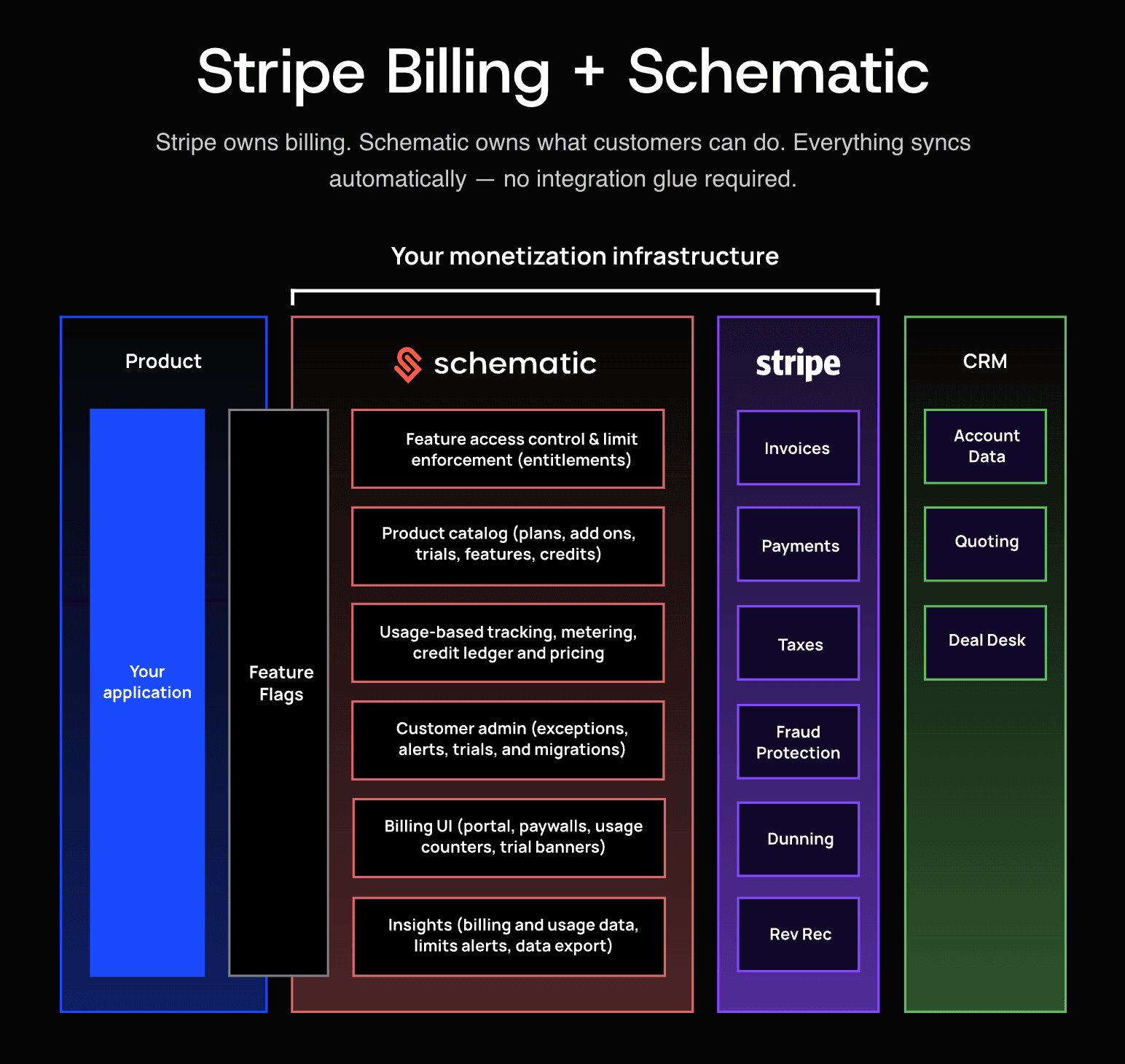
Schematic also provides additional capabilities on top of Stripe, such as usage-based metering, smart feature flags, internal admin dashboards, and embeddable billing components.
Schematic handles monetization at every stage, from how you charge your customers to how they experience your product. It decouples billing logic from the application, so go-to-market teams can control pricing, packaging, and software entitlements without deploying code.
FAQs About ASC 606
What are the five steps in ASC 606?
Under ASC 606, companies should identify the customer contract, identify performance obligations, set the transaction price, allocate the transaction price to obligations, and recognize revenue. These steps help businesses accurately report revenue from customer contracts.
What is ASC 606 in simple terms?
ASC 606 is a revenue recognition standard. It tells companies when and how to record revenue from customer contracts. The core principle is that the business only recognizes revenue once it delivers the promised goods or services to the customer.
Is ASC 606 hard?
Meeting ASC 606 compliance can be difficult because of unclear performance obligations, ongoing contract modifications, variable pricing, and scattered data from multiple systems. Businesses often use automated systems to simplify revenue recognition processes.
What are the five criteria for revenue recognition?
The five criteria are contract approval, clear rights for each party, payment terms, commercial substance, and probable collection. These criteria help a company decide whether an agreement qualifies as a customer contract under ASC 606.