 Ryan Echternacht
SaaS and AI companies require more than a checkout page to monetize their software. They also need to meter usage, control feature access, enforce limits, and connect product activity to billing setup.
A software development kit (SDK) designed for monetization gives developers a set of ready-made tools for adding billing and pricing functions to an app. It allows engineering to implement monetization on top of existing platforms without writing code from scratch.
With the right SDK, teams spend less time building and maintaining monetization logic. They can use the SDK's prebuilt components to simplify revenue generation.
In this guide, we'll explain the definition and importance of a monetization SDK.
TL;DR
- A monetization SDK refers to developer libraries and tools that integrate applications with pricing and billing APIs.
- Monetization SDKs help developers meter billable events, enforce usage limits, process payments, provide positive user experiences, and change pricing logic without code changes.
- The key features to consider are native support for different languages and frameworks, flexible configuration, event webhooks, and error or retry semantics.
- Schematic provides powerful SDKs that help SaaS and AI companies ship any pricing model, change packaging, meter usage, and enforce access at runtime.
What Is a Monetization SDK?
A monetization SDK is a set of code, libraries, and developer resources used to connect a product to pricing and billing systems.
It seamlessly integrates with an application so that it can capture usage events and manage feature access based on what the customer has purchased.
A monetization SDK is a useful tool for many developers. It helps them enforce pricing, packaging, software entitlements, and usage-based billing in software apps.
Monetization strategies often change in AI and SaaS platforms. The ComparEdge's SaaS Price Volatility Report tracked 2,042 pricing page adjustments among 329 products in 2026.
Without SDKs, every pricing change requires engineers to write one-off code inside the application.
SDKs allow teams to update plans, track usage, and implement monetization features consistently without code changes after the initial setup.
Why Do SaaS and AI Companies Need Monetization SDKs?
Monetization is not just a billing function inside a product. It defines how usage is tracked, how access is granted, and how customers interact with paid features. These decisions influence an app’s success as the company scales.
Meter Billable Usage Events
SaaS and AI companies often launch usage-based pricing because it aligns costs directly with customer value. Traditional billing solutions aren’t designed to capture usage events.
Developers use monetization SDKs to connect their app to modern usage-based billing platforms, which can support real-time metering. The platform can then collect usage metrics, such as API calls, tokens, AI credits, gigabytes of data storage, compute hours, and monthly active users (MAU).
Teams can measure how much each customer consumes during a defined billing period and connect that activity to the correct pricing rules.
Developers no longer need to create separate usage tracking logic for every metered feature or service. They simply use the SDK to add metering functionality to the application.
Enforce Limits at Runtime
Usage-based products need to check account limits before or during a product action. These include usage allowances, contract quotas, credit balance, or feature access.
A monetization SDK can recheck limits on each call, return a clear response to the application, and trigger runtime enforcement. It prevents customers from using more resources than what they paid for.
For AI products with costly model calls or compute, entitlement checks and enforcement can protect profit margins by stopping unapproved usage before costs build up. These are a core part of SDK monetization for platforms with variable consumption.
Process Payments Seamlessly
Monetization SDKs help developers add secure checkout and payment flows directly into the product, whether that's a communication platform or a mobile app for iOS or Android.
Instead of building transaction and payment security logic from scratch, the SDK connects the product to payment solutions.
RevOps teams can use this setup to collect a recurring subscription fee, enable in-app purchases, or charge customers based on usage.
This structure also supports several revenue streams without writing a separate payment flow for every pricing model, plan, or paid product action.
Provide Positive User Experiences
Monetization rules affect what customers see and what they can do inside a product.
SDKs can provide a consistent product experience by keeping paid access, limits, and account changes in sync with the customer’s current subscription and billing state.
They offer the following benefits to users:
- Runtime access to paid features that match current plan and billing status
- Fewer mid-session interruptions after upgrading, downgrading, or purchasing add-ons
- Real-time visibility into usage and limits
- Clear upgrade paths once limits are exceeded
- Consistent product behavior, regardless of whether the user is connecting from a new device or has a different role
A smoother product experience can improve user engagement and retention rate over time.
Change Pricing Without Redeploying Code
Hard-coded pricing rules can turn each update into an engineering sprint.
Monetization SDK can move plan logic, limits, and entitlements into configuration that the application reads at runtime.
With a single SDK, teams can apply those rules consistently without changing code every time pricing changes.
Engineers can focus on developing software features and optimizing app performance rather than rewriting access checks for new plans, exceptions, or contract terms.
Key Features to Look for in Monetization SDKs
Here's what you should consider when evaluating SKDs for monetization.
Language and Framework Support
Look for a monetization SDK that supports the languages and frameworks already used in your product. It should feel natural to install and use within your existing codebase.
Strong language support also gives most developers familiar methods, objects, and patterns, which can make adoption easier for frontend and backend engineering teams.
Configuration Settings
Check if the monetization SDK provides clear settings for environment selection, account identity, API credentials, and request context. These options help teams control how a single SDK behaves in app development, staging, and production.
Simple configuration also makes the integration easier to manage as the product evolves or runs across multiple deployments.
Event Webhooks
Webhook support notifies the system in real time when billing or account state changes. Common events may include subscription plan upgrades, downgrades, cancellations, or refunds.
Webhooks let your application react to these changes without repeatedly querying the billing system for new information.
Reliability and Error Handling
The SDK should return clear error messages and define what happens when requests fail, time out, or hit rate limits. Retry rules are also important for temporary failures.
Reliable error handling capabilities help developers build fallback logic and prevent failed monetization requests from causing confusing product behavior.
Schematic Supports Powerful SDKs to Operate Monetization at Runtime
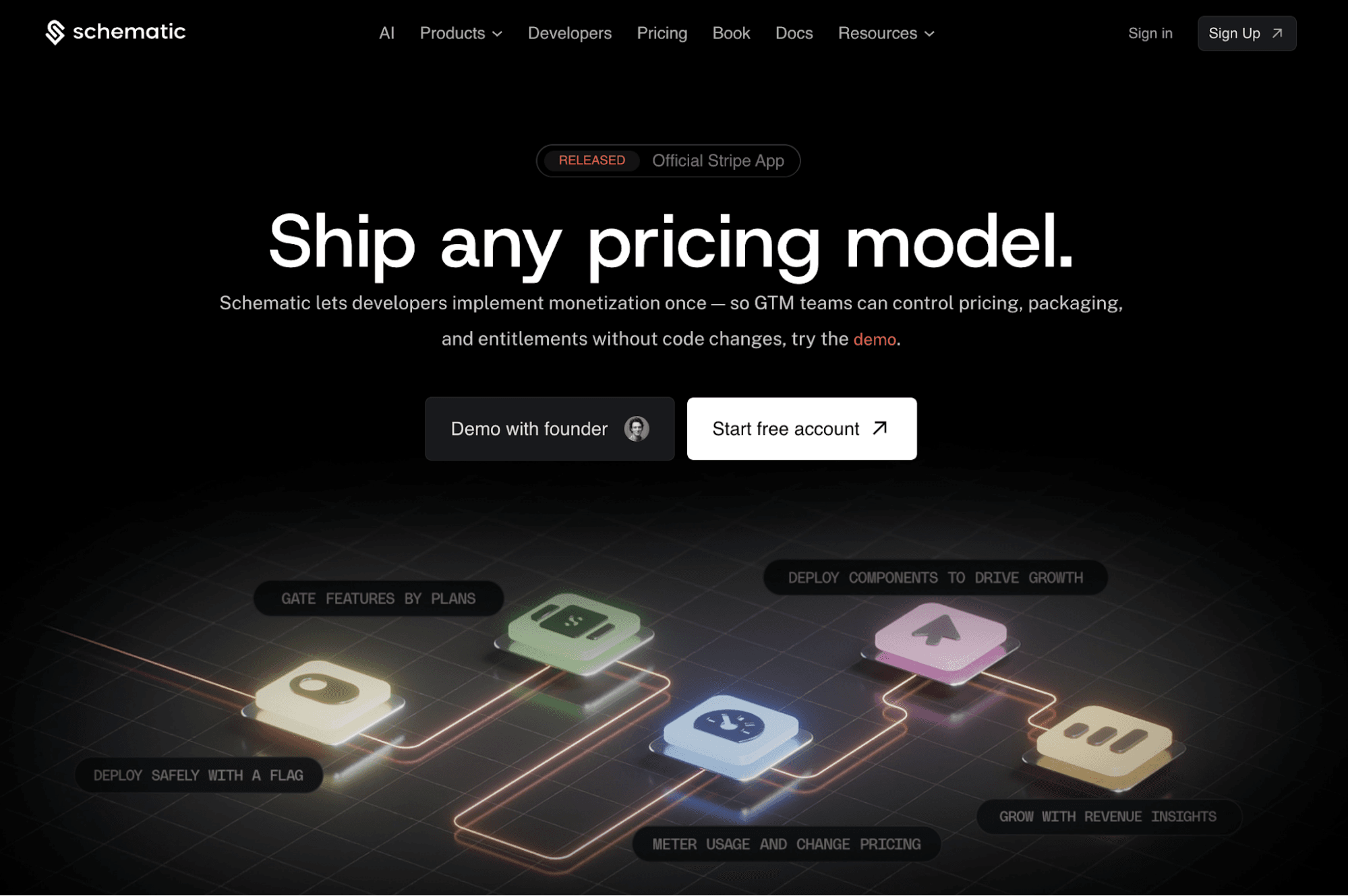
Schematic is a complete usage-based billing platform for software and AI companies selling to enterprises. It combines pricing, usage metering, an auditable credit ledger, entitlements, payment processing, and customer-facing components.
To operate AI and SaaS monetization, Schematic offers SDKs for the following languages and frameworks:
Type | SDKs |
Frontend | React, React Native, Vue, Angular, Next.js, JavaScript (Client-side) |
Backend | Node.js, Python, Go, Java, C#, Ruby |
These SDKs are designed for feature management, packaging, and entitlement tracking. They allow developers to evaluate pricing and access rules at runtime instead of hardcoding logic based on a Stripe plan.
Schematic also supports real-time metering at scale and evaluates who gets what through entitlement checks.
Enterprise credit wallets are another core feature. These give customers real-time visibility and control over usage, so they aren’t surprised by runaway bills or unexpected access throttling. They make it easier to trust usage-based billing.
FAQs About Monetization SDK
How do monetization SDKs work?
Monetization SDKs connect the application to pricing, billing, and entitlement systems. During a live request, the app sends context such as plan, role, and workspace to the SDK. The system evaluates entitlements in real time and returns an access decision. SDKs also count usage events, recheck limits on each call, and apply enforcement when thresholds are reached.
What can app developers do with monetization SDKs?
App developers use monetization SDKs to track billable events, manage feature access, enforce usage limits, enable seamless checkout flows, and update pricing logic through configuration instead of code.
Can you monetize SaaS and AI products without SDKs?
Yes. Teams can build monetization logic directly into their applications and connect to payment and billing APIs themselves. However, this involves writing and maintaining custom code for usage tracking, entitlements, pricing rules, payment events, and account changes. That can lead to technical debt when the company grows, and pricing becomes complex.