All posts
9 Software Monetization Models for SaaS and AI Products (2026)
Blog· Ryan Echternacht·Feb 18, 2026
Ryan Echternacht·Feb 18, 2026
Software monetization models have moved beyond simple subscriptions. If you build a SaaS or AI product, your pricing probably combines seats, usage, credits, limits, and add-ons to reflect how customers adopt and consume the product.
These models affect more than revenue. They decide what users can access, when upgrades appear, how limits apply, and how value shows up inside the product over time. The way customers pay very much determines what they can do at runtime.
A software monetization model defines how access and usage convert into revenue, and how those rules are enforced inside the product as customers interact with it.
This article breaks down the most common software monetization models used in 2026 and explains where each fits as pricing expands beyond basic subscriptions.
TL;DR
- Software monetization models define how access, usage, and limits turn into revenue in SaaS and AI products.
- The 9 most common software monetization models include flat-rate pricing, per-seat pricing, usage-based pricing, credit-based pricing, tiered plans, add-ons, freemium, marketplace fees, and outcome-based pricing.
- Most products run hybrid monetization, mixing subscriptions with usage, credits, add-ons, or sales-negotiated contracts to reflect how customers buy and consume software.
- Product-layer enforcement keeps monetization consistent at runtime. Tools like Schematic let teams manage plans, entitlements, limits, and usage without shipping billing logic in application code.
9 Software Monetization Models Teams Use in 2026
Below are the most common monetization models software companies use in 2026, with practical examples of where each fits.
1. Flat-Rate Subscription Monetization
Flat-rate subscription charges a fixed recurring fee for unlimited core access, regardless of users, usage volume, or features unlocked.
It fits products where customer value stays consistent over time and renews on a fixed schedule.
A common setup includes one plan, for example, at $299 per month, with no scaling costs.
When usage climbs without tied revenue, it misses growth, so most extend this base layer with usage or add-ons.
2. Per-Seat Monetization
Per-seat monetization ties pricing to how many people actively use the product. Every new user added to an account increases the cost. You see this pattern most often in collaboration tools and products sold to enterprise customers.
Seats are often priced around $25 per user per month, with admin roles controlling access to premium features.
It is frequently connected directly to entitlements, so access updates immediately when users are added or removed. That avoids manual license management and billing mismatches.
Seat-based pricing reflects team growth well, but it rarely captures heavy usage on its own. Many products pair it with other pricing models.
3. Usage-Based Monetization
Usage-based pricing charges customers for what they actually consume. That could mean API calls, events processed, compute minutes, or data volume. Revenue grows with demand instead of headcount.
A product might allow 1 million events per month, then charge for every additional block.
Engineering track usage data continuously and enforce limits inside the product, not weeks later on an invoice. Tight integration with billing systems keeps charges predictable.
Usage-based monetization works well when value increases with activity and when customer usage patterns vary widely in accounts.
4. Credit-Based Monetization
Credit-based monetization fits products where actions vary in cost. You sell credits upfront, then deduct them as customers trigger work inside the product.
A lightweight action may consume a small number of credits, and a heavier operation may consume significantly more.
AI products use this model when usage-based pricing feels too noisy and flat plans hide real cost. A customer might buy 50,000 credits per month and watch usage draw that balance down in real time. You monetize software without surprising invoices or blocking legitimate usage.
Credits support flexible pricing, reduce revenue leakage, and create new revenue streams without forcing constant plan changes.
5. Tiered Plans
Tiered plans group access, limits, and features into clear packages. Each tier serves a specific customer segment with different expectations and budgets.
Most products start with three tiers:
- The lowest tier protects existing revenue with tight limits
- The middle tier captures expansion as usage grows
- The top tier supports overrides and custom terms
Entitlements enforce these rules inside the product, not just inside billing platforms.
Tiered plans help generate revenue without overcomplicating pricing and packaging. Customers understand what changes when they move up a tier, which keeps upgrades predictable and reduces confusion.
6. Feature or Add-On Monetization
Add-ons let you charge for capabilities that only some customers need. You keep the core software focused, then sell advanced features separately. This avoids bloated plans and awkward pricing jumps.
Examples include audit logs, advanced controls, premium integrations, or higher-rate limits. Features attach directly to entitlements, so access changes instantly after purchase without support tickets or manual toggles.
Add-ons support customer acquisition at the low end and drive revenue growth with existing customers. They also give product teams room to ship new features without reshaping the entire business strategy.
7. Freemium and Free Tier Models
A free tier keeps the door open without giving everything away. You let users work inside the product, but you decide where it stops. That stop might be usage volume, feature depth, or how many people can join.
Freemium works when early adoption drives long-term growth. A solo user might receive core functionality with a fixed usage cap.
Once real work begins, limits surface inside the product and guide upgrades based on behavior rather than marketing prompts.
Free tiers support customer satisfaction and early adoption, but only when limits are enforced cleanly. Without enforcement, free users turn into unpaid load instead of future paying customers.
8. Marketplace and Platform Fees
Marketplace products earn revenue when transactions are completed. Buyers and sellers interact through the platform.
The platform takes a percentage, charges a flat commission, or requires paid listings. Revenue ties directly to transaction activity.
One platform might take 15% from each completed transaction. Product rules control who can list, who can buy, and when payouts unlock. Entitlements enforce those rules inside the product instead of relying on other business systems.
Platform fees create recurring revenue streams that scale with demand. They open revenue opportunities without forcing a subscription on users who may never transact.
9. Outcome- or Value-Based Monetization
Outcome-based monetization charges for results instead of access. Customers pay when the product delivers something measurable, such as leads captured, fraud blocked, or time saved.
This model relies on value-based pricing rather than feature counts.
AI and automation tools use this approach when usage-based models fail to reflect delivered value. Products may charge per resolved case instead of per API call. Usage tracks and billing triggers when outcomes register.
Outcome pricing can support customer satisfaction and strengthen competitive advantage, but only when measurement stays precise and product rules are enforced consistently.
Why Hybrid Monetization Models Are Now the Default
Most SaaS and AI teams no longer rely on a single pricing pattern. Products start simple, then add complexity as customers grow, usage shifts, market trends, and buying paths split between self-serve and sales.
One model rarely supports all of that.
Hybrid monetization reflects how software products operate in the global software industry today. You need predictable revenue at signup and room to expand later. You need limits that protect value and pricing that responds to real usage. That balance defines the right software monetization strategy.
Modern products combine models to match market demands:
- Subscription plus usage overages to capture growth
- Base plans paired with add-ons for flexibility
- Subscriptions paired with credits for variable workloads
- Self-serve plans paired with sales-negotiated contracts
Hybrid setups tie pricing tiers to real customer value. Runtime enforcement replaces manual business processes, which keeps pricing consistent and supports modern software monetization solutions as products scale.
How to Monetize Your Software
Monetizing software means translating pricing decisions into product behavior. The model alone does not drive revenue. Enforcement does.
You need plans, entitlements, limits, and usage rules that update in real time as customers interact with the product.
The sections below outline practical ways SaaS and AI teams monetize software successfully:
Align Monetization With How Customers Use the Product
Start with usage patterns inside the product. Stable access points support subscriptions or seats. Variable consumption points toward usage or credits. Expansion behavior supports tiers and add-ons.
You monetize more effectively when pricing reflects real product actions. Track where customers hit limits, invite teammates, or trigger high-cost operations. Those moments signal where monetization should apply.
Define Plans And Entitlements First
Plans should describe more than price. Each plan needs clear entitlements. Features, limits, usage caps, trials, and add-ons should attach directly to those entitlements.
When entitlements drive access, upgrades and downgrades apply instantly. You avoid manual checks and billing delays. Product behavior stays consistent with the pricing state.
Enforce Limits And Usage At Runtime
Monetization breaks when limits are enforced late. Usage should be evaluated during the billing cycle, not after invoices are generated.
Runtime enforcement prevents revenue leakage. Trials expire when they should. Free tiers stop when caps hit. Overages apply as usage grows.
Customers understand what they can do at every moment.
Support Hybrid Pricing And Hybrid Selling
Most products mix models. A self-serve subscription might include usage overages. Enterprise deals often include credits, add-ons, and contract exceptions.
Your system needs to handle standard plans and sales overrides together. Pricing changes should not require code deployments. Product access should reflect negotiated terms immediately.
Keep Monetization Logic Out Of Application Code
Pricing logic breaks down when it lives in application code. Every pricing change turns into a release. Every exception adds another condition that becomes hard to reason about over time.
Moving monetization logic outside the application keeps product behavior stable while pricing changes. Plans, limits, and entitlements can be updated without redeployments, and ownership stays shared across product, engineering, and RevOps instead of being locked in code.
Monetization works when these decisions are enforced at runtime and stay tied directly to product behavior.
Schematic: Operating Monetization Models at Runtime
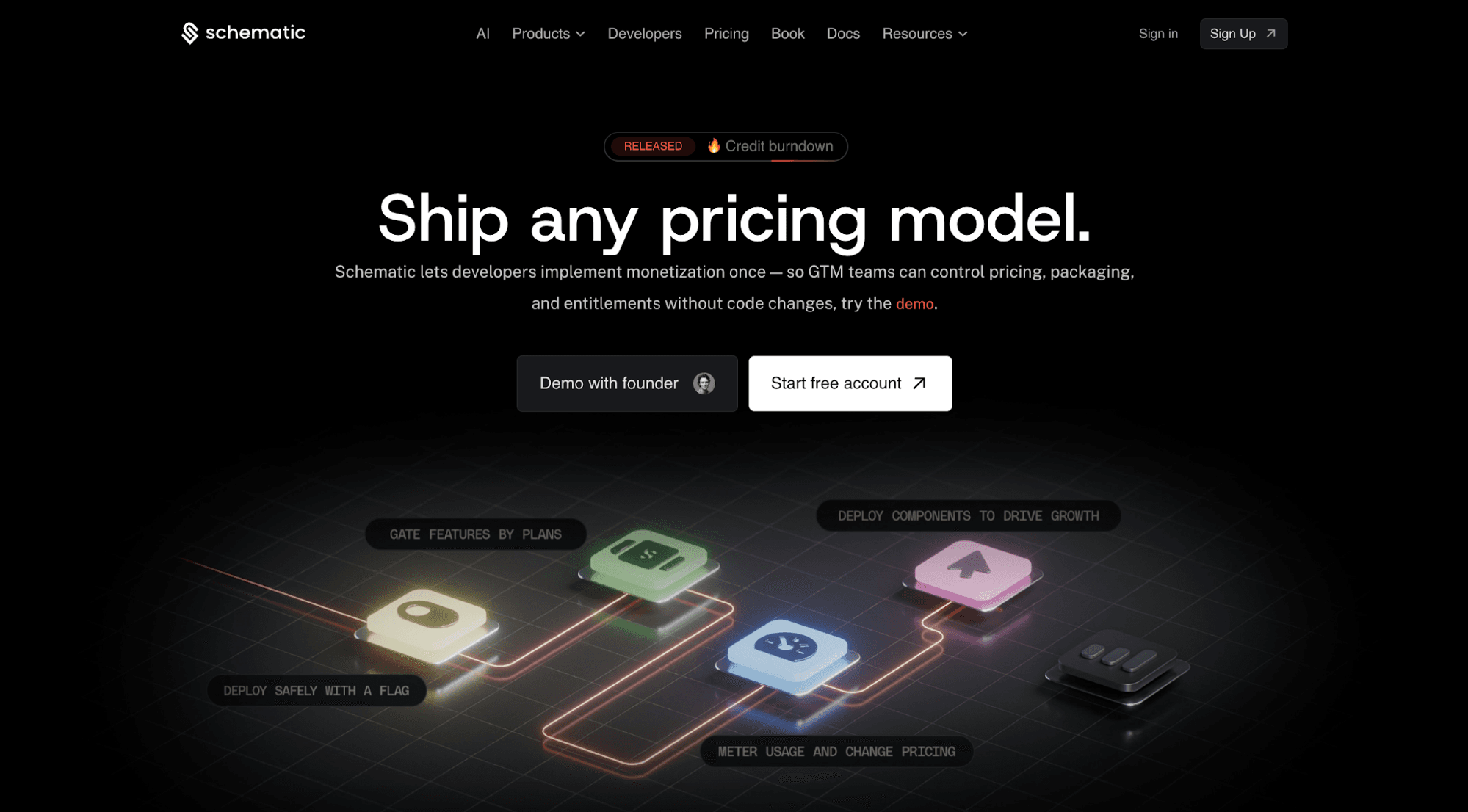
Most software monetization models break in practice because pricing never fully reaches the product. Subscriptions live in billing systems. Usage lives in analytics. Access rules end up hard-coded or stretched through feature flags.
Schematic, built on Stripe, sits at the product layer where your monetization models become enforceable decisions.
Stripe continues to handle billing, invoices, and payments, and Schematic works alongside it. You can use Schematic to control what users can access, how much they can consume, and when product behavior changes.
Schematic serves as the system of record for plans, SaaS entitlements, usage limits, credits, trials, add-ons, and customer-specific terms. Your product evaluates those rules at runtime, so access reflects the customer’s current state rather than a past invoice.
Schematic fits products where:
- Subscription, usage, and credit models run together
- Limits need to be enforced mid-cycle instead of after billing closes
- Sales overrides and temporary exceptions become routine
- Pricing updates need to ship without code changes
You keep pricing flexible while your product stays predictable because entitlements live outside application code
FAQs About Software Monetization Models
What is software monetization?
Software monetization is how a company turns product access and usage into revenue. It defines how software constitutes billable value through plans, usage limits, credits, licenses, or fees, including for SaaS platforms and mobile apps.
What are the different types of monetization?
Common monetization types include subscriptions, per-seat pricing, usage-based pricing, credit systems, freemium models, marketplace fees, and outcome-based pricing. Many teams combine these into new business models to support growth and changing customer behavior.
How do you monetize a software product?
You monetize a software product by choosing a pricing strategy that matches how customers use it, then enforcing access, limits, and upgrades inside the product. Effective monetization helps maximize revenue, protect margins, and accelerate growth without relying solely on marketing.
What is a monetization model?
A monetization model defines how customers pay, what they can access, and how usage converts into revenue. It also supports software IP protection by controlling entitlements, licenses, and limits based on customer state and contracts.