 Ryan Echternacht
Software pricing is no longer limited to subscription plans with fixed fees. Many SaaS companies now charge customers based on how much they use a product. This usage can include API calls, storage, transactions, AI credits, or monthly active users (MAUs).
Usage-based billing software is a platform that helps teams track customer usage, apply pricing rules, and generate accurate invoices based on actual consumption. It can reduce manual billing tasks, lower the risk of missed charges, and prevent disputes.
This guide explains how usage-based billing platforms work, who needs them, and their main benefits. We'll also share tips for choosing the right usage billing software for your SaaS business.
TL;DR
- Usage-based billing platforms are tools that let software companies bill customers based on how much they use a product.
- The platform works by collecting usage data, metering events, applying pricing rules, generating invoices, and processing payments via a payment system.
- SaaS businesses benefit from automated usage tracking, fewer billing errors, less revenue leakage, stronger customer trust, better product-led growth, and improved pricing flexibility.
- To choose the best usage billing software, look at the supported pricing models, metering accuracy, automation capabilities, integrations, and customer-facing tools.
- Schematic is an all-in-one usage billing platform for software and AI companies. It helps teams close enterprise deals faster by giving customers real-time visibility and control over consumption.
What Are Usage-Based Billing Platforms?
Usage-based billing platforms, also known as consumption billing software, are tools that help SaaS companies charge customers based on product usage.
In a usage-based pricing model, the total bill changes depending on how much the user consumes. Teams that rarely use the product have lower costs. High-usage customers pay more.
Pricing feels fair because it's based on the actual value a customer receives rather than a fixed fee that may not match real usage.
Usage billing platforms connect product activity to billing operations. For example, they can monitor usage events, such as using 10 GB of storage or consuming 50 monthly credits. Then, they apply the right pricing rules so each customer is billed for the correct amount.
Usage-based billing systems also enable SaaS businesses to manage complex billing scenarios with fewer mistakes.
Instead of using spreadsheets or manual checks, teams can rely on automated software to track usage, calculate charges, create invoices, and process payments.
Who Needs Usage-Based Billing Software?
Any SaaS business that charges customers based on product usage needs usage billing software. This includes established organizations and startups.
Established SaaS companies rely on usage-based billing software to manage complex pricing models at scale. They usually have many plans, custom contracts, discounts, credits, overages, and add-ons.
Large organizations use the platform to automate usage tracking, reduce manual work, and keep invoices accurate as usage increases.
On the other hand, startups use usage billing software to test pricing and support early growth. They charge customers pay-as-you-go or pay-as-you-use to reduce sign-up friction.
As their product matures and customer base expands, startups often need to move away from simple usage metrics and toward more complex pricing structures. They rely on usage billing software to launch different models and bill customers without creating more work for engineering or finance teams.
In both cases, the goal is the same: connect usage to revenue while simplifying the billing process.
How Usage-Based Billing Platforms Work
Usage-based billing systems turn product activity into billable usage, then convert that usage into accurate invoices. Here's a closer look at how these platforms for usage-based billing work:
Collect Usage Data
The first step is tracking usage data from the SaaS product.
The billing platform receives events each time a user takes a billable action. This may include an API request, file upload, payment transaction, or message sent.
Each event should include details, like customer ID, account ID, event type, timestamp, and usage amount. This helps the platform connect each action to the right customer.
The best usage-based billing systems support real-time usage tracking. This is important when customers need clear visibility to prevent runaway bills or proactive alerts about usage spikes.
Meter and Aggregate Usage Events
After collecting usage data, the billing software meters and groups the events.
Metering means the platform measures or sums usage based on the chosen billing metric. For example, it may count total API calls, add up storage used, or track the number of credits consumed over time.
Then, the platform groups usage events by customer, plan, product, and billing period.
This step helps turn raw usage data into organized billing records. It also keeps usage tied to the correct account.
Enforce Pricing Rules
Once usage is tracked and aggregated, the billing system applies specific pricing logic. These rules decide how much each customer owes based on actual usage, plan, or custom contract.
For example, you may charge a flat rate (e.g., $15 for 1 TB of storage).
You can also use tiered pricing, where you break down usage into defined tiers (e.g., 0-10k units, 10k-100k units, etc.). The unit prices decrease as usage increases. In this case, customers pay less per unit if they use more than 10k units.
Another popular usage-based pricing structure is overages on top of a base plan. You charge customers a recurring fee for access to your product with limited usage. Once they exceed that threshold, you can bill for additional consumption and capture upside revenue.
Generate Invoices
After calculating charges based on pricing rules, the usage billing software generates invoices. Each invoice should show what the customer used and how much they owe.
Depending on the pricing structure, the platform can add line items for base fees, usage fees, overages, credits, discounts, and taxes.
Invoices are usually created at the end of a billing cycle, such as monthly or yearly. Some SaaS companies may also bill as soon as a customer reaches a usage limit.
Process Payments
The final step is payment processing.
The usage-based billing platform can send the invoice to the customer and collect payments through a connected payment solution or payment gateway. This tool offers different payment methods, allowing customers to pay via credit card, bank transfer, or digital wallet.
Some advanced usage billing solutions can also track payment status and refunds. If a payment fails, these tools can even send automated reminders or retry the payment.
6 Key Benefits of Adopting Usage-Based Billing Platforms
Below are the advantages you can expect once you adopt usage-based billing software.
1. Automate Usage Tracking
A usage billing platform helps SaaS companies track product usage without relying on manual checks.
It can automatically collect usage events from the product and consolidate them into logical billing units.
Without a dedicated billing system, teams may need to pull usage data from product logs, spreadsheets, or internal tools.
Usage billing software reduces that manual work, allowing the business to charge customers faster and with less back-and-forth.
2. Reduce Billing Errors
Usage-based or consumption-based pricing is prone to human errors when teams track usage and calculate charges manually.
A billing system minimizes that risk by automating billing workflows, from usage metering to invoice creation.
The platform can also match usage events to the right customer, apply the right pricing rules, and calculate charges accurately.
Fewer billing errors mean fewer support tickets and disputes. Customers can trust their invoices when charges match their actual consumption.
3. Prevent Revenue Leakage
Revenue leakage occurs when a SaaS business earns revenue from product usage but fails to bill for it. This can happen when they miss usage data, apply the wrong pricing rules, or calculate incorrect charges.
Usage-based billing platforms prevent revenue leakage by automatically tracking billable actions and connecting them to customer accounts.
If an account goes over a usage limit, uses more credits, or completes more transactions, the system can also capture that extra activity for billing.
It helps SaaS teams charge for the usage they already provide, which can protect revenue.
4. Gain Customer Trust
Usage billing software makes it easier to explain usage-based fees to customers by offering real-time dashboards. This gives customers a clear view of their current usage without waiting for the invoice to arrive.
The platform also sends proactive alerts to warn users before they exceed usage limits, use additional credits, or reach a higher pricing tier.
Some systems can also enable hard usage caps. These block more usage and stop extra charges until the user approves an upgrade.
All these controls help customers trust their bills because they can see how charges are tied to real usage. They reduce confusion and improve customer satisfaction.
5. Support Product-Led Growth (PLG)
Usage-based billing platforms support product-led growth by allowing pricing to scale with customer value.
Users can start with a lower cost, try the product, and expand as they get more value from it.
This go-to-market strategy works well for products where usage naturally increases over time. A customer may begin with a small number of API calls or limited credits for startups. As their needs scale, their usage and bill can grow as well.
A dedicated billing system gives SaaS teams the usage data they need to track growth and identify accounts that are ready to expand.
6. Improve Pricing Flexibility
Usage billing software gives business users the controls they need to test and iterate on usage-based pricing models.
GTM teams can launch pay-as-you-go pricing, usage tiers, credits, overage pricing, and hybrid models without rebuilding the billing infrastructure every time they need to implement changes.
RevOps can offer promotional plans or adjust usage limits in free trials to increase customer conversion rates.
A usage-based billing platform makes it easier to support flexible pricing structures for different plans and customer segments.
Startups can start with pay-as-you-go, then add new SaaS pricing models as the product grows or when customer behavior changes.
Common Usage-Based Billing Models That the Platform Should Support
Pricing flexibility depends on the usage-based billing models the platform can support. SaaS teams need room to charge for usage in different ways.
Pay-As-You-Go
Pay-as-you-go charges customers only for what they use. There is no fixed amount to be paid besides the usage charges set by the company.
For example, a SaaS business may bill per API call, per transaction, per message, or per credit.
If a customer uses more, they pay more. If they use less, they pay less.
This pricing model works well when usage patterns change often. It can also lower the entry cost for new customers because they do not need to commit to a large plan upfront.
Metered Billing
Metered billing tracks a specific usage metric and charges customers based on the measured amount over a defined billing cycle.
The usage billing system must collect usage data and turn it into a billable metric. Common billing metrics include storage used, data processed, seats added, reports generated, and emails sent.
Metered billing helps SaaS companies match the invoice to customer consumption.
Tiered Usage-Based Pricing
In usage-based billing contexts, tiered pricing charges different rates as usage moves through defined levels.
The first usage tier may have a fixed price, while higher tiers may have lower unit prices.
For example, you may charge one rate for the first 50 reports generated, a lower rate for the next 100, and another rate after that.
The billing platform should apply the correct charges to different pricing tiers. This is important because mistakes in pricing logic can lead to inaccurate invoices and customer disputes.
Overage Pricing
Overage pricing applies when a customer uses more than the amount included in their plan. The customer pays the base subscription fee, then pays extra for usage that exceeds the limit.
For example, a plan may include 100k events per month. If the account uses 120k events, the extra 20k events are billed as overage fees.
This usage-based pricing model provides predictable subscription revenue while still capturing upside from higher usage.
Make sure the billing platform can track limits, calculate extra usage, and show overage charges clearly on the invoice.
Credit Burndown
Credit burndown pricing gives customers credits that burn down as they take billable actions inside the product.
Each action reduces the credit balance based on the company’s pricing rules. For example, a single API call may cost 1 credit, while a larger task may cost 10 credits.
When customers run out of credits, they can purchase additional credits, enable automatic top-ups, or upgrade to a higher tier. The usage billing software should track those activities in real time.
Credit-based models support flexible pricing. Finance and product teams can raise or lower the credit cost of an action without rebuilding billing infrastructure.
Volume-Based Pricing
Volume pricing sets the unit price based on total usage during a billing cycle. Higher usage often earns a lower price per unit.
For example, a customer that uses 5k units may pay one price per unit, while an account that uses 100k units is charged a lower price for all units.
This model works well for SaaS companies that want to reward high-usage customers.
Hybrid Pricing
A hybrid pricing model is a type of multi-dimensional pricing strategy where companies bill for two or more variables.
It typically combines a fixed subscription fee with consumption billing. This structure lets teams charge a base monthly fee for access to the product, then bill for credits, tokens, or MAUs through a usage model.
Hybrid is a popular pricing model for SaaS companies because it balances the need for revenue predictability and flexibility. A Growth Unhinged survey reveals that 37% of businesses use it.
Finance teams get a stable baseline of recurring revenue from the fixed pricing component, while the organization captures expansion revenue as usage increases.
How to Choose the Best Usage-Based Billing Software
The best usage-based billing software should fit your usage metric, pricing model, financial requirements, and customer expectations. Here are some tips for choosing the right platform.
Step 1: Identify Your Usage Metrics
Decide which actions should be billed. The right usage metric should match how customers get value from your product.
For example, if you offer a product analytics tool like PostHog, you can charge based on the number of events processed.
If you're building a team collaboration platform, you might want to consider billing for seats or the number of licensed users on an account.
Cloud infrastructure companies can charge for compute, storage used, transactions, or API requests.
Choose a usage metric that should be easy for your team to track and easy for customers to understand. Below are some examples:
- API calls
- Credits
- Data transfer or storage
- Session recordings
- Compute resources
- Reports
- Emails
Step 2: Match the Platform to Your Pricing Model
Check if the billing platform can deploy various usage-based pricing models. Some SaaS companies prefer pay-as-you-go pricing. Others need tiers, overages, credits, or hybrid pricing.
Invest in software that supports variable pricing plans as your product grows. This way, you avoid changing platforms in the future in case you need to change pricing.
Make sure the pricing engine can apply the right rules to each customer account. These include flat-rate pricing per unit, volume discounts, credits, and commitments with usage flexibility.
Step 3: Evaluate Metering Accuracy
Metering accuracy is one of the most important factors to evaluate when choosing usage-based billing software. If the usage data is wrong, the invoice will be wrong as well.
The platform must continuously collect usage events from your product and match each event to the right customer. It should also handle duplicate events, late events, missing data, and corrections.
Accuracy matters when accounts have unpredictable usage patterns or when you offer different products with various billing metrics. Small tracking issues can eventually turn into billing delays, revenue reporting inaccuracies, and customer disputes.
Step 4: Review Billing Automation Features
The best billing platform automates billing, from usage metering and rating to invoice generation. This reduces manual work and lowers the risk of missed charges.
Look for features that monitor usage events, apply credits, handle overages, and add volume discounts.
You should also check if it can collect payments and send automatic follow-ups for failed transactions.
Billing automation helps finance teams close billing periods faster and spend less time fixing invoice issues.
Product and GTM teams also benefit because they can quickly adjust billing structures and usage limits.
Step 5: Check Integration Capabilities
Product usage events start inside your app, but billing data may need to move between sales, finance, and IT systems.
Make sure the usage billing platform can connect to your existing tech stack. This includes subscription management systems, accounting software, data warehouses, customer relationship management (CRM) software, entitlement management systems, and payment processors.
Strong APIs and SDKs are also important. They let engineering teams fetch usage events, enforce metered paywalls, limit access, and build custom workflows.
Step 6: Consider Finance and Accounting Requirements
Finance teams need more than usage data and invoices from the billing platform. They also need tools for reporting, tax management, and revenue recognition.
Usage-based billing can be harder to manage because revenue fluctuates from one period to the next.
Choose a platform that helps finance teams recognize revenue accurately, calculate overages, handle refunds, and forecast revenue trends.
Step 7: Look for Customer-Facing Systems
The best usage-based billing software should not only serve internal teams. It should also help customers understand their usage, limits, and charges.
Look for usage dashboards and self-service portals that support transparent pricing. These features allow customers to check their usage without waiting for the invoice to be sent.
Make sure the platform can also send proactive alerts when customers are near their plan's usage limit. Notifications give them enough time to reduce usage, approve more spending, or upgrade before extra charges apply.
Schematic Implements Usage-Based Billing Your Customers Can Trust
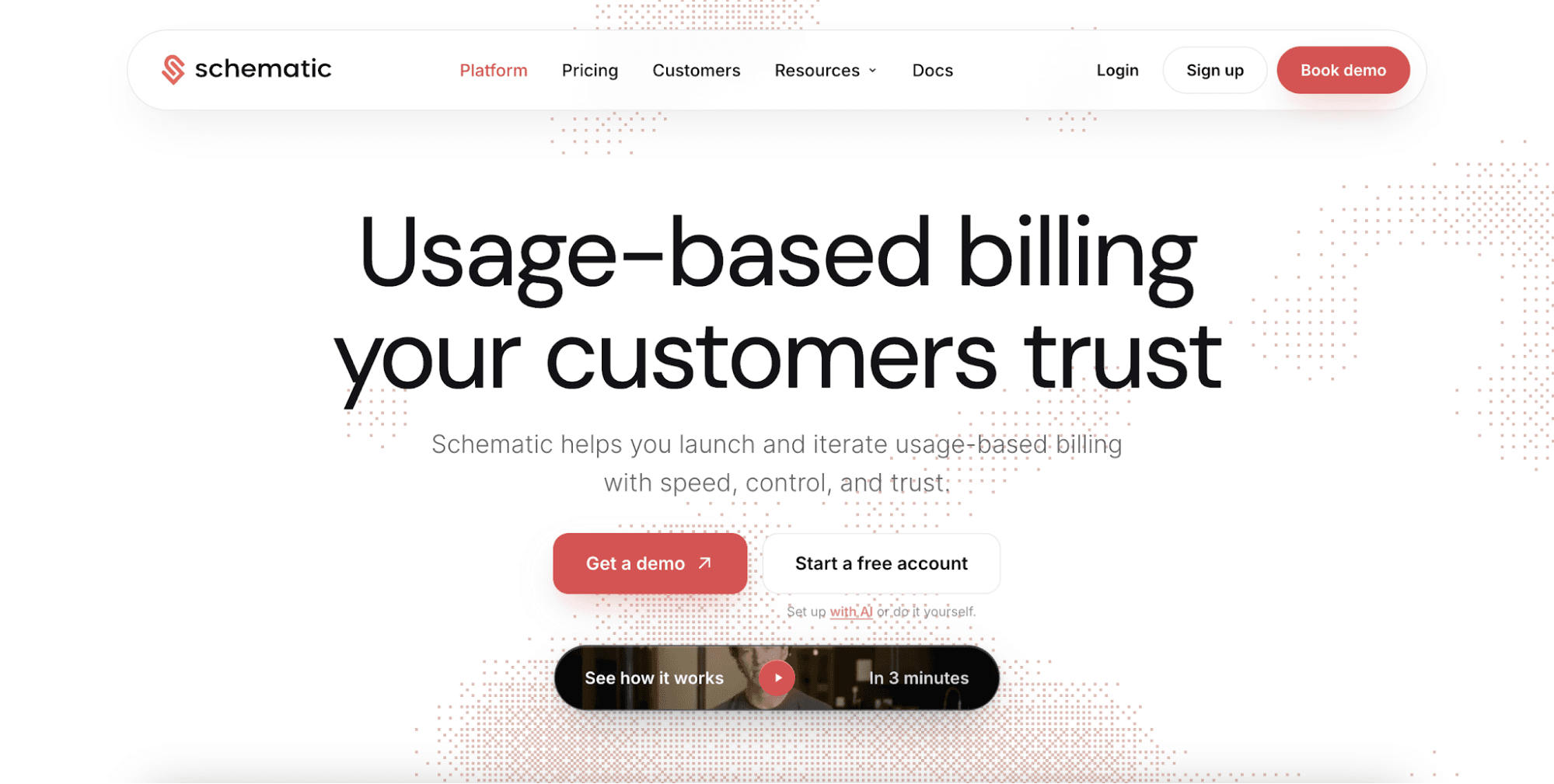
Schematic is the best usage-based billing platform for software and AI companies selling to enterprises.
Schematic is the only usage billing software with runtime enforcement. It can gate features and answer access questions from the same ledger that bills customers. Usage policies automatically take effect without filing a support ticket.
Native credit wallets give customers full visibility and control over their consumption. Buyers can set per-user or per-agent usage limits, receive a warning before usage stops, change the credit top-up policy, and define what happens at the cap.
Schematic also helps teams launch and iterate on any usage-based model, including pay-as-you-go, overage, credit burndown, and per-seat pricing, from one engine. Version plans, preview changes, and change packaging through configuration, not code.
Use Schematic to solve the trust problem in usage billing, close enterprise deals faster, drive expansion, and earn more revenue.
FAQs About Usage-Based Billing Platforms
What is an example of usage-based billing?
An example of usage-based billing is a SaaS company charging customers for each API call, credit, transaction, or gigabyte of storage used. The total bill changes based on actual usage.
How are usage-based billing platforms different from subscription billing systems?
Subscription billing systems usually charge a fixed recurring fee. Usage billing platforms charge based on product activity. This helps SaaS companies serve different customer segments. Smaller teams with low usage can pay less, while larger accounts pay more as usage scales.
How does usage-based billing software prevent revenue leakage?
Usage-based billing software prevents revenue leakage by automatically tracking billable usage, applying pricing rules, and creating accurate invoices. Businesses avoid missed charges and manual errors, which can improve customer retention.
What is the difference between usage-based and outcome-based pricing?
Usage-based pricing lets customers pay based on how much they use the product. Outcome-based pricing charges based on the result the product delivers, such as a resolved ticket, completed workflow, or qualified lead.