All posts
AI Credits for Startups: How They Work and Best Practices
Blog· Ryan Echternacht·Mar 25, 2026
Ryan Echternacht·Mar 25, 2026
Pricing an AI product is not simple. Your costs increase every time a user runs a request, generates content, or uses a feature. At the same time, customers rarely behave the same way. Some use your product lightly, while others rely on it heavily.
This creates real risk for early-stage startups. If you price too low, heavy usage can eat into your profit margins. Pricing too high can slow down growth and lose users.
That is why many startup founders are turning to AI credits. Instead of guessing how much users will consume, you package usage into credits so pricing stays flexible while still being easy for customers to understand.
In this guide, you’ll learn how AI credits for startups work and why founders should use credit-based pricing.
TL;DR
- AI credits for startups are usage-based units that bill customers for AI actions, such as image generation, data analysis, or API calls within a product.
- They work by assigning a credit value to each AI feature and deducting credits from a user’s balance as they use that functionality.
- Startups use AI credits to align pricing with usage, protect margins, manage unpredictable AI usage, support experimentation, simplify pricing, and encourage product adoption.
- Platforms like Schematic help startups manage AI credits, usage, limits, and plans without building or maintaining complex billing logic.
What Are AI Credits for Startups?
AI credits for startups are billing units tied to product usage. Each action, such as an API call, export, or event lookup, consumes a set number of credits.
This gives users a simple way to receive access to AI services or features without dealing with complex pricing like compute time.
Most products show credit usage in real time. Customers can see how many credits they have left, review past activity, and understand which actions are using their credits.
Startups sell AI credits in different ways. For example, some include a fixed number of credits in a monthly plan. Others offer prepaid bundles, which allow customers to purchase more credits when needed.
Free trials may also come with a small credit balance, so users can try AI features before committing.
How Do AI Credits for Startups Work?
AI credits for startups work by turning AI usage into simple units that users can spend.
Each action inside your product has a defined credit cost. For example, creating images or processing data will deduct a specified amount of credits from the user’s balance.
When a customer signs up for your product, they receive credits based on their plan. These may come from a free trial, a monthly subscription, or different program tiers. Some users may also be eligible for bonus credits during promotions.
As customers use AI features, credits are deducted in real time based on what they do.
On the backend, your product tracks usage and connects it to credit consumption.
When credits run low, users can upgrade or buy additional resources using a valid credit card or any payment method.
If the credit balance reaches zero, the user's access to features typically pauses. Alternatively, you can enable overage billing, where users continue using the product and pay for additional usage beyond their credit balance.
Why Should Startups Use AI Credits for Pricing?
AI credits give startups a flexible way to price their products and remain in control of usage, revenue, and growth. Here are the top reasons why startup founders should adopt credit-based pricing:
Align Pricing with Actual Credit Usage
AI credits tie pricing directly to how customers use your product. Every action consumes credits, so usage drives revenue in a clear way.
This creates a fair system for all types of customers. Light users spend fewer credits, while heavy users spend more. You don’t need to group them into rigid plans.
It also makes pricing easier to manage. You don’t have to predict how much every customer will use your product. Instead, you charge customers based on their credit usage.
Protect Profit Margins
AI costs increase with every request. If you rely on fixed pricing, heavy users can quickly eat into your margins.
AI credits help you stay in control. Every action has a defined credit cost that reflects your underlying expenses.
As users consume more, they also spend more money on credits. That means your revenue grows with usage.
You can also adjust credit pricing over time. If your operational expenses change, you can update how many credits each action consumes.
Handle Unpredictable AI Usage
Customers want predictable spend, but their AI usage is not consistent. One prompt might use cheap and fast inference, while another may trigger a complicated AI journey in different models.
AI credits smooth out variable usage patterns. Customers can prepay for a block of credits and use them at their own pace. They'll find it easier to manage costs since they know how much they have already paid and how much usage remains in their accounts.
Startup companies benefit from more predictable revenue. You collect payment upfront and allow flexible usage at the same time.
Support Experimentation
If your startup is growing fast, your team needs to move quickly and test new ideas without getting blocked by pricing decisions.
AI credits give you that flexibility. You can adjust the credit cost of a feature without changing your pricing structure or affecting the customer’s billing agreement.
This means users continue spending credits the same way, even as you change how features are priced behind the scenes.
Meanwhile, developers can focus on the product and not on how to price or package every new feature. Engineering teams can ship solutions faster.
Simplify Multi-Product and Feature Pricing
AI products often include multiple features or tools, such as text generation, search, or data processing. Pricing each one separately can quickly become hard to manage.
AI credits simplify this by using a shared credit pool across your entire product. Instead of creating separate pricing for each feature, everything draws from the same balance.
This makes packaging easier for your team. You don’t need to build and maintain different plans for every feature.
It also gives your customers more flexibility. They can consume credits to use different features based on their needs without being locked into one use case.
This keeps pricing simple as your product expands.
Encourage Product Adoption
AI credits make it easier for users to get started. You can offer small credit packages or free credits, so customers can try your product without a high upfront cost.
It lowers the barrier to entry. More users are willing to sign up and test your product before committing.
As usage increases, revenue grows with it. Customers start small, then spend more credits as they see value.
A credit-based pricing model also supports product-led growth. Users pay based on how much they use your product, not forced upgrades from sales.
How Different Startups Benefit from AI Credits
AI credits support organizations at different stages of the startup journey by helping them manage costs, pricing, and growth as their platform and customer base expand.
- Series A - These startups are still finding product-market fit after pre-seed funding. They use AI credits to price their product without guessing usage upfront. They can offer simple credit packages, test pricing quickly, and collect upfront revenue.
- Series B - They are scaling the product and expanding market reach. AI credits help Series B startups handle different usage levels in various accounts without changing the billing agreement. This keeps pricing flexible while supporting larger customers and improving revenue consistency.
- Series C - These startups are often profitable and focused on global expansion. AI credits help standardize pricing across different products, support enterprise usage, and keep revenue aligned with growing demand at scale.
Best Practices for Using AI Credits in Startup Pricing
AI credits work best when your pricing is clear, flexible, and tied to actual usage. These best practices help you set up a system that scales with your product.
Define AI Credit Value
When you start building your pricing model, determine your actual operating costs. Look at API usage, cloud infrastructure, and other expenses tied to each AI action. Then, convert that into a simple credit value.
Make sure the credit value is easy to understand and clearly posted on your company's website. Customers should know what one credit represents.
For example, if you have an AI/ML platform, one credit means 1,000 tokens generated or one model inference call.
If you're selling a developer tool, a single credit can equal one test run or a build minute.
Avoid complexity. When users don't understand credit value and pricing, they may hesitate to use your product.
Set Usage Limits and Alerts
Users want control over their credit spending. Give them clear visibility into how many credits they have left and how fast they are using them.
Add alerts when usage reaches certain levels. For example, you can notify users when they are close to running out of credits. This prevents surprises and builds trust.
You can also set limits to pause usage before credits are fully consumed. Doing so protects users from overuse and helps them manage their budget.
Allow Easy Credit Top-Ups
When users run low on AI credits, they should be able to add more without friction.
Offer predefined bundles so users can quickly choose how many credits to add.
Make it easy to register and complete the purchase flow in a few steps. The faster users can top up, the less likely they are to drop off.
This increases customer satisfaction and provides consistent revenue for your startup.
Offer Free AI Credits to Drive Adoption
Free AI credits help users get started. You can offer a small balance at signup so they can test your product.
This reduces hesitation and lets customers experience value early. It also helps accelerate adoption, especially for new users exploring your product.
Many organizations, including major cloud providers, follow this approach. For example, Google Cloud offers free cloud credits to new companies so they can start building a proof of concept without upfront costs. The AWS cloud platform also provides credits for free.
Keep the free credits limited so users have a reason to upgrade. You want them to see value quickly and continue using your product.
Combine AI Credits with Subscriptions
You can combine AI credits with a base subscription plan. The subscription provides access to your product, whereas credits cover usage.
This pricing model gives you predictable revenue while still allowing usage to scale. It also works well if you offer advanced features or technical resources tied to higher plans.
You can create tiers with different credit amounts based on user needs. This makes it easier to support both small businesses and enterprise customers.
Monitor and Iterate Pricing
Track how users consume AI credits over time. Look at which features drive the most usage and where costs are increasing.
Then, use this data to review your pricing. You may need to change how many credits certain actions consume.
By regularly adjusting your pricing, you can improve profit margins and remain competitive.
Startups are not the only ones doing this. According to Kyle Poyar of Growth Unhinged, the top 500 SaaS and AI companies made over 1,800 pricing changes in 2025 alone. Out of 500, 79 now offer a credit model.
This report shows that pricing is an ongoing process, not something you set once and leave unchanged.
Launch AI Credit Pricing for Startups With Schematic
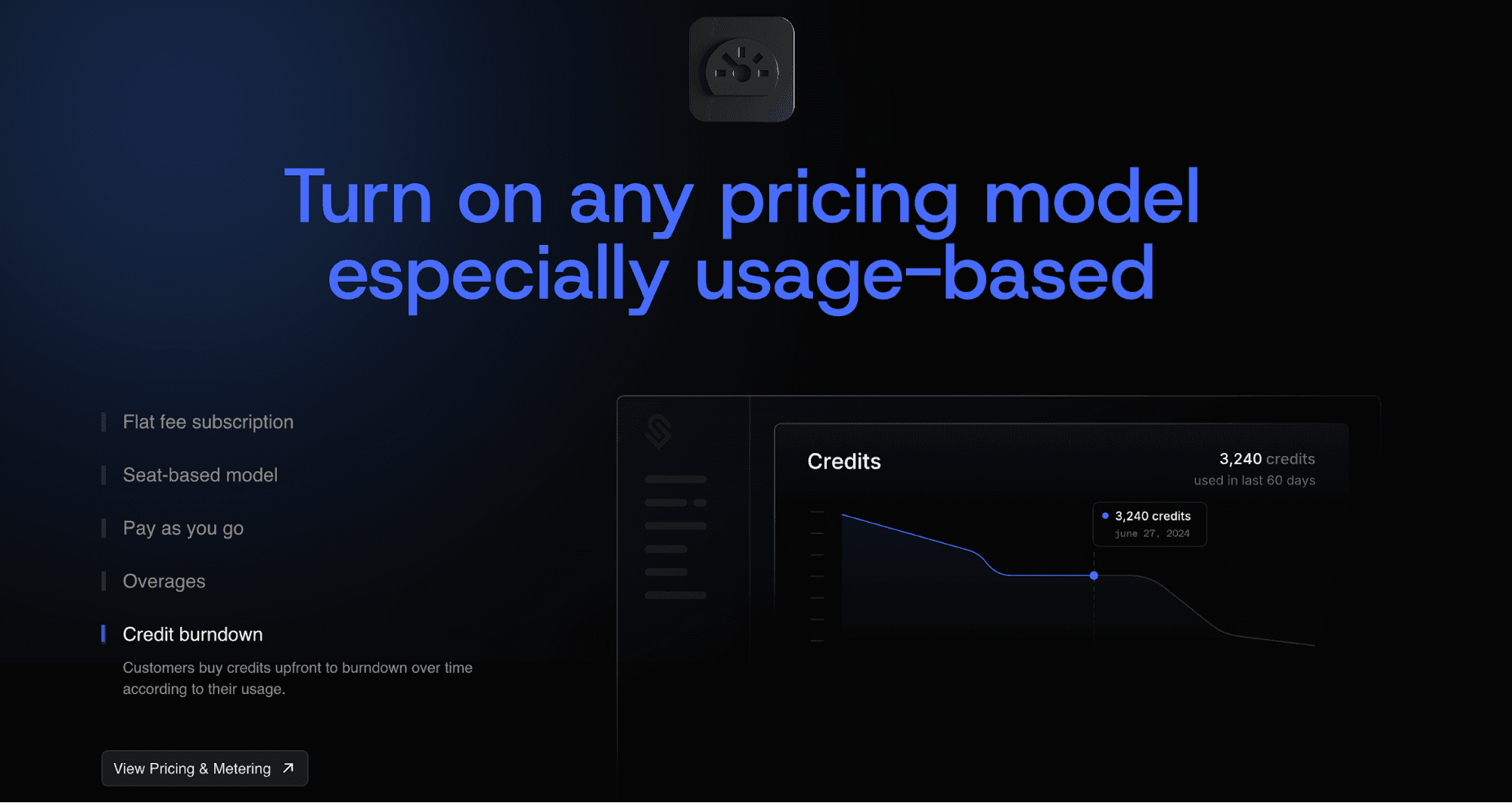
Building AI credit systems inside your product can get complex fast. You need to track usage, manage balances, handle edge cases, and keep billing aligned with what users can access.
Schematic provides a better way to handle credit-based monetization.
By integrating with Stripe, Schematic serves as the central system for managing plans, credits, limits, SaaS entitlements, add ons, and overrides.
Instead of writing and maintaining custom billing logic, you define how credits work and let Schematic enforce it inside your product.
With Schematic, you can:
- Launch credit-based pricing without hard-coded logic
- Package AI credits inside a seat-based or hybrid plan
- Enforce credit burndown in real time
- Monitor usage events and pause access once limits are reached
- Enable prepaid top-ups or overages
- Keep product behavior aligned with Stripe billing state
Engineering implements monetization once. Product and GTM teams update pricing, launch new plans, and adjust credit allocations without code changes.
FAQs About AI Credits for Startups
How do startups price AI credits?
Startups price AI credits by mapping expenses to usage. They look at API calls, compute, or infrastructure costs, and then convert them into credit units. Each feature or action consumes credits based on usage, with a margin added to stay profitable. Startups communicate credit value on the pricing page or marketing materials.
When should AI startups use credits?
AI startups should use credit-based pricing when product usage varies among customers or features. Some teams may run a few requests, while other workers generate thousands of AI outputs. Credits also help when different AI models have varying costs. For example, text is considerably cheaper to run than image generation.
What are examples of AI credit pricing in startups?
Startups often charge credits per action. For example, one text generation may cost a single credit, but image generation may cost more. Some startups offer monthly credits, while others sell prepaid bundles that users can buy anytime.
Who uses AI credits for pricing?
Both startups and established businesses use credit-based pricing. Startups adopt this model to manage costs as they grow. Larger companies apply it across complex products and AI services. For example, Microsoft 365 AI features, which power productivity, require AI credits. The exact credit allotment depends on the user's Microsoft 365 plan.