 Ryan Echternacht
PostHog offers developer tools for building products, talking to customers, and understanding user data. What initially started as an open-source analytics tool now offers more than 10 products, including session replay, feature flags, and surveys.
One thing that stands out is how PostHog pricing works. Unlike many product analytics platforms that bill based on monthly tracked users (MTUs), PostHog charges based on raw input metrics like API requests, events, and responses.
PostHog's pricing page is also unique because it feels more like an e-commerce checkout than a typical SaaS pricing page. Social proof, impulse-driven calls to action (CTAs), and pricing calculators remove decision friction.
PostHog makes the choice easy and intuitive for developers. You pick only what you need and pay for actual consumption instead of features you don't use.
This guide breaks down PostHog pricing to help you understand how much it actually costs.
TL;DR
- PostHog has a usage-based pricing model. You start free, then pay based on usage like events, recordings, and API requests as you scale.
- The developer tool offers two main plans: Free and Pay-as-you-go. Both include unlimited team members, API access, and single sign-on.
- Each product has its own pricing, with free monthly limits and tiered rates that get cheaper at higher volumes.
- You can extend PostHog with platform packages or paid add-ons: Boost ($250/month), Scale ($750/month), and Enterprise (custom pricing).
- PostHog's all-in-one developer tool makes it easy to build products. Platforms like Schematic help you define pricing, packaging, and feature access without hard-coded logic.
How PostHog Pricing Works
PostHog offers a generous free tier for all products with usage limits that reset monthly. You don't need a paid plan as long as you stay within predefined limits.
If your usage goes beyond the free tier, PostHog switches to transparent, usage-based pricing. That means you don’t pay a fixed subscription fee. Instead, you’re charged based on actual consumption.
Each PostHog Cloud product has its own pricing metric. For example, product analytics is based on event volume, session replay is billed per recording, and feature flags are priced per request.
You only pay for the specific products you use, and you can set billing limits per product to avoid unexpected costs as your usage grows.
PostHog Pricing Plans
PostHog offers two simple pricing plans: Free and Pay-as-you-go. Both include unlimited team members, no limits on tracked users, API access, and SSO with Google, GitHub, and GitLab. This makes it easy to scale without seat-based pricing restrictions.
Free Plan
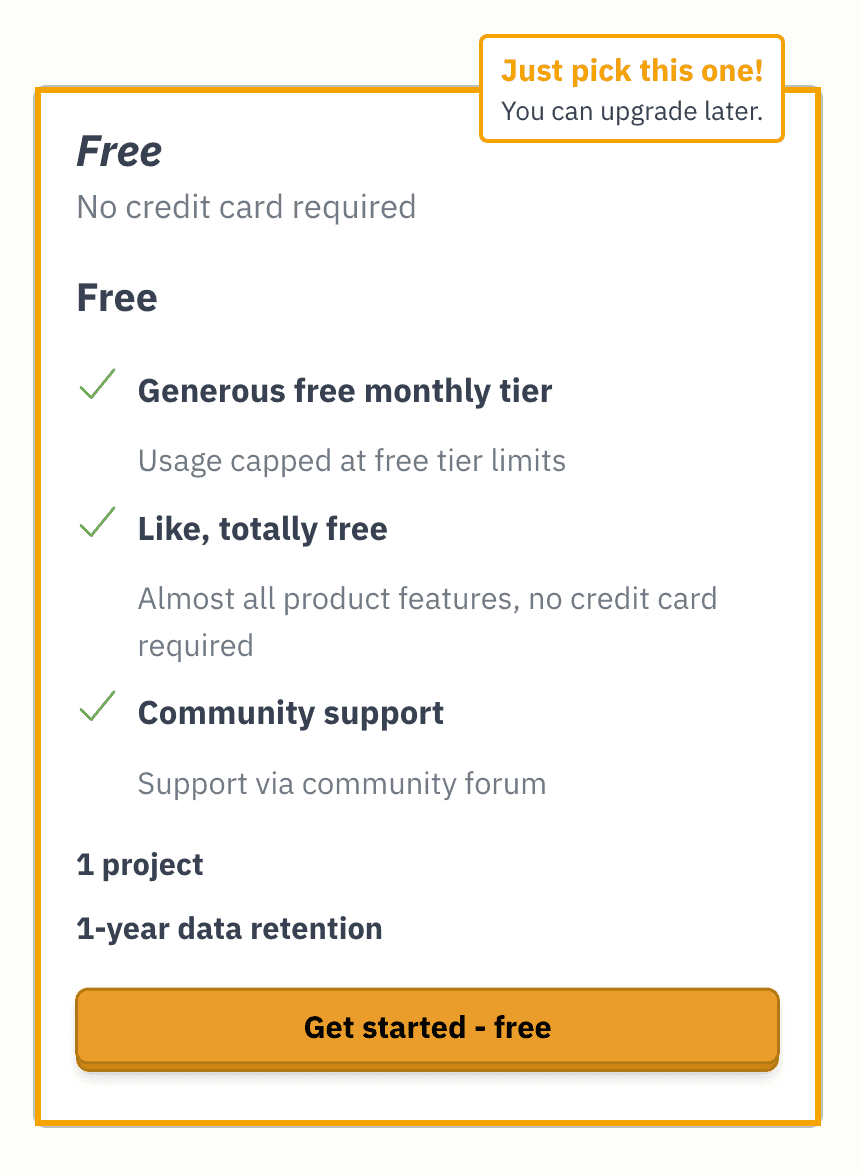
The Free plan provides full access to PostHog’s core products without an upfront cost.
Source: PostHog.com
You can use PostHog analytics, session replay, feature flags, experiments, and more within generous monthly usage limits that reset every billing cycle.
Each product, such as analytics or session replay, comes with its free usage allowance. As long as you stay within those limits, you won’t pay anything.
PostHog's Free plan also includes community support. It allows a single project with one-year data retention.
If you want more projects, longer data retention, or additional usage beyond the limits, you'll need to upgrade to a usage-based pricing plan.
The Free tier is best for early-stage startups, indie developers, hobbyists, and teams validating product ideas before scaling.
Pay-as-You-Go
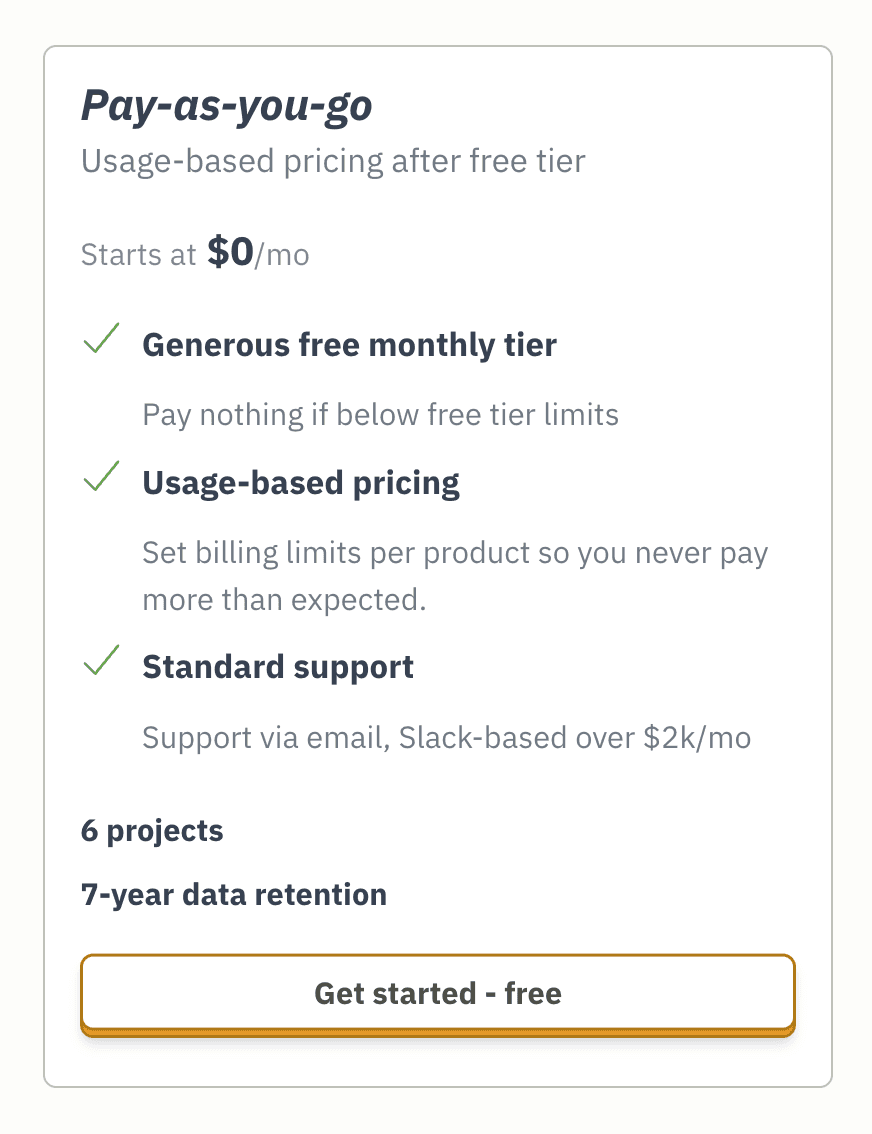
The Pay-as-you-go plan kicks in automatically when usage exceeds the free tier limits.
Source: PostHog.com
Instead of forcing you into rigid pricing tiers, PostHog's pricing model is usage-based. It charges customers depending on their actual consumption for each product, such as events, recordings, or feature flag requests.
You only pay for what you use beyond the free allowance and only for the products you enable. This pay-as-you-go pricing model helps you scale gradually without committing to expensive plans upfront.
PostHog's Pay-as-you-go plan offers standard support via email, six projects, and seven years of data retention.
It suits scaling startups, growth-stage SaaS companies, and teams with increasing product usage that need flexible pricing without lock-in.
PostHog Platform Packages
After signing up for a free plan, you can subscribe to PostHog's platform packages to unlock unlimited projects and advanced features. These include white labeling, access control, two-factor authentication, and single sign-on (SSO) login.
These packages sit on top of the core PostHog pricing plans and incur additional costs. They are designed for teams that need more features and control.
Boost Add-On
The Boost add-on expands what you can do beyond the default pay-as-you-go setup, especially for growing businesses. It costs $250 per month.
With Boost, you get more flexibility in how you manage projects and data. You can:
- Enforce 2FA and SSO login
- Automate provisioning
- Use your own branding on shared dashboards
- Customize chart colors
- Access team collaboration features
- Configure security permissions
- Set up access settings for publicly shared resources like insights
- Retain session replay data up to 12 months
Boost is useful if you’re managing multiple projects or environments and want stronger collaboration.
Scale Add-On
The Scale add-on is best for scaling teams that need better control over access, security, and operations. It's priced at $750 per month.
This package includes all features in the Boost package plus the following capabilities:
- Priority support with a target response time of 24 hours
- Activity logs for two months
- SAML SSO
- Approval workflows
- AI-powered product analytics
Scale helps you move from basic usage to a more structured setup designed to scale with your organization.
Enterprise Add-On
The cost of the Enterprise add-on is hidden on PostHog's website. It suits large enterprises that need strict security, data privacy, compliance, dedicated support, and training.
You get all the capabilities in the previous platform packages, plus Enterprise features, such as:
- Priority support with a target response time of 8 hours
- Session replay data collection and retention for up to 60 months
- Activity logs for 60 months
- A dedicated account manager
- Role-based access control
- Ongoing training
- Custom master services agreement (MSA)
- Custom pricing
- Invoice payment
Having dedicated customer support is important for large teams running PostHog in production at scale. Faster response times can make a big difference when issues come up.
PostHog Product Pricing Breakdown
Once you go beyond the free plan limits, PostHog charges you based on actual usage. Each PostHog product is priced separately, so you only pay for what you use.
Actual costs reduce with scale. That means the cost per unit goes down when your usage increases.
Let's break down these expenses below:
Product Analytics
Product analytics is PostHog’s core product. It tracks event data from websites, mobile apps, and other applications. This helps developers understand user behavior and make informed decisions for product development.
PostHog's pricing for its product analytics platform is based on events.
The first one million events per month are free. After that, pricing starts at $0.0000500/event for 1–2 million events and decreases as volume increases.
Here's a table for your reference.
Monthly Volume | Price per Event |
First 1 million events | Free |
1–2 million | $0.0000500/event |
2–15 million | $0.0000343/event |
15–50 million | $0.0000295/event |
50–100 million | $0.0000218/event |
100–250 million | $0.0000150/event |
250 million+ | $0.0000090/event |
Web analytics are billed through PostHog's product analytics platform.
Paid add-ons are also available, such as:
- Group analytics - This lets you associate events with a group, such as a company, community, or project. It costs $0.000071/event.
- Data pipelines - If you want to transfer PostHog data to your data warehouse, expect to pay $0.000062/event.
Session Replay
Session replay in PostHog tracks user interactions or user engagement within a website or software app. You can see clicks, scrolls, and navigation paths, which can help debug technical issues and identify user friction without context switching.
PostHog bills for session replay per recording every month.
You get the first 5,000 session recordings every month for free. If you exceed the limits, you'll pay overage fees.
Here's how much session replay costs:
Recording Count | Price per Recording |
First 5k | Free |
5–15k | $0.0050/recording |
15–50k | $0.0035/recording |
50–150k | $0.0020/recording |
150–500k | $0.0017/recording |
500k+ | $0.0015/recording |
The pricing for mobile replays in PostHog is different. The first 2,500 mobile recordings are free, while the rest are paid.
Mobile Recording Count | Price per Recording |
First 2.5k | Free |
2.5-15k | $0.0100/mobile recording |
15-50k | $0.0070/mobile recording |
50-150k | $0.0040/mobile recording |
150-500k | $0.0034/mobile recording |
500k above | $0.0030/mobile recording |
Feature Flags
Feature flags let you release features safely to specific users or groups. You can turn features on or off without redeploying code.
PostHog's feature flag pricing is based on requests. The platform gives you the first million requests for free. The cost beyond that number varies.
Number of Requests | Price per Request |
First 1 million requests | Free |
1–2 million | $0.000100/request |
2–10 million | $0.000045/request |
10–50 million | $0.000025/request |
50 million+ | $0.000010/request |
Surveys
With PostHog's no-code surveys, you can develop in-app or on-page pop-ups with freeform text responses, ratings, and multiple choices.
You don't have to pay anything for the first 2,500 responses, but you'll be charged per response once you go beyond that limit.
Number of Responses | Price per Response |
First 1.5k responses | Free |
1.5–2k | $0.100/response |
2–10k | $0.035/response |
10–20k | $0.015/response |
20k+ | $0.010/response |
Managed Warehouse
Managed warehouse lets you store large amounts of PostHog data (events, persons, groups, etc.) in your DuckDB warehouse. You receive a dedicated data store and flexible compute without the operational overhead.
PostHog pricing for the managed warehouse is based on rows. The first million rows come without cost. The platform charges a minimal fee if you exceed that limit.
Number of Rows | Price per Row |
First 1 million rows | Free |
1–10 million | $0.000015/row |
10–25 million | $0.000010/row |
25–50 million | $0.000008/row |
50–100 million | $0.000005/row |
100–1 billion | $0.000002/row |
1 billion+ | $0.000001/row |
Data Pipelines
PostHog's data pipelines provide full-service integrations for ingesting, transforming, and sending data to other sources.
The pricing depends on multiple resources, whether real-time destinations or batch exports.
Here's a table showing expected costs for real-time destinations.
Trigger Event Volume | Price per Trigger Event |
First 10k trigger events | Free |
10–50k | $0.000500/trigger event |
50–100k | $0.000300/trigger event |
100k–1 million | $0.000150/trigger event |
1–10 million | $0.000100/trigger event |
10–100 million | $0.000050/trigger event |
100 million+ | $0.000025/trigger event |
The table below provides prices for batch exports.
Number of Rows | Price per Row |
First 1 million rows | Free |
1–10 million | $0.00001500/row |
10–50 million | $0.00000500/row |
50–100 million | $0.00000250/row |
100 million+ | $0.00000125/row |
Error Tracking
Error tracking in PostHog helps you identify, monitor, and resolve exceptions within your app to ensure fast product shipping.
PostHog charges users per exception. Developers with fewer than 100k exceptions don't need to pay overage fees.
Number of Exceptions | Price per Exception |
First 100k | Free |
100–325k | $0.000370/exception |
325k–10 million | $0.000140/exception |
10 million+ | $0.000115/exception |
PostHog AI
PostHog's AI agent serves as your copilot for data analysis and insights. You can use natural language prompts to analyze product data, surface user behavior insights, summarize survey responses, create email templates, and more.
PostHog follows credit-based pricing for its AI product.
The first 2,000 AI credits are free. Once you go beyond that limit, you pay $0.01 per credit every month.
LLM Analytics
LLM analytics helps you track usage, latency, spans, and per-user costs for AI-powered features in PostHog.
You are charged $0.00006 per event each month. You don't have to pay anything for the first 100k events.
Logs
PostHog logs integrate with the OpenTelemetry Protocol (OTLP) and provide deeper insights into events and user data.
PostHog bills logs per GB.
Bandwidth | Price per GB |
First 50 GB | Free |
50–300 | $0.25/GB |
300+ | $0.15/GB |
Workflows
PostHog offers a no-code, drag-and-drop workflow builder. This allows you to automate processes and send messages to users.
The pricing for PostHog workflows varies by email and destination.
Below are the estimated costs for emails:
Number of Emails | Price per Email |
First 10k emails | Free |
10–50k | $0.003000/email |
50–100k | $0.001800/email |
100k–1 million | $0.001000/email |
1–10 million | $0.000500/email |
10–100 million | $0.000375/email |
100 million+ | $0.000250/email |
Here's a pricing breakdown of destinations based on dispatches:
Number of Dispatches | Price per Dispatch |
First 10k dispatches | Free |
10–50k | $0.0007500/dispatch |
50–100k | $0.0004500/dispatch |
100k–1 million | $0.0002250/dispatch |
1–10 million | $0.0001500/dispatch |
10–100 million | $0.0000750/dispatch |
100 million+ | $0.0000375/dispatch |
Inbox
Products in self-driving mode use the Inbox product to return work back to human developers. It's where your team can review reports or pull requests (PR) and decide what happens next.
PostHog's Inbox is currently in Beta mode.
The pricing is based on pull requests. The first three PRs are free, while using beyond the set allocation incurs extra charges. An additional PR costs $15 each.
Build Products on PostHog, Ship Any Pricing Model With Schematic
PostHog offers an all-in-one developer platform for building products. But it doesn’t handle how you price, package, or control access to features. That’s where Schematic fits in.
Schematic, built on Stripe, is the monetization operating system for modern SaaS and AI companies. It serves as the system of record for plans, software entitlements, limits, credits, and exceptions.
Go-to-market teams and non-technical users define pricing and packaging inside Schematic, while the product enforces those rules during runtime. Plans, access controls, usage limits, and overrides match what’s defined in billing systems like Stripe.
Engineering teams stop writing billing and entitlement code inside the application. They can focus on improving the product.
FAQs About PostHog Pricing
How much does PostHog cost?
PostHog doesn’t have a fixed price since it follows usage-based billing. The total monthly cost depends on actual usage.
For example, if you stay within the product usage limits, you don't have to pay anything. But if usage exceeds the limit, you pay per event, recording, or other usage metric. You can set billing limits to control spending and avoid unexpected or hidden costs.
Is PostHog self-hosted free?
Yes, PostHog offers an open-source version that is free to use. This self-hosting option means you purchase and manage your own infrastructure, handle deployments, take care of the initial setup, and deal with scaling issues yourself.
Is PostHog any good?
PostHog is a strong choice for developers and engineering teams that want analytics, session replay, feature flags, experiments, and related tools in one platform. Its free tiers, generous usage allowances, and self-hosting option make it suitable for growing companies.
How does PostHog compare to Mixpanel?
PostHog is an all-in-one platform that combines analytics, session replay, feature flags, experiments, error tracking, and other capabilities. It's primarily used by technical teams.
Mixpanel also offers analytics and feature flags, but it focuses on event tracking, heatmaps, and metric trees. It's designed for product and growth teams.