 Ryan Echternacht
Pay-as-you-go (PAYG) and pay-as-you-use pricing are often used interchangeably, but they focus on different elements of usage-based billing.
One tracks and bills continuous usage over time, while the other charges customers based on individual action or usage event. This small difference can change how users think about cost, risk, and value.
Differentiating between PAYG and pay-as-you-use is important for software-as-a-service (SaaS) and AI companies. If you treat these two models as the same, you may set the wrong expectations for pricing. This can lead to confusion, billing errors, or pushback from customers.
Below, we'll compare pay-as-you-go and pay-as-you-use pricing to help you decide which one fits your business.
TL;DR
- Pay-as-you-go tracks continuous usage over time, while pay-as-you-use charges per action or event. The main difference lies in how you measure consumption.
- PAYG pricing works well for metrics like storage, compute, and bandwidth that grow over time. Pay-as-you-use is better for API calls, transactions, or messages where each action is counted and priced.
- The right pricing model depends on how your product is used and how customers expect to pay.
- Schematic helps you launch any usage-based pricing model while keeping plans, entitlements, limits, and exceptions aligned with billing.
What Is Pay-As-You-Go Pricing?
PAYG pricing is a billing model where customers pay for continuous usage over time. Usage is tracked with a running meter, and costs increase as the product is used.
Pay-as-you-go is tied to how much of a resource is consumed within a defined billing cycle. Resources usually include storage size, bandwidth, and compute minutes.
The PAYG model charges based on ongoing consumption rather than a single action or event. For example, if a customer uses 10 GB of data in a month, they are billed for that total usage.
It can use a single meter or multiple meters. A single meter tracks one type of usage metric, such as compute or build minutes. Multiple meters monitor the usage of various metrics at the same time. Each meter has its own rate, and total consumption is added together into one final bill.
Pros:
- No upfront commitment for customers
- Fast to launch
- Scalable and flexible
- Clear unit economics
Cons:
- Hard to predict total costs over a billing period
- Users may lose track of ongoing usage
What Is Pay-As-You-Use Pricing?
Pay-as-you-use pricing charges consumers each time they perform a specific action or use a feature in an app. Billing is tied to discrete events instead of ongoing usage over a set period.
Every action has a set price in this model. For example, if one API call costs $0.01, the customer pays $0.01 every time they make that request.
In some cases, pay-as-you-use can incorporate prepaid credits or tokens. Let's say you have an AI tool. Users buy AI credits upfront and “burn” them as they generate actions. This is also known as credit burndown pricing.
Pros:
- Low barrier to entry
- Transparent fees per action
- Better control over spending per use
- Easy to scale up and down
Cons:
- Expensive bill with frequent actions
- Difficult to estimate total costs in advance
Key Differences Between Pay-As-You-Go and Pay-As-You-Use Pricing
Pay-as-you-go and pay-as-you-use pricing may sound similar. But these models differ in how usage is tracked, billed, and understood by customers.
Below are the key differences worth noting.
Payment Timing
In PAYG pricing, you track usage over time and charge customers at the end of a billing period. You add up total usage, then charge based on that amount.
For pay-as-you-use pricing, you bill customers in real time. Every time a user performs an action, you apply a cost right away.
Pricing Structure
PAYG pricing is tied to usage over time. Customers are charged based on total consumption during a billing period. The cost increases as usage continues. The accumulated amount translates to the final bill.
In pay-as-you-use, pricing is tied to each action. Every time a user performs an action, a charge is recorded. The total bill is the sum of all actions during the billing cycle.
Usage Tracking Method
Pay-as-you-go pricing uses a continuous single meter or multiple meters. It tracks usage on a running total, such as data usage or compute time. Billing is based on the full amount of usage over a period, typically a month.
Pay-as-you-use follows an event-based method. Each action has a fixed price, and the system counts how many times that action occurs. Every event is priced separately.
Customer Predictability
With PAYG pricing, costs depend on how usage builds over time. It can be hard for customers to predict their total bill because of continuous usage. Small increases in consumption can add up without clear visibility.
It's also difficult to predict pay-as-you-use pricing. If users trigger many actions, expenses can grow quickly. However, customers can estimate spending by counting actions. Since they know the price per action, they can calculate expected costs based on usage patterns.
Budget Control
Neither pay-as-you-go nor pay-as-you-use can limit spending by default. Costs depend on how much the product is used, so spending can quickly increase if usage is not monitored.
In PAYG pricing, usage builds over time through a continuous meter. For pay-as-you-use, expenses grow as customers perform more actions.
Higher usage leads to higher costs in both pricing models.
To manage this risk, customers can set hard limits, such as usage caps, spending limits, or alerts. These controls help prevent runaway spending and keep costs within a set budget.
Common Use Cases
PAYG pricing is typically used when you can measure consumption by a continuous metric (e.g., compute time, storage, bandwidth, or minutes).
A common example is mobile phone plans, where you charge users based on data usage, call minutes, or roaming fees. This model can also appear in a prepaid plan or a recurring payment setup where usage builds over time.
Pay-as-you-use pricing is used for products based on actions. These include API calls, transactions, or jobs, where each action is counted and priced.
For example, a payment platform like Stripe charges a fee for every transaction processed. It treats each payment as a separate event with its own cost.
Pay-As-You-Go vs. Pay-As-You-Use: Which Is Better?
The right pricing model depends on how your product is used.
Choose pay-as-you-go pricing if your product tracks usage over time. This works well for metrics, such as compute, storage, or bandwidth.
Pay-as-you-use pricing makes sense if your product is built around actions. If customers trigger events like API calls or transactions, charging per action is easier to understand and track.
You should also consider how your target audience thinks about cost. If they focus on total usage over time, PAYG pricing is a better fit. Those thinking in terms of actions will find pay-as-you-use pricing clearer.
Can You Combine PAYG and Pay-As-You-Use With Other Pricing Models?
Yes, you can combine pay-as-you-go and pay-as-you-use with other pricing models.
Many companies mix these models with subscription plans, credits, or tiered pricing. In fact, an OpenView research reveals that 46% of SaaS companies take a hybrid approach when it comes to pricing.
For example, you can charge a monthly subscription fee and switch to usage-based pricing for add-ons. This could include ongoing usage (pay-as-you-go) or per-action charges (pay-as-you-use).
You can also set base limits in a subscription model, and then charge overage fees for usage spikes.
Combining pricing models gives you an advantage over competitors by supporting product-led growth and sales-led motions.
Some users want to sign up quickly with no long-term commitment, while others are fine with enterprise contracts.
A combined approach is also helpful for aligning pricing with how different users behave, whether they use the product lightly or at scale. This pricing strategy lets you capture more revenue without forcing all customers into the same structure.
Ship Any Pricing Model, Especially Usage-Based, With Schematic
Schematic helps you quickly launch any pricing model, including usage-based, seat-based, credit-based, and hybrid pricing.
Instead of hard-coding billing logic, you define plans, limits, trials, and entitlements in one place. That means faster experimentation, quicker go-to-market, and no engineering bottlenecks when you want to iterate on monetization.
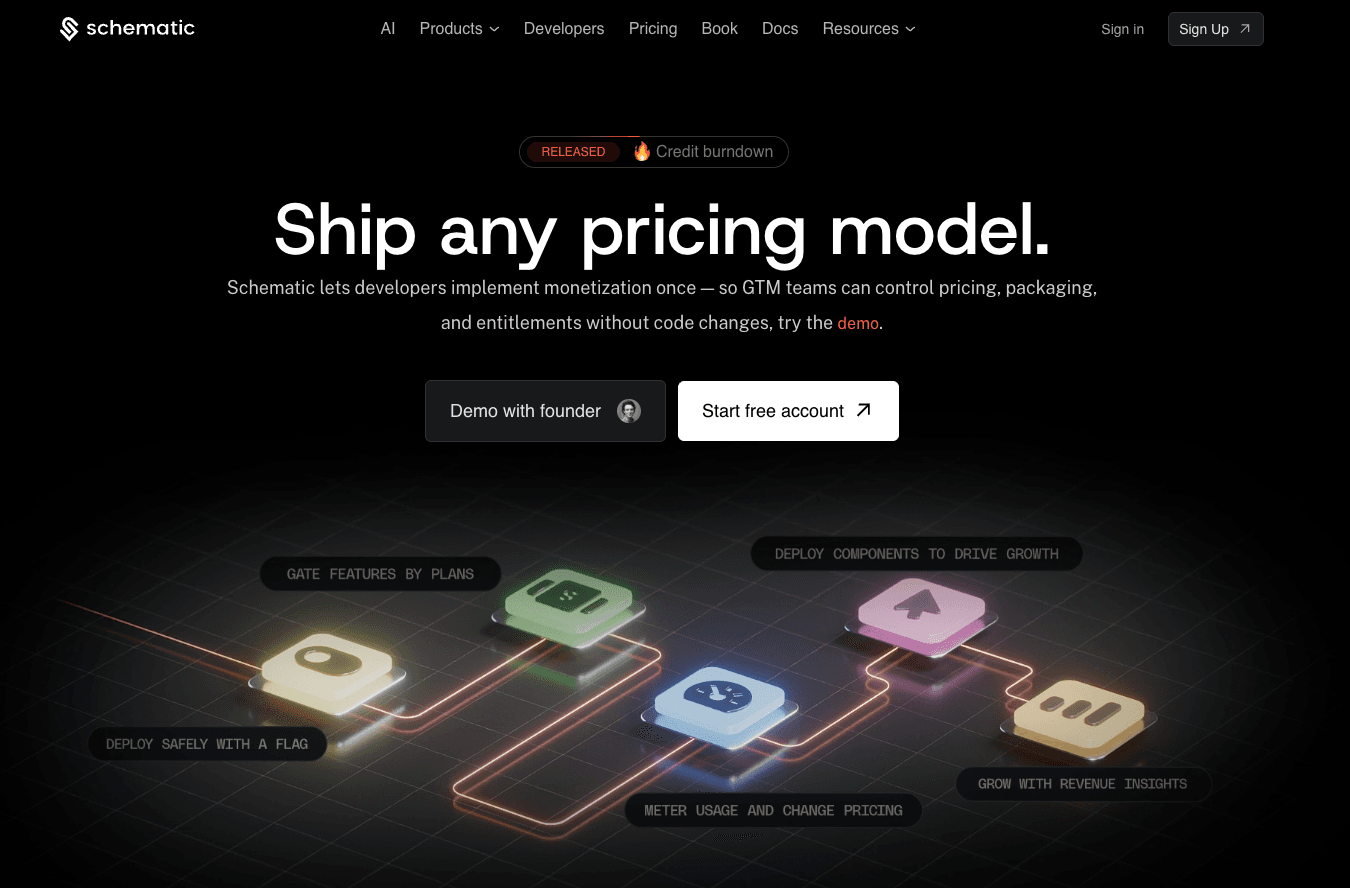
It's the monetization layer that sits between your app and Stripe. Stripe automatically handles payments and invoices, while Schematic acts as the system of record for plans, software entitlements, trials, add-ons, limits, and exceptions.
At runtime, Schematic evaluates and enforces those access rules directly inside your app.
Engineering benefits because they no longer write billing and entitlement code. Product and GTM teams can roll out pricing tests and feature access without waiting on developers.
FAQs About Pay-As-You-Go vs. Pay-As-You-Use
What is the difference between pay-as-you-go and pay-as-you-use?
Pay-as-you-go tracks usage over time using a continuous metric, such as storage or compute. Pay-as-you-use counts each action, like an API call or a transaction. The former bills for ongoing usage, while the latter counts charges for each individual event.
What are the most common pricing models?
The most popular pricing models in SaaS include subscription (flat fee), per-seat, pay-as-you-go, pay-as-you-use, tiered, and credit burndown pricing. Many companies combine these models to support more customers and different usage patterns.
Is pay-as-you-go pricing better than a subscription model?
Pay-as-you-go can be better than a subscription model in some ways. PAYG is the fastest on-ramp when value maps cleanly to a countable unit, and you want low friction. It's also the popular choice if product usage varies widely. However, a subscription model still makes sense when procurement and purchase predictability matter.
Where does PAYG pricing beat more complex models?
PAYG works best when you need speed and simplicity. You can launch fast with one rate per unit. It also supports frictionless trials with no upfront cost. PAYG fits workloads with usage spikes since charges track actual activity. Plus, it adapts to evolving customer needs and business expansion, so you don't have to worry about scalability.