 Ryan Echternacht
Software-as-a-Service (SaaS) pricing used to be mostly seats and subscriptions. These billing models worked when usage was predictable and products were easy to package.
But things have changed. Usage patterns now vary widely between accounts. At the same time, customers expect more flexibility from their bills.
This shift has led many SaaS businesses to rethink how they charge customers. Metered billing is one approach that ties pricing directly to actual usage.
Still, to make it work, SaaS teams need accurate tracking, clear usage metrics, and reliable metered billing software.
In this guide, we'll explain what metered billing means and how it works. We'll also break down the key components, different types, benefits, and challenges in managing metered billing.
TL;DR
- Metered billing is a pricing model that charges customers based on actual usage instead of a fixed subscription fee.
- It works by tracking usage, applying pricing rules, and generating invoices based on total consumption within a billing cycle.
- Key components of metered billing include usage metrics, tracking systems, pricing logic, billing cycles, customer visibility tools, alerts, and entitlements.
- Metered billing helps SaaS companies grow revenue, improve retention, lower entry barriers, enable flexible pricing, and identify new monetization opportunities.
- Schematic enables teams to operate metered billing at runtime by turning Stripe billing data into product behavior and enforcing usage limits.
What Is Metered Billing?
Metered billing is a SaaS pricing model where customers are billed based on how much they use a product.
Instead of paying a fixed fee, costs increase or decrease depending on actual usage, such as the amount of data transferred or the number of API calls made.
It follows the same principle used by telecom companies, where customers pay only for the mobile data they use.
In SaaS, metered billing supports usage-based billing, as it ties billing directly to user consumption.
How Metered Billing Works
A metered or usage-based billing system works by tracking customer usage and turning that data into charges over a set period.
The billing process starts when a user interacts with your product. Each activity, such as an API call or data upload, is recorded as a usage event.
These events are then collected and summed during a billing period. The system applies pricing rules to calculate the total cost based on usage levels.
At the end of the cycle, the billing platform automatically generates an invoice that reflects total usage. It bills customers based on that amount, either automatically or through manual payment.
A well-structured metered billing workflow eliminates the need for price estimates or flat fees. It instantly calculates charges based on the tracked usage and the predetermined rates per unit.
Key Components of Metered Billing
An effective metered billing setup relies on several elements. Each component is important for tracking, calculating, and communicating usage-based charges to the customer.
1. Usage Metric
The usage metric is the unit you measure and charge for. It defines what "consumption" means in your product. Common examples include API calls, data storage, compute hours, or the number of transactions.
Charging per API call works well for generative AI tools. Meanwhile, billing for compute hours makes sense for developer platforms like Vercel.
The right choice is important because it shapes your entire pricing model. If the metric does not match how customers see value, pricing will feel unfair.
A good usage metric should be easy to measure, simple to explain, and directly tied to customer outcomes. It should also scale as customers grow to ensure your revenue grows with them.
2. Metric Tracking System
The metric tracking system records every usage event inside your product. Each time a customer performs an action, the system logs it as usage data.
This system often runs in real time. It captures events, like API requests, data transfers, or processed tasks, and stores usage data for later billing.
Accuracy is very important. Even small errors can lead to incorrect charges and billing disputes, which can affect customer trust.
3. Rating and Billing Logic
Rating and billing logic turn raw usage data into billable amounts. This is where pricing rules are applied to each unit of metered usage.
For example, the billing system may implement a fixed price per unit, volume discounts, or tiered pricing. It calculates how much each customer owes based on their actual usage.
The process often involves multiplying usage by price or applying different rates at various levels.
The billing logic should handle all pricing scenarios, including overages, discounts, and credit-based pricing. It's the primary metered component that converts product activity into revenue.
4. Billing Cycle
The billing cycle defines when you charge customers and collect payments.
Many SaaS companies use monthly and annual billing periods, but some use weekly cycles. The choice depends on customer preferences or the nature of services rendered.
During the cycle, the billing engine tracks and stores usage data. At the end of each period, it totals all usage and applies pricing rules to generate the final invoice.
5. Customer Visibility Tools
Customer visibility tools show users how much they are using and how much they are spending. These usually come in the form of dashboards or reports.
Without real-time usage visibility, customers may not understand their charges until they receive an invoice. This can lead to billing surprises and disputes.
Customer visibility tools prevent these scenarios by showing usage as it happens. They help existing customers track usage and manage costs.
6. Alerting Systems
Alerting systems notify customers and internal teams about usage changes. These alerts can trigger when users exceed limits or reach a threshold.
For example, a customer may receive a warning when they are close to a usage cap. They have enough time to adjust their activity or upgrade their pricing plan.
Alerts can also flag unusual activity or errors to maintain accuracy in billing.
7. Entitlements Layer
The entitlements layer controls what a customer is allowed to use. It defines limits, access levels, and included usage based on a subscription plan or contract.
For example, a plan may include 100 AI credits per month.
The entitlement management system tracks this allowance and decides what happens when the limit is reached. It may block access, allow overages, or trigger plan upgrades.
Types of Metered Billing
There are several ways to structure metered billing. Let's take a closer look at each one below.
Per-Unit Pricing
Per-unit pricing is the simplest form of metered billing. Customers pay a fixed price for each unit they consume.
For example, a SaaS product may charge $0.01 per API call or $2 per GB of data stored.
Customers can quickly estimate costs by multiplying usage by price.
This billing model suits products with clear and consistent usage patterns.
However, costs can grow quickly as usage increases. Pricing may feel expensive at scale, especially when compared to pricing models that offer discounts.
Volume-Based Pricing
Volume-based pricing reduces the cost per unit as usage increases. Once a customer reaches a certain level, a lower price applies to all units used.
For example, if a customer reaches a usage threshold, every unit may be billed at the discounted rate. This makes it attractive for high-volume users who consume large amounts of a service.
A volume-based pricing model encourages customers to use more of the product. It also supports growth by rewarding scale with lower costs.
However, revenue can be less predictable because prices drop as usage rises. SaaS companies need to balance discounts with margins to avoid losing revenue at higher usage levels.
Tiered Pricing With Overage Charges
Tiered pricing divides usage into multiple tiers or subscription plans with different price points. Each tier is designed to serve different customer segments, such as hobbyists or enterprise clients.
As usage increases, customers move into higher or lower cost tiers. For example, a plan may include up to 10,000 API calls for a set price. Meanwhile, the next tier covers 50,000 API calls at a lower cost per unit.
Each plan reflects a different level of usage and pricing. This helps companies match pricing with customer size and needs.
Overage pricing applies when customers go beyond the included usage in their plan. Any extra usage is billed separately based on predefined rates.
Benefits of Metered Billing Models
Metered billing helps SaaS companies match pricing with actual usage while creating new ways to grow revenue and keep customers engaged. Here are the benefits of metered billing models:
Support Revenue Growth
Metered billing ties revenue directly to how much customers use your product. As usage increases, revenue also increases without adding extra friction to the sales process.
Customers spend more as they get more value from your SaaS product. You don't have to force upgrades. Instead, you benefit from natural expansion revenue.
Metered billing also helps you capture revenue from heavy users. With flat-fee subscriptions, high-usage customers may pay less than they should. Usage-based billing fixes this by charging based on actual activity.
Improve Customer Retention
Metered billing reduces the risk of churn by providing fair pricing. Customers only pay for what they use, so they are less likely to feel overcharged.
When usage drops, customers don’t need to cancel their subscription plan. They simply pay less. This keeps them connected to your product instead of leaving completely.
Clear usage tracking and pricing make it easier for customers to understand their bills. This builds trust and reduces disputes.
Lower the Barrier to Entry
With metered billing, customers can try the product without paying a high upfront cost or committing to a fixed plan.
A lower barrier to entry allows new customers to get started right away.
It's especially useful for startups or small teams testing a new tool. They can experiment without worrying about wasting money on unused capacity.
As they see value, they increase usage at their own pace. This improves the chances of long-term product adoption.
Enable Flexible Pricing
Metered billing gives you more control over how you price your SaaS product. You can combine different pricing models, such as per-unit, tiered, or hybrid structures.
This flexibility allows you to serve different customer segments with one pricing structure. Individuals or small businesses can use and pay less, while larger customers can scale up.
You'll also find it easier to adjust SaaS pricing and packaging over time. You can change rates, add tiers, or introduce new metrics as your product evolves.
Use Data-Driven Insights to Identify New Monetization Opportunities
Metered billing provides a clear view of how customers use your SaaS product. Every action is tracked, which makes it easier to understand customer behavior in real time.
This increased visibility helps you identify patterns in usage trends. For example, you may see that certain features are used more often or drive higher engagement. These insights can guide pricing decisions and highlight areas where you can charge based on value.
Metered billing can also reveal gaps in your current billing operations. You may find delayed events tracking or missing overage fees. You can close these gaps by using metered billing software.
Challenges and Limitations of Metered Billing
While metered billing offers clear benefits, it also introduces trade-offs that SaaS companies need to manage carefully as they scale their pricing model.
- Complex implementation: Metered billing requires a strong infrastructure. You need reliable internal systems to handle usage tracking, calculation, and invoice generation. Poor setup can lead to costly errors and revenue leakage.
- Billing disputes: Incorrect usage data can lead to billing disputes. If customers do not trust the numbers, they may question charges. The lack of transparency can make these issues harder to resolve.
- Revenue predictability issues: Revenue can change based on how much customers use the product. This makes revenue forecasting harder. Businesses should plan for usage swings that directly affect income.
- Data accuracy and usage tracking errors: Metered billing depends on accurate tracking. Missing or duplicated data can lead to wrong charges. Even small errors can affect customer trust and revenue recognition.
Best Practices for Adopting Metered Billing
Below are some best practices to follow when implementing metered billing.
Pick the Right Usage Metrics
Your usage metric defines how you charge customers. It should reflect how customers get value from your product. If this metric feels disconnected, pricing will not make sense to users.
Choose metrics that are easy to measure and explain. For example, API calls or storage usage are clear and predictable. Avoid complex metrics that customers cannot track on their own.
Provide Usage Dashboards
Customers need to see how much they are using your product at any time. Usage dashboards provide real-time visibility into activity and costs.
Without dashboards, customers only see charges at the end of the billing cycle. This can lead to confusion and support requests.
Make sure these dashboards can show usage by feature, time period, or account. They help customers manage spending and avoid surprises before the invoice arrives.
Use Billing Notifications and Spending Caps
Billing alerts help customers stay in control of their usage. They can notify users when they approach limits or cross certain thresholds.
For example, a billing platform can send a warning when usage reaches 80% of a plan. This gives customers time to adjust usage or upgrade.
Spending caps add another layer of control. They limit how much a customer can spend in a billing cycle.
These tools reduce billing surprises and improve the overall customer experience.
Maintain Transparent Communication With Customers
Clear communication is the key to making metered billing work. Customers need to understand how pricing works before they start using your SaaS product.
Explain how you measure usage, how you calculate charges, and when billing occurs. Keep pricing pages simple and easy to follow.
Avoid hidden fees or unclear rules. If customers do not understand pricing, they are more likely to question invoices later.
Transparent communication builds trust and improves customer satisfaction.
Use Reliable Metered Billing Software
Metered billing depends on accurate data and stable systems. A reliable billing platform helps you track usage, apply pricing rules, and generate invoices without errors.
When evaluating different usage billing solutions, consider the following factors:
- Usage tracking accuracy: Can it capture and store usage data without errors?
- Scalability: Can it handle growth as usage and customers increase?
- Flexible pricing support: Does it support per-unit, tiered, and hybrid models?
- Integration options: Can it connect with your product, customer relationship management (CRM) software, and payment processors?
- Real-time reporting: Does it provide clear usage and cost visibility?
- Automation: Can it handle invoicing, alerts, and billing without manual work?
The best metered billing software reduces manual work, lowers the risk of billing mistakes, and prevents disputes.
Review and Adjust Pricing Regularly
Metered billing is not a set-it-and-forget-it model. You need to review pricing as your product evolves and customers' needs change.
Analyze usage data to see how customers interact with your product. Identify patterns, gaps, or areas where pricing may not reflect value.
You may need to adjust rates, add tiers, or change metrics over time. This keeps pricing aligned with actual usage and market conditions.
Operate Metered Billing at Runtime With Schematic
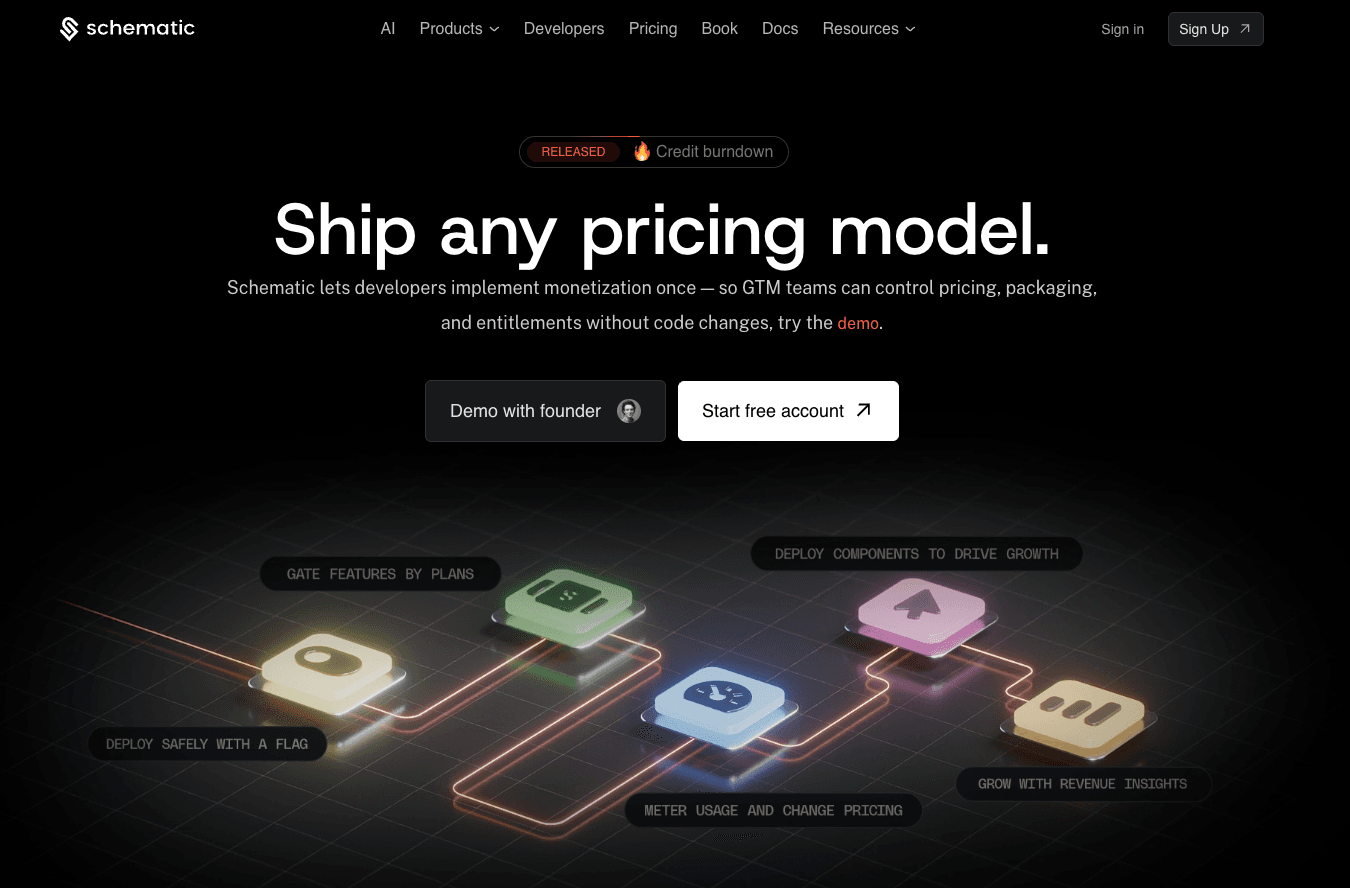
Schematic helps SaaS and AI companies run metered billing directly inside their product. It is built on Stripe, which handles payments, invoices, and subscriptions. Schematic adds the entitlements layer that turns Stripe billing state into application behavior.
Instead of hardcoding pricing and billing logic, Schematic serves as the system for your product catalog. Define plans, software entitlements, limits, trials, credits, add-ons, and exceptions in one place without building integration glue.
Engineering stops writing billing code and maintaining complex entitlement systems. GTM teams can continuously iterate on monetization.
On top of these capabilities, Schematic provides drop-in billing components that help you control metered billing. Build a pricing table, offer usage dashboards, and provide access to customer portals with just a few lines of code.
FAQs About Metered Billing
What is metered billing?
Metered billing is a pricing model where businesses charge customers based on how much they use a product or service. It is also known as usage-based pricing.
What are the 30-60-90 payment terms?
30-60-90 payment terms allow customers to pay their invoices in stages. The first part of the payment is due in 30 days, another portion in 60 days, and the final balance in 90 days.
What are the three types of billing?
In SaaS, the three main types of billing are subscription, metered, and tiered. Subscription or recurring billing offers a fixed fee that must be paid regularly for access to the software, regardless of usage. Metered billing charges customers for their usage. Tiered billing offers different packages based on features or volume.
How do you set up and configure metered billing systems?
To set up metered billing, define your usage metric, track usage data, apply pricing rules, and generate invoices. You also need dashboards, alerts, and a billing system that connects usage data with pricing logic.