Vercel is one of the most popular platforms for deploying modern web applications, especially for Next.js projects.
Vercel's pricing looks simple at first. There is a free Hobby plan, a Pro plan, and an Enterprise option.
But once your app gets traffic, you also pay for additional usage like bandwidth, execution time, and Edge Requests. That means your total bill can change as usage grows.
This guide breaks down Vercel pricing plans and the hidden costs that often surprise developers. If you are building or scaling on Vercel, this will help you understand what you are really paying for.
TL;DR
- Vercel offers three pricing plans: Hobby (free) for personal projects, Pro ($20 per user/month) with $20 usage credits, and Enterprise with custom pricing.
- Team seats quickly add up in the Pro plan. Paying $20 per developer every month can become expensive as your team grows.
- Most costs come from usage, and not the base plan. Your final bill depends on how your app runs in production.
- Hidden fees in Vercel include edge requests, bandwidth usage, ISR reads/writes, blob, image optimization, Edge config, active CPU time, Vercel AI agent, build minutes, and enterprise add-ons.
Vercel Pricing Plans
Vercel offers three pricing plans designed for different stages of application growth. Most teams start with the free Hobby plan during early development, and then transition to Pro and Enterprise plans as their infrastructure and collaboration needs expand.
The platform follows a tiered pricing structure where each Vercel plan unlocks higher limits, advanced features, team capabilities, and additional platform functionality as applications scale.
Hobby Plan
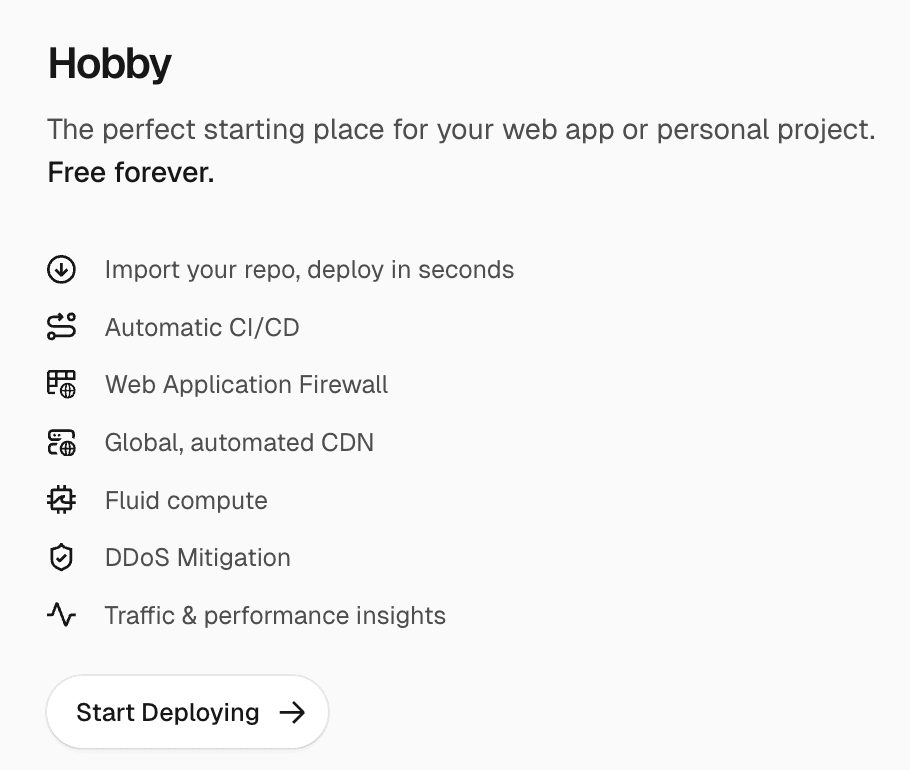
The Hobby plan is Vercel’s free tier for personal projects and early experimentation.
Source: Vercel.com
The Hobby plan supports solo developers building early-stage applications, personal projects, and prototypes.
Hobby offers automatic CI/CD, global deployment through the Vercel edge network, basic observability tools, and built-in platform protections, such as a web application firewall and DDoS mitigation.
It also includes 100 GB of fast data transfer per month and limited compute resources designed for small workloads.
Commercial usage is restricted, which means the Hobby plan is typically used for learning, testing, and side projects.
Pro Plan
The Vercel Pro plan is the standard plan for production applications and small teams.
Source: Vercel.com
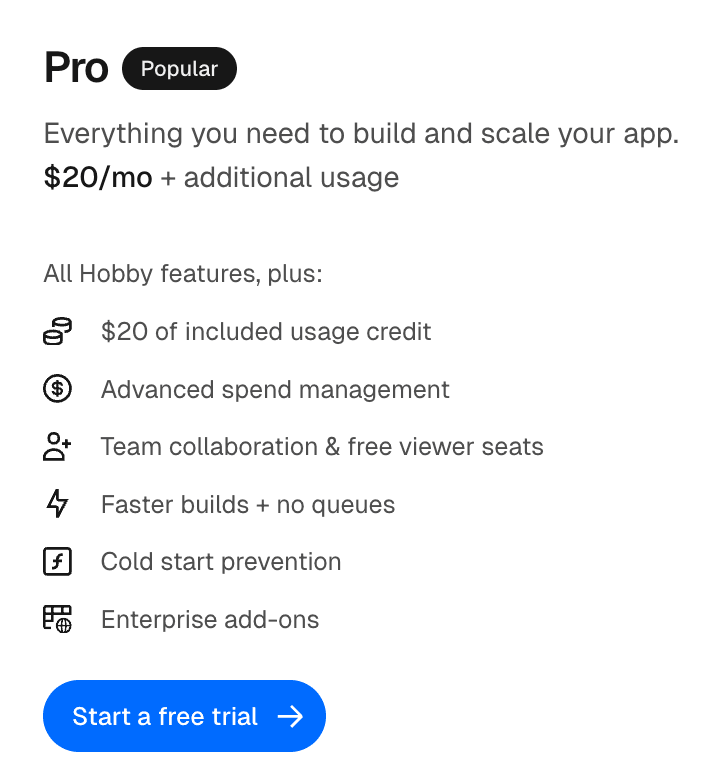
Vercel's Pro plan starts at $20 per developer seat per month. This creates a predictable fixed monthly fee based on team seats, with additional resource usage billed separately.
The Pro plan includes all Hobby features in addition to $20 worth of monthly credits and higher infrastructure limits.
Pro also unlocks collaboration features, including shared environments, role-based access control, and free viewer seats for non-developers.
Additional capabilities include advanced spend management controls, faster builds with no deployment queues, and cold start prevention for serverless functions.
Pro even supports better performance through technologies such as fluid compute, which helps reduce cold starts and stabilize runtime behavior for production applications.
Most developers running customer-facing applications or SaaS products operate within the Pro plan before upgrading to an Enterprise contract.
Enterprise Plan
The Vercel Enterprise plan provides advanced infrastructure controls, security features, and operational support for large organizations.
Source: Vercel.com
Enterprise uses custom pricing agreements based on usage requirements and organizational needs.
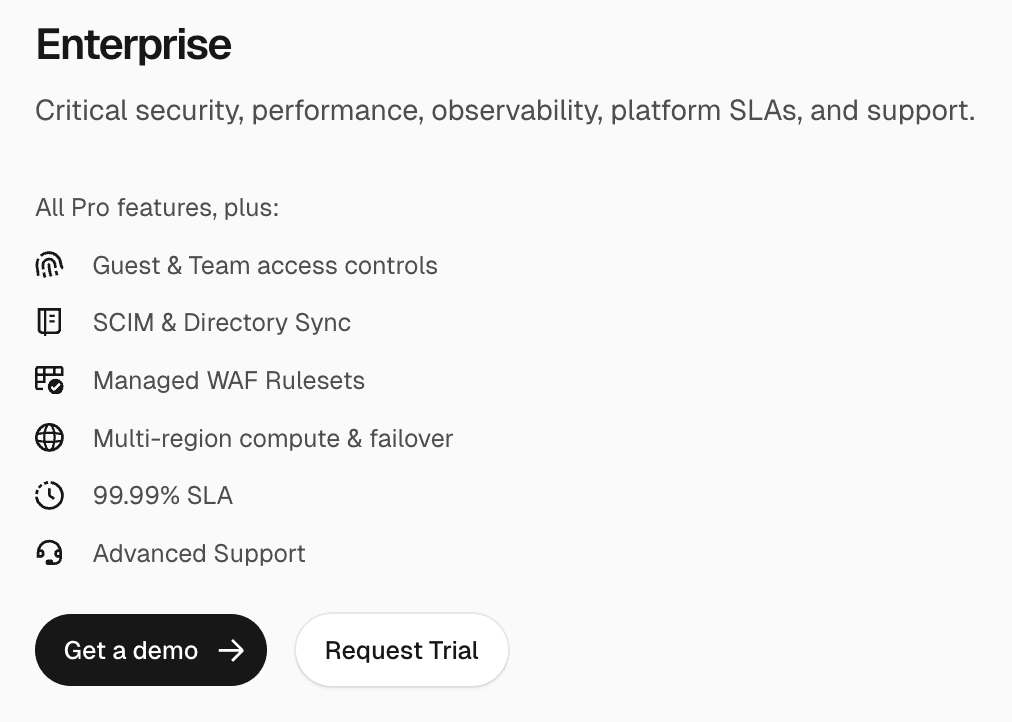
The Enterprise plan includes all Pro features plus advanced capabilities, such as audit logs, single sign-on (SSO), directory synchronization, and enhanced access controls for Vercel team members and guests.
Enterprise customers also receive dedicated support, a 99.99% platform SLA, and options for multi-region compute and advanced infrastructure controls.
Vercel's Enterprise plan is built for large organizations seeking greater performance, collaboration, and security.
Hidden Costs in Vercel
Vercel pricing combines a subscription pricing model with usage-based billing. This means the total cost depends on how your app runs in production.
Many of these charges are not obvious at first, which can drive costs up as your usage grows.
Edge Requests
Edge Requests are traffic handled by Vercel's network. Any time a user loads HTML, CSS, JS, images, dynamic content, or triggers an API call on a Vercel site, it is recorded as an edge request.
The Hobby plan includes 1M edge requests per month. This generous limit works for low-traffic apps, but you can hit caps quickly.
Pro provides a higher number (10M) of Edge Requests each month. If you exceed that limit, you pay an additional $2 per 1M edge requests. Total costs can grow fast with high traffic or frequent middleware use.
Enterprise customers can choose from custom limits with custom pricing.
Bandwidth Usage
Bandwidth usage, or data transfer, is the amount of data sent between Vercel's delivery network and end users.
On Hobby, bandwidth is free but capped at 100 GB per month.
The Pro plan includes a higher monthly bandwidth allowance of 1 TB. This sounds like a lot, but many web apps reach this limit faster than expected due to the following reasons:
- Large images or videos
- High traffic spikes
- Frequent API calls
- Poor asset optimization
If you go beyond the 1 TB Pro plan limit, you need to pay $0.15 per extra GB.
Enterprise plans offer higher limits and custom pricing based on bandwidth usage.
Team Seats
Team seats refer to the number of developers, viewers, and team members who can access and work on a Vercel project.
The Hobby plan offers a single developer seat for free. This works for solo developers but does not support team collaboration.
Pro charges $20 per month per developer seat. It also includes unlimited viewer seats and one billing seat with read-only access to all team projects.
Here's how seat-based pricing looks in the Pro plan:
Team Size | Monthly Base Cost | Annual Base Cost |
1 developer | $20 | $240 |
3 developers | $60 | $720 |
5 developers | $100 | $1,200 |
10 developers | $200 | $2,400 |
20 developers | $400 | $4,800 |
These are just base costs for developer seats before overage fees apply. A company with 10 developers can easily spend a total of $300–500 per month after adding bandwidth and edge request costs.
Vercel's Enterprise plan offers custom pricing for developer, viewer, and billing seats.
ISR Reads/Writes
Incremental static regeneration (ISR) lets you update static pages after deployment. It helps revalidate content in the background without rebuilding the entire site.
An ISR read happens when a cached page is served to a user. Meanwhile, an ISR write occurs when you write cached data to the global Vercel Cache.
The Hobby plan includes limited ISR reads (1M per month) and ISR writes (200K per month).
On Pro, you pay $0.40 per 1M ISR reads and $4 per 1M ISR writes.
The Enterprise option offers larger limits and custom pricing. This gives more room for high-traffic apps that rely heavily on dynamic content updates.
Blob
Vercel Blob is an object storage service. It lets you store and serve files like images, videos, and large assets directly from your app.
The Hobby plan offers the Blob feature for free with the following caps:
- Storage size - 1 GB per month for all Blob stores
- Simple operations - 10,000 Blob object reads per month
- Advanced operations - 2,000 Blob object writes, modifications, and listings per month
- Blob data transfer - 10 GB per month
For Pro, Blob pricing is usage-based. Here's how much it costs:
- Storage size - $0.023 per GB
- Simple operations - $0.40 per 1M
- Advanced operations - $5.00 per 1M
- Blob data transfer - Starts at $0.05 per GB
Enterprise customers get custom blobs and pricing.
Image Optimization
Vercel enables you to optimize images to reduce file size without affecting the quality. However, the cost for image optimization varies based on your selected pricing plan.
Hobby includes 5K image transformations, 300K image cache reads, and 100K image cache writes every month for free.
If you are a Pro user, expect to pay $0.05 for 1K image transformations, $0.40 per 1M image cache reads, and $4 per 1M image cache writes.
The Enterprise plan offers custom pricing for image optimization.
Edge Config Reads/Writes
Edge config is a global data store in Vercel. It lets you work with feature flags, critical redirects, and IP blocking.
Hobby plan users get 100K edge config reads and 100 edge config writes per month for free.
The Pro plan charges $3 per 1M reads and $5 per 500 writes.
The Enterprise contract provides higher limits, which can suit teams running large-scale edge config workloads.
Active CPU Time
Active CPU measures the time your code actively runs during execution. It applies to both Vercel Functions and the Vercel Sandbox, where compute runs on demand.
Instead of billing the total duration, Vercel charges only for the time the CPU is in use. It reduces waste and saves money for workloads with high idle time, such as AI inference.
The Hobby plan includes 4 free hours of active CPU usage on the Vercel Functions and 5 free hours on the Vercel Sandbox. It is enough for testing, but not for heavy workloads.
Active CPU usage on the Pro plan is billed at $0.128 per hour, regardless of whether you're using Vercel Functions or Vercel Sandbox.
Enterprise users get custom CPU time and pricing.
Vercel AI Agent
Vercel's AI agent lets you build, deploy, and scale AI-powered workflows inside your app.
This beta feature is not available on the Hobby plan. It is designed for production use and requires a paid subscription.
The Pro plan charges $0.30 per action plus the pass-through token cost.
The Enterprise option offers custom pricing.
Build Minutes
Build minutes are part of Vercel’s DX platform, which enables you to build and deploy workflows from code to production. These builds consume time and resources, especially for large apps.
If you're on the Hobby plan, you don't receive build minutes. You need to upgrade to the Pro or Enterprise plan.
Pro users spend $0.014 per minute for standard machines, $0.028 per minute for enhanced machines, and $0.126 per minute for turbo machines.
Enterprise customers pay a custom price depending on their usage.
Add-Ons
Vercel offers enterprise add-ons for teams on the Pro plan. These features are optional, but many teams use them in production, which adds to the total cost.
Observability Plus
Through Observability Plus, Vercel gives you the ability to monitor the performance and traffic of your projects.
This feature costs an extra $10 per month or $1.20 per 1M events for Pro users. Extended data retention for up to 30 days is included in addition to advanced metrics, a query engine, and AI query prompting.
Web Analytics Plus
Vercel includes advanced analytics, which provide valuable insights into your website's visitors.
This add-on feature costs $10 every month and comes with UTM parameters and an extra 12 months (24 total) of reporting windows.
Vercel Infrastructure Limits Teams Should Know
Vercel handles scaling automatically, but applications still run within platform limits that affect architecture decisions. These limits are in place to prevent abuse.
Function Duration
Vercel Functions operate within runtime-specific execution limits. Long-running jobs often need to move into async workflows, background systems, or external compute services.
Proxied requests also have a maximum timeout of 120 seconds.
Concurrency and Build
Build and deployment activity also has limits. The Hobby plan includes a single concurrent build, while Pro includes 12. Enterprise customers get custom limits.
Build time per deployment is capped at 45 minutes on all Vercel pricing plans.
These limits are important for teams running frequent preview deployments, large monorepos, or active CI/CD pipelines.
File Upload
Large uploads and deployment payloads can also create constraints. Static file uploads through the CLI are limited to 100 MB on Hobby and 1 GB on Pro.
CLI deployments are also limited to 15,000 source files for Pro trials.
Teams can generate as many output files as needed during a build, but large volumes (100,000 or more) can increase build time. Any build that goes past 45 minutes will fail.
Project and Deployment
General platform limits also vary by pricing plan. Hobby supports 200 projects and 100 deployments per day. Pro offers unlimited projects and 6,000 deployments per day. Enterprise provides unlimited projects and custom deployments.
Route creation is capped at 2,048 routes per deployment for Hobby and Pro unless custom enterprise limits apply.
Domains, Logs, and Environment Variables
Hobby supports 50 domains per project. Pro and Enterprise support unlimited domains, with soft limits (100K and 1M, respectively) that can be increased through support.
Environment variables are limited to 1,000 per environment per project.
Runtime log retention also varies by plan. Hobby stores logs for an hour, Pro keeps them for one day, and Enterprise stores them for three days.
Best Use Cases for Vercel
Vercel fits best for applications that prioritize fast deployment, better performance, and managed infrastructure. The platform removes much of the operational overhead required to run modern web applications.
Situations where Vercel works well include:
- Frontend-heavy web applications - Applications that deliver most functionality in the browser benefit from Vercel’s global edge network and optimized static delivery.
- Next.js applications - Vercel builds and deploys Next.js projects with minimal configuration, including support for features such as incremental static regeneration and optimized routing.
- Static sites and content platforms - Documentation sites, marketing pages, and blogs often run efficiently on the platform. In fact, Vercel hosts over 2.3 million websites as of early 2026.
- Startups prioritizing deployment speed - Teams building new products often choose Vercel to launch quickly without managing dedicated infrastructure per project.
- Teams preferring fully managed infrastructure - Organizations that want to avoid self-hosting infrastructure often choose Vercel to manage deployments, CDN delivery, and application environments.
Build Apps on Vercel, Ship Any Pricing Model With Schematic
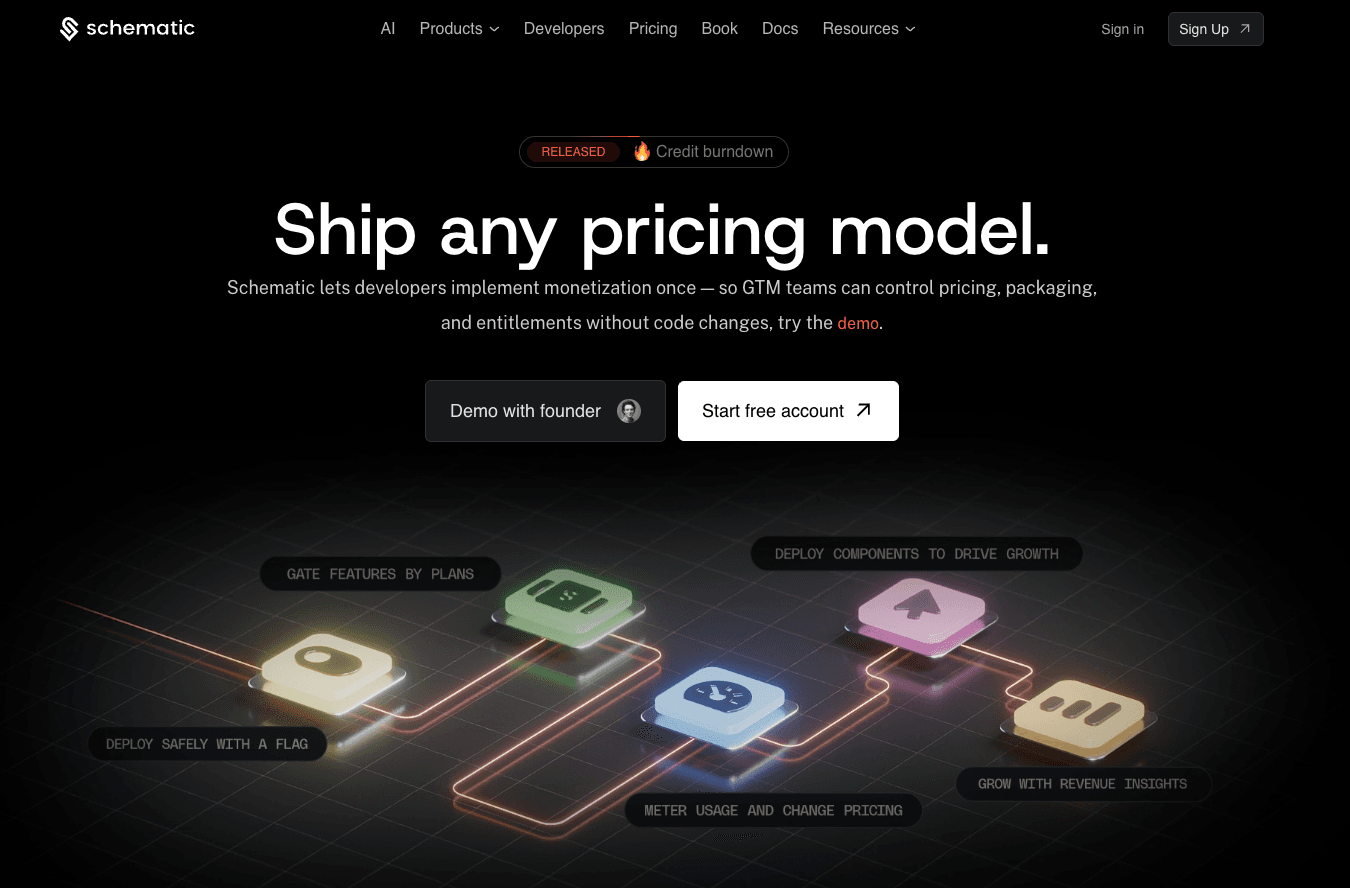
Schematic, built on Stripe, is a monetization operating system that handles plans, SaaS entitlements, limits, credits, and add-ons outside application code.
Go-to-market teams define pricing and packaging inside Schematic, while the product enforces those rules during runtime. Plans, feature access, usage limits, and account overrides remain consistent with billing systems such as Stripe.
Engineering teams avoid writing custom billing code and maintaining entitlement logic inside the application.
With Schematic, you can focus on what makes your app great, and not how you price, package, or bill.
FAQs About Vercel Pricing
Is Vercel free?
Yes, Vercel's Hobby plan is free forever. However, it comes with strict limits on bandwidth, active CPU time, and storage size. Once your app scales, you will likely need to upgrade to a paid plan.
How much does Vercel cost per month?
Vercel's Pro plan costs $20 per developer per month. The total monthly costs will increase if you add more developer seats. Overage fees also apply for edge requests, bandwidth, image optimization, edge config, build minutes, and other features.
Is Vercel suitable for large teams and enterprise deployments?
Vercel supports large organizations through its Enterprise offering. The Enterprise plan starts with custom pricing based on platform activity, security requirements, and organizational scale. Enterprise customers negotiate pricing and platform capabilities directly with Vercel.