 Ryan Echternacht
Many SaaS companies introduce artificial intelligence (AI) into their products, but struggle to turn it into revenue.
Customer usage is growing, yet pricing doesn't keep up. This creates a gap where your AI tool drives value but does not drive enough revenue growth.
That’s because AI monetization is different from traditional SaaS pricing. AI usage is not fixed, and costs can change quickly based on how customers use your product.
If you don’t adjust AI pricing and packaging, you either lose profit margin or leave revenue on the table.
This guide covers seven AI monetization strategies you can implement. We'll also discuss key challenges and how to solve them.
TL;DR
- AI monetization turns AI usage into revenue through pricing, packaging, and entitlements.
- Companies use these 7 monetization strategies: usage-based pricing, credits, subscriptions, overages, hybrid models, value-based pricing, and freemium.
- Monetizing AI is challenging due to rising AI costs, unclear ROI, pricing mismatches, compliance issues, and billing complexity.
- Schematic provides a complete monetization platform for AI and software companies. It meters usage, bills customers, enforces limits at runtime, and gives enterprise customers real-time visibility and control over their consumption.
What Is AI Monetization?
AI monetization is the process of turning AI features and outputs into recurring revenue for SaaS and AI companies.
You price AI functionalities based on actual usage, seats, subscriptions, AI credits, outcomes, or other models that reflect the real value your AI delivers.
However, monetization involves more than AI pricing. Packaging and software entitlements also play a major role.
You need to decide who can use your product's AI features, what limits apply, and how those features are grouped into plans or tiers.
An effective AI monetization strategy should connect pricing models, packaging rules, access controls, and value.
When done right, it allows revenue to grow alongside AI product usage and protects gross margins.
Direct vs. Indirect Monetization
Not all AI monetization looks the same. SaaS and AI providers can generate revenue in two main ways, depending on how they deliver and capture value.
In many cases, organizations combine both approaches to balance growth and revenue.
- Direct monetization: You charge customers specifically for AI outputs or usage, such as API calls, tokens, or compute time. Pricing is tied to how much or how often they use the AI.
- Indirect monetization: You bundle AI features into existing plans to raise prices, boost customer retention, and provide more value to customers. You don't charge for AI as a separate line item in the invoice.
7 Effective AI Monetization Strategies
SaaS and AI businesses use several monetization models to generate revenue and align pricing with measurable value. Here are the AI monetization strategies you can implement:
1. Usage-Based Pricing
Usage-based billing, especially pay-as-you-go, is a natural choice for AI products.
AI expenses are tied to usage. Every API call, token, or generative AI request has an actual cost behind it.
But it's difficult to charge customers because usage can vary a lot. Some only run a few requests per day, while heavy users run large volumes of usage events.
Pay-as-you-go solves this problem. It aligns pricing with both cost and value. SaaS buyers only pay for what they use, and your revenue increases as AI usage scales.
It also lowers the barrier to entry. New users can start small without a significant investment and scale over time. This improves user adoption rates.
2. Credit-Based Pricing
Credit-based pricing uses credits as the unit of access to AI features.
Instead of charging directly per request or token, each action consumes a set number of credits. This makes pricing easier to understand, especially when your AI application has different types of actions with varying costs.
You can monetize prepaid credits in several ways.
One common approach is the credit burndown model. Customers buy prepaid credits upfront to consume over time according to their usage.
Some SaaS companies also package AI credits into tiered pricing plans. In this setup, customers receive a fixed number of credits every billing cycle based on their plan. When credit packs run out, users can purchase more as an add-on or upgrade to a higher tier.
3. Flat-Rate Subscriptions
Many AI businesses still rely on subscription-based pricing. According to ICONIQ's 2026 State of AI Snapshot, 58% of companies still include a subscription component in AI pricing.
Flat-rate subscriptions work if you want to monetize AI indirectly.
You do not charge per AI feature or per output. Instead, you bundle AI functionalities into your existing plans and increase the packaging price based on the extra value.
Customers pay a monthly or annual recurring fee and receive AI access within defined limits. This keeps pricing simple and predictable.
It also helps improve user adoption. Customers see AI as part of the core product instead of an additional expense.
To manage AI costs, you can set usage caps or fair use limits. This prevents heavy AI usage from affecting your gross margins while keeping the experience consistent for most customers.
4. Overage Pricing
Overage pricing charges customers when they exceed included plan limits.
Users pay a base fee that includes a set amount of AI usage. Once they go over, they pay extra fees based on actual usage.
This monetization strategy helps balance predictability and flexibility. You give customers a base allowance, but you can still capture higher revenue potential from increased usage.
Overage pricing also protects your profit margins. Heavy users pay more instead of consuming resources for free.
However, you need to communicate limits clearly. Unexpected charges can affect customer satisfaction and lead to frustration if users are not aware of their usage.
5. Hybrid Monetization
Hybrid monetization uses two or more AI pricing models in a single pricing structure. AI products may include subscriptions, credits, usage-based billing, or overages.
For example, customers pay a base subscription and extra fees based on usage or certain features.
Hybrid monetization is popular in AI companies because no single pricing strategy fits all use cases. Some customers want predictable pricing, while others prefer pay-as-you-go.
Hybrid pricing models also support both direct and indirect monetization. You can bundle AI into plans while still charging for specific AI features.
6. Value or Outcome-Based Pricing
Value-based pricing ties what you charge to the outcome your AI delivers.
Instead of billing for usage, you price based on results. This could include revenue generated, tasks completed, or time saved.
This strategy works well when the value of your AI is clear and measurable. Customers are willing to pay more money when they see a direct impact on their daily workflows.
Outcome-based pricing, on the other hand, shifts the focus from cost to results. It's easy to justify higher pricing if the AI solution can automate tasks and contribute to business success. That is why outcome pricing is often used in enterprise deals.
However, it can be harder to implement. You need a reliable way to measure outcomes and link them to your pricing strategy.
7. Freemium
Freemium pricing offers basic AI features for free while charging for advanced usage or premium features.
This AI pricing strategy drives higher adoption rates. Users can try your AI product without risk and see its value before paying.
You can limit free usage through caps, metered paywalls, or feature restrictions. Once users reach those limits, they need to upgrade to a paid plan.
Freemium works well for products with strong product-led growth. It creates a steady flow of new users.
When done right, freemium supports revenue growth by turning active users into paying customers.
How to Choose the Right AI Monetization Strategy
Choosing the right AI monetization strategy depends on how your product delivers value, how customers use it, and how your business captures revenue. Here's what you need to consider:
Know Your Core Value Proposition
Start by identifying your value metric.
A value metric is the unit that connects customer value to how you charge. In AI products, this could be tokens, requests, reports generated, raw data processed, or tasks completed.
You need to pick a value metric that reflects how customers get value from your AI tool. If the metric is unclear, your monetization strategy will feel disconnected.
Analyze How Customers Use Your AI Product
Look at how customers interact with your AI product.
Track usage data to identify who uses AI features lightly and who uses them heavily. These data-driven insights help you understand variation in customer behavior and customer interactions.
If AI usage varies a lot, credit-based or consumption pricing may work better. When usage is stable, subscriptions or seat-based pricing may be enough.
Benchmark Against Competitors
Study how similar companies monetize their AI tools.
Look at existing products in your market. Review their pricing pages, packaging, and limits. This helps you understand what customers already expect.
However, do not copy competitors directly. Use their monetization strategy as a reference point, then look for gaps you can fill.
The goal is to create a competitive advantage. For example, you can offer simpler pricing, better packaging, or a plan that matches customer needs to stay competitive.
Consider Your Go-to-Market Strategy
Your sales motion should shape your AI monetization strategy.
If you rely on self-serve growth, keep monetization simple. Customers should understand pricing and packaging without needing sales support. This reduces friction and speeds up product adoption.
SaaS and AI companies selling to enterprises will need flexible pricing models. These may include custom plans, volume discounts, or negotiated terms based on usage.
You should also think about new sales opportunities. Pricing should make it easy to grow revenue through upsells, add-ons, higher tiers, or new revenue streams.
Common Challenges in AI Monetization and How to Overcome Them
Many companies struggle with monetizing AI because usage varies, costs fluctuate, and billing models are complex to design. Below are the key challenges businesses face and how to solve them.
High and Unpredictable AI Costs
AI infrastructure costs can change quickly. Each request, API call, or large language model adds to the total operating expenses.
As AI usage scales, costs can rise faster than expected. This becomes a problem when pricing does not keep up.
If you charge a flat fee but usage suddenly spikes, your profit margins shrink. Heavy users can consume a large share of resources without paying more.
Solution: Align pricing directly with usage and set clear limits. Track AI costs per action and adjust your monetization strategy as usage patterns change.
Unclear ROI and Value Perception
Customers often struggle to understand the value of AI features.
They may use the product but fail to see a clear link between usage and business impact. It creates doubt around AI investments, especially when costs increase without clear results.
Internal teams, such as finance teams, may find it difficult to justify pricing changes or upsells without strong proof of value.
This is common with AI features that feel abstract. Outputs may vary, and results are not always easy to measure.
Solution: Tie AI usage to clear outcomes, such as cost savings, higher revenue, or productivity gains. Show results through metrics, reports, or case studies that make value easy to understand.
Pricing Model Mismatch
Many companies apply the wrong pricing model to their AI product.
For example, they may use flat-rate pricing when usage varies widely. Or they may charge per feature when value is tied to outcomes. This creates a disconnect between how customers use the product and how they are charged.
As a result, some users overpay while others underpay. This leads to churn, lost revenue, or poor margins.
A mismatched model can slow growth and create friction during sales because customers may not understand pricing.
Solution: Match your AI pricing to value metrics and usage patterns. Test different models and adjust based on real-time data.
Regulatory Compliance Issues
Various regulations affect how you monetize AI and present its value.
For example, data retention rules control how long you can store user data. Auditability requirements mean you must track how autonomous agents make decisions. Fairness rules can limit how outputs are generated and used.
Compliance is not just a legal concern. It directly impacts your monetization strategy and product design.
Solution: Work with legal teams early and adapt your monetization model to meet regulatory requirements.
Billing Complexity
AI monetization often leads to complex billing infrastructure.
You may need to support subscriptions, usage-based pricing, credits, overages, and add-ons all at once. Each model adds more logic to your billing system.
Managing entitlements, limits, and exceptions can become difficult. Engineering teams often end up building custom billing and entitlement logic that is hard to maintain.
This slows down product development. It also leads to billing errors and poor customer experience.
Solution: Decouple pricing logic from product code. Use monetization platforms like Schematic to price what you sell, meter usage, and grant credits while enforcing access at runtime and giving customers cost predictability.
Schematic Monetizes AI Through Usage Billing Customers Trust
Schematic turns AI usage into revenue without building complex billing systems or hurting customer trust. It provides a complete usage-based billing platform for software and AI companies that want to close enterprise deals.
It's the only billing software that solves the trust problem in usage-based pricing. Enterprise credit wallets give customers real-time visibility and control over their consumption.
Buyers can set spending caps, receive warnings before usage stops, configure auto top-ups, and decide what happens at the limit. Hard caps block access as soon as the limit is reached, while soft caps enable continued usage and bill extra consumption as overages.
Rahul Gill from Macabacus shares, "Schematic's ability to offer usage caps, bundles, and top-ups gave our customers the cost predictability they need."
The runtime entitlement engine enforces the policies set by your customer or your team. It can gate features and answer access questions from the same ledger that bills.
Plus, Schematic includes out-of-the-box billing tools designed for the AI era. Credit rollovers, expiry windows, priority consumption, and concurrency-safe holds support credit burndown pricing.
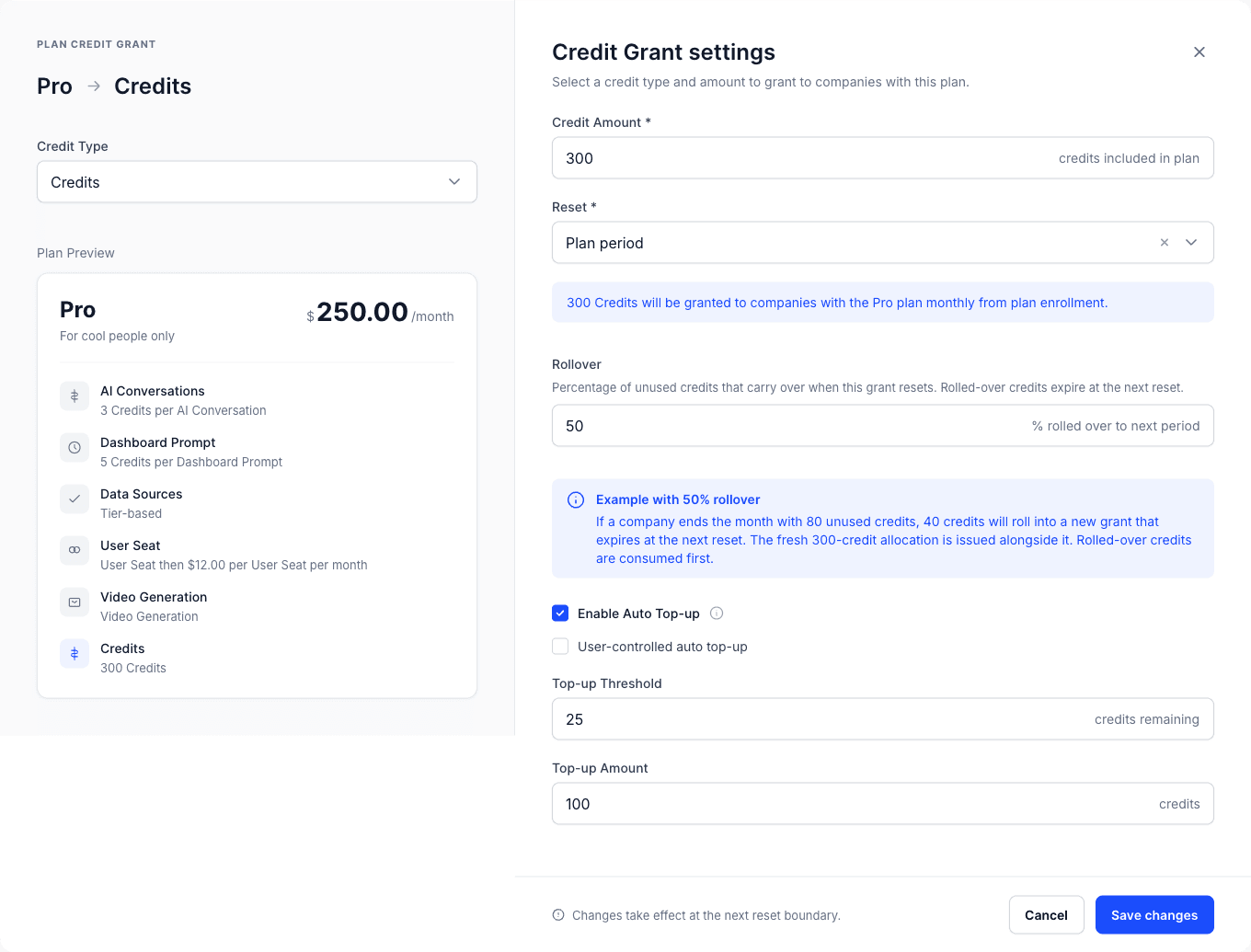
Teams can even version plans, migrate customers, and meet revenue recognition compliance using an append-only ledger.
FAQs About AI Monetization
How do you monetize AI?
You can monetize AI by connecting measurable value and product access to pricing. You can charge based on usage, subscriptions, credits, user seats, or overages. The goal is to cover AI costs and increase revenue as usage scales.
What's the biggest challenge when introducing AI features?
The biggest challenge is aligning cost, pricing, and value. AI usage can vary a lot, and costs can rise quickly. If pricing does not reflect this, profit margins may drop, or customers might think pricing is unfair. A good rule is to tie pricing closely to usage and outcomes.
How much should you price AI tools?
AI pricing depends on your value metric, costs, and the customer's willingness to pay. Some companies charge per usage, while others bundle AI into plans. Start with a monetization model that reflects value, then adjust pricing based on usage data and customer feedback loops.