Recurly vs. Stripe Billing: Full Comparison For Software and AI
Read our Recurly vs. Stripe Billing review and find out how the two platforms compare. Discover what makes Schematic the superior alternative to both.
 Ryan Echternacht
On this page
- Overview
- TL;DR
- Recurly vs. Stripe Billing: What Is the Difference?
- Recurly Key Benefits and Features
- Stripe Billing Key Benefits and Features
- Recurly vs. Stripe Billing: A Detailed Comparison Breakdown
- Recurring Billing
- Subscription Management
- Usage-Based Pricing
- Payments Orchestration
- Dunning Management
- Revenue Recognition
- Integration Capabilities
- Pricing Plans
- How to Choose Between Recurly and Stripe Billing
- Where Recurly and Stripe Billing Fall Short
- Why Should AI and SaaS Companies Consider Schematic
- Switch to Schematic for Usage-Based Billing and Entitlements Your Customers Can Trust
- FAQs About Recurly vs. Stripe Billing
- Which is better for recurring billing: Recurly or Stripe Billing?
- Can Recurly and Stripe Billing prevent involuntary churn?
- Is Recurly or Stripe Billing better for small businesses?
Subscription billing is still a popular way to monetize products, especially among early-stage companies. According to the 2026 State of B2B Monetization report, 37% of businesses with less than $5M annual recurring revenue (ARR) implement flat-fee subscriptions.
Both Recurly and Stripe Billing are popular platforms that can handle subscriptions, generate recurring invoices, and retry failed payments. But they are built differently.
Recurly focuses on subscription management, payment recovery, customer retention, and revenue reporting.
Stripe Billing provides the flexibility to manage subscription billing alongside usage-based billing and hybrid models.
This guide compares the key features of Recurly and Stripe Billing to help you make an informed decision.
TL;DR
Both Recurly and Stripe Billing can manage subscriptions and recurring billing, but they approach churn prevention, payment processing, and usage-based pricing differently.
Recurly focuses on the entire subscriber lifecycle by providing tools for plan creation, payment processing, subscriber retention, and revenue reporting.
Stripe Billing combines pricing, metering, billing, and invoicing capabilities to unify a company's revenue stack.
Both platforms lack real-time entitlement enforcement and usage governance controls for businesses that ship consumption-based models.
Schematic is the better choice for software and AI companies selling usage-based plans to enterprises. It can meter usage, grant credits, enforce entitlements, and give customers full control over their usage to gain their trust.
Recurly vs. Stripe Billing: What Is the Difference?
Recurly is a subscription management and recurring billing platform in one. It covers the entire subscriber lifecycle, from creating plans and collecting recurring payments to reducing churn and winning back customers.
It also connects payment recovery, subscriber retention, and revenue reporting. Commercial teams can manage subscriptions without waiting on engineering to write custom code for every change.
Plus, Recurly offers multiple payment gateway connectors with real-time failover and full API control. Subscription-based businesses can work with more than one payment processor or run several processors simultaneously.
Stripe Billing provides an integrated subscription billing platform where companies can price, meter, send invoices, and grow their revenue.
The platform supports subscriptions, usage-based charges, flexible tiered pricing, and hybrid pricing models. It suits businesses that want to monetize AI products and enter new markets.
The main difference between Recurly and Stripe Billing is their focus. Recurly handles the full lifecycle of subscription management to retain customers and grow revenue. Meanwhile, Stripe Billing can simplify AI monetization, launch subscription plans, and help companies scale globally.
Recurly Key Benefits and Features
Recurly goes beyond recurring billing to manage the entire subscriber lifecycle. It helps SaaS companies attract new customers, recover failed payments, reduce churn, and scale recurring revenue from one platform.
The platform also tracks subscriber activity, payment failures, and churn risks. This data gives product, RevOps, and finance teams the information they need to take action before customers cancel their plans.
Here are the key features of Recurly.
Flexible subscription pricing: Combine recurring subscriptions with one-time purchases, add-ons, discounts, trial pricing, or usage-based charges.
Churn mitigation: Use smart payment retries, an automatic account updater, and dunning workflows to support subscription recovery and prevent churn.
Payments orchestration: Connect to different payment gateways, support multiple currencies, and offer local payment methods to reach more users.
Fraud management: Detect suspicious transactions, prevent account fraud, and reduce chargebacks.
Retention reporting: Use built-in analytics and AI-powered insights to identify subscribers at risk of churning.
Automated revenue recognition: Use Recurly RevRec to automate revenue reporting, support ASC 606 and IFRS 15 standards, and close the books faster.
Enterprise-grade compliance features: Use built-in encryption, single sign-on, two-factor authentication, and role-based access controls to protect sensitive data.
Stripe Billing Key Benefits and Features
Stripe Billing provides a flexible billing platform that manages pricing, subscriptions, usage-based billing, and invoicing.
SaaS businesses can implement different pricing models, reduce churn, and collect payments while managing billing complexity at scale. They can combine subscriptions with usage overages in one billing flow.
The platform also supports localized pricing, custom billing rules, and different payment methods. This helps teams break into new industries and grow revenue.
Below are the core features of Stripe:
Subscription and usage-based billing: Design recurring subscriptions, usage-based models, hybrid plans, or any custom billing model inside Stripe.
Automated invoicing: Create accurate invoices and send automatic payment reminders without writing custom code.
Payment processing: Accept payments in different currencies through Stripe Payments or connect to other payment processors. Customers can pay through a hosted payment page or a secure link.
AI-powered revenue recovery tools: Use AI dunning software, an expired card updater, and dunning emails to recover money you should've earned.
Self-service customer portal: Users can update payment details, view invoices, and manage subscriptions without needing customer support.
Billing analytics: Track average revenue per user, failed payments, and subscription performance using Stripe's Sigma.
Compliant revenue recognition: Turn complex accrual accounting calculations into automated reports that meet ASC 606 and IFRS 15 standards.
Recurly vs. Stripe Billing: A Detailed Comparison Breakdown
Below, we'll compare the key features of Recurly against Stripe Billing to help you decide which one fits your needs better.
Recurring Billing
Recurly and Stripe Billing handle recurring subscriptions and invoice creation. They also support billing changes, discounts, and recurring payments in multiple currencies.
Recurly has built-in subscription billing models. It helps SaaS companies charge customers for recurring plans, one-time purchases, or hybrid models.
Teams can test different subscription offers and tailor plans to the subscriber. For example, they can provide free trials, special promotions, or coupons to attract new users and drive expansion revenue.
Stripe Billing offers similar features but connects recurring charges directly to Stripe's payment and invoicing tools. Teams can create monthly or annual plans, apply coupons, handle prorations, and send recurring invoices.
Both platforms are strong options for recurring billing. Recurly offers faster setup due to its prebuilt templates, while Stripe Billing supports localization and flexible billing.
Subscription Management
Recurly and Stripe Billing are closely matched when it comes to subscription management. Both support plan creation, free trials, upgrades, downgrades, cancellations, and automated renewals.
However, Recurly places more emphasis on the entire subscriber lifecycle. Businesses can test promotional offers, pause subscriptions, manage discounts, and create cancellation flows to retain customers.
The platform also generates reports on subscriber behavior and retention. These provide the necessary insights to enhance decision-making.
Stripe Billing focuses on managing subscriptions within its recurring billing and payment solution. It can launch billing models, convert customers using coupons or free trials, and handle prorations.
A self-service portal allows customers to change plans, update payment details, and manage active subscriptions themselves.
Usage-Based Pricing
Stripe Billing offers stronger support for usage-based pricing through Metronome, a separately priced Stripe product.
Companies can charge for API calls, AI tokens, compute usage, and other metrics using flexible pricing models.
Recurly supports usage-based charges through add-ons linked to active subscriptions. Businesses must send usage records to Recurly, which then calculates charges based on the subscription plan.
Although both Recurly and Stripe Billing support usage-based pricing, they have significant limitations. Aggregation, rating, limit enforcement, and usage governance all happen outside their respective platforms. Engineering needs to write custom code to track usage and enforce limits.
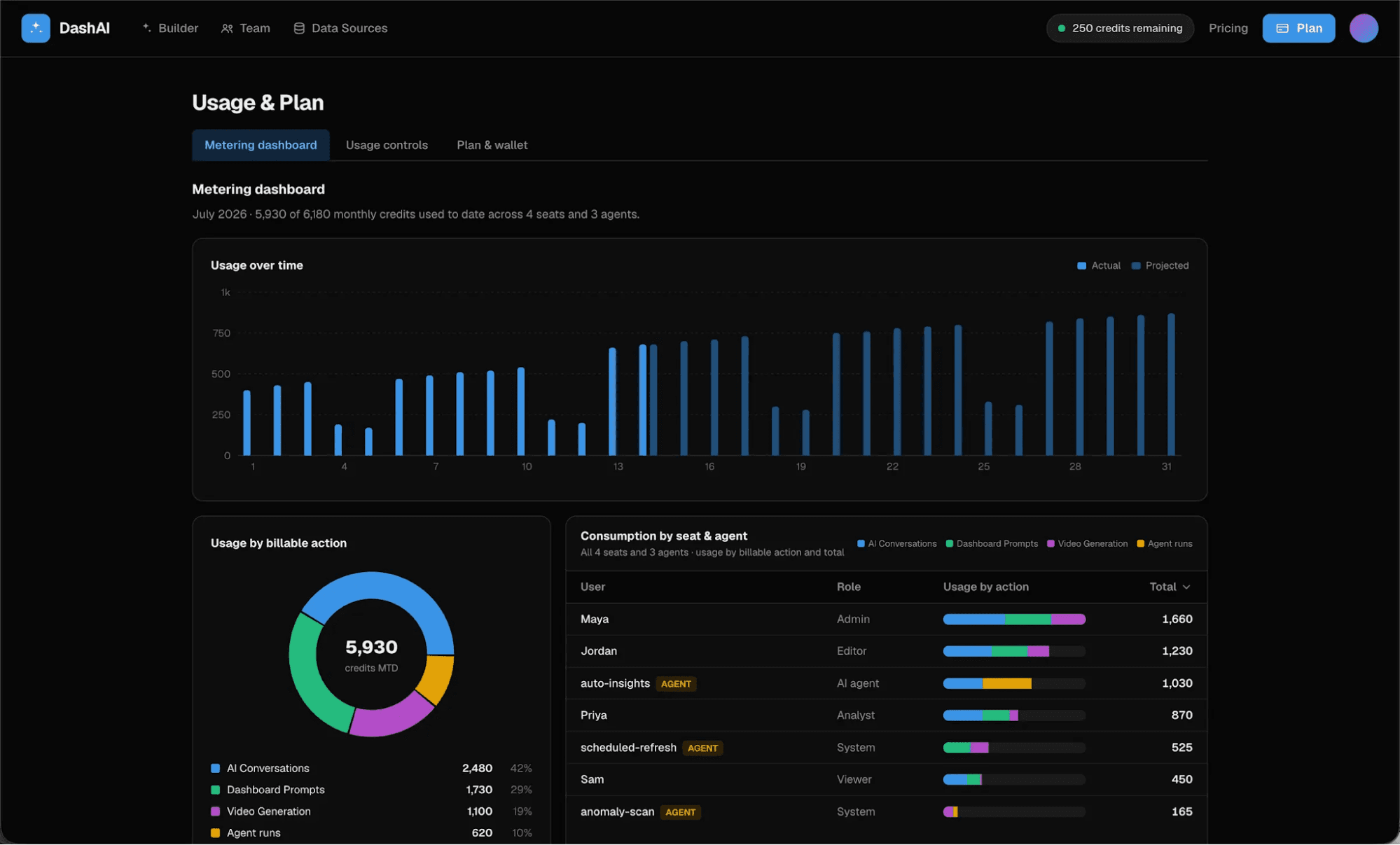
If your company needs to implement usage-based billing at scale, consider a complete usage billing platform like Schematic. It provides a metering dashboard, self-service controls, and enterprise wallets.
Payments Orchestration
Both Recurly and Stripe Billing support global payments. However, they take different approaches to payment processing.
Recurly allows subscription-based businesses to connect to payment gateways. It supports different payment methods, currencies, backup payment options, and automatic gateway failover.
Teams can switch to different gateways when needed or run multiple gateways at the same time. This offers more flexibility when choosing payment processors.
Stripe Billing has an integrated payment solution that accepts payments online or in person. It provides hosted payment pages, shareable payment links, and embedded checkout forms to provide personalized experiences.
The platform also helps SaaS companies sell cross-border by presenting plans in local currencies and offering multiple payment methods. It even handles taxes to ensure global tax compliance.
Dunning Management
Recurly uses intelligent retries, automatic card updates, and advanced dunning tools to recover failed payments. Its account updater refreshes card details before renewals to prevent failed charges.
Teams can also set reminder schedules, recovery periods, and personalized dunning campaigns for different customer groups.
Similar to Recurly, Stripe Billing includes AI-powered smart retries to retry declined payments. It also offers automatic card updates, custom dunning workflows, and cancellation surveys to help businesses recover revenue and reduce churn.
Both platforms can prevent involuntary churn. Recurly gives businesses more control over targeted subscriber retention campaigns, while Stripe Billing connects payment recovery directly to its billing and payment system.
Revenue Recognition
Recurly offers RevRec, which automates revenue recognition for subscription contracts and different pricing models. It provides a unified view of subscriptions, billing, and revenue reporting, which allows finance teams to close the books faster.
Recurly also helps businesses comply with ASC 606 and IFRS 15 accounting standards by handling the five-step process automatically.
Meanwhile, Stripe Billing integrates with the Revenue Recognition product to simplify revenue recognition. It translates all transactions and billing terms into reports or journal entries that connect to general ledger accounts.
Finance teams can also create custom rules to recognize revenue that align with unique performance obligations. They can even review journal entries down to the customer, invoice, and account level to inform decision-making.
Integration Capabilities
Recurly provides APIs, webhooks, and the Recurly.js JavaScript library for linking your existing tech stack.
APIs support integration with enterprise resource planning (ERP) systems, customer relationship management (CRM) software, and data warehouses. Meanwhile, webhooks send one-way notifications when important activities happen, such as a customer pausing their subscription.
Recurly also offers mobile SDKs for native in-app payments on iOS and Android mobile apps. Plus, an app management connector brings Apple App Store and Google Play subscription data into one system.
Stripe Billing connects directly to other Stripe products, including Stripe Payments, Invoicing, Tax, and Revenue Recognition. It provides a unified financial infrastructure that helps your company grow revenue.
Stripe Billing also integrates with CRM software, CPQ solutions, and accounting tools like NetSuite. It even supports custom integrations via the API.
Recurly offers flexible connections to external systems and app stores. Stripe Billing works well for AI and SaaS companies already using Stripe products.
Pricing Plans
Recurly offers three pricing plans for its subscription management platform.
Starter ($249/month + 0.9% of billing volume): It includes automated subscription billing, flexible pricing, static churn prevention, limited payment methods, and a single dunning campaign.
All-Access (Starts at <1% of billing volume, billed annually): Adds intelligent churn prevention, AI agents, analytics, multiple dunning campaigns, advanced plans, custom reports, and more payment methods.
All-Access for Shopify (As low as <1% of billing volume, billed annually): Suits companies that want to integrate billing into their Shopify stack. This plan includes custom bundles, gift subscriptions, cancel-save surveys, and a hosted subscriber portal.
Stripe Billing lets businesses choose from two pricing options.
Pay-as-you-go: Companies with low or unpredictable billing volume only pay for what they use without recurring platform fees.
Pay monthly: Organizations can choose their preferred volume tier. Those dealing with up to $100k in monthly billing volume pay $620 per month.
How to Choose Between Recurly and Stripe Billing
The choice between Recurly and Stripe Billing comes down to your priorities when it comes to recurring billing and subscription management.
Both platforms support recurring billing, but Recurly focuses on subscriber retention and flexible payment processing. Meanwhile, Stripe Billing combines pricing, metering, invoicing, and payments to unify a company's revenue stack.
Choose Recurly if you want to:
Manage the entire subscriber lifecycle, from signup to renewal and retention.
Test different subscription offers, trials, discounts, and promotions.
Reduce involuntary churn through smart payment retries and custom dunning campaigns.
Support multiple payment gateways, currencies, and payment methods.
Track subscriber behavior and find ways to improve retention rates.
Use Stripe Billing when you need to:
Automate recurring billing, invoicing, payment collection, and revenue recognition.
Support subscriptions, usage-based pricing, and hybrid billing models.
Connect billing to Stripe Payments, Tax, and Revenue Recognition.
Give customers self-service portals where they can manage subscriptions.
Expand into new markets by offering multiple payment methods, currencies, and languages.
Where Recurly and Stripe Billing Fall Short
Both Recurly and Stripe Billing support usage-based pricing, but neither platform enforces usage limits inside your product.
Engineering still needs to write entitlement logic to control access and prevent customers from exceeding their usage limits. That can lead to revenue leakage and technical debt, as developers need to maintain code when commercial teams update plan allowances and credit grants.
Usage-based pricing is also difficult to trust because users cannot predict their bills. A single prompt can exceed budgets, forcing customers to dispute their bills.
Unfortunately, Recurly and Stripe Billing do not surface consumption inside the product. There's no way for customers to learn about their current usage and spending. They need to wait until the invoices arrive, which can lead to frustration and loss of trust.
Why Should AI and SaaS Companies Consider Schematic
Schematic is the only billing software that solves the trust problem in usage-based pricing. It provides real-time metering, credits, runtime entitlements, and usage governance controls.
The platform tracks software entitlements against caps and enforces limits as usage happens. One flag check works in React, Node, Python, and Go so that the user interface and the API are in sync.
Enterprise credit wallets give buyers real-time visibility and control over their consumption. They can set thresholds per company, per seat, or per agent, manage auto top-ups, and receive alerts before usage stops.
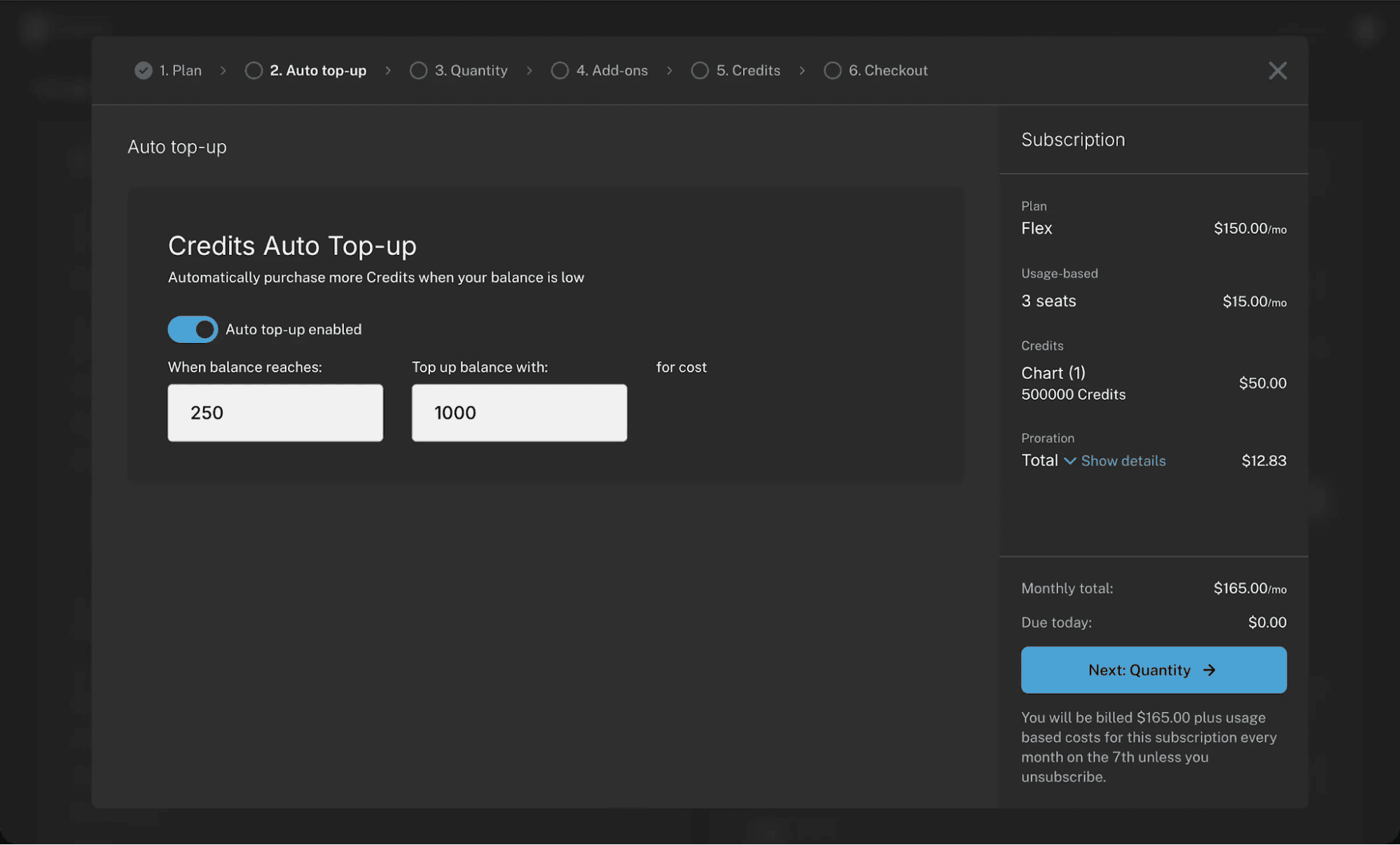
As customer experience lead Rahul Gill from Macabacus puts it, "Schematic's ability to offer usage caps, bundles, and top-ups gave our customers the cost predictability they need."
Book a demo to see Schematic in action!
Switch to Schematic for Usage-Based Billing and Entitlements Your Customers Can Trust
Schematic is the complete usage-based billing platform for software and AI companies selling to enterprises.
Unlike traditional billing solutions, Schematic gives enterprise customers real-time visibility into usage, spend forecasts, self-service controls, and configurable spending limits. These features prevent runaway bills or unexpected access throttling.
In addition to usage governance, Schematic can meter usage events, grant credits, and enforce limits at runtime. The entitlement engine automatically applies policies the moment they are saved. This protects profit margins by preventing customers from using more than what they're entitled to.
Schematic also offers out-of-the-box tools that allow companies to:
Configure credit rollover policies, expiry windows, and priority consumption rules.
Reserve credits before committing or releasing them based on the action's results.
Version plans, migrate customers, and run trials.
Track credit-based revenue recognition on an append-only ledger.
Record every grant, deduction, and check for faster debugging and implementation.
Ship any pricing model without a billing rebuild.
FAQs About Recurly vs. Stripe Billing
Which is better for recurring billing: Recurly or Stripe Billing?
Both platforms handle recurring invoices, renewals, and subscription changes. Recurly is better for businesses that prioritize subscriber retention and multiple payment gateways. Stripe Billing is a strong choice for companies that want recurring billing connected to Stripe's native payment solutions.
Can Recurly and Stripe Billing prevent involuntary churn?
Yes. Recurly uses smart payment retries, automatic card updates, and personalized dunning campaigns to recover failed payments. Stripe Billing offers AI-powered smart retries, card updates, and payment reminders. Both platforms help businesses reduce involuntary churn and recover revenue.
Is Recurly or Stripe Billing better for small businesses?
Stripe Billing may be better for smaller companies because it offers pay-as-you-go pricing without a monthly commitment. Recurly is worth considering for established businesses that need advanced churn prevention tools, payment orchestration for multiple gateways, and AI-powered insights.