 Ryan Echternacht
Recurring billing means repeatedly charging customers on a predefined schedule, such as monthly or yearly. It is how SaaS companies collect payments for software subscriptions, add-ons, and usage-based plans.
However, many SaaS teams still manage parts of the recurring billing process by hand. They manually create invoices, track renewals, update plans, and follow up on failed payments. This can lead to missed revenue and more work for finance, sales, and customer success teams.
Recurring billing software helps solve these problems. It automates subscription billing, payment collection, invoicing, payment retries, and revenue tracking.
With the right tool, SaaS teams can spend less time on routine billing tasks and more time growing annual or monthly recurring revenue.
This article lists the seven best recurring billing software and their key features.
TL;DR
These are the top seven recurring billing solutions for SaaS businesses:
- Stripe Billing
- Recurly
- Chargebee
- Metronome
- Zuora
- Zenskar
7 Best Recurring Billing Software in 2026
Below are the best platforms for handling recurring payments for software subscriptions.
1. Schematic + Stripe
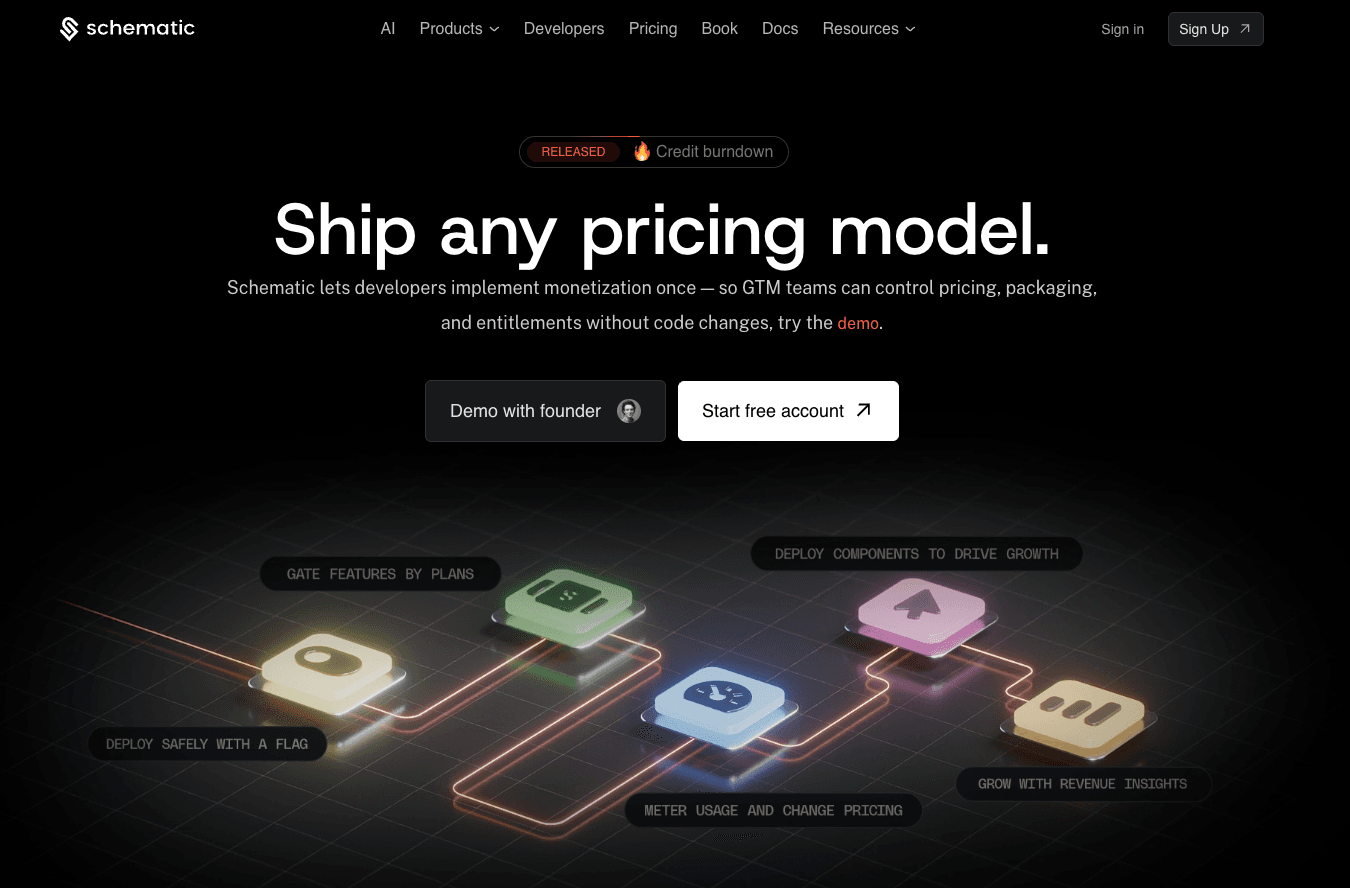
Schematic is the best recurring billing platform for modern SaaS and AI companies that need to manage recurring plans and ensure access in-product matches subscription state.
The platform offers bi-directional sync with Stripe. Stripe handles recurring payments, invoice creation, dunning workflows, tax compliance, and revenue recognition.
Schematic adds powerful capabilities on top of Stripe. These include a product catalog, usage metering, feature access control, internal admin dashboards, and embeddable billing components.
Businesses can ship any pricing model without hard-coding billing logic into the application. Create custom plans, adjust limits, manage software entitlements, enable credit rollovers, and offer add-ons in one place.
Schematic also evaluates and enforces access inside the product at runtime. Engineering stops writing entitlement code. Product and go-to-market (GTM) teams get the necessary controls to iterate on software monetization.
Key Features
- Native Stripe app with real-time access control, usage enforcement, and customer lifecycle management
- Centralized product catalog for plans, limits, trials, features, add-ons, and custom overrides
- Support for usage-based pricing models (e.g., pay-as-you-go, credit burndown, overages, and seat-based pricing)
- Runtime feature access control and limit enforcement
- Single scrolling page for the company profile
- Drag-and-drop billing components to build pricing tables, usage dashboards, and customer portals
- Real-time insights into revenue, billing, and usage data
- Seamless integrations with Stripe, Segment, Clerk, WorkOS, Salesforce, and HubSpot
- SDKs for all major stacks
- Compliance with SOC 2 and GDPR requirements
Pricing
- Starter (Free): Gain access to 10 subscriptions, 500k monthly events, two company overrides, scheduled downgrade, and basic integrations.
- Growth ($200/month): Includes everything in Starter plus 100 subscriptions, 10m monthly events, 20 company overrides, a single webhook, and the ability to remove the Schematic branding.
- Enterprise (Custom pricing): Offers all features in the Growth plan, unlimited scale, role-based access control, data exports, and premium support.
- Add-on for teams ($500/month): Add unlimited company overrides and webhooks that your team can use.
2. Stripe Billing
Source: Stripe.com
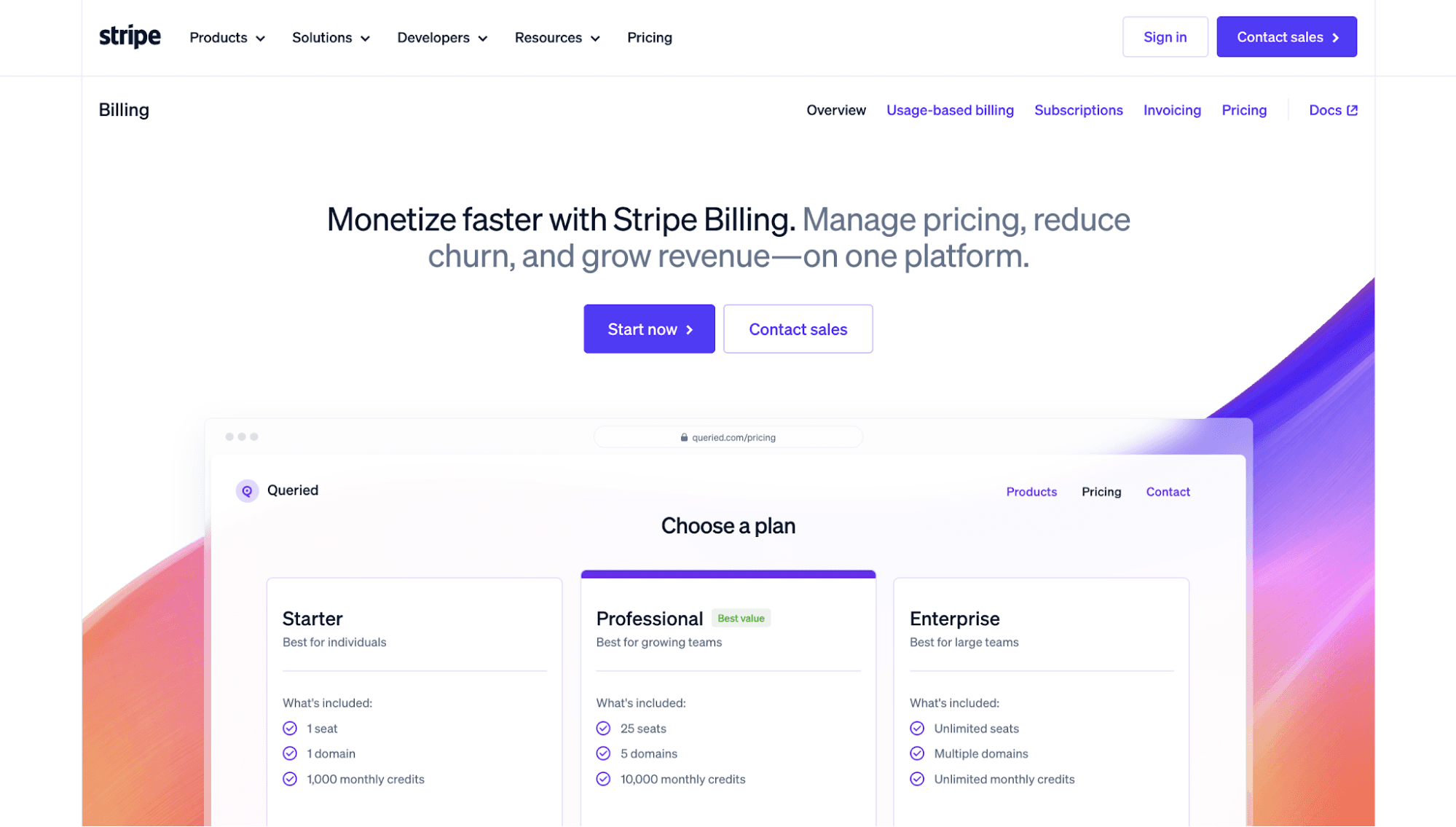
Stripe Billing is a popular recurring billing system for companies that want to consolidate billing, payments, tax handling, invoicing, and revenue recognition.
The software can localize subscription pricing, customize billing logic, and collect recurring payments in one automated flow. It also supports multiple payment methods and currencies, giving customers more options on how they want to pay.
Stripe Billing provides AI-powered tools for payment retries, card account updates, cancellation surveys, and dunning workflows. These features protect recurring income by reducing payment issues before they turn into churn.
SaaS teams also use Stripe to implement subscription pricing models and usage-based billing models. The platform can meter events, translate them into invoices, connect to payment processors, and track key metrics.
Key Features
- Automated invoice generation, payment processing, and reconciliation
- Support for subscription and usage-based pricing models
- Subscription management with built-in coupons, free and paid trials, and prorations
- AI-powered revenue recovery tools
- Reporting insights into annual or monthly recurring revenue (ARR/MRR), churn, and other key metrics
Pricing
- Pay-as-you-go (0.7% of billing volume): This suits businesses with low or unpredictable billing volume, as they only pay for what they use.
- Pay monthly ($620/month): Companies with over $100,000 billing volume per month can subscribe to an annual plan with monthly recurring fees.
3. Recurly
Source: Recurly.com
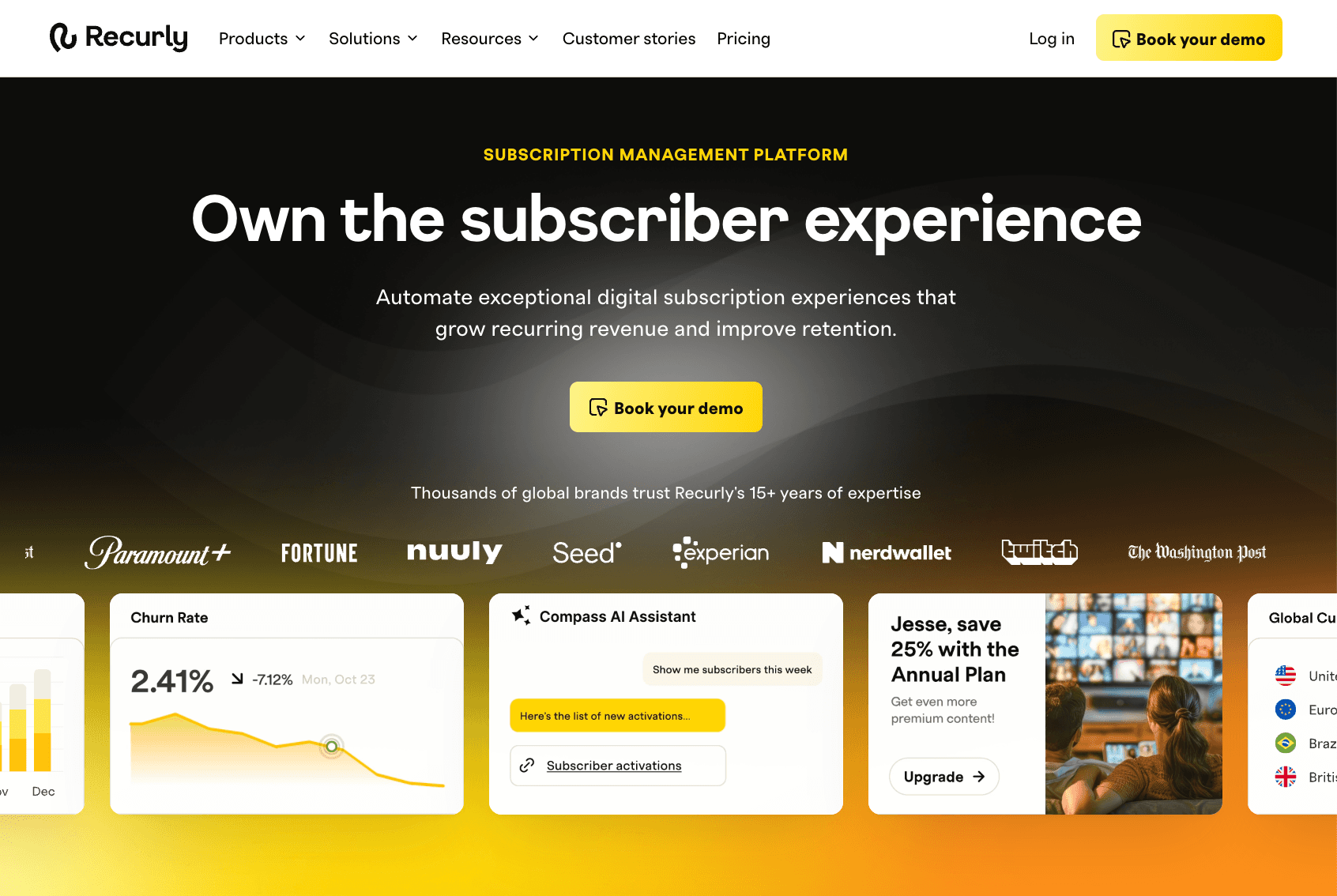
Recurly offers a subscription billing platform built to manage and expand recurring revenue. It can launch any pricing model and design checkout flows that connect to your existing tech stack.
The software connects to multiple payment gateways and payment processors, allowing you to reach global customers. Built-in active fraud management prevents churn and minimizes chargebacks.
Additionally, Recurly's billing software automates revenue recognition for different recurring revenue models. This enables your finance team to close books faster while meeting ASC-606 and IFRS-15 compliance.
Recurly suits SaaS companies that want to manage subscriptions, recurring billing, payments orchestration, churn management, and compliance in one place.
Key Features
- Automated recurring billing workflows, credit adjustments, and tax handling
- Subscriber management with automated lifecycle and dunning communications
- Global payments orchestration with fraud management
- Revenue recognition and compliance support
- Real-time reporting dashboards
Pricing
- Starter ($249 per month + 0.9% of billing volume): Covers global subscription billing, flexible pricing, churn prevention tools, and limited payment methods.
- All-Access (as low as <1% of billing volume): Includes everything in Starter plus AI-powered tools, custom reporting, multiple dunning campaigns, single sign-on capabilities, and additional payment methods.
- All-Access for Shopify (as low as <1% of billing volume): Integrates directly with a company's Shopify stack, and includes customized bundles, prepaid subscriptions, surveys, and a self-serve bulk updater.
4. Chargebee
Source: Chargebee.com
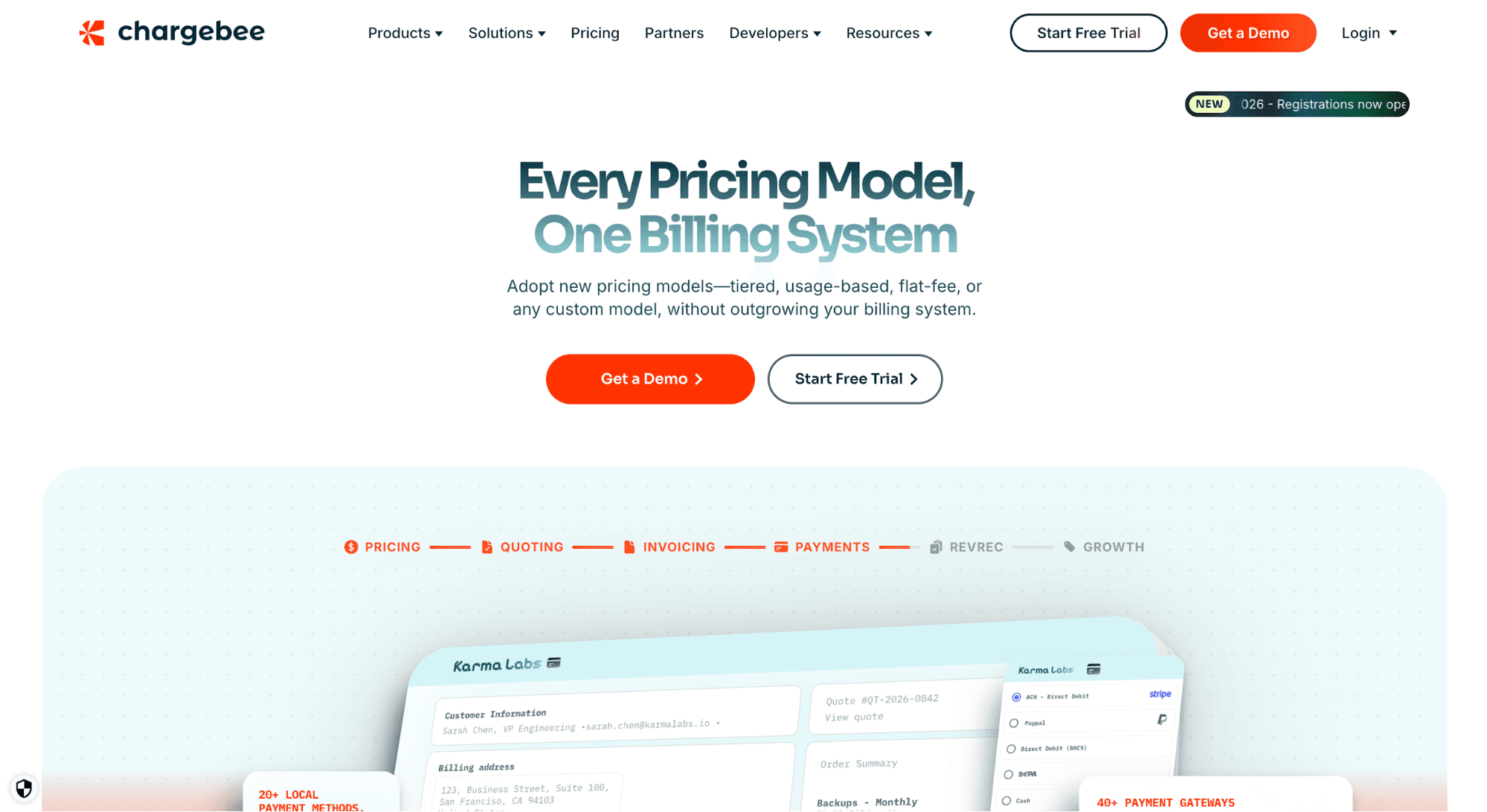
Chargebee offers a unified billing system for managing complex subscription models, such as usage billing, tiered pricing, multi-year, and hybrid pricing models.
A centralized product catalog lets you create custom offerings and iterate on pricing without code. You can also set up recurring billing logic and automate invoicing workflows to reduce manual work.
Chargebee connects to different payment gateways, which can support multiple currencies and local payment methods. This helps you deliver a more personalized checkout experience that can increase conversion rates.
The recurring billing software can even automate the entire customer lifecycle, from trial management to revenue recovery. Billing adjustments for plan upgrades, downgrades, and renewals happen instantly in the background.
Key Features
- Product catalog for subscription plans, add-ons, and billing frequencies
- Payment gateway connections that support over 100 currencies
- Automated billing, invoicing, and tax management
- End-to-end subscription management
- Subscription analytics and insights
Pricing
- Starter (Free for the first $250k of cumulative billing, then 0.75% on billing volume): Includes flexible billing, custom usage metering, limited payment gateway connections, hosted payments, and sales tax support.
- Performance ($7,188/year): Adds smart dunning tools, advanced and consolidated invoices, migration support, and engineering consultation.
- Enterprise (Custom pricing): Offers multi-entity support, account hierarchy, contract terms, and on-demand discounting.
5. Metronome
Source: Metronome.com
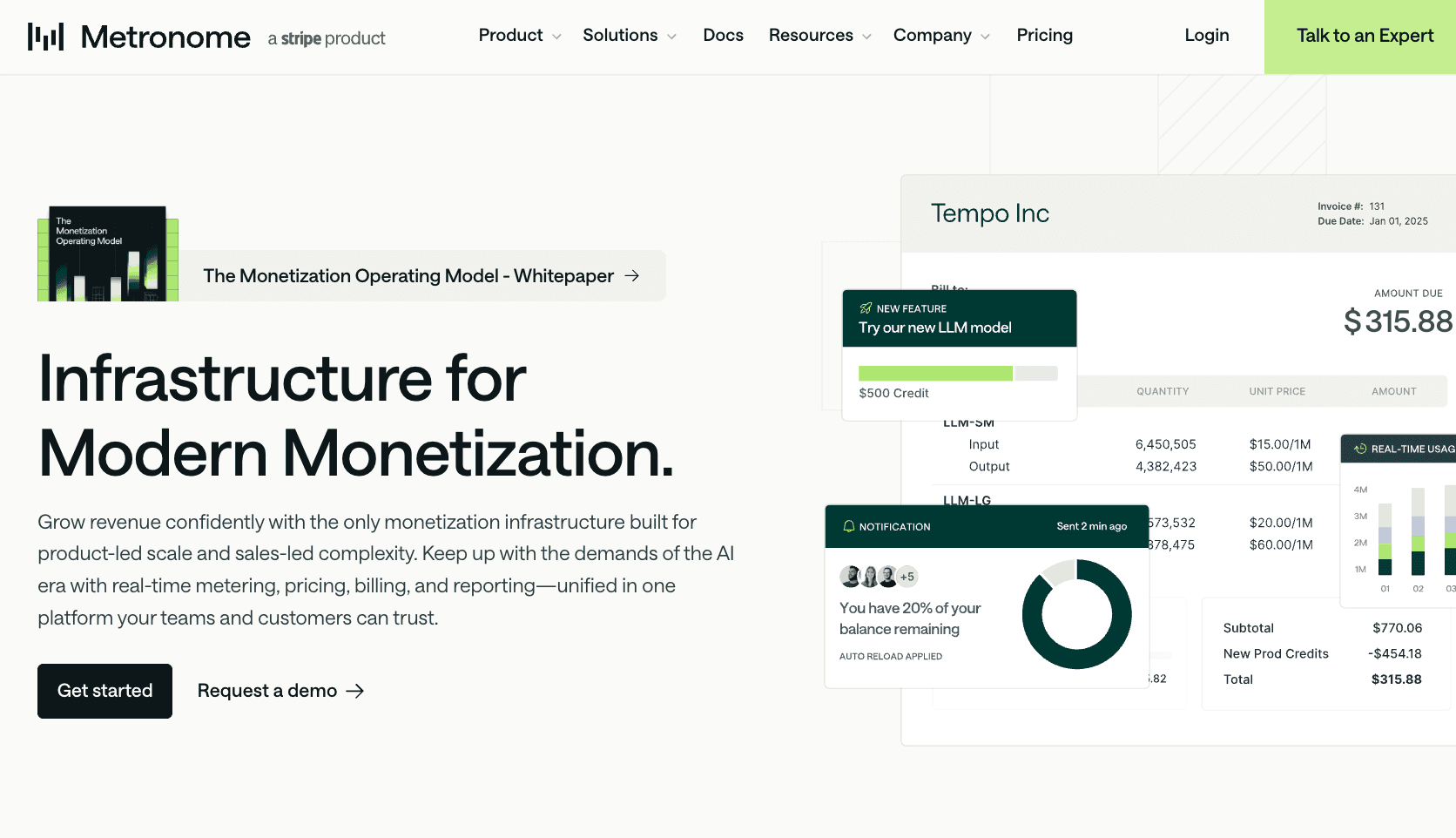
Metronome is a recurring billing software that specializes in usage billing. It lets you charge recurring fees for tokens, seats, credits, API calls, and other usage-based units.
The system automatically collects raw usage events and turns them into billable metrics. It also provides real-time usage and revenue data, making it easier to track customer consumption, calculate daily revenue, and conduct margin analysis.
In addition to usage-based and metered billing, Metronome gives customers control over their spending. Configurable alerts and limits prevent runaway spend, while billing dashboards reveal current usage.
Metronome also supports pricing experiments by offering centralized visibility of your core pricing models. Adjust usage limits, contract terms, product offerings, discounts, and more without switching between different monetization platforms.
Key Features
- Pricing levers for usage-based, subscription, and hybrid models
- Centralized rate cards, commits, and credit systems
- Embedded revenue and usage data
- In-app billing dashboards
- Native integrations with payment processors, accounting software, and cloud marketplaces
Pricing
- Starter (Free): Covers real-time event ingestion, usage-based billing, low-latency alerting, native Stripe integration, and embeddable billing dashboards.
- Custom (Custom pricing): Includes advanced features, enhanced service-level agreements (SLAs), data exports, and priority support.
6. Zuora
Source: Zuora.com
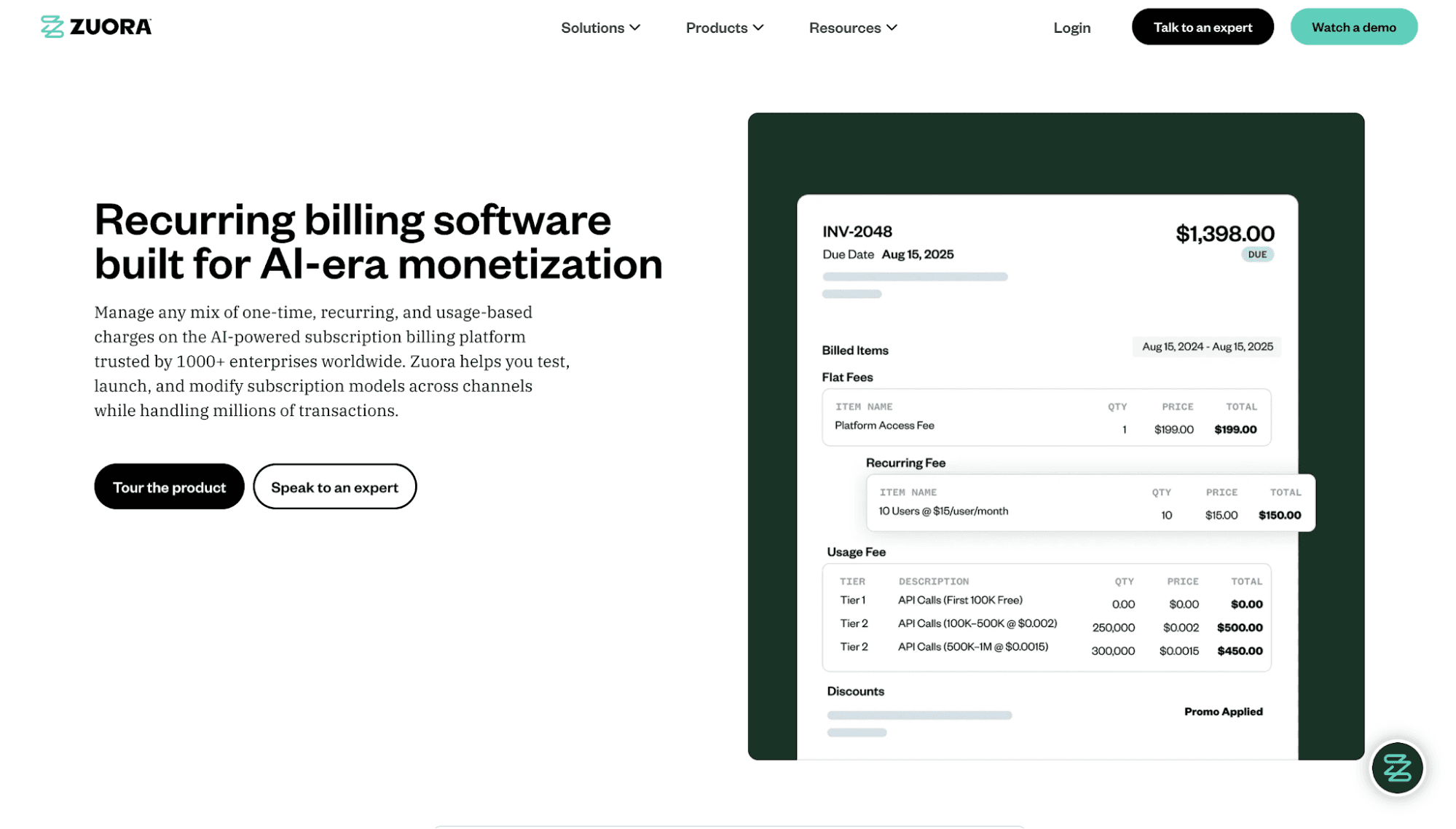
Zuora offers a modern recurring billing solution designed for flexible SaaS pricing and packaging. It supports subscriptions, one-time charges, usage-based fees, milestone billing, and hybrid models.
It provides built-in extensibility through the Extension Studio. This lets you set custom recurring billing logic, monitor deployments for new product launches, and create custom solutions that adapt to your unique business needs.
Zuora also takes care of payment processing, invoicing, and revenue recognition. It automates complex billing and revenue streams, which helps you keep up with customer demands at scale.
Plus, Zuora's integrated CPQ software can configure quotes throughout the entire customer lifecycle, from new sign-ups to upsells to renewals. At the same time, it ensures all key metrics are accurately captured in financial reports.
Key Features
- Out-of-the-box recurring billing models
- Extension Studio for custom configurations
- Global payments orchestration with built-in payment gateway connectors
- Electric invoicing and tax compliance
- Automated order-to-cash lifecycle management
Pricing
Zuora offers custom pricing, depending on the products or modules selected.
7. Zenskar
Source: Zenskar.com
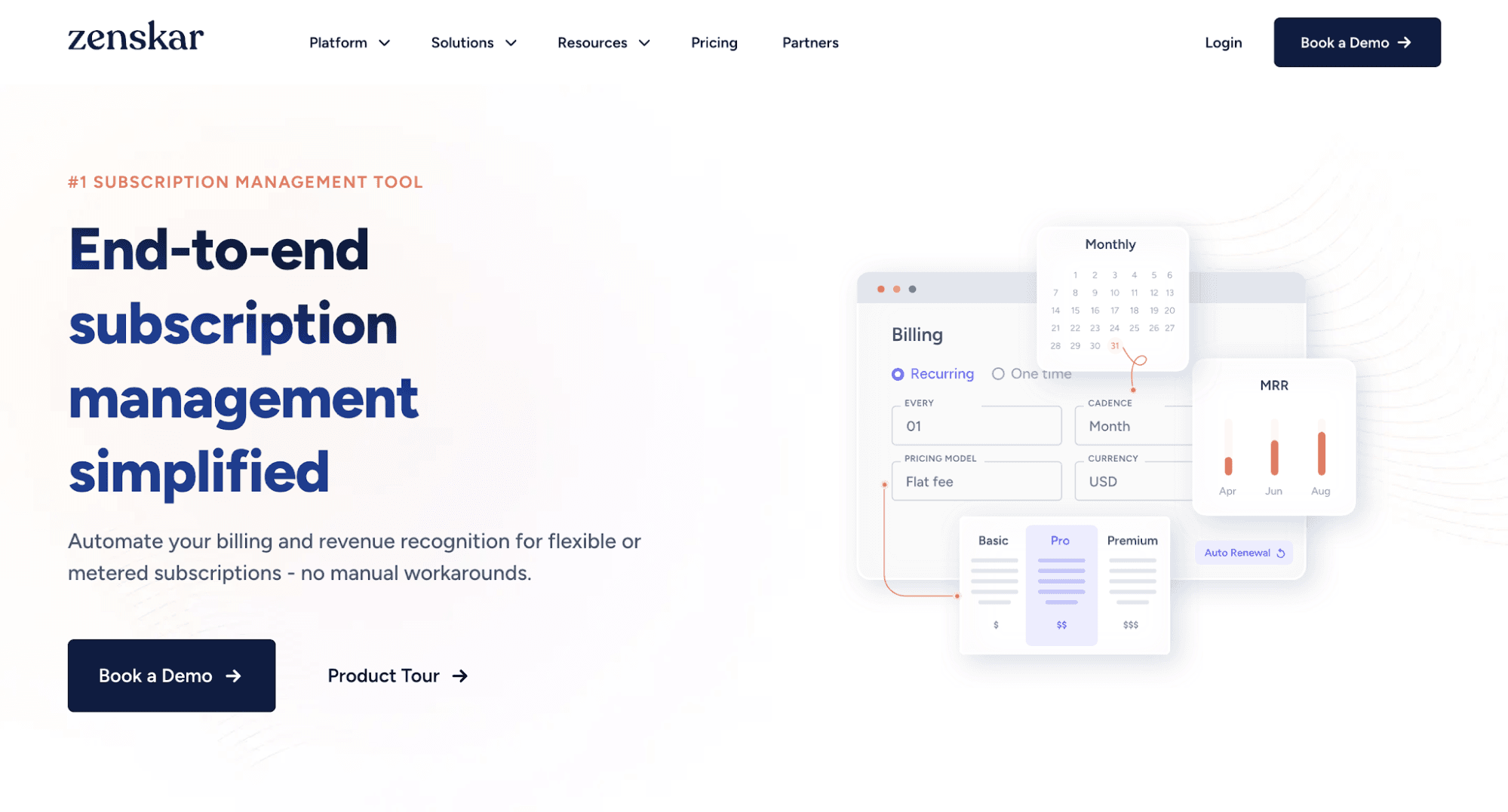
Zenskar combines recurring billing software with a subscription management platform. It handles subscription billing, revenue recognition, payment collections, SaaS reporting, and churn management.
With Zenskar, you can set up any pricing structure, such as flat-rate, tiered, usage-based, and per-user pricing. You can also offer add-ons, credits, and entitlements.
Meanwhile, a self-serve billing portal enables customers to track their usage, upgrade or downgrade plans, and change payment methods at any time. Zenskar automatically sends alerts when payment fails to prevent involuntary churn.
Zenskar can also sync customer data, contracts, invoices, payments, and tax calculations through native integrations. This reduces manual data entry and simplifies order-to-cash processes.
Key Features
- Product catalog for plans, add-ons, credits, and entitlements
- No-code, self-service customer portal
- Failed payment alerts and reminders
- Custom revenue recognition rules
- Subscription analytics with pricing performance and product usage metrics
Pricing
- Starter (Custom pricing): Includes basic features, limited integrations, and support.
- Standard (Custom pricing): Adds premium support, hands-on implementation, and access to all integrations.
- Enterprise (Custom pricing): Comes with dedicated support, white-glove implementation, and on-demand integrations.
Benefits of Recurring Billing Software
Here are the benefits you can expect when adopting recurring billing software.
Reduce Failed Payments and Involuntary Churn
Failed payments can lead to involuntary churn and revenue leakage. According to Churnkey, most payments fail because of insufficient funds, which make up around 40% of declines. Card-related issues, like expirations, also contribute to 10-15% of all declines.
Recurring billing software can minimize these risks by retrying failed payments automatically. The platform can also send dunning emails, update expired card details, and alert teams when an account needs attention. This improves payment success rates and reduces churn caused by payment issues.
Improve the Customer Experience
Recurring billing software provides access to a self-service portal. This makes it easier for customers to buy, renew, or upgrade plans without waiting for support.
It also enables users to view their current usage, change payment methods, and configure subscription settings easily, which can improve customer satisfaction.
Save Time and Minimize Errors Through Automation
Recurring billing software automates repetitive billing tasks that often slow teams down. These include invoice creation, payment collection, renewal reminders, tax calculations, and subscription lifecycle management.
Automation helps finance, product, and sales teams save hours on manual effort every month. It also reduces billing complexity as the business adds new plans, usage-based pricing, overrides, and exceptions.
Instead of tracking each account by hand, teams can manage pricing rules, subscription data, payment details, and invoices in one place. This minimizes billing errors that can lead to disputes, refunds, or support tickets.
Scale Pricing Faster
SaaS pricing often changes as the company grows, the product matures, or customer needs change.
You may start with flat-fee subscriptions, then eventually add usage-based fees, AI credits, add-ons, and volume discounts.
Recurring billing software makes these changes easier to manage without rebuilding your billing infrastructure.
You can quickly ship any subscription pricing model, change packages, add new products, and create custom billing logic.
Gain Insights Into Key Billing Metrics
Recurring billing software provides real-time data on revenue, account health, and customer behavior. It tracks key metrics, such as ARR, MRR, churn, customer lifetime value, upgrades, downgrades, and refunds, from one system.
These metrics give leaders a better view of what is working and what needs attention. Finance teams can review revenue trends. Product managers can see which plans or pricing models drive revenue growth. Customer success teams can identify accounts at risk and take action before they churn.
Manage Recurring Plans and Enforce Access at Runtime With Schematic
Schematic is the monetization operating system for modern SaaS and AI companies. It gives teams one place to manage recurring subscription plans, entitlements, limits, add-ons, trials, credits, and overrides.
Schematic sits between your product and Stripe. Stripe manages invoices, payments, and revenue recognition for recurring plans. Schematic ensures access in the product lines up with the customer's subscription.
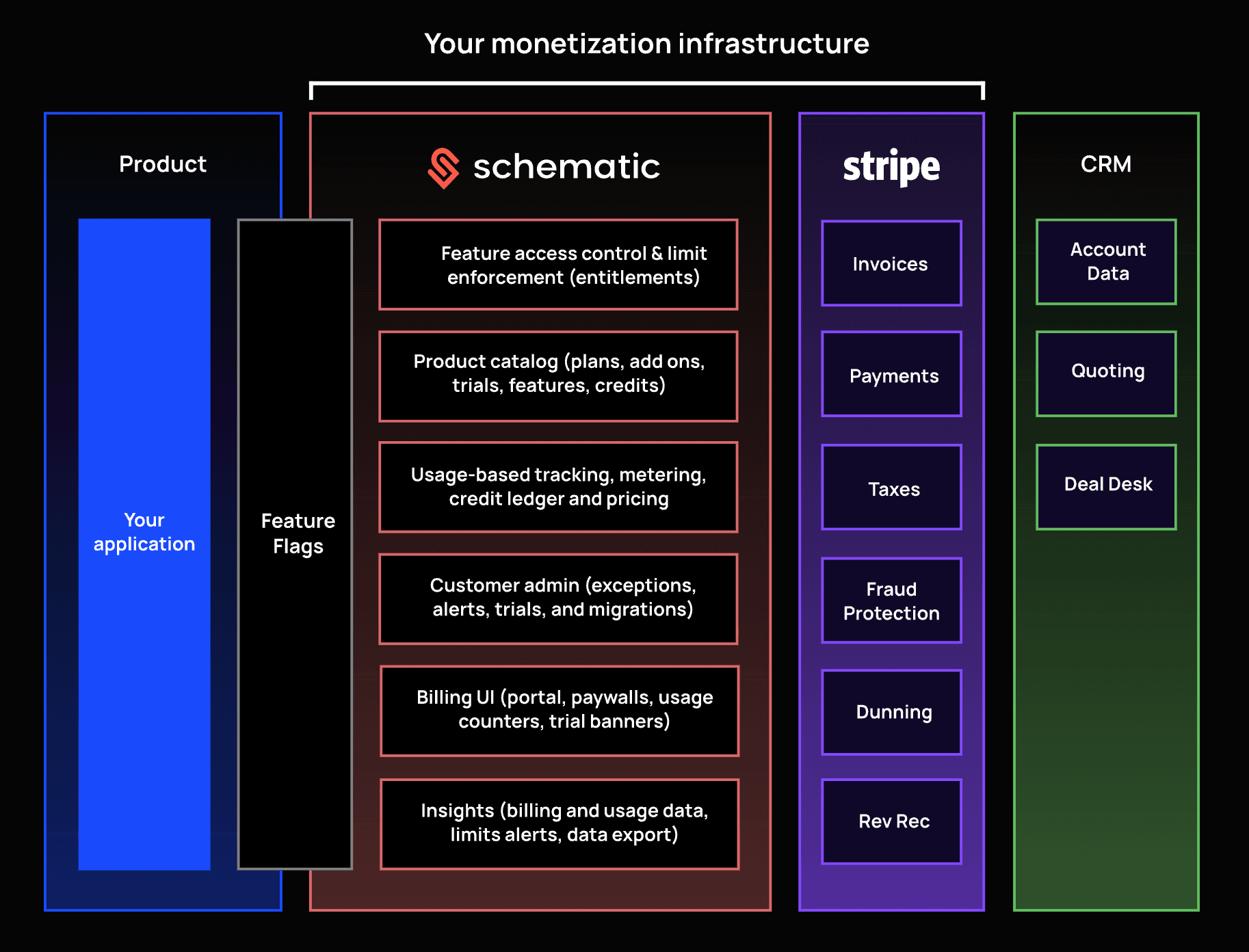
By decoupling billing logic from the application, Schematic enables product and GTM teams to control pricing, packaging, and limits without deploying code.
Engineering stops writing two hundred lines. They only need to implement monetization once. Schematic evaluates and enforces access inside the product at runtime.
FAQs About Recurring Billing Software
What does recurring billing mean?
Recurring billing means a business charges a recurring fee on a set schedule. For SaaS companies, this often refers to monthly or yearly payments for access to software, features, or usage.
What are the best platforms for automated recurring billing?
The best platforms for automated recurring billing include Schematic, Stripe Billing, Chargebee, Recurly, and Zuora. The right choice depends on your pricing model, payment needs, reporting requirements, and billing complexity.
What is the difference between recurring billing software and subscription billing software?
Recurring billing software automates the process of collecting fixed payments on a predefined schedule. Subscription billing software adds advanced capabilities, such as managing the customer lifecycle, handling billing cycles, metering usage, and recovering payments.
How does recurring billing software benefit SaaS companies?
Recurring billing software helps SaaS companies collect payments and grow recurring revenue. It also reduces manual billing work by automatically generating invoices, connecting to payment gateways, and sending follow-ups.