All posts
How to Compare Subscription Management Platforms for Businesses
Blog· Ryan Echternacht·Mar 24, 2026
Ryan Echternacht·Mar 24, 2026
Choosing the best subscription management software is no longer just about billing or payment processing. For SaaS and AI companies, it affects how you price, package, and control access inside your product.
The problem? Most subscription-based businesses compare tools the wrong way. They focus on invoices and payments but ignore pricing logic, SaaS entitlements, and flexibility.
That leads to slow product changes and messy workarounds later, especially if you’re running usage-based pricing, hybrid plans, or credits.
In this guide, you’ll learn how to compare subscription management platforms the right way so you can choose a system that fits your business model.
TL;DR
- Before comparing subscription management software, you should know your needs, product setup, and internal workflows.
- Focus on features that go beyond billing and payment processing, such as entitlements, usage metering, and in-product enforcement.
- Compare how well each platform supports flexible pricing models, integrations, automation, compliance, and security.
- Evaluate the tool's ease of use, pricing, and performance in real scenarios.
- Schematic supports runtime enforcement for subscription plans, limits, trials, and exceptions while integrating with Stripe for invoice processing.
10 Steps to Compare Subscription Management Platforms for Businesses
These steps will help you compare the best subscription management software based on how your company operates, and not just on feature lists.
1. Know Your Needs
Before you evaluate different platforms, think about how your business currently works and where it’s going.
Start with your pricing model. Are you using a flat-rate, tiered, usage-based, or credit-based system? Many SaaS and AI companies now rely on hybrid pricing, so your subscription platform should support that from day one.
Next, think about how your product handles access and usage. Do you gate features by plan? Do users pay as they go or consume AI credits? This goes beyond billing. It’s about how pricing connects to your product.
You should also map out your internal workflows. How do engineering, finance, and product teams interact with the entire subscription lifecycle? Think about where their work usually slows down.
Lastly, consider future growth. For example, if you’ll launch new pricing plans often, you need a platform that lets you update pricing without heavy engineering support. Those planning to expand globally should look for multiple payment options and support for different currencies.
2. Note Must-Have Features
Once you know what you need, the next step is to determine which features are non-negotiable.
Not every subscription management platform will match how your business operates. Some tools focus only on payment collection, while others connect the subscription model to plans, in-product access, and customer experience.
Here are some key features to consider:
- Software entitlements and access control - Define what each customer can access based on their subscription plan, usage, or contract terms.
- Usage metering - Track how customers consume your product, such as seats, credits, API calls, and overages.
- In-product enforcement - Apply limits at runtime, so enforcement stays aligned with the current plan state and usage.
- Sales-led overrides - Adjust pricing, limits, exceptions, and discounts without code changes.
- Customer self-service portal - Allow customers to upgrade, downgrade, or manage their subscriptions on their own.
- Customer lifecycle management - Manage free trials, upgrades, renewals, and cancellations throughout the entire customer lifecycle in one place.
- Dunning management - Recover failed payments with automated retries and notifications.
For example, if you're an AI company selling API access, you may need usage metering, entitlements, and in-product enforcement working together. Without these, you may bill customers correctly but still fail to control how they use your product.
3. Check Support for Multiple Pricing Models
Subscription businesses don’t rely on a single pricing model. They use different approaches based on how customers buy, use, and scale their SaaS or AI product.
It’s important to compare subscription software based on how well it supports multiple pricing models. If the platform is too rigid, it will limit how you price and package your product.
Here are the main pricing models to look for:
- Flat-rate pricing - This model charges a single fixed price for full access to the product. Managing subscriptions with flat rates is simple, but they're less flexible as customer needs grow.
- Tiered pricing - It offers different plans with set features or limits, which lets you group customers based on value.
- Seat-based pricing - This model charges customers based on the number of users or software licenses.
- Usage-based pricing - It bills users based on how much they use the product, such as API calls or data usage.
- Hybrid pricing - It combines multiple approaches, such as a base subscription plus usage, seats, or credits. This gives subscription businesses more flexibility and supports both self-serve and sales-led motions.
- Modular pricing - This model lets customers pay for add ons or extra features. SaaS and AI companies can match different customer needs without forcing plan upgrades.
4. Review Automated Billing Capabilities
Automation plays a big role in how well your billing system performs as you grow. Manual processes slow teams down and increase the risk of errors.
The right billing automation system can handle recurring payments and recurring invoices without constant input from finance. Sales and marketing teams can experiment with new pricing, features, add ons, and limits.
When comparing different tools, look at how flexible the automation is. The best subscription management platform should support different billing cycles, proration, and mid-cycle changes without breaking your system. It should also automatically handle failed payments with retries and notifications to protect cash flow.
Check how billing connects to your product and pricing logic. If automation is limited, your team will spend more time fixing billing issues instead of focusing on product development or scaling.
5. Evaluate Ease of Use
Some subscription management platforms may check all the right boxes on paper. But they won’t matter if your team avoids using them or needs constant support to complete basic tasks.
Pay closer attention to ease of use. Can finance manage billing without friction or extra steps? Can product and sales teams adjust plans, create trials, and introduce new features without waiting on engineering?
You should also look at how simple it is to oversee multiple subscriptions, create billing components, and monitor usage.
A system that feels slow or confusing will create friction over time.
This becomes even more important with a complex billing infrastructure. The right subscription management solution should make it easy to manage plans, entitlements, usage, and limits without adding extra work for your team.
6. Look at Integration Options
Your subscription management platform should not work in isolation. It needs to connect with the tools your team already uses across billing, product, and finance.
Start with payment gateway integrations. A strong platform should support major payment gateways like Stripe and PayPal. This lets you manage transactions across different regions without switching billing software.
You should also check how it connects to your sales, finance, and CRM tools. Seamless integrations help you track revenue recognition and update customer traits based on their subscription plan without relying on manual workarounds.
Connections with identity providers, such as Clerk, also matter. They connect user identities to subscription data, making it easier to assign and enforce entitlements.
The best subscription management software offers prebuilt integrations, webhooks, and open APIs. This makes it easier to plug into your existing tech stack without building integration glue.
7. Analyze Revenue Reporting and Subscription Analytics
Reporting is another important factor to consider when comparing subscription management solutions. Without clear data, it’s hard to understand how your pricing and billing decisions affect growth.
The best tools should surface core metrics like monthly recurring revenue, annual recurring revenue, and customer lifetime value. These help you track how your business is performing over time.
You should also look at billing volume to understand how many transactions your system handles and how that changes as you scale.
Beyond revenue insights, check if the platform can analyze product usage data. This is especially important for AI and SaaS companies that rely on usage-based or hybrid pricing. It helps you see who’s overusing, underpaying, and ready to expand.
The goal is to measure monetization performance in one place. If your reporting is split across tools, it becomes harder to make decisions or adjust pricing based on real data.
8. Consider Compliance and Security
Compliance and security should be part of your evaluation from the start. They're important because they directly impact how you handle payments, store customer data, and report revenue. Gaps in these areas can lead to failed audits, payment issues, or legal risks that are costly to fix later.
Look at how the platform handles payment security. Support for standards like PCI DSS can protect sensitive payment data and reduce risk when processing transactions.
SOC 2 compliance is also important, as it demonstrates the software vendor's commitment to data privacy.
You should also check how the platform handles tax compliance. If you sell in multiple regions, you need a system that can manage different tax rules without manual work.
Evaluate how revenue is tracked and reported within the platform. It should support audit-ready revenue recognition to help accounting teams close books quickly and accurately.
9. Compare Pricing
Pricing for subscription management software can vary widely. Most platforms charge a monthly or annual fee, but that’s only part of the total cost.
When comparing tools, look at how pricing scales with your business. Some charge free or lower rates, but shift to enterprise pricing as your usage, seats, and feature needs grow.
You should also consider hidden fees, especially for platforms with custom pricing. These may include extra charges for payment processing, advanced features, or additional integrations, which can add up.
The goal is to understand the total cost of the subscription management platform and not just the starting price.
You may find that a cheaper tool upfront may become more expensive if it lacks flexibility. You might need to rely on engineering to handle pricing changes, build workarounds for missing features, or manage billing issues manually. These hidden costs often show up in lost time, slower product updates, and missed revenue opportunities.
In contrast, a higher-priced platform may make more sense if it helps you manage recurring billing and pricing efficiently. For example, automating invoicing means you spend less time on manual tasks and focus on growing your business.
10. Test the Top Subscription Management Tools
Before making a final decision, you need to see how each subscription management platform works in practice. Demos and free trials help you understand how the system handles real use cases, not just what’s shown in sales materials.
During this stage, involve different teams that will use the platform daily. Engineering can review feature flag management and pricing model implementation, while RevOps can test pricing changes and trials.
Here's what you can test inside the subscription management software:
- Implement different pricing models to see how easy it is to build
- Run pricing changes, upgrades, and downgrades
- Simulate real scenarios like failed payments or mid-cycle changes
- Check how the platform handles usage tracking, limits, and in-product access together
- Review the interface to confirm non-technical teams can use it without support
- Generate reports to see if you can track revenue, usage, and customer trends in one place
Finally, pay attention to vendor support during the trial period. Fast and helpful responses can make a big difference when technical issues come up. A platform with strong support will help your team resolve problems quickly and keep your subscription billing model running smoothly.
What You Should Gain from Choosing the Right Subscription Management Platform
Once you’ve compared your options, the next step is knowing what you should get from the platform. The right tool should do more than handle billing. It should improve how you price, package, and manage access inside your product.
Below are key benefits the platform should deliver:
Ensure Consistent Revenue Collection
The right subscription management software helps you collect revenue on time and without friction. It automates recurring payments and handles retries when payments fail.
That means you don’t have to track invoices or follow up manually. The system handles recurring billing in the background while your team focuses on other work.
It also supports different payment methods and global transactions. This makes it easier to charge customers, regardless of their location.
With fewer billing issues, your revenue becomes more stable and predictable.
Ship Pricing Changes Faster
With the right subscription management software, you can launch pricing without delays. You can quickly roll out new plans, adjust tiers, or test pricing.
This is important for SaaS and AI companies that need to adapt quickly. Markets change fast, and your pricing should keep up.
You should be able to make updates directly from the platform. Product and sales teams can manage changes on their own without waiting on engineering.
Faster pricing updates mean you can respond to customer needs and market shifts without slowing down your team.
Surface Monetization Opportunities
Good platforms don’t just track billing data. They show how customers use your product and where revenue can grow.
You can track which features get used the most and where customers hit limits. This shows where you can introduce add ons or expand plans when needed.
Usage data also gives insight into how customers get value from your product. You can adjust pricing to match that behavior.
With better visibility into monetization opportunities, your team can make smarter decisions about packaging and pricing.
Reduce Churn and Boost Customer Retention
Churn adds up faster than most businesses expect. According to Churnkey, a 5% monthly churn rate can lead to losing nearly 46% of customers over a year. Even small gaps in your billing can have a big impact.
Subscription management software helps reduce churn, especially involuntary churn caused by failed payments. It automates retries, sends reminders, and gives customers simple ways to update their payment details.
The same Churnkey study shows involuntary churn can be recovered with the right systems in place. That means you can save a large portion of lost revenue.
By fixing payment issues early and improving customer satisfaction, you retain more customers and protect your revenue over time.
Improve Team Efficiency
The right platform removes friction between finance, RevOps, and engineering teams. The result? Everyone stays aligned and gets more done with less effort.
Finance can manage billing, invoices, and reporting without relying on spreadsheets or manual fixes. This reduces errors and allows them to close books quickly.
RevOps can launch new plans, run trials, and manage deals without waiting on engineering. They can experiment with pricing and respond to customer needs in real time.
Engineering spends less time maintaining billing logic or fixing issues. They can focus on developing your company's core product instead.
How Schematic Supports Product-Led and Sales-Led Subscription Management
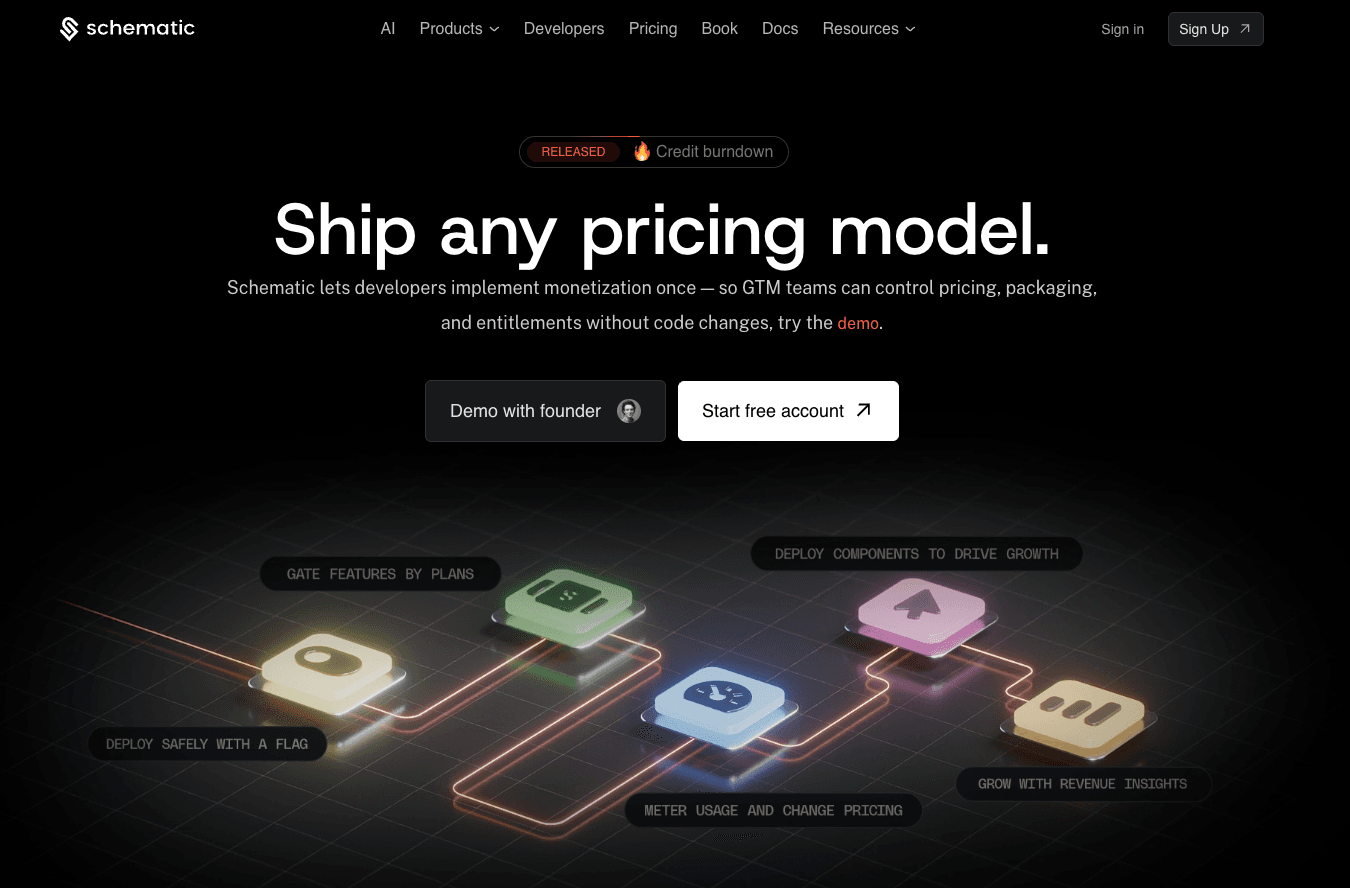
Modern SaaS and AI companies need to support both self-serve and sales-led growth. Schematic offers a subscription management platform designed for this hybrid model.
It acts as the system of record for your catalog, plans, trials, credits, add ons, and overrides. This gives you one place to manage pricing, packaging, and entitlements across both motions, which eliminates the need for multiple point solutions.
Schematic sits between Stripe Billing and your product. Stripe continues to process invoices, payments, and taxes, while Schematic controls plans, entitlements, limits, and exceptions.
Product teams can update plans and create trials without waiting on developers. Engineering no longer needs to maintain billing and entitlement code. Schematic evaluates and enforces access inside the product at runtime.
FAQs About How to Compare Subscription Management Platforms for Businesses
What are the key features to look for when comparing subscription management solutions?
Prioritize features that connect billing with your product, such as entitlements, usage tracking, in-product enforcement, and overrides. You should also check support for multiple payment gateways, automated subscription plan management, self-service portals, and dunning management.
How to choose the right subscription management software?
Start by defining your pricing model and product needs. Compare platforms based on features, compliance, integrations, and ease of use. Make sure the software works seamlessly with your payment processor, such as Stripe payments, to avoid billing errors. Involve finance, product, sales, and engineering to test workflows before deciding.
Are subscription billing platforms worth it for startups?
Yes, they are worth it, especially if you plan to scale. A good platform helps startups manage billing, pricing, packaging, and access in one place. It also improves customer loyalty by creating a smoother billing experience. This reduces manual work and helps you avoid rebuilding systems as your product grows.