 Ryan Echternacht
Fixed subscription pricing is acceptable when product usage stays predictable. But that pricing model starts to break down when SaaS companies serve customers with very different usage patterns, costs, and needs.
Usage-based pricing (UBP) solves this by charging users based on actual consumption. Instead of collecting the same flat fee each month, your company can bill for API calls, AI credits, tokens, compute time, or other usage metrics tied to the product.
However, UBP is one of the most challenging models to implement. You need to choose the right value metric, set a fair rate per unit, ensure real-time usage tracking, and provide full visibility into consumption, among other steps. Otherwise, new and existing customers might push back and throttle usage.
This step-by-step guide teaches you how to implement usage-based pricing. We'll also discuss the common mistakes you should avoid.
TL;DR
- To implement usage-based pricing, choose a usage metric that aligns with product value, select the right pricing model, calculate unit costs, and set clear pricing rules.
- You should also invest in reliable metered billing software, ensure cross-functional alignment, define what happens at the usage limit, give customers real-time visibility into consumption, connect usage to access, and iterate on pricing.
- Avoid mistakes, such as choosing the wrong metric, migrating all customers at once, failing to enforce limits, using complex pricing, and building billing infrastructure from scratch.
- Schematic helps software and AI companies implement usage-based pricing that customers can trust by combining metering, billing, credit wallets, self-service controls, and runtime entitlements in one platform.
How to Implement Usage-Based Pricing in 10 Steps
Follow these 10 steps to adopt usage-based pricing successfully.
1. Choose the Right Usage Metric
The first step involves selecting the right usage metric. It should reflect how customers consume your product and where value creation happens.
The best metric is measurable, scalable, easy to understand, and predictable enough for customers to estimate future costs.
While usage-based pricing often relies on technical metrics, such as API requests or queries, they should still reflect customer value.
Usage metrics can vary depending on the product type. Here's a closer look at the most popular ones:
- APIs and developer tools: API calls, API requests, or events.
- Data and analytics software: Queries, rows scanned, or gigabytes of storage.
- Cloud infrastructure platforms: Compute hours, bandwidth, or gigabytes of storage.
- Marketing and customer relationship management (CRM) software: Contacts, messages or emails sent, minutes, or monthly active users (MAU).
2. Select a Usage-Based Pricing Model
Choosing what to meter is just the start. You also need to decide how to incorporate usage charges into your pricing strategy without affecting your existing revenue streams.
The pricing model defines the way you turn metered usage data into a billable amount. Different usage-based models can also impact how customers pay and how easy it is for them to plan future spending.
Choosing the right structure helps your SaaS business balance revenue predictability, customer satisfaction, and operating costs.
Let's review the most popular usage-based billing models below.
Pay-As-You-Go Pricing
Pay-as-you-go (PAYG) pricing charges customers for product usage without limits or minimum commitments.
Buyers only pay for what they use. If they consume more resources, they can expect a higher bill. If they use the product less often, they pay less.
Let's say a developer tool charges $0.02 per API call. A customer making 1,000 API calls would pay $20. A buyer who uses 15,000 API calls is billed $300.
The billable amount is closely connected to actual usage. Pricing feels fair because customers don't need to pay for unused features or seats, which is common in subscription-based pricing.
Tiered Usage-Based Pricing
Tiered pricing in a usage model changes the price per unit when consumption reaches set thresholds.
High-volume users may pay lower rates per unit or move into different pricing tiers.
A tiered pricing model attracts different buyers, especially enterprise customers, by providing flexibility and scalability.
For example, in a communications platform, the first 100 emails are priced at $0.05 each. The next 200 emails cost $0.045 each, the succeeding 300 emails cost $0.040, and so on.
This structure supports volume pricing because the cost per unit decreases as current usage grows. It rewards loyal customers and power users.
Credit Burndown Pricing
In credit burndown, customers buy prepaid credits that they consume over time.
Credits act as a universal currency and give buyers more flexibility in how they use the product. Different features or actions consume varying credit amounts.
Credit-based pricing also introduces budget predictability by showing how much usage (credits) is left and when to buy more. This is different from PAYG pricing, where customers pay as they use without an upfront commitment.
Hybrid Models
Hybrid pricing combines two or more pricing models into one structure.
Many SaaS businesses add usage-based components on top of a recurring subscription fee. For example, a Pro subscription plan costs $49/month and includes 100 GB of data. If the customer needs more storage capacity, they pay extra for the additional GB of data.
In hybrid billing, the subscription component gives buyers predictable costs. Sellers also benefit from the recurring revenue they earn.
Meanwhile, usage-based charges enable companies to capture potential upside from higher usage. Pricing scales naturally with actual needs rather than a forced plan upgrade.
Custom Pricing With Minimum Usage Commitments
This pricing model blends consumption-based billing with a fixed revenue floor.
Customers commit to a minimum amount each billing period. In return, they expect volume discounts, higher usage limits, custom plans, or other contract terms.
If usage stays below the commitment, the customer still pays the agreed minimum amount. However, once consumption exceeds the threshold, extra usage is billed as overage charges.
Minimum commitments give vendors a more stable cash flow while still allowing customers to increase usage as demand grows.
3. Compute Costs Per Usage Unit
To set the ideal price points, you need to know how much it costs to deliver each usage unit. Doing so gives you a clear baseline for protecting margins as customer consumption grows.
Start by adding the direct costs tied to every unit. For AI products, these may include model inference, tokens, GPU time, third-party fees, storage, or data processing. In SaaS platforms, costs are usually related to cloud infrastructure, bandwidth, transactions, or external services.
Then, compare unit costs with the price you plan to charge. Leave enough room to cover overhead expenses and maintain a healthy margin.
You should also model pricing for different usage levels. Enterprise customers may expect lower rates for consistent product usage. It's important to test whether those volume discounts still produce acceptable margins for your business.
Don't forget to revisit these calculations when infrastructure costs, model providers, or usage patterns change.
4. Set Clear Pricing Rules
Once you've calculated your costs, define exactly how usage data turns into billable charges. Pricing rules should be simple enough for your customers and internal teams to understand.
Decide whether you're charging a flat rate per unit ($0.5 for a token processed) or a tiered rate ($0.02 for 0-1,000 API calls, $0.0150 for 1,000-10,000 API calls, or $0.01 for more than 10,000 API calls).
If you're combining usage charges with subscription fees, you should determine included usage allowances, overage rates, and discounts.
Decide when usage limits reset and how to calculate usage charges each billing cycle. For example, you can allow unused credits to roll over to the next period, or bill overages immediately or at a later date.
You should also establish clear rules for refunds, late usage events, contract changes, and custom pricing. These prevent billing disputes and give internal teams a shared source of pricing logic.
5. Invest in a Reliable Metering and Billing System
A SaaS metering and billing system can turn product consumption into billable amounts.
It tracks usage events, applies pricing rules, generates accurate invoices based on rated pricing logic, and even collects payments when connected to a payment gateway.
This platform is useful for handling large event volumes or multiple usage-based billing models. Traditional recurring billing tools cannot support real-time usage data ingestion, especially when customers have different usage rates, credits, limits, or contracts.
You need reliable metered billing software to implement usage-based pricing successfully.
Key Features of the Metered Billing Software
Below are the core features to consider when evaluating metered billing solutions.
- High-throughput usage ingestion: The platform should process large volumes of usage and billing data without losing or duplicating records.
- Real-time rating: Make sure the metered billing software applies pricing rules to usage units as events arrive. This helps teams calculate charges, balances, and overages in real time.
- Invoicing tools: Check whether you can turn rated usage into clear billable totals and generate accurate invoices based on actual consumption.
- Support for flexible pricing models: Look for software that supports pay-as-you-go, tiered pricing, credit burndown, hybrid plans, and other pricing models without needing custom billing logic for every change.
- Built-in integrations: The metered billing platform should connect to payment gateways, CRM software, data warehouses, and subscription management software like Stripe Billing.
- Revenue recognition capabilities: Check whether the software helps finance teams recognize revenue based on each contract's terms.
- Entitlement management: Most metered billing software only handles metering and rating. Look for a platform that connects usage to product access and manages software entitlements.
6. Ensure Cross-Functional Alignment
Once you have chosen the right metering and billing software, the next step is execution. That depends on people, not just tooling.
Many businesses treat usage-based pricing as a one-team job. However, product, sales, engineering, customer success (CS), finance, and revenue operations (RevOps) all play an important role.
According to the 2025 State of SaaS Pricing report, pricing ownership is distributed across product, finance, sales, and marketing without a clear standard. Yet 90% of leaders believe their organization has the right structure in place.
To ensure cross-functional alignment, you need to assign clear responsibilities.
Product Teams
Product teams usually own pricing and packaging decisions in a usage model. They define what to charge for and how value is measured.
Their key responsibilities include deciding which actions or features to monetize, instrumenting the product to track usage events, and designing usage-based plans (with the appropriate allowances, limits, etc.).
They also work with engineering to make sure usage data is recorded correctly and sent to the billing system.
Plus, product teams validate usage-based pricing with customers: They conduct pricing experiments, market research, and A/B pricing tests to ensure the model matches perceived value and willingness to pay.
Engineering Teams
Engineering teams build the technical systems that capture, process, and send usage events to the metering and billing platform.
If the product manager says "we charge $0.50 per credit," engineering professionals ensure that every credit is metered accurately, rated correctly, and recorded in the product.
They see to it that each event includes the correct customer, quantity, timestamp, and other important attributes.
They can also implement usage caps, metered paywalls, access throttling, and feature gating for cost control and runaway bill prevention.
It is also the engineer's job to provide reconciliations, audit logs, and APIs. These will help finance, RevOps, and customer support trace any charge back to raw usage events.
Sales Teams
Sales teams explain the usage-based pricing model to prospects and help new customers understand how consumption may affect future invoices.
Sales representatives should know the product's value metric and usage pricing rules. That way, they can educate buyers on the variable nature of the pricing model.
They also collect feedback from prospects who may find certain parts of the pricing hard to understand. They can then use that data to improve messaging and communication styles in the future.
For larger accounts, sales reps may negotiate custom pricing, minimum usage commitments, or volume discounts. They need to work closely with product and engineering teams to avoid making promises that the billing system cannot support.
Customer Success Teams
Customer success teams drive efficient growth for any company running usage-based pricing.
They help customers set up the platform, define success metrics, and share different use cases that encourage buyers to use more of the product.
CS teams are the first point of contact when customers question usage charges or need help understanding invoice line items.
They can also track key metrics, such as engagement level, net revenue retention, and customer retention rate, among others. They use that data to recommend changes in pricing and packaging.
Customer success teams also watch for buyers who are using far more or less than expected. High usage may signal an expansion opportunity, while low usage might point to weak product adoption and requires intervention.
Finance Teams
The finance department ensures the usage-based pricing model is economically sound, compliant, and correctly reflected in the books. They do this by following revenue recognition rules like ASC 606 and IFRS 15.
They also set pricing guardrails, such as minimum gross margins, discount thresholds, and approval workflows for non-standard terms (e.g., custom rates or minimum commitments).
It is also the finance team's responsibility to confirm that pricing rules match signed contracts and that usage revenue covers the cost of serving customers, especially for AI products with variable infrastructure costs.
Revenue Operations Teams
Revenue operations connects the different teams and systems involved in usage-based pricing.
They standardize definitions to make sure terms like "usage," "overage," and "discount" mean the same thing for product, sales, CS, and finance.
They also keep customer records, contract terms, billing data, and CRM information consistent.
Plus, RevOps teams provide dashboards for tracking usage, recurring revenue, customer acquisition costs, and forecasted expansion revenue. These will help leadership make better-informed pricing decisions.
7. Decide What Happens When Customers Reach Usage Limits
Define how the product should respond before a customer reaches a usage cap.
You can enforce hard caps, where the platform automatically blocks further requests once the user hits a limit.
Alternatively, you can enable soft caps. Customers continue using the product beyond the limit and pay overage fees for additional usage.
If you've implemented a credit-based pricing model, you can allow buyers to turn on automatic top-ups when their balance gets low.
8. Give Buyers Complete Visibility and Control Over Consumption
Customers find it hard to trust usage-based pricing because they cannot predict their bill.
Provide real-time usage dashboards to show buyers their current consumption, spend forecasts to predict how much they will pay, and spending limits to ensure usage will stay within budget.
Notifications can warn customers before they reach limits, such as 50%, 80%, or 100% of their usage allowance.
Dashboards and self-service controls improve the customer experience by giving buyers flexibility over how they use and pay for your product.
9. Connect Usage to Product Access
Usage data should affect what customers can access inside the product. Entitlement management connects pricing rules, usage allowances, and subscription status to features and limits.
For example, a user may lose access to a feature after reaching a hard cap or gain more capacity after buying additional credits. Enterprise customers may have custom limits that differ from standard plans.
An entitlement management system should read current usage and apply the correct product rules for each account. This keeps billing and product access in sync so that customers receive the features and usage included in their plan or contract.
10. Gather Feedback and Iterate on Pricing
Usage-based pricing should change as you learn more about customer behavior, costs, and buying patterns.
Review how customers use the product after launch and look for signs that the pricing model is too hard to understand or does not match how they receive value.
Ask sales and customer success teams about customers' opinions on pricing, limits, and invoices. Review support tickets, billing disputes, usage trends, and upgrade behavior. Use their feedback to adjust rates, allowances, tiers, or credit costs.
Test changes with a small group first, then compare results before rolling out pricing updates to your entire customer base.
Common Mistakes to Avoid When Implementing Usage-Based Pricing
Avoid these common mistakes before launching usage-based pricing.
Wrong Usage Metric
Misaligned metrics can make usage-based pricing feel unfair or confusing.
The metric should have a clear link to the value customers receive. It should also be measurable, predictable, and easy for buyers to understand.
If customers cannot estimate how their activity affects cost, they may hesitate to adopt the pricing model.
Choose pricing metrics based on the activities that help customers achieve their goals. For example, if your software analyzes data, the best metrics could be the amount of data processed or the number of useful insights generated. These help customers connect what they pay with what they gain from the product.
Mass Migration to Usage-Based Pricing
Moving every customer to UBP at once creates unnecessary risk. Existing customers may have contracts, budgets, and buying habits built around fixed subscription plans.
A sudden and mass migration to a different pricing model can lead to confusion and pushback.
You should start with new customers or a small group of existing accounts. This gives you time to test billing workflows, usage rating rules, customer communication, and support processes.
Lack of Usage Visibility and Pricing Predictability
Customers may hesitate to adopt usage-based pricing if they cannot understand what they are consuming or estimate future costs.
They shouldn't have to wait for the invoice to learn that their usage increased for the billing period. If bills are higher than expected, they might file a dispute and lose trust in your business.
It's important to give customers real-time visibility and control over their consumption.
Poor Usage Limit Enforcement
You may lose revenue if product access does not respond correctly when customers reach limits. A plan may promise a fixed usage allowance, but weak limit enforcement allows consumption to continue.
Usage beyond the threshold can eat into your profit margins and may lead to revenue leakage.
Many companies avoid this pricing pitfall by investing in entitlement management software or a complete monetization platform, like Schematic, that enforces usage limits at runtime.
Zach Hawtof, CEO and co-founder of Titanet, said that "Stripe's features were too Boolean to handle complex entitlement systems, so we turned to Schematic to solve that problem."
Overcomplicated Pricing Structures
Too many value metrics, rates, tiers, and exceptions make usage-based pricing hard to explain and manage.
Many software companies bill for API calls, tokens, gigabytes of storage, and seats at the same time.
Customers end up tracking each metric to ensure they don't overspend or overuse. Meanwhile, internal teams need to build pricing logic and ensure the billing software enforces those rules accurately.
Disjointed Internal Operations
Usage-based pricing breaks down when product, engineering, sales, customer success, finance, and RevOps follow different rules.
For example, sales reps may promise a custom rate that the finance department does not know, while product managers apply a different usage limit that engineering cannot easily build. These gaps can lead to incorrect charges and customer confusion.
Create one shared source for pricing rules, contract terms, limits, and account changes. Define who owns each part of the process to avoid miscommunication.
Building Usage Billing Infrastructure From Scratch
Building usage billing infrastructure can consume valuable time, money, and engineering resources.
Developers must create metering systems, invoicing tools, credit wallets, entitlement systems, payment retry logic, and custom integrations from scratch.
But the work doesn't stop after launching the system. Engineers need to write custom billing code whenever pricing rules, contracts, or packaging change.
For many software and AI businesses, buying a complete monetization operating system can reduce this burden. Engineering teams can focus on core product development, not maintaining custom billing code.
Macabacus is one company that is reaping the benefits of buying, instead of building, its usage billing infrastructure. Rahul Gill, customer experience lead at Macabacus, said, "We didn't want to burden our engineering team with building and managing a metering system, and Schematic solved that for us."
Schematic Helps You Implement Usage-Based Pricing Your Customers Trust
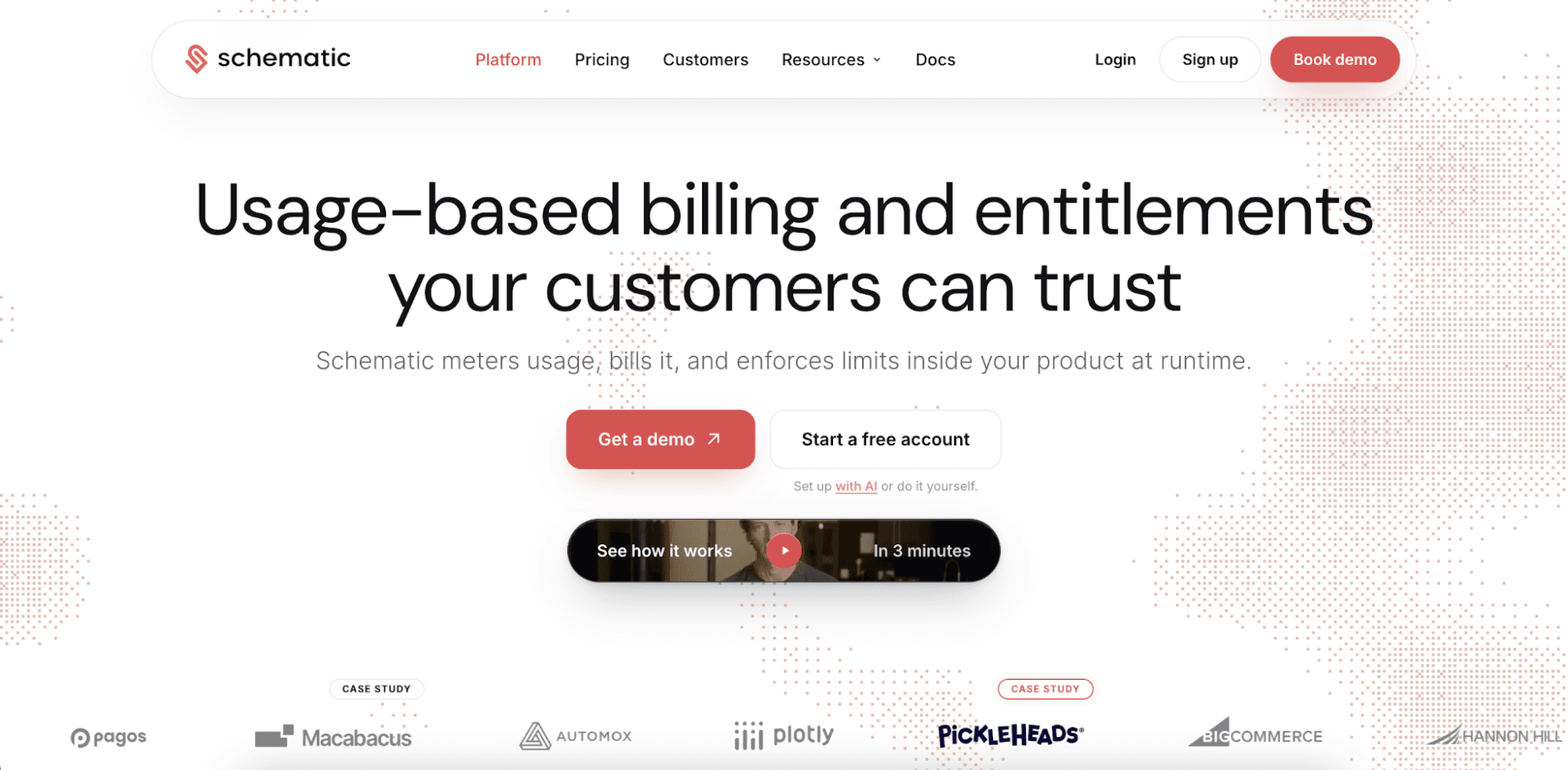
Schematic is the best usage-based billing platform for software and AI companies selling usage-based plans to enterprise customers. It combines metering, billing, and runtime entitlements to address customer trust structurally.
Native credit wallets show customers exactly what they use and owe. Meanwhile, spend forecasts, self-service controls, and configurable spending limits give buyers full control over their consumption.
As Macabacus shares, “Schematic's ability to offer usage caps, bundles, and top-ups gave our customers the cost predictability they need.”
Schematic also provides out-of-the-box AI billing tools to help teams launch usage-based pricing quickly and with confidence.
Version plans, migrate customers, run trials, reserve credits, log every event, and support any pricing model without a billing rebuild.
FAQs About How to Implement Usage-Based Pricing
How does usage-based pricing work?
Usage-based pricing charges customers based on how much of a product or service they consume. Companies track a billable usage metric, such as API calls, tokens, credits, or compute time, then apply pricing rules to calculate charges for each billing period.
Can you give me an example of usage-based billing?
An AI platform might charge customers based on the number of tokens they consume each month. If one customer uses twice as many tokens as another, their bill increases based on the extra consumption recorded by the billing system.
What is consumption-based pricing?
Consumption-based pricing is another term for usage-based pricing. Customers pay according to actual consumption instead of only paying a fixed subscription fee. It can work well for products with highly variable usage, where customer activity changes daily.
What are the most popular usage-based pricing models?
Common usage models include pay-as-you-go, tiered pricing, credit burndown, hybrid pricing, and custom pricing with minimum usage commitments. Each model determines how measured usage turns into charges and how much pricing flexibility customers receive.