 Ryan Echternacht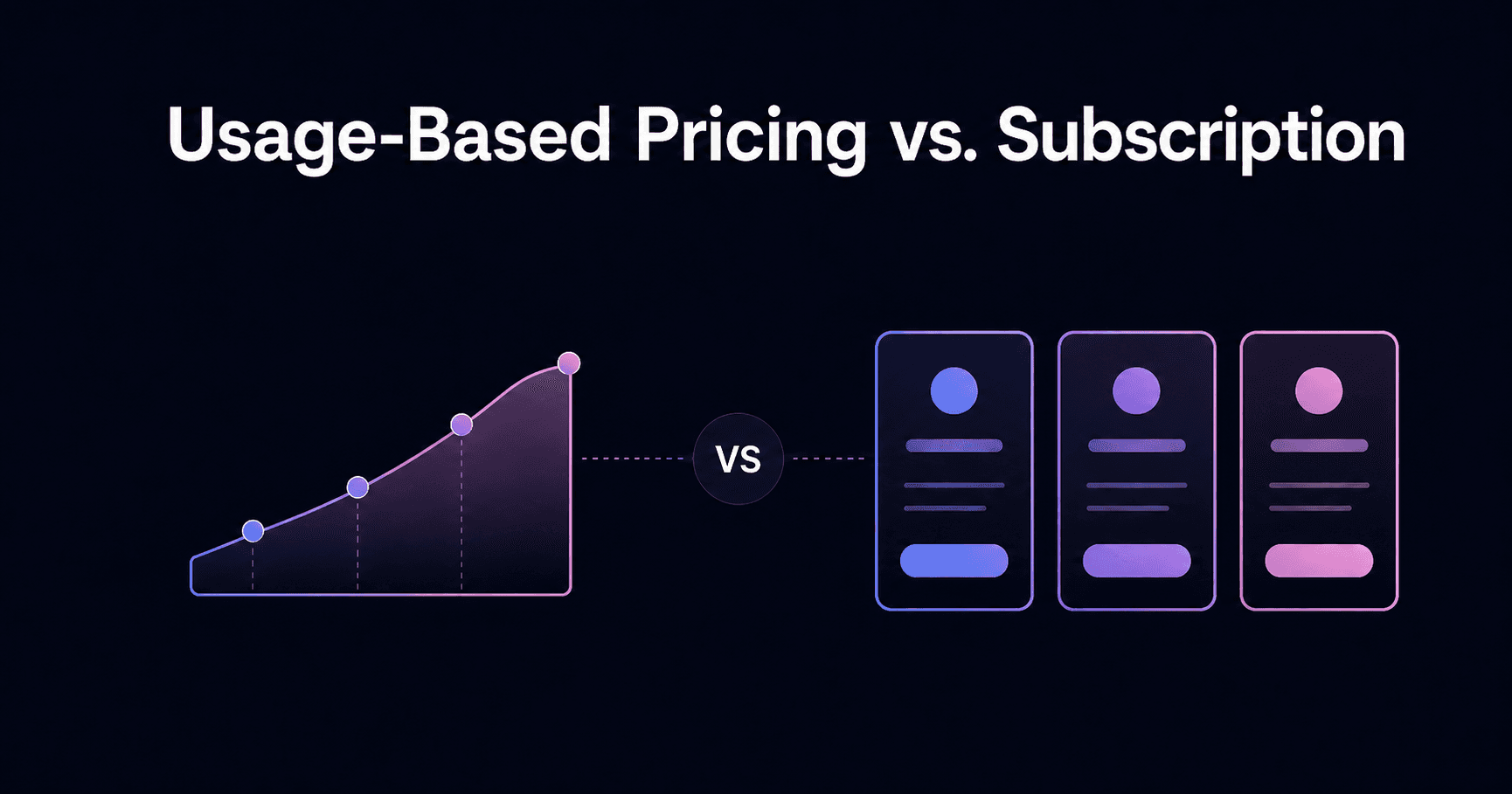
Software-as-a-Service (SaaS) companies often struggle to decide how to price their products. Should they charge a fixed fee for access to their platform? Or should they bill customers based on how much they use the product? The answer can shape revenue growth, customer adoption, and overall business success.
With usage-based pricing, customers pay for their actual consumption, allowing revenue to scale with usage. Charges may depend on API calls, tokens, AI credits, or transactions. Many teams rely on usage-based billing platforms to track these usage metrics and generate accurate invoices.
Flat subscription pricing charges the same amount for each billing cycle, regardless of customer usage. This pricing model can make revenue and spending easier to predict.
Below, we'll explain the key differences between usage-based pricing and subscription models. We'll break down pros and cons to help you choose the right approach.
TL;DR
- The main difference between usage-based pricing and subscription pricing is how they charge customers, which affects cost predictability, expansion revenue, and billing requirements.
- Usage-based pricing bills customers based on actual usage, such as API calls, credits, tokens, storage, compute, transactions, or monthly active users. It's less predictable, but it supports natural expansion through increased usage.
- Subscription pricing collects a fixed recurring fee from customers. It provides stable revenue, although profit margins shrink when usage varies widely.
- Most companies use a hybrid pricing model that combines subscriptions with usage-based charges to balance predictable revenue with usage-driven growth.
- Schematic helps software and AI companies launch usage-based and hybrid pricing with full customization, control, and predictability.
What Is Usage-Based Pricing?
A usage-based pricing model is when customers pay based on actual usage instead of paying a flat fee every billing cycle. It's also known as consumption-based pricing.
Charges can be tied to API calls, prepaid credits, data storage, compute hours, transactions, tokens, monthly active users (MAU), or other usage metrics that reflect product consumption.
Usage-based pricing works by tracking usage events inside the product and turning them into organized billing records. These usage records are added up over a billing cycle. Finance teams generate accurate invoices at the end of the billing period.
There are several ways to structure usage-based models.
With pay-as-you-go pricing, customers are billed for each unit they consume. The pricing structure stays simple because each unit has a clear price. There is also no upfront commitment.
Tiered pricing, also known as volume pricing, lowers the price per unit when usage reaches set levels. For example, you might charge $1 per unit for the first 100 tokens, $0.90 for the next 200 units, and $0.80 after 300 tokens.
Credit burndown is a popular usage-based billing model for AI products because it gives customers more predictability over variable infrastructure costs. Users purchase credits upfront that they spend over time as they use the product.
Pros of Usage-Based Pricing
Here are the advantages of implementing usage-based pricing:
- Lower barrier to entry: With usage models, customers can start using the platform without upfront commitment. This supports product-led go-to-market strategies.
- Natural revenue expansion: Revenue can automatically increase as customer usage scales. This supports sustainable growth without forcing a plan upgrade. Increased product usage from existing customers can also lead to higher net dollar retention.
- Alignment between pricing and value: Usage models align pricing with customer value. Light users pay less, while enterprise customers with higher usage pay more.
- Higher customer satisfaction: Buyers pay in line with their usage patterns, which can make pricing feel fairer. Usage-based pricing can also reduce concerns about paying for services customers do not use.
- Profit margin stability: Customers who consume more of the product can incur real marginal costs for SaaS and AI companies. Usage-based pricing protects gross margins by charging these power users significantly higher.
Cons of Usage-Based Pricing
Despite its benefits, usage-based pricing still has drawbacks. Let's break them down below.
- Unpredictable costs: Usage-based charges can vary widely compared to a subscription model that has a flat monthly fee. Buyers may struggle to predict expenses, which can lead to budget concerns and internal pushback.
- Billing complexity: Usage-based billing needs more than checkout pages. It requires a robust metering engine, flexible rating systems, runtime enforcement, and customer visibility tools. Traditional billing systems are not equipped to handle thousands or millions of usage events in real time.
- Unstable revenue: Business income depends on customer usage. It complicates monthly forecasting and makes financial planning more difficult.
What Is Subscription-Based Pricing?
A subscription pricing model charges customers a set amount for ongoing access to a product or service. In most cases, subscription pricing is billed monthly or annually through fixed recurring payments.
Subscription pricing is a popular pricing method for SaaS products and streaming services like Netflix. Customers retain platform access as long as their subscription remains active.
The subscription model comes in three main types: flat-rate, tiered feature-based, and freemium pricing.
Flat-rate pricing gives customers the same features for a flat fee each billing cycle. It fits products with a single use case.
Tiered feature-based models offer several pricing plans meant to serve different customer segments. Most products have Basic, Pro, and Enterprise plans, with higher tiers including additional features.
Meanwhile, freemium gives users access to a free tier with limited features. To unlock advanced capabilities and other tools, new customers need to upgrade to a paid plan.
Pros of Subscription Pricing
Subscription pricing offers several benefits to software companies and their customers.
- Steady recurring revenue: Subscriptions create predictable revenue streams through regular billing cycles. They give SaaS companies a clearer view of expected monthly and annual income.
- Budget clarity: Customers know their fixed costs even before an invoice arrives. They can easily plan software spending and avoid uncertainty around monthly expenses.
- Increased customer lifetime value: Subscription pricing strengthens customer loyalty by integrating the product into their daily habits and creating a psychological commitment through upfront financial investment. It increases the total revenue earned from each account throughout the entire customer relationship.
- Higher valuation: Consistent cash flow and recurring billing models can make SaaS companies more attractive to investors and financial institutions assessing long-term revenue stability.
- Valuable data insights: Ongoing subscriptions make it easier to track customer usage patterns and analyze customer behavior. These provide useful insights that help teams improve products, adjust pricing strategies, and deliver personalized experiences.
Cons of Subscription Pricing
Although it's a popular pricing model, subscription pricing comes with several downsides worth looking into.
- Customer retention burden: Keeping subscribers is an ongoing process. It requires proactive support, engagement, regular product updates, and retention efforts to reduce cancellations and protect recurring revenue.
- Profit margin erosion: Power users may create much higher service costs without generating additional revenue for a business. This can significantly reduce profit margins.
- Pricing sensitivity: Customers may resist price increases when they do not see added value. Higher fixed fees can also make it difficult to encourage price-sensitive buyers to renew their plan.
Usage-Based Pricing vs. Subscription Pricing: 10 Key Differences
After learning how usage-based and subscription models work, it's time to learn the differences between the two. Here are the main distinctions.
1. Charge Structure
A usage-based pricing model bills customers according to product consumption, such as API calls, tokens, data stored, or transactions. That's why charges vary from one billing cycle to the next.
In contrast, subscription pricing charges a fixed amount for continued software access during a set period. The bill rarely or never changes, regardless of a customer's actual usage.
2. Revenue Predictability
Since a usage-based model has variable charges, SaaS companies find it difficult to predict revenue growth. Profits can increase when usage grows and fall when activity drops.
Teams need to analyze different usage patterns closely when building revenue forecasts to ensure accurate financial modeling.
On the other hand, a subscription model gives SaaS companies more predictable revenue because it charges customers the same amount every billing cycle.
Finance teams can easily estimate monthly and annual revenue with greater accuracy than usage-based pricing. This can simplify financial planning and investor reporting.
3. Customer Cost Predictability
In a usage-based pricing model, customers pay for only what they use. However, many users find it difficult to predict how much they will consume.
Bills can suddenly spike if usage surges unless capped or well‑instrumented with proactive alerts. Customers may question their invoice when they see unexpected charges.
There's also the risk of autonomous AI agents causing usage and cost to scale rapidly. Real-time enforcement is important to prevent runaway spending.
In subscription pricing, customers pay a fixed recurring amount. That makes monthly or annual software costs easier to estimate. Buyers already know how much they owe before the billing cycle begins.
4. Expansion Revenue
Usage-based pricing can automatically increase revenue as product consumption grows.
A customer who processes more data, sends more requests, or runs more AI workflows can generate more profit for the company without changing their plan. It supports natural revenue growth.
In contrast, subscription companies often need customers to upgrade plans, add seats, or purchase add-ons to capture higher revenue. This usually requires manual intervention from customer success managers.
Usage-based pricing links revenue expansion to consumption, whereas subscription pricing often depends on a separate purchase decision.
5. Customer Acquisition Friction
Usage-based pricing can lower buying friction because customers start small without upfront financial investment.
They don't need to commit to a large contract size before testing the platform. And product adoption naturally scales with value realization.
Meanwhile, subscription pricing often asks customers to choose a plan and pay upfront. This can create more hesitation for buyers with uncertain needs and lower budgets.
Subscription services may be easier to sell when customers already have a clear need for the product and its features.
6. Billing Infrastructure
Usage-based pricing usually requires complex billing systems that meter raw usage events, aggregate usage data, apply pricing rules, and create invoices.
SaaS companies also need audit trails and real‑time usage dashboards to prevent billing disputes. An entitlement management system is another must-have tool to ensure customers don't go beyond set limits and spike up infrastructure costs for the business.
Billing for subscriptions is often simpler because the recurring amount is known before the billing period starts.
The billing platform only needs to manage plans, renewals, upgrades, and cancellations. It doesn't need to account for variable usage patterns.
7. Revenue Recognition
Revenue recognition is challenging for companies with usage-based pricing. Under ASC 606 and IFRS 15, they need to treat usage fees as variable consideration. That means estimating transaction prices at the start of the contract and updating them as actual consumption data arrives.
Finance teams can only recognize revenue once the service is consumed, or in the case of credit-based pricing, when credits are used.
Revenue recognition is relatively straightforward in subscription pricing. Subscription companies only record income when they successfully deliver a service, not when the customer pays.
Let's say a customer pays $1,200 upfront for an annual subscription plan. The business logs it as deferred revenue and recognizes $100 per month as earned revenue throughout the year.
8. Value Alignment
Customer value alignment is strong in usage-based pricing. It connects spending directly to product consumption.
When customers use more of a product and gain more value from it, their charges can increase with that activity.
In contrast, subscription pricing has low to moderate value alignment. It charges the same recurring fee even when two customers have different usage patterns. An enterprise buyer may use the product daily, while a small account only uses it a few times each month.
A subscription pricing model works well when usage is consistent, and the product only has a single use case.
9. Churn Risk
Churn in usage-based pricing is often gradual. Customers may stay active while their usage and spending drop over time. They may also leave after facing disputes or bill shock, especially when they cannot accurately track usage and costs.
SaaS companies implementing usage-based pricing should provide real-time visibility and controls over usage to prevent churn.
With subscription pricing, churn occurs when customers cancel or fail to renew their plan on time. This may happen when users rarely use the platform or when a payment fails.
Teams can reduce churn risks by providing ongoing value and using automated dunning workflows to retry failed payments.
10. Best Fit
Usage-based pricing suits products where consumption varies over time. It's also a good fit when the value metric is closely tied to usage, such as API calls made, transactions processed, or data stored.
Subscription pricing makes sense if usage is relatively consistent and predictable. It also works well when the product's unique value proposition is connected to access and features.
Side-by-Side Comparison of Usage-Based Pricing vs. Subscription Pricing
Below is a comparison table to help you see the differences between usage-based and subscription pricing at a glance.
Category | Usage-Based Pricing | Subscription Pricing |
Charge Structure | Variable; per-unit consumption | Fixed fee per billing cycle |
Revenue Predictability | Variable; harder to forecast | High predictability |
Customer Cost Predictability | Low (costs rise or fall each period) | High (same bill each period) |
Expansion Revenue | Grows organically through increased usage | Requires manual upsell conversations |
Customer Acquisition Friction | Low (little to no upfront commitment) | High (upfront commitment) |
Billing Infrastructure | Complex (metering, rating, enforcement, transparency) | Simple (recurring billing) |
Revenue Recognition | Complex (variable consideration) | Relatively straightforward |
Value Alignment | High (pay for what you use) | Moderate (based on access or features) |
Churn Risk | Billing disputes | Underutilization |
Best Fit | Products with variable usage patterns | Stable products with simple use cases |
Usage-Based vs. Subscription: Which Pricing Model to Choose?
Implement usage-based pricing when customer value scales with consumption, and usage varies widely between accounts. A small startup and a large enterprise may use the product at very different levels, so charging by consumption can reflect that gap clearly.
This pricing model works well for communication APIs, cloud infrastructure, data warehouses, and developer tools like Vercel.
Consumption-based pricing is also a good fit for AI products that price based on tokens, requests, or compute hours.
Choose subscription pricing when customer value stays relatively steady, regardless of usage. It's also the preferred pricing structure of buyers who want predictable costs and fixed budget cycles.
Subscription pricing is also the better choice if you want simplicity. It does not require detailed usage tracking, event processing, or complex billing rules.
Why Many SaaS Companies End Up With Hybrid Pricing Models
While subscription and usage-based pricing are often presented as opposite models, many companies end up combining both in one pricing structure. According to the 2026 State of Go-to-Market report, 48% of businesses now use hybrid pricing models.
A popular hybrid model blends a base subscription plan with usage-based charges. The subscription gives organizations a steady revenue floor and provides customers with a more predictable bill. Meanwhile, the usage component captures upside when product activity increases.
This setup can work well for most SaaS and AI companies because it balances two goals. The business gets stable recurring revenue, while variable consumption lets revenue expand naturally as customers use the product more often.
How to Successfully Implement Hybrid Models
Hybrid pricing is one of the hardest pricing models to operate. Follow the tips below to implement this pricing model successfully.
Set a Predictable Base Fee
Start with a base subscription that gives customers a clear minimum cost each billing period. The fee should cover core product access and provide your company with a steady revenue floor.
Make sure the amount is easy to understand. Avoid including too many conditions in the base plan. The goal is to give buyers cost stability before adding any usage-based charges.
Select a Clear Value Metric
Choose a usage metric that closely reflects how customers gain value from your product.
For AI companies, this could be tokens, API requests, generated images, or completed tasks. Meanwhile, SaaS vendors can tie value to seats, transactions, storage, or monthly active users.
A hybrid pricing model works best when the usage metric is simple to track, explain, and connect to customer activity.
Use Real-Time Metering
Invest in a monetization operating system that tracks usage as it happens to ensure accurate billing. Make sure it can record each billable event, group usage by customer, and send clean data to your billing system.
Real-time metering also helps customers see how much they have consumed before the billing period ends. This reduces disputes and gives finance teams more reliable data for revenue reporting.
Decouple Pricing Logic from Application
Store pricing rules separately from your core product code. Doing so makes it easier to change rates, add new tiers, test different pricing strategies, or adjust usage limits without rebuilding product features.
The billing layer should handle rating and pricing, while the application focuses on recording usage events.
This setup also reduces the amount of engineering work needed when you need to change your pricing model later.
Provide Visibility and Control Over Usage
Give customers access to a usage dashboard or a self-service portal where they can see current consumption. Send proactive alerts when usage reaches predefined thresholds so that buyers can manage spending before receiving an invoice.
You should also allow customers to set usage caps and control what happens at the limit. Hard caps can block access as soon as the user hits the limit. Soft limits let usage continue and bill it in arrears.
Real-time visibility and controls help buyers trust the usage component of the hybrid model.
Launch a Pilot and Monitor Key Metrics
Test the hybrid pricing model with a small group of users before rolling it out across the entire customer base. Track revenue growth, gross margins, expansion revenue, usage levels, tickets related to billing disputes, and customer feedback.
Then, compare results with your previous pricing setup and look for signs that customers are pushing back.
Use what you learned from the pilot to adjust the base fee, usage rates, thresholds, or billing rules before a full launch.
Launch Usage-Based Pricing and Hybrid Models With Schematic
Schematic is a usage-based billing platform for software and AI companies selling to enterprises. Launch usage-based and hybrid plans without rebuilding billing systems or hardcoding pricing logic.
Commercial teams use Schematic to meter usage events, grant credits as part of a subscription plan, enforce limits at runtime, manage software entitlements, and give customers consumption visibility and control.
Schematic makes usage-based pricing something customers can trust, not fear. Users can set per-seat and per-agent limits, control auto top-up rules, and decide what happens at the limit.
Both buyers and sellers gain confidence that usage will stay within budget and that customers will only be charged for what they expect.
FAQs About Usage-Based Pricing vs. Subscription Pricing
What is the difference between usage-based pricing and subscription-based pricing?
Usage-based pricing bills customers based on how much they consume. Subscription pricing charges a recurring fee for platform access during a set billing period. One changes with usage, while the other is fixed.
What does usage-based pricing mean?
Usage-based pricing means customers are billed according to how much they consume a product. Charges may depend on API calls, tokens, credits, seats, compute time, or another usage metric.
What are the pros and cons of usage-based pricing?
Usage-based pricing can lower the barrier to entry, support automatic expansion revenue, and align pricing closely with customer value. However, its downsides include less predictable customer bills, unstable revenue, and more complex billing infrastructure requirements.
What is SaaS vs. subscription?
SaaS stands for Software-as-a-Service and describes software delivered online. Meanwhile, subscription refers to a pricing method that charges a fixed recurring fee. Many SaaS products naturally fit the subscription model. However, software vendors can also adopt usage-based, hybrid, or freemium pricing.