All posts
How a Monetization OS Supports Fast-Growing SaaS Companies
Blog· Ryan Echternacht·Aug 3, 2026
Ryan Echternacht·Aug 3, 2026
Product managers want to test a new feature bundle. Sales reps want to offer a custom plan. Customer success teams want to grant exceptions for a strategic account.
None of these tasks is simple for many SaaS and AI companies. Commercial teams need to file tickets to adjust packaging, launch new pricing models, run a promotion, or apply an override.
That's because monetization still relies on hardcoded logic, fragmented tools, and manual workflows. Each pricing change requires engineering support.
This slows down sales, product, customer success, and go-to-market (GTM) teams. It also pulls engineers away from core product development.
A monetization operating system (OS) gives SaaS and AI businesses a more flexible way to monetize their products.
In this article, we'll discuss what a monetization OS is, why most companies need it, and how it benefits fast-growing teams.
TL;DR
- A monetization OS is a modular platform that stores pricing plans, entitlements, limits, overrides, and billing data.
- SaaS and AI companies use it to manage complex monetization as they add more products, new plans, customer exceptions, and hybrid sales motions.
- A monetization OS helps business teams launch new pricing models faster without relying on engineering for every change.
- It can also centralize product catalog data, connect your entire stack, enable pricing experiments, and create clearer billing experiences inside the product.
- Schematic is the monetization OS that lets you control pricing and packaging without code changes, so you can continuously iterate on monetization.
What Is a Monetization Operating System?
A monetization operating system is a flexible platform that enables SaaS companies to control pricing, packaging, and in-product access without brittle logic or one-off messes.
It acts as the system of record for plans, limits, software entitlements, credits, add-ons, trials, and exceptions.
A monetization OS sits between the app (the actual product), billing system, customer relationship management (CRM) software, and go-to-market stack. It decouples pricing and billing logic from code.
This gives commercial teams full control over monetization. It's not just what to charge for the product. It helps them connect value to revenue growth.
Developers can focus on what makes the product great instead of building and maintaining complex monetization infrastructure.
Why Fast-Growing SaaS and AI Companies Need a Monetization OS
Monetizing software products is often challenging for fast-growing SaaS teams. Usage varies a lot between customers. Subscriptions hardcoded into the product mean that plan changes require engineering involvement. Custom deals, limits, and overrides introduce edge cases that basic pricing systems cannot handle.
Here are some reasons why SaaS and AI companies should adopt a monetization OS.
Pricing Becomes More Complex as Companies Scale
Most companies start with a simple pricing structure. They may offer three subscription plans: Basic, Pro, and Enterprise. Each tier includes a fixed set of features, which can naturally guide buyers to the right plan based on their needs.
This monetization strategy can work early on. But as the product matures and customer needs change, you need to quickly adapt pricing to market shifts.
It's not enough to sell access to the software. You may need to consider charging for usage, add-ons, prepaid credits, premium support, or extra services.
AI features and products also add to the complexity. Static and seat-based pricing don't work for AI because value is not tied to the number of human users. Instead, costs and usage are driven by tokens, API calls, compute, AI agents, and machine traffic.
One account may generate thousands of automated requests with only a few users, while another may have many users but low consumption. As a result, AI companies often need usage-based or credit-based pricing models that better reflect how customers consume the product.
Without a monetization OS, teams often define these rules in code, spreadsheets, billing tools, and CRM fields. That makes pricing and packaging harder to manage at scale.
Every Pricing Change Requires Engineering Support
When pricing and entitlement logic are hardcoded, business teams cannot make changes on their own. A small update may need a ticket, a sprint, testing, and a product deploy.
This slows down work because every change requires engineers. Launching a new plan, changing a usage limit, adding a trial, or creating a custom package should not depend on the next release cycle.
It also distracts engineers from core product development. Instead of building features, they spend time updating billing rules, access logic, and application behavior.
A monetization OS enables commercial teams to control pricing, packaging, and entitlements without waiting on developers.
Engineers set up the foundation once. Product managers can adjust usage limits. Account executives can provision an overage exception for a strategic account. RevOps teams can launch a promotional offer.
Multiple Product Catalogs and Fragmented Data Slow Down Teams
Many SaaS and AI companies maintain product catalogs in several places.
Pricing plans are managed in the billing tool. Enterprise contracts may live in the CRM. Feature access might be embedded in application code. Usage data is stored in a warehouse. Exceptions are tracked in spreadsheets.
Multiple product catalogs and scattered data create a major problem.
Instead of checking only one system, teams need to switch between different tools and fix mismatched data before each pricing change can go live. They cannot react in time to market changes or shifts in customer behavior.
A monetization OS solves this challenge by creating one shared system for the product catalog. When everything lives in one place, teams can quickly respond to customer needs, market trends, competitor pricing, and future growth.
How a Monetization OS Can Benefit SaaS and AI Businesses
A monetization operating system decouples pricing logic from the application. This provides several advantages to modern SaaS and AI companies.
Launch Any Pricing Model Without Engineering
A monetization OS helps you implement any pricing model without rebuilding your billing or monetization stack.
You can launch flat-fee subscriptions, pay-as-you-go pricing, tiered plans, credit burndown, and hybrid models independently from engineering.
You can also define plans, limits, trials, and entitlements for each model in one system. The product can automatically enforce those rules at runtime.
Engineering only needs to set up the monetization flow once. You can ship new pricing models within hours, not weeks.
Experiment With Any Pricing Strategy Instantly
A monetization OS enables commercial teams to test new pricing strategies with less delay and lower risk.
Product managers can quickly bundle or unbundle features. Account executives can try new deal terms without filing a ticket. GTM teams can launch new offers.
This is useful for SaaS and AI companies with multi-product offerings, different customer segments, and constantly changing go-to-market strategies.
Teams can learn what customers want, how much they are willing to pay, and which pricing plan leads to sustainable revenue growth. Then, they can continuously iterate on monetization as customer needs change.
Centralize Your Product Catalog
A monetization OS provides one source of truth for plans, add-ons, limits, credits, trials, and entitlements.
With a centralized product catalog, sales, finance, product, and engineering can work from the same data.
Teams can update pricing, packaging, usage limits, and feature access rules in one place instead of managing them across several systems.
This improves consistency, reduces manual work, and helps businesses implement changes faster.
Connect Your Existing Tech Stack
A monetization OS does not need to replace every tool in your existing monetization infrastructure. That's because it seamlessly connects to the systems you already use.
These may include a CRM, billing platform, data warehouse, product analytics software, identity providers, and developer tools.
A monetization OS also integrates with multiple billing providers. You can keep customer and usage data in sync, route new subscriptions using business logic, or migrate accounts from one system to another.
Out-of-the-box integrations reduce manual data entry because information flows seamlessly between platforms. Sales, product, GTM, finance, and development teams can work with the same data, even when their tools are different.
Support Hybrid Pricing and Hybrid Selling Without Hardcoded Logic
Modern SaaS and AI companies often sell in more than one way. They want to layer self-serve onto sales-led, drive product-led expansion, or introduce hybrid pricing that combines two or more monetization models.
This is becoming more common. According to Growth Unhinged, 37% of software companies now offer hybrid pricing.
The problem is that hybrid models are hard to manage when pricing rules are hardcoded. A self-serve customer may buy a standard plan. An enterprise account might need custom terms. Tickets keep piling up because every change is not a quick fix for engineering.
A monetization OS helps you manage hybrid pricing and hybrid selling (e.g., self-serve, sales-led, and everything in between) without building one-off logic for every case.
Engineers stop writing pricing and billing code. Business teams can sell flexibly while staying aligned with what the product actually allows.
Make Billing Part of the Product Experience
Customers shouldn’t need to contact support to understand their plan, current usage, or limits. They must be able to see what they have, what they are using, and what options are available inside the product.
A monetization OS helps bring billing into the product experience. It can surface usage data, plan details, upgrade paths, add-ons, credit balances, and renewal options. This creates smoother customer journeys by displaying the right message at the right time.
For example, when an account reaches a usage limit, the product can show an auto-upgrade path instead of forcing users to contact sales or support.
A monetization operating system also gives customers the access layer they need to change and manage plans on their own.
Key Features of a Monetization OS
A monetization operating system provides the necessary tools to manage pricing, usage, access, billing, and subscriptions in one place.
- Flexible pricing engine: Create, manage, and test different pricing strategies from a single source of truth.
- Usage metering and pricing: Track usage events and launch any consumption-based pricing model, including pay-as-you-go, overages, per-seat, and credit burndown.
- Entitlement and feature access control: Define what each customer can access based on what they've purchased. The product enforces plan and usage limits at runtime.
- Billing and payments orchestration: Integrate with billing platforms to create invoices, process payments, and sell add-ons.
- Subscription management: Handle plan changes, renewals, trials, upgrades, downgrades, cancellations, and custom contract terms without engineering.
- Extensive integrations: Connect to your existing tech stack to keep pricing, billing, customer, subscription, and usage data in sync.
Schematic Lets You Ship Pricing as Fast as You Ship Products
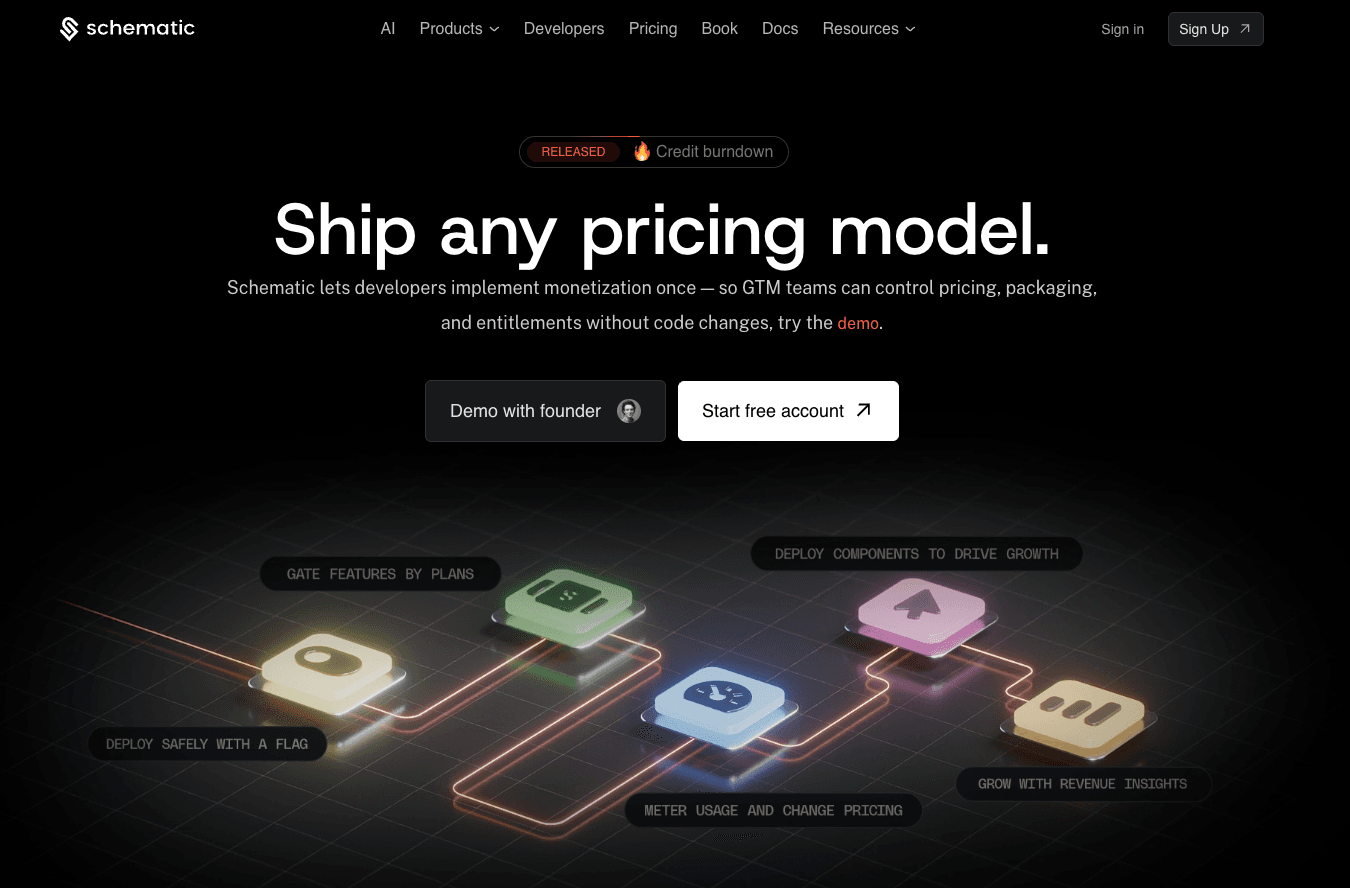
Schematic is the monetization OS for the AI era. It helps modern SaaS and AI companies manage pricing, packaging, and entitlements without burying that logic in product code.
It provides the control plane for all monetization operations. Define and update plans, entitlements, limits, trials, credits, and add-ons from a centralized product catalog.
Schematic, built on Stripe, also manages the whole customer lifecycle. It tracks usage against plan limits, billing data, and customer exceptions.
Stripe handles payments, invoices, and revenue recognition. Schematic adds real-time access control, usage enforcement, revenue insights, and billing components on top of Stripe.
Product and engineering teams can quickly decouple billing from application code. Go-to-market teams can implement pricing changes as fast as the business ships product.
FAQs About Monetization OS
What is the difference between a billing provider and a monetization OS?
A billing provider handles payments, invoices, taxes, and subscription billing. A monetization OS manages the product-side logic behind pricing, packaging, usage, entitlements, limits, and feature access. Many SaaS and AI companies use both tools together to monetize products.
Can a monetization OS reduce engineering work?
Yes, a monetization OS can reduce engineering work by decoupling pricing logic from the application. Engineers are free to focus on developing product features instead of writing billing code.
How does a monetization OS benefit commercial teams?
A monetization OS gives commercial teams more control over pricing and packaging. Sales, product, customer success, and GTM teams can implement changes without waiting for developers. They can launch new pricing models, adjust limits, offer add-ons, create custom plans, and experiment with monetization strategies.