 Ryan Echternacht
A SaaS price increase is one of the fastest ways to grow revenue. But many SaaS companies struggle with it, not because they don’t want to raise prices, but because they don’t know the right time to do it.
Increase prices too early, and you risk customers pushing back. When you wait too long, you're leaving money on the table.
This is where most SaaS vendors get stuck. They lack clear signals and rely on guesswork instead of data.
In this article, we'll answer the question of when to increase prices and how to do it without upsetting customers.
TL;DR
- A SaaS price increase is often needed when customers don’t push back on pricing, your pricing has stayed the same for too long, your product improves, competitors charge more, or customers say you have cheap pricing.
- How often you raise prices depends on many factors, such as your business size, market demand, product value, and customer loyalty.
- Companies increase SaaS pricing to grow revenue faster, improve margins, attract better customers, cover rising costs, and support ongoing product development.
- To raise prices successfully, analyze your current pricing, define a new strategy, communicate changes early, offer options to customers, and adjust based on feedback.
- Schematic is the complete monetization platform that helps AI and software companies launch any pricing model, version plans, and roll out plan changes and price increases through configuration.
When Should Your SaaS Company Increase Prices?
Here are the top signs it's time for a price hike.
Customers Don't Negotiate
If customers are not pushing back on your pricing or asking for discounts, that is a strong indication that you're underpriced.
In SaaS, some level of customer resistance is healthy. If no active user questions your price, it often means they expected to pay more.
Raising prices in this case is not risky. It simply aligns your pricing with market expectations.
You Had the Same Pricing for Years
Some SaaS businesses treat pricing as a one-time decision. That is a mistake. Your product, market, and customers change over time.
If your pricing has stayed the same for the past years, you are leaving money on the table. Or, worse, you're losing profit margins due to SaaS inflation and rising prices.
A SaaS price increase supports healthy and sustainable SaaS growth.
You've Recently Launched New Features
If your product has improved over time, your pricing should reflect that. Major vendors keep adding updates but fail to adjust pricing.
When users get more features, they receive additional value from your product. This changes how SaaS vendors price the product.
Think about what your product currently offers compared to when you first set your pricing. If you now deliver AI features, better performance, or stronger results, it's a clear signal to increase your pricing.
Competitors Are Charging More Than You
Do competitors charge more for a similar or weaker product? If yes, your pricing may be out of sync with the market, and it's time to increase it.
Customers thoroughly compare options before deciding which SaaS tool to purchase.
Higher-priced competitors can shape how these buyers see value. In many cases, pricing signals quality.
If you stay at a lower price, some customers may question your product's value. Consider raising prices to capture market share.
However, this does not mean you should copy competitor pricing. Pricing is not just about matching others anymore. It is also about understanding your own value, then pricing based on that.
Your Operational Costs Are Increasing
As your software company grows, you face higher SaaS costs. You often pay more for infrastructure, support, hiring, and tools to continue delivering value to a large customer base.
Those are clear signs you should increase pricing.
Staying on a flat rate while costs increase can shrink profit margins.
Remember, pricing is not only about growth. It is also about sustainability. A price increase helps maintain healthy margins and support long-term revenue growth.
Your SaaS Product Has High Value
SaaS pricing should be tied to value, not just operational costs.
If your product delivers strong results for customers, it's time for your pricing to reflect that.
Value-based pricing is a common SaaS pricing strategy. It focuses on what your product is worth to the customer instead of how much it costs to run.
For example, if your product saves time, increases revenue, or reduces manual work, most customers might be willing to pay more.
When the value you deliver grows, it's easier to justify quarterly or annual price increases.
Customers Say You Have Low Prices
If users say your product is "cheap," it may sound positive, but it often means you are underpriced.
There is a difference between "affordable" and "cheap." Affordable means good value. Cheap can signal low pricing compared to value.
Customer perception matters. If your product is seen as low-cost, it may affect how buyers judge quality.
Feedback like this should not be ignored. It often means customers would accept a higher price. That makes it a clear indicator to increase SaaS prices.
How Often Should You Raise Prices?
There is no fixed rule for how often you should increase prices. The answer depends on your business size, market share, product value, and customer loyalty, among other factors.
Most SaaS vendors make pricing adjustments annually. According to Growth Unhinged, three in four software companies applied changes to their pricing in 2025.
Some established SaaS businesses increase prices more often. Others wait longer, especially if they are early in growth or still refining their product.
The key is not to follow a strict schedule. Instead, connect price increases to actual changes in your product, customers, and market conditions.
Regular price changes help you keep up with inflation and maintain healthy margins. They are a primary growth lever, and great SaaS companies frequently iterate on pricing.
Top Reasons to Increase SaaS Prices
Here are the main reasons SaaS companies raise prices.
Increase Revenue Quickly
This is the most obvious one.
A SaaS price increase significantly boosts revenue without requiring new customer acquisition.
Instead of chasing new users, you earn more from existing customers, which leads to a higher revenue per customer. You can reduce spending on marketing or sales teams.
Plus, you can also improve profit margins quickly, making it easier to grow your SaaS business.
Strengthen Perceived Value
Pricing affects how customers see your product. If your price is too low, some users may assume your product is less capable.
A higher price can signal quality. It shows that your product delivers strong results and is worth paying for.
This matters in competitive markets. Enterprise buyers often compare options based on both features and price. Customers can easily switch vendors depending on the fairness of packaging and AI bundling.
However, cheap pricing can create doubt, even if your product delivers strong results.
By raising prices, you align your market positioning with actual product value.
Attract the Right Customers
Pricing also shapes the type of customers you bring in. Lower prices often attract users who are more price-sensitive and more likely to churn.
These smaller accounts may demand more support to encourage subscription renewal while contributing less revenue to your SaaS company. This creates strain on your team and reduces efficiency.
On the other hand, higher prices tend to attract enterprise buyers who care more about results than cost. These users are often easier to work with and stay longer since they are more likely to sign a multi-year deal agreement.
Offset Rising Operational Costs
Operational costs tend to increase as your product improves and your customer base grows. Better infrastructure, faster performance, and stronger support all require ongoing investment.
Stagnant pricing can cause profit margins to shrink over time. This limits your ability to grow.
A price increase helps balance these rising costs. It allows you to maintain healthy margins without cutting back on quality.
Support Future Product Innovation
Growth requires reinvestment. You need resources to build new features, improve performance, and expand your product.
If your pricing does not grow with your product, you may struggle to fund these improvements. This can slow down progress.
A price increase provides you with the extra budget to keep improving your SaaS product. It supports faster development and better user experience.
It also helps you stay competitive. SaaS companies that invest in their product tend to win over time.
Risks of SaaS Price Increases
While there are clear benefits to increasing SaaS pricing, you also have to consider the risks.
- Higher customer churn: Price-sensitive customers may find the increased costs and surprise increases unacceptable, which can lead to churn.
- Damage to brand perception: Some vendors deliberately mask their rising prices. This can damage brand loyalty, lead to negative reviews, and affect the next renewal decision.
- Reduced expansion revenue: Customers may reduce subscription seats, lower license counts, or downgrade plans to offset higher costs, which decreases net revenue retention.
- Lower usage: In usage-based pricing, higher costs per usage metric can lead to lower adoption rates. It decreases the value a customer gets and negatively affects customer satisfaction.
How to Successfully Raise SaaS Prices
To mitigate the risks previously mentioned, you should approach SaaS price increases carefully. Here's a guide you can follow to raise prices without upsetting customers.
1. Analyze Current Pricing Model and Performance
The first step in raising prices is to figure out your new SaaS pricing strategy. To do that, you need to know where you stand presently.
Review your current model, plan tiers, revenue per account, churn, upgrade rates, downgrade rates, and customer feedback. Look at which plans bring in the best customers and which features drive the most value.
Traditional subscriptions and per-seat pricing can still work. But many SaaS companies are moving toward usage-based pricing and hybrid models as usage becomes unpredictable and AI applications take over. For example, seat-based pricing is rapidly declining as AI agents replace more human tasks.
Outcome-based pricing is also becoming a popular choice. Outcome-based models only charge customers once the product delivers a successful result or a measurable outcome, such as qualified leads or resolved support tickets.
This analysis helps you avoid guessing. You can see where pricing is too low, which pricing models are effective, and whether you need an entirely new pricing structure.
2. Define New SaaS Pricing Strategy
Use the previous analysis to choose a pricing strategy that fits your business needs and customer expectations.
The new pricing model should match how customers use your SaaS product and how they receive value.
Here are some types to consider:
- Tiered pricing: Offer multiple plans that cater to different customer segments, such as startups, growing teams, and enterprise customers.
- Usage or consumption-based pricing: Charge customers based on their actual usage, such as API calls or storage used.
- Credit burndown: Allow users to buy credits upfront that they can spend or use over time.
- Hybrid pricing: Combine a base subscription with usage-based charges or add-ons. This model provides stable revenue while capturing upside from increased usage.
- Outcome-based pricing: Customers pay based on the result your product helps create, such as time saved or leads generated.
3. Communicate the Price Increase
Customers should not feel surprised or confused about a price increase.
Before rolling out the pricing changes, tell users what is changing, when it changes, and why it is changing.
Explain how the product has improved and how the new pricing reflects better service, faster updates, and stronger results. This makes cost clarity important in avoiding customer pushback.
Use more than one channel to communicate the great SaaS price surge. Send an email, add in-app notices, update your help center, and train your customer support team. Enterprise customers may need a personal note from their account manager.
4. Start With New Customers First
The safest way to raise SaaS prices is to start with new customers. This lets you test the new pricing before changing anything for existing users.
New customers do not have the same history with your old pricing. They are seeing your product and offer as it stands today. That makes them a better group for testing new plans, price points, limits, and packaging.
However, you should still watch how they respond. Track demo close rates, trial conversions, sales objections, and early churn rate.
If the new pricing works with new customers, you have a stronger case for rolling it out to legacy customers.
5. Offer Flexible Plans or Alternatives to Existing Customers
You need a more careful approach when introducing the new pricing to your legacy customers, especially early adopters of your SaaS product.
Most contracts are won by a set price, so future increases can feel unfair.
Let them pick from several options:
- Retain their current plan at a higher rate.
- Downgrade their plan to continue paying the same rate.
- Stay on a legacy pricing plan with limited features, with the option to upgrade later.
You can also offer a transition plan with a longer rollout timeline. Doing so gives existing customers more time to ease into the new pricing structure.
By providing alternatives, you can reduce customer churn and avoid pushback.
6. Provide Discounts or Incentives When Needed
Discounts can help during a SaaS price increase, but they should be used with care. Do not offer them to everyone by default.
Use discounts when they protect a strong customer relationship (often in an enterprise account) or help ease a larger price change. For example, you can offer a limited-time annual plan, a loyalty discount, or a short transition rate.
Clearly state the discounted amount in the contract terms and fine print. Set an end date. Then, make sure the customer knows what happens after the discount ends.
Incentives can also work well. You might offer extra onboarding, additional support, or access to advanced features for a short period. This can help customers feel they are gaining value, not just paying more.
7. Adjust Pricing Based on Key Metrics and Customer Feedback
A price increase does not end after launch. You need to track what happens next to make better-informed decisions about pricing in the future.
Monitor customer churn, revenue per account, plan changes, trial conversion, sales close rates, and support tickets. You should also review customer feedback. The numbers show what changed, while the feedback explains why.
If churn rises in one segment, review that customer group first. If new customers accept the price but existing users push back, your communication or transition plan may need work.
Ship Any Pricing Model, Preview Changes, and Enforce Limits at Runtime With Schematic
Schematic provides a complete monetization platform for software and AI companies selling to enterprise accounts.
Pricing lives as data on a real-time ledger. That means a plan change becomes a config change.
Model any pricing, create custom plans, meter usage, and simulate changes without filing an engineering ticket. Teams can also offer add-ons, overrides, and exceptions to expand accounts and increase revenue.
Max Ade from Pickleheads shares, "The ability to give customers overrides and exceptions to their plan limits is a must-have feature for any billing platform."
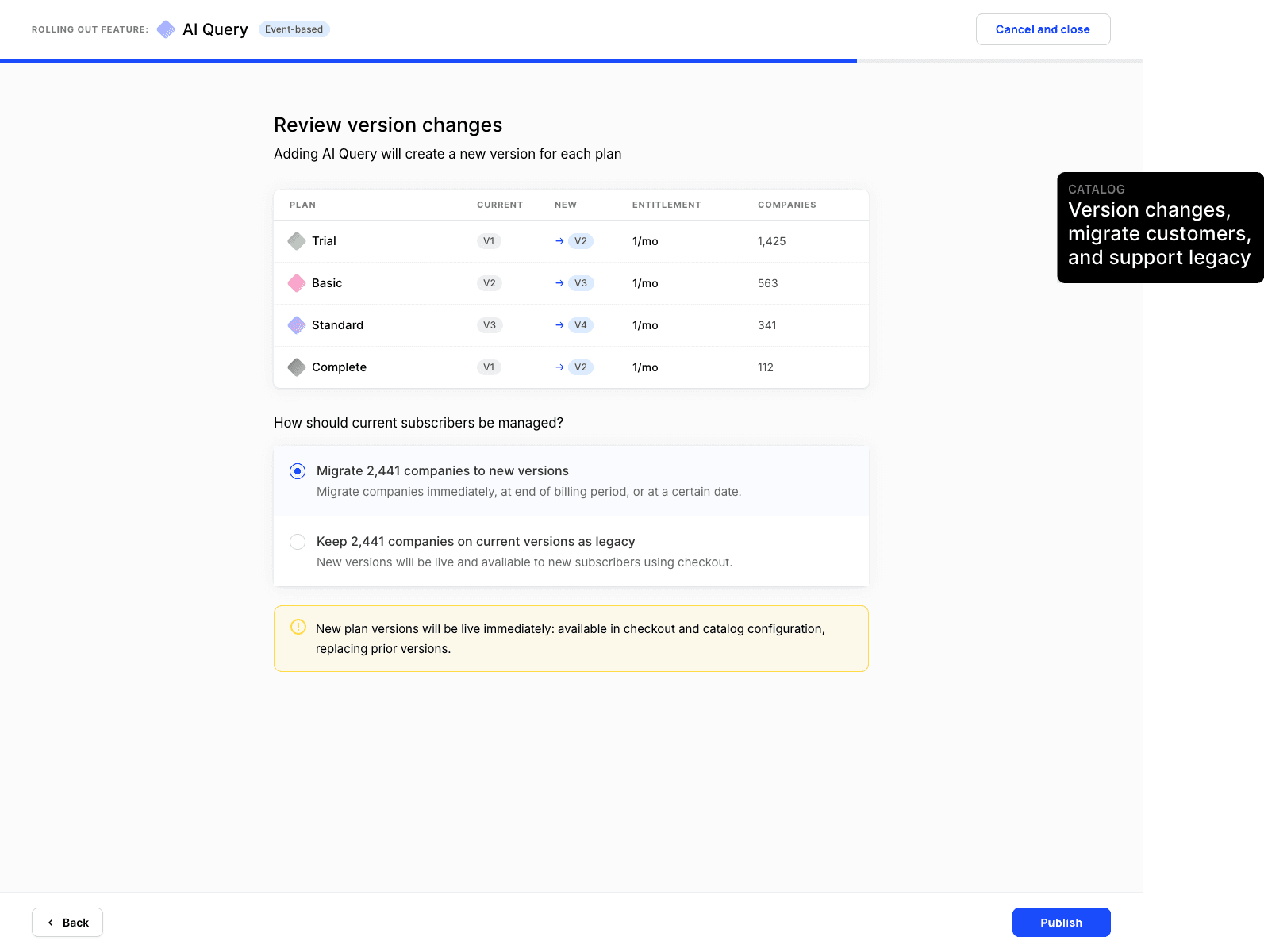
Schematic also includes out-of-the-box billing tools, such as plan versioning and customer migration. Version changes, migrate customers between different plans, and run sales-assisted trials.
What sets Schematic apart is its real-time entitlement engine and robust enterprise credit wallets. Unlike traditional billing platforms, Schematic gives enterprise customers real-time visibility into usage, spend forecasts, self-service controls, and configurable spending limits.
Buyers can set usage caps per seat or per agent, configure auto top-up rules, receive alerts before usage stops, and define what happens at the limit. The entitlement engine enforces those policies in real time from the same ledger used for billing. This prevents runaway bills or unexpected access throttling.
FAQs About SaaS Price Increase
What is the average price increase for SaaS?
Most SaaS companies raise prices by around 5% to 10% every year. Smaller increases mitigate risks, while larger ones may work if the reason is tied to strong product value. The right amount depends on your market, customer base, and how much value you deliver.
What is the 3-3-2-2-2 rule of SaaS?
The 3-3-2-2-2 rule is a growth benchmark for SaaS businesses. Companies should aim to triple annual revenue for the first two years and double revenue over the next three years. This rule helps protect margins and beat the standard market inflation rate.
What is the 10x rule for SaaS?
The 10x rule means your product should deliver at least 10 times the value of its cost to the customer. For example, if your SaaS tool saves a freelancer $100 each month, charging $10 monthly gives them a 10x return and makes pricing fair.
What is the rule of 40 in SaaS?
The rule of 40 is a SaaS performance benchmark. It states that your annual growth rate plus profit margin should equal 40% or more.