 Ryan Echternacht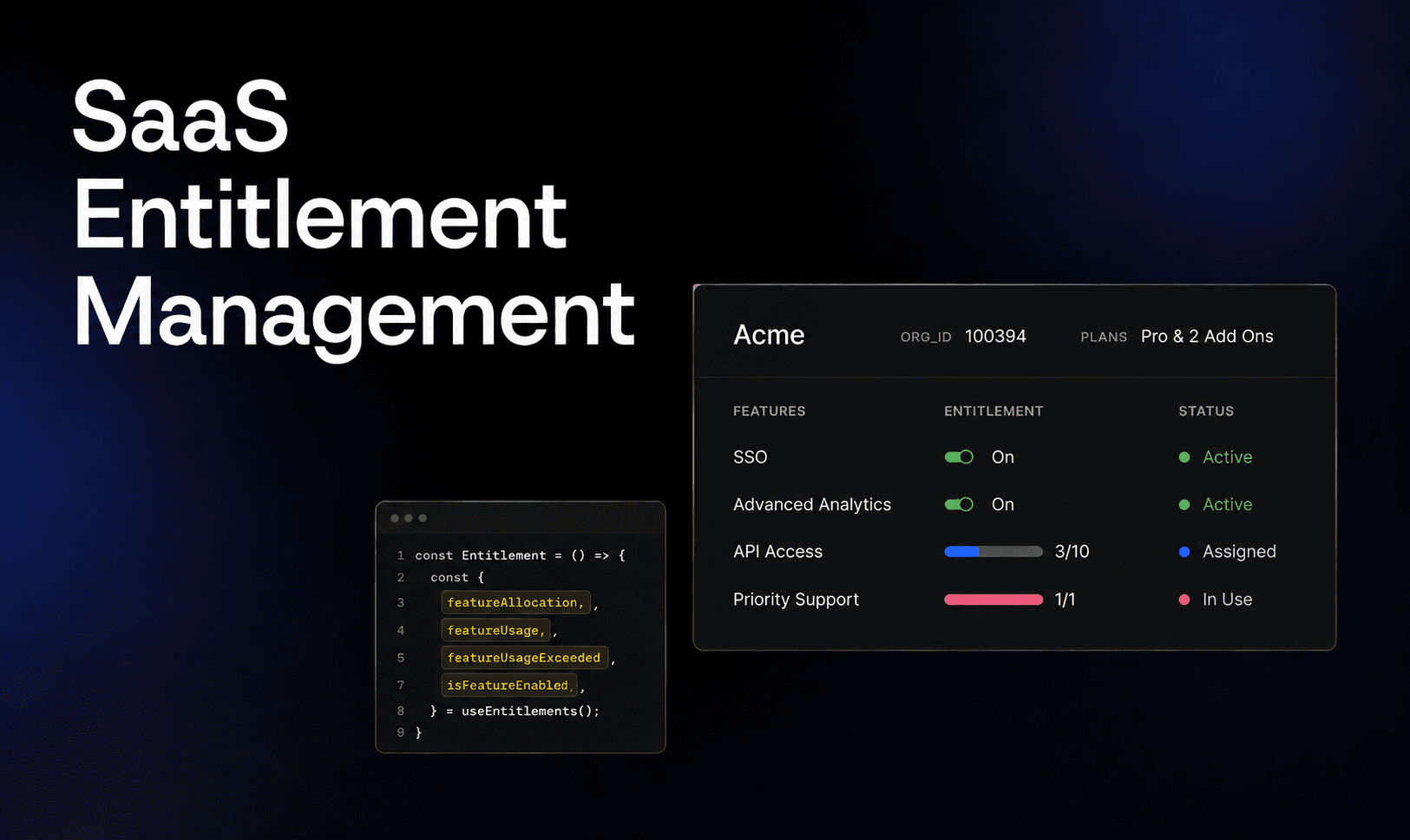
SaaS entitlement management controls what each customer can access inside the software product based on what they've purchased.
For example, a user subscribed to a Pro plan can use 10 seats, 50 AI credits, and advanced features. An enterprise customer, on the other hand, may have generous usage limits, custom overrides, or special contract terms.
These access rules and limits are called software entitlements.
When you manage entitlements effectively, every customer gets the right access at the right time. Upgrades take effect quickly. Downgrades remove feature access rights cleanly. Sales can freely experiment with pricing and packaging strategies, while engineering implements monetization once.
This guide explains what SaaS entitlement management means, why it's important, and when to use entitlement management software.
TL;DR
- SaaS entitlement management controls what each customer can access inside a SaaS product based on their plan, contract, or subscription status.
- Entitlements work by checking a customer’s account before the product allows, limits, or blocks an action, such as using a feature, calling an API, or adding a seat.
- Effective entitlement management helps SaaS companies align access with what customers paid for, ship pricing changes faster, increase expansion revenue, and support flexible monetization.
- On the other hand, building entitlements in-house can create technical debt, slow down monetization changes, and pull engineers away from core product development.
- Schematic provides an entitlements layer on top of Stripe. Engineers implement monetization once, while GTM teams can control plans, limits, and exceptions without hard-coded logic.
What Is SaaS Entitlement Management?
SaaS entitlement management is the process of defining and managing what each customer account can use inside the software application.
It covers the specific features, seats, usage limits, credits, add-ons, trials, and plan benefits tied to a customer’s plan or contract.
SaaS entitlements are not the same as access permissions. Permissions control what individual users can do based on their specific role, such as admin or member. They are owned by the IT security department.
Entitlements determine what an account has access to depending on its plan, contract, or billing status. They are evaluated by product, RevOps, and finance teams, with engineering building the entitlement management system that enforces them.
For example, permissions allow an admin to edit project settings, while a viewer can only read project details. Software entitlements decide whether accounts have 5 seats, 1,000 API calls, or SSO enabled.
How Do SaaS Entitlements Work?
SaaS entitlements work by checking a user's subscription plan or contract before the software product grants access to a feature, resource, or limit.
A customer account may try to generate a report, use prepaid credits, or request access to a paid feature.
Before the product runs that action, it checks the entitlements layer.
This layer reviews the account’s active features, seat count, usage limits, credits, add-ons, subscription status, and any custom terms against access policies.
Then, it decides whether to allow the request, limit activity, or deny access.
For example, if metered usage exceeds a predefined quota, the entitlements layer can apply overage pricing or enforce hard limits to prevent runaway spending.
When a customer is on credit-based pricing, the system checks the remaining credit balance and restricts user access when the balance reaches zero.
The product immediately enforces the access decision inside the request flow. It also records usage patterns and activity, then sends that data back to the entitlement layer for future access checks.
The Importance of Effective SaaS Entitlement Management
Entitlements help SaaS businesses control access, protect revenue, and enforce pricing inside the product. Here are the reasons why it's important to manage entitlements effectively.
Align Access With What Customers Pay For
Customers should only receive the features, seats, credits, and limits included in their subscription plan or contract.
Effective entitlement management makes sure that access is tied to the sale to prevent revenue leakage or disputes.
It also keeps software access consistent throughout the customer lifecycle.
If a plan includes 10 seats, the product should not allow 20. When a user buys an add-on, that particular feature should become active without manual effort.
Customers who have downgraded their plan should not be able to use features like advanced analytics.
Enable Faster Pricing and Packaging Changes
SaaS companies often need to test new plans, add-ons, limits, bundles, and trials. Effective SaaS entitlement management makes these changes easier to manage.
When entitlement rules are decoupled from application code, teams can update packaging without asking engineers to rewrite plan checks each time. This gives product and RevOps complete control over how offers are built.
For example, your company wants to move an advanced report feature from the Enterprise plan to the Pro plan.
That change can instantly happen through the entitlement system instead of writing entitlement code inside the product.
This helps teams launch new pricing tiers, respond to customer needs faster, and gain a competitive edge without delays from hardcoded pricing rules.
Increase Expansion Revenue Opportunities
Faster pricing and packaging changes create more room for expansion revenue.
When account executives and customer success teams can control entitlements without code changes, they can test new ways to grow existing accounts. They can offer a time-limited trial of a premium feature or test a paid add-on with a small customer group.
Effective entitlement management can also show the right upgrade path at the right moment.
Once the product knows what a customer has, what they use, and what they have reached, it can guide them toward the next paid option.
For example, a user who exceeds their credit limit may see an option to buy more credits. An account that reaches its seat limit may see a prompt to add seats.
Support Usage-Based Billing and Other Complex Pricing Models
SaaS businesses are moving away from flat-fee subscriptions. Many now charge based on seats, API calls, storage, tokens, credits, monthly active users (MAUs), or another usage-based billing metric.
That shift in software monetization makes access control harder. The product must know what each customer can use, how much they have already used, and what should happen when they reach a limit.
Effective SaaS entitlement management helps you implement complex pricing models and manage access inside the product.
For example, in a credit burndown model, the customer purchases a set number of credits to use over time. If the balance reaches zero, the entitlement management software can tell the product to either block further activity or show an upgrade option.
Reduce Support Tickets
Product access issues often turn into support tickets. A customer may ask why a new feature that they've paid for is missing, why a seat cannot be added, or why a limit was reached too soon.
SaaS entitlement management reduces these problems by keeping access rules clear and current. When billing status, plan changes, and product access stay in sync, customers face fewer issues.
The right entitlement management solution also gives internal teams a single source of truth. Customer support can check what a customer should have access to instead of asking engineering or searching through multiple catalogs.
Strengthen Security and Compliance
Software entitlements protect paid features, private data, and sensitive actions inside a SaaS product.
Each customer should only access the resources needed for their plan, role, or contract. If they are not entitled to a feature, the product should block the request inside the request flow, not just hide the button in the interface.
Effective SaaS entitlement management maintains a compliant and secure environment by keeping access tied to valid business rules.
Clear entitlement rules also make it easier to revoke access when a subscription ends, a trial expires, or a contract changes. This improves data security and reduces the chances of product misuse.
Risks and Challenges of Building Entitlements In-House
Homegrown entitlement management systems can work early on. But they usually break once pricing, selling, and business models become more complex.
Below are the risks and difficulties you may face when building entitlements in-house.
High Development and Maintenance Costs
Building entitlements in-house means signing up for an infinite roadmap with actual costs.
A homegrown entitlement system often needs feature flags for each monetized capability, webhooks to catch billing state changes, retry logic when webhooks fail, and queues for failed events. It also requires a database schema for entitlement state, plus migration support as plans change.
The work does not stop there. Teams often need cache rules, admin panels for customer success teams, pricing pages, checkout flows, self-service portals, and access checks wired into each feature.
Each new plan, add-on, limit, or contract term leads to extra work and higher operational costs.
Developer Burnout
In-house entitlements can pull developers into work that feels far from core product development.
Instead of building features, they spend time fixing billing webhooks, updating access checks, handling edge cases, and supporting one-off sales requests.
This work can feel endless because pricing keeps changing as the product evolves and customer needs change.
Even a simple plan update may require code changes, QA cycles, release planning, and production fixes. That constant pressure can lead to burnout.
Over time, the entitlement system becomes something no one wants to own.
Lack of Pricing Agility
Hard-coded entitlement logic can make it difficult to change pricing or launch new offers quickly.
A small pricing update may require changes across several parts of the product. For example, moving a feature to a different subscription tier may affect the checkout flow, upgrade prompts, product UI, and backend access checks.
This creates friction for product, sales, and GTM teams. They may want to test a new bundle, grant temporary access, or adjust usage limits, but each change depends on engineering.
As a result, pricing updates become slower and riskier. Teams avoid pricing experiments because the entitlement system is too rigid to support them.
Scalability Issues
In-house entitlement systems often work well when pricing is simple. They may support a freemium plan and a few gated features without much trouble.
Problems start when your company adopts hybrid pricing. You may combine fixed subscription fees with usage-based charges, add-ons, and custom contract terms.
Each layer adds more rules for the entitlement management platform to track and enforce.
And as your business grows, those rules must work across more products, customer segments, and billing states.
What began as a simple access management system can turn into a blocker for larger accounts, hybrid selling, and complex pricing models.
Revenue Leakage
Revenue leakage happens when customers get more access than they paid for or when billable usage is not tracked correctly.
In a homegrown entitlement management system, this occurs when billing records, product access, and usage data fall out of sync.
A customer may keep premium features after a downgrade. Another may pass a usage limit without being charged or blocked.
According to LeakShield's analysis of over 500 revenue audits, entitlement over-provisioning is one of the main sources for revenue leakage, accounting for 7% of total leaked revenue.
These issues are easy to miss when entitlement logic is spread across application code and billing systems. Small gaps can turn into larger financial losses as your customer base grows.
Poor Customer Experience
Customers expect plan changes to work right away. If they upgrade to a higher-tier plan, new features should appear. If they buy more seats or credits, those limits should update without a support ticket.
A homegrown entitlement system can create delays when access depends on manual steps or fragile sync jobs. Customers may see the wrong limit, lose access by mistake, or wait for support to fix their account.
These problems hurt trust and customer satisfaction. They also make the product feel less reliable, which may lead to churn.
Security Vulnerabilities
Entitlements are part of product access control. If the system is built poorly, users may reach features, data, exports, or API endpoints they should not access.
This risk grows when access checks are handled in different parts of the codebase. One feature may check the plan correctly, while another may miss the rule. A hidden endpoint may still allow access even when the user interface blocks it.
Manual overrides can also create security risks if no one tracks who granted access, why it was granted, or when it should end.
Best Practices for SaaS Entitlement Management
Here are some best practices for managing SaaS entitlements.
Decouple from Application Code
When access rules live inside the application, every plan change becomes a code change.
This slows down pricing experimentations and creates more room for bugs. A simple plan update can affect the UI, backend checks, upgrade prompts, and billing flows.
Instead, keep entitlement rules outside the core application when possible. The product should ask the entitlement layer whether access should be allowed. Then, it should act on that decision.
That makes pricing and packaging easier to change without changing application code.
Centralize the System of Record
Without a central system of record, entitlement logic can live in billing systems, product code, sales contracts, and admin panels.
That leads to confusion. One team may think a customer has access, while the product blocks the feature. Another customer may keep access after a downgrade.
A central system of record gives teams one place to check plans, limits, add-ons, trials, credits, and contract terms.
It also provides complete visibility into every entitlement decision. This makes it easier to understand why a user was blocked or allowed access to the product.
Use an Entitlement Management System
An entitlement management software sits between your product and the rest of your tech stack, including your CRM, billing, and subscription management platform.
Instead of forcing every system to manage access rules on its own, the entitlement system keeps those rules in one place.
Your product can check that layer when it needs to allow, limit, or block customer access. This enables you to test pricing and packaging changes without breaking other systems.
For example, you can test a new add-on, plan limit, or trial offer without rewriting billing logic or touching product code.
Have Fallbacks in Place
You need safe defaults when the entitlement system fails.
You may not want to block product access completely. At the same time, you should not let customers make changes that they might not undo once the system is working again.
For example, if a customer hits a limit and the product cannot confirm the account state, avoid a hard crash. Show a read-only view, an upgrade prompt, or a soft cap instead.
Doing so keeps the user moving without creating risky account changes. It also gives your product a safer way to enforce entitlements during outages, sync delays, or edge cases.
Plan for Overrides and Exceptions
Software monetization often needs exceptions. Sales teams may close a custom contract. RevOps may need to extend a trial. Customer success teams might need to grant extra features not included in the plan.
These cases should not require one-off code changes. They should be handled through clear override rules inside the entitlement system.
Each override should have an owner, reason, start date, end date, and a record of who approved it. That keeps exceptions from becoming hidden access problems.
Run Entitlements and Enforce Access In-Product at Runtime With Schematic
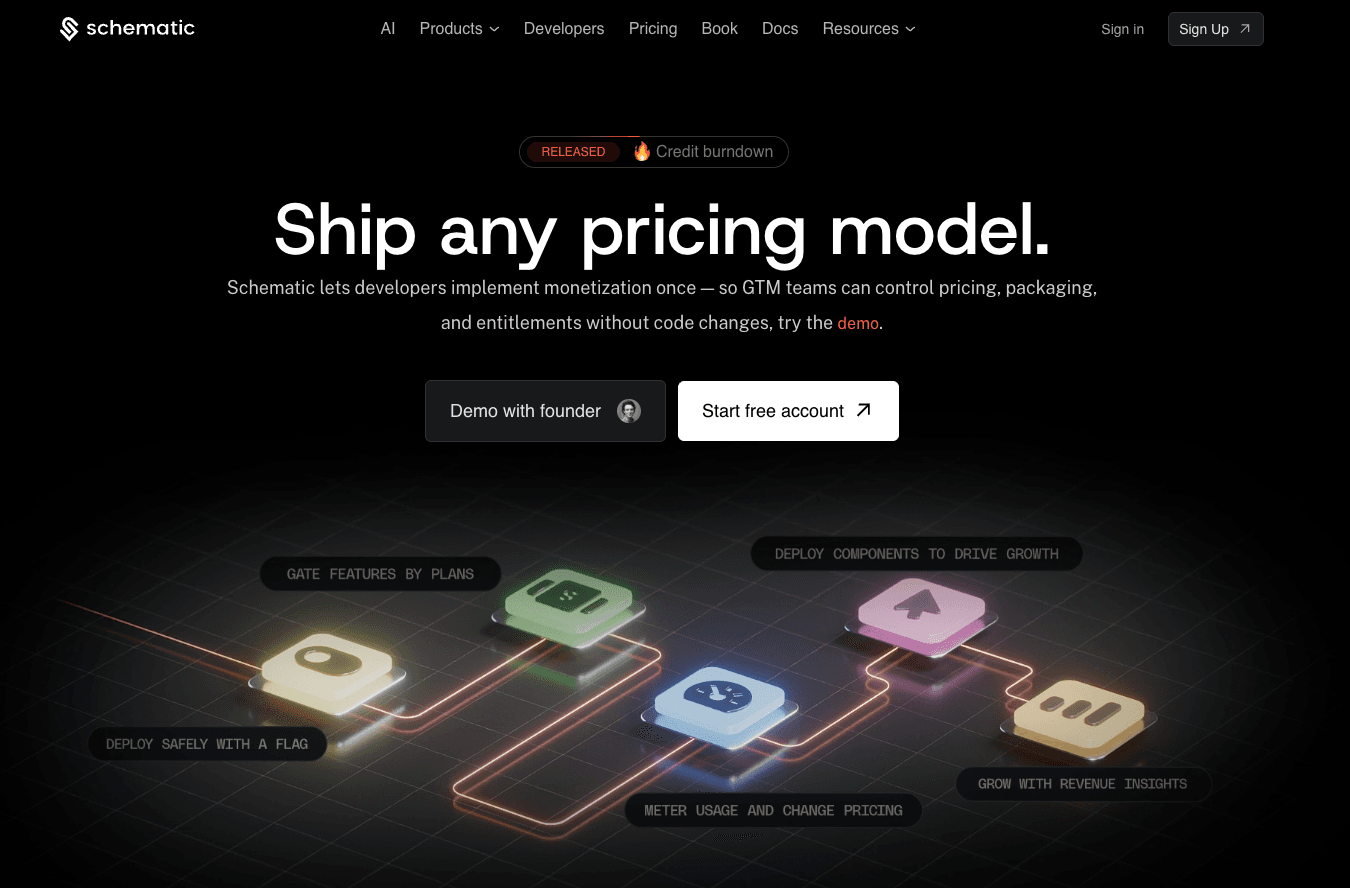
Schematic helps modern SaaS and AI companies manage pricing, packaging, and entitlements without code changes. It decouples billing logic from the application to enforce pricing changes and access in-product at runtime.
Schematic, built on Stripe, acts as the system of record for your product catalog. Stripe handles payments, invoices, tax management, and revenue recognition. Schematic lets teams configure plans, entitlements, limits, trials, add-ons, overrides, and exceptions in one place.
The platform provides the control plane that businesses can use to continuously iterate on monetization. Developers stop writing billing code and maintaining homegrown entitlements systems. GTM can sell flexibly while staying aligned with what the product actually allows.
FAQs About SaaS Entitlement Management
What is entitlement in SaaS?
An entitlement in SaaS is a product rule that defines what a customer account can access based on their plan or contract. It may include features, seats, credits, API access, usage limits, or custom contract terms.
Why do SaaS companies need an entitlement management system?
SaaS businesses need an entitlement management system to keep product access tied to each customer’s plan, contract, and usage. It supports runtime entitlement enforcement, prevents revenue leakage, and provides other key benefits, like less manual work and faster pricing changes.
Should you integrate entitlement management with billing systems?
Yes, entitlement management platforms should connect with billing systems. This ensures that product access instantly updates when a customer upgrades, downgrades, cancels, or buys an add-on.