 Ryan Echternacht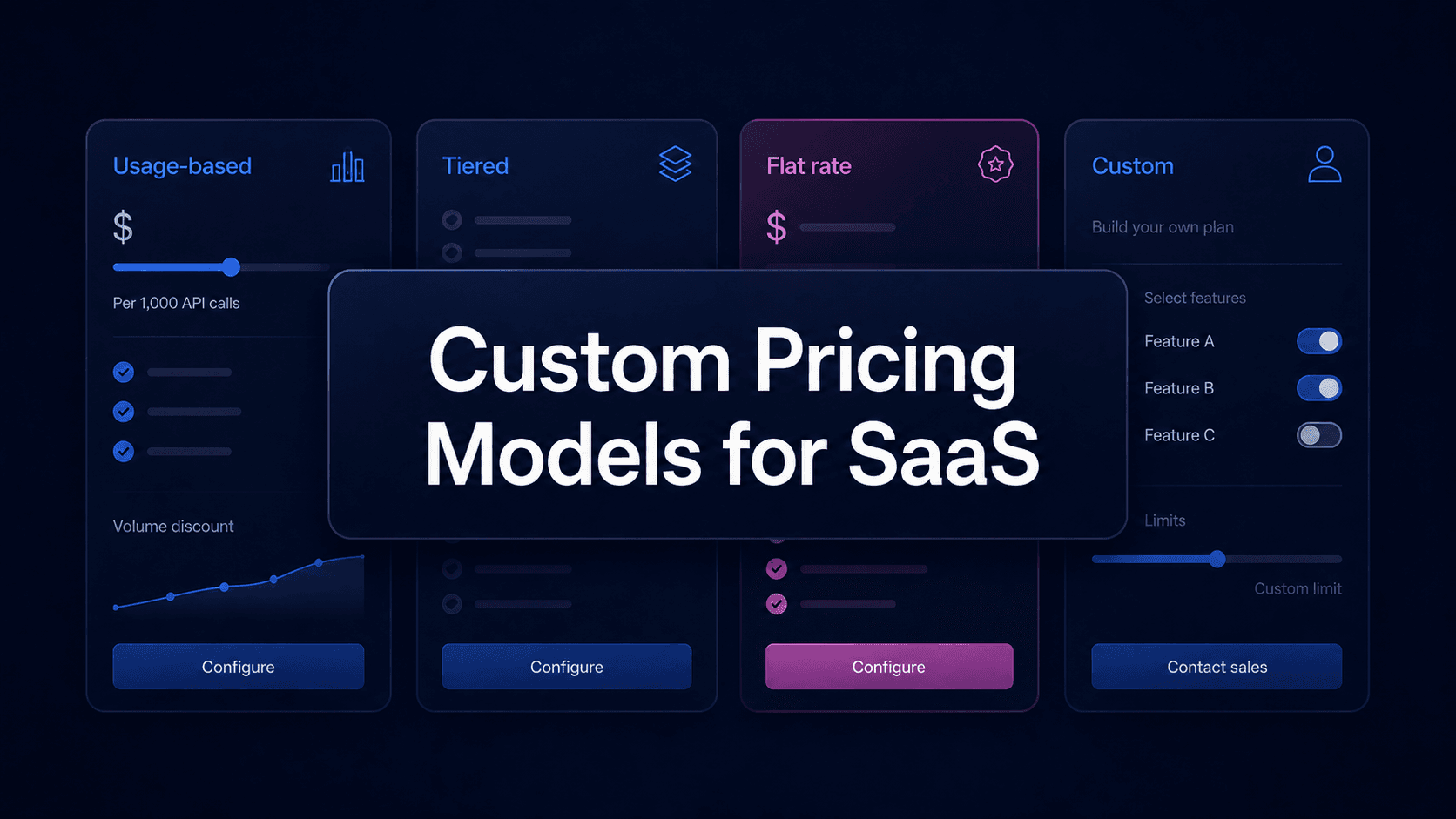
Fixed subscription plans may work at first, but they can become too rigid as customer needs change. Some buyers require more seats, higher usage limits, premium support, or special contract terms. Others may only want to pay for what they use.
Custom pricing models give SaaS businesses more control over how they package and price their software product. They can set prices based on usage, seats, features, volume, customer value, or results. Sales teams close more deals while giving buyers a custom plan that fits their needs.
This guide explains custom pricing and how it differs from other pricing models and strategies. We'll also discuss the different custom pricing structures that SaaS teams can ship.
TL;DR
- A custom pricing model offers a personalized price point to a specific customer based on their needs or requests.
- It makes sense when a SaaS company attracts enterprise buyers with variable usage patterns, budgets, and requirements.
- Unlike fixed pricing models, custom pricing can change based on the order form, account size, purchase volume, and product configuration.
- Popular custom pricing structures include base fees with usage-based charges, tiers with configurable features, seats with credits, consumption billing with volume discounts, value-based pricing, and outcome-based pricing.
- Schematic provides a complete monetization platform that helps SaaS companies launch custom plans, define billing terms, and manage the entire customer lifecycle without code changes.
What Is a Custom Pricing Model?
A custom pricing model tailors the price of a SaaS product to an individual buyer or a specific customer segment. The total cost may depend on usage volume, seat count, contract length, support level, or personalized software configurations.
B2B SaaS companies often use custom pricing when enterprise customers have unique needs or budgets that do not fit standard pricing plans.
The sales team carefully reviews the buyer's requirements, sets the price, and defines the billing terms in a custom quote or contract.
The final setup may combine a base subscription fee with a custom number of seats, usage-based charges, add-ons, or service costs.
When Should a SaaS Company Introduce Custom Pricing?
A SaaS business can introduce custom pricing when one price no longer fits every buyer. This often happens when customer needs, product usage, operational costs, or contract terms vary by account.
Below are some signs that custom pricing may be a good fit:
- The company begins attracting enterprise buyers who need more users, features, and services.
- Usage patterns differ greatly from one customer to another.
- Contracts include several products or modules.
- Enterprise customers request custom setup, training, or integrations.
- Deals regularly involve procurement and negotiation.
- Sales teams often change standard pricing tiers to close deals.
Custom Pricing vs. Other Popular SaaS Pricing Models
Standard or fixed pricing models charge the same price for all customers. Custom pricing changes depending on the buyer's specific requirements, purchase history, order volume, and software configuration.
Below, we'll discuss how custom pricing compares to different pricing models.
Flat-Rate Pricing
A flat-rate pricing model charges a fixed fee for one product package.
Every customer gets the same features, limits, and service level for the same price. Buyers can choose between monthly and annual billing, but the packaging stays the same.
This model is simple to explain and easy to bill. Prospects already know the full cost before they sign up. It often works for SaaS products with a primary use case and steady usage.
Custom pricing works differently. The final price can change based on account size, contract terms, service needs, or product setup. Flat-rate pricing does not adjust the package or price for each buyer.
Tiered Pricing
A tiered pricing model offers several packages sold at different price points. Each tier may include advanced features, more users, higher usage limits, or additional services.
Customers select the package that best fits their needs and budget.
For example, a Basic tier gives free users access to limited features. Upgrading to a Pro plan unlocks more capabilities that suit growing teams. Meanwhile, choosing an Enterprise tier means access to the advanced version of the platform.
The price increases as customers move to a higher tier. Each plan has set inclusions and pricing rules, so buyers within the same tier pay the same rate.
In contrast, custom pricing doesn't rely only on predefined packages. A sales rep can change features, limits, services, or contract terms for one buyer.
A tiered pricing model caters to different customer segments, while a custom pricing strategy creates a unique offer based on the buyer's preferences.
Per-User Pricing
A per-user pricing model, also known as seat-based pricing, charges customers based on how many people can access the software.
Some SaaS businesses offer per active user pricing, which bills only for people who use the product during the billing period.
Per-user pricing works well for communication platforms, customer relationship management (CRM) software, and project management tools where value is tied to the number of users using the software.
The total bill increases as more users join the account. Each seat usually has the same feature access.
Custom pricing can charge per user, but customers customize what individual employees can do. For example, entry-level users cannot see sensitive data, while admins can configure settings.
Usage-Based Pricing
Usage-based pricing is where customers pay for the exact amount of services or resources they consume. That's why it is also known as consumption pricing.
Usage-based pricing works by tracking and aggregating product usage data during each billing cycle. SaaS companies can charge for API calls, storage, messages, transactions, data volume, or compute time.
The usage billing platform applies pricing rules to the recorded amount. For example, usage can be billed at a flat rate (e.g., $2 for 1,000 API calls) or broken down into defined tiers (e.g., 0-10k units, 10k-100k units, 100k-150k units).
Credit burndown is another type of usage-based pricing model. Instead of paying for raw usage metrics, customers purchase a set number of credits that they can burn over time as they consume the product.
On the other hand, a custom pricing model can include usage-based fees. However, the exact rate, usage allowance, minimum spending amount, and contract terms may differ for each account.
Feature-Based Pricing
Feature-based pricing bills customers based on the capabilities they can use. Lower-priced plans include basic tools, while higher-priced plans unlock advanced features.
Customers pay more when they need additional capabilities, reports, integrations, security tools, or support.
This pricing model is common when a product's value is tied to features, and those capabilities can be divided into clear groups.
Custom pricing may also charge for feature access, but the SaaS vendor can build a unique package for one buyer. Sales reps might bundle or unbundle certain features, set special limits, or include additional services at an extra cost.
Feature-based pricing uses fixed packages, while custom pricing allows account-level changes.
Freemium Pricing
A freemium pricing model gives users free access to the software product. However, the free tier only includes limited features, users, storage, or usage allowance. Customers need to upgrade to a premium plan to use the full version of the platform.
Freemium is a popular pricing model for products that are easy to use and where costs per free user are low. It also makes sense when the target market prefers to test the platform before committing to a paid plan.
When implemented properly, a freemium model can lead to viral word-of-mouth recommendations, lower customer acquisition costs, and product-led growth.
Custom pricing is typically sales-led. Sales reps evaluate unique business needs and negotiate pricing with clients before finalizing the contract.
Freemium lowers the barrier to entry because users can quickly sign up to try the product.
Competitor-Based Pricing
Competitor pricing establishes prices by reviewing what similar SaaS companies charge. A business may price below rivals to attract budget-conscious buyers, match the market rate, or charge more to establish premium branding.
In competitor-based pricing, teams carefully research public pricing pages, plans, limits, and contract terms. They use competitor data as a guide when setting price points. Customer needs may still shape packaging, but the market rate remains the primary reference point.
The main difference between competitor-based and custom pricing is that the former focuses on external factors, while the latter evaluates the internal needs of potential customers.
6 Custom Pricing Structures That SaaS Businesses Can Implement
Most SaaS companies combine different pricing models when structuring custom plans. However, the options below merely serve as a guide. Custom pricing changes for each buyer based on their specific needs, company size, and agreements.
1. Base Subscription Plan + Usage-Based Expansion
This structure combines a fixed subscription fee with extra charges when usage goes beyond the plan's threshold. It's a popular type of hybrid pricing model.
The base fee typically covers platform access, core features, and a set amount of usage. Customers pay more if they need additional API calls, transactions, messages, compute hours, or monthly active users.
It supports a recurring revenue model while still capturing upside when buyers consume beyond the plan's limit.
SaaS companies should define the included allowance, usage metric, rate, billing period, and overage pricing rules. They must also give buyers real-time visibility into their usage to earn their trust and prevent disputes.
2. Tiered Plans + Feature Customization
A tiered pricing plan gives both sellers and buyers predictability. Sales teams can then change features of a selected tier to better fit the customer’s needs.
Let's say an existing customer is on the Pro tier. They want to add more projects, but they don't need strict security controls or custom integrations included in the Enterprise plan. They also lack the budget for it.
Instead of creating a whole new package from scratch, SaaS companies can offer extra projects as add-ons.
This approach gives finance teams a clear pricing base while still allowing sales reps to change account-level details. The standard tiers keep quoting and billing more organized.
3. Per-Seat Pricing + Credits
This structure charges customers for each seat and gives individual users a set number of credits that they can consume over time.
Per-seat pricing means revenue grows as active users increase, while credit-based pricing prevents unlimited usage under a flat fee.
In a custom plan, SaaS businesses can set how many credits each seat receives, which actions use credits, how fast credits burn, and whether unused credits roll over to the next billing period.
Customers can then choose what happens when the balance runs low. Hard limits stop access when credits reach zero. Soft limits let usage continue and bill it in arrears. Automatic top-ups buy more credits as soon as the balance reaches a predetermined level.
4. Consumption Pricing + Volume Discounts
Consumption billing charges customers based on how much of the product they consume, while offering lower rates for higher usage levels. It can apply to API requests, tokens, messages, gigabytes of storage, compute hours, and other usage billing units.
The SaaS company sets usage tiers, each with its own price. The customer’s final rate depends on the tier their total usage falls into during the billing period.
For example, an account using 100,000 units may pay a lower price per unit than a buyer consuming 10,000 units.
Custom plans can set account-specific tiers, rates, minimum commitments, and billing periods. The contract and invoice should clearly state how usage is measured and which tier is selected.
5. Value-Based Pricing
Value-based pricing is a SaaS pricing strategy that charges customers based on their perceived value of the product.
It differs from cost-plus pricing, which adds a profit margin to the cost of building, hosting, and supporting the product. Cost-plus pricing mainly considers the seller’s expenses.
Value-based pricing focuses on what the buyer may gain, such as more revenue, lower costs, less risk, or time savings.
The SaaS company reviews the customer’s goals, expected gains, company size, and use case before creating the quote. Since value can differ by account, it should not be the only pricing strategy used without clear price floors and approval rules.
6. Outcome-Based Pricing
Outcome-based pricing only bills customers when the software produces an agreed result. The actual fee may depend on leads generated, payments recovered, support cases closed, appointments booked, or another successful result.
The contract must define the outcome, how it is tracked, when it counts, and which system provides the final record. It should also follow set rules for failed events, repeated results, refunds, and billing disputes.
This custom pricing structure ties value closely to customer success, but both sides need clear measurement rules.
SaaS companies may charge only for outcomes or combine a base subscription plan with outcome fees. The base fee covers platform access, while the outcome fee changes with the results produced.
Key Benefits of Custom Pricing
Custom pricing gives SaaS companies more control over how they package and sell their products. Here are the advantages to expect.
Improve Conversion Rates
Custom pricing can remove the gap between a fixed plan and what a buyer actually needs. You can adjust user limits, features, support, billing terms, or usage rules before sending a quote. You can also address budget limits.
This gives the buyer a clear reason to accept the deal because they are not paying for tools they will not use.
For example, you may lower the monthly subscription fee while setting a higher overage rate when usage exceeds the plan's limit. You can also charge extra if the buyer needs priority support and access to a dedicated account manager.
By providing tailored offers, you can reduce price objections and help more qualified leads become paying customers.
Increase Revenue Potential
Custom pricing helps SaaS companies earn more from buyers with higher needs while still serving customers with smaller budgets.
You can charge more for advanced features, extra seats, and higher usage limits instead of forcing every buyer into the same plan.
At the same time, offering lower-entry packages or limited setups can make the product more affordable for budget-conscious customers. This expands access to more parts of the market without lowering the price for every account.
The result is sustainable revenue growth from both customer segments. Enterprise buyers can pay more based on their needs, while small teams can start with a plan they can afford and grow over time.
Align Pricing With Customer Value
Custom pricing connects price to the value each buyer expects to receive. A small team and a large company may use the same product, but their goals, usage, and gains may be very different.
You can create a personalized quote that reflects time saved, costs reduced, revenue gained, or work completed. You can also account for user count, product limits, support needs, and contract length.
When you align pricing with customer value, your SaaS company benefits from better profit margins.
Differentiate From Competitors
Custom pricing creates a competitive advantage when other SaaS businesses offer rigid plans that do not fit larger accounts with complex needs.
A flexible quote can include the right mix of features, credits, add-ons, and contract terms.
You can also adjust offers based on customer needs and current market trends. For example, you can use prepaid credits for AI tools, offer volume discounts for large accounts, or charge outcome-based fees for products that deliver measurable results.
The goal is not to lower the price for every deal to beat competitors. You want to build an offer that fits the customer's needs better than a fixed package.
Do not forget to set clear limits and approval steps to keep custom pricing under control.
Encourage Customer Loyalty and Long-Term Commitments
Custom pricing supports long-term customer relationships because the plan can change as the account grows.
A buyer may start with a Basic plan. Later on, they upgrade to a Pro tier and negotiate terms to include higher limits. Your SaaS company can cater to their needs without migrating them to a fixed plan that doesn't fit their requirements.
You can also offer discounted rates in return for annual payments, higher minimum spending, or multi-year terms. This gives customers budget predictability, while your business collects cash upfront.
Make sure the custom plan has clear paths for renewal and account growth to increase customer lifetime value.
The pricing should still be easy to understand. Existing customers are more likely to stay when they know what they pay for and how future charges work.
Challenges in Implementing Custom Pricing
Custom pricing gives SaaS companies more flexibility, but it can create extra work for sales, billing, and finance teams.
Billing Complexity
Custom contracts may include unique prices, billing dates, credit rules, usage rates, discounts, and renewal terms. Traditional billing platforms may not support every setup without manual work.
Teams should track what each customer bought, how charges are calculated, and when invoices should be sent. Errors can lead to missed charges, inaccurate bills, or customer disputes.
Without a reliable SaaS billing solution, each new deal increases the workload for different departments.
Sales reps send the quote. Account executives pass the deal to solutions, then solutions send it to engineering. Finance finds a problem with the first invoice. Since signing the contract a week prior, the customer still cannot access the product.
Longer Sales Cycles
Custom pricing often requires more steps than a self-serve plan. Vendors need to learn about the buyer’s requirements, create a quote, review terms, and gain approval before closing the deal.
Customers may involve finance, legal, security, and IT teams before signing the contract. According to the State of Business Buying 2026 report, the usual purchasing decision includes 13 internal stakeholders and 9 external influencers. The number increases for more complex or strategic deals.
Each department may ask for changes to pricing, payment terms, service levels, or contract length.
SaaS companies should collect customer feedback during these talks to learn which terms cause delays or confusion. Provide a clear quotation, live demos, and case studies to shorten sales cycles.
Inconsistent Pricing
Custom pricing can lead to large price differences between similar customers. Sales reps may offer discounts, extra features, or special terms without following the same rules.
Customers may question the price if they learn that another company received a better deal for a similar setup.
SaaS teams must choose the right pricing model supported by price floors and discount limits. Quotes should follow set rules based on seats, usage, features, or service needs.
Managers should review unusual deals before approval. These steps keep prices fair while still giving sales teams room to meet specific customer needs.
Scalability Constraints
Custom pricing models can become hard to manage as the number of customers grows. SaaS teams need to create a unique package and billing setup for each account.
Manual work may be manageable with a small customer base. However, it breaks when sales teams close more deals, and customers request changes in the middle of their billing cycle. Engineers need to ship software when a buyer asks for a custom deal.
SaaS companies should implement custom plans as configuration instead of one-off logic scattered in the application's codebase.
When custom plans are configuration, commercial teams can quickly adjust terms without waiting on developers to write billing code.
Inaccurate Revenue Forecasting
Custom pricing makes future income difficult to predict. Deals may have different discounts, billing dates, minimum spending rules, and contract lengths.
Usage-based fees can change every month, while custom renewals may raise or lower account value.
Finance teams often struggle to estimate income when contract details are stored in separate files or sales tools.
It's important to integrate customer data from sales, billing, and CRM software. This makes it easier to track fixed fees, expected usage, renewal dates, and possible account growth in one place.
How Schematic Helps SaaS and AI Teams Launch Custom Plans
Schematic is the best all-in-one monetization operating system for SaaS and AI companies selling custom plans to enterprise customers. It provides all the tools required to launch usage-based billing and other common SaaS pricing models through sales-led or self-service channels.
Schematic ships custom plans as a first-class object. Each custom deal is a standalone plan for one company. It has its own prices, software entitlements, metered rates, billing terms, grace periods, overages, and flat-rate components.
Commercial teams can easily configure these custom plans, send invoices, and forward the payment link to the customer. They also handle the entire subscriber lifecycle (e.g., upgrades, downgrades, and exceptions) from the same plan.
Engineering no longer needs to ship software for every enterprise deal. They simply instrument entitlement checks, send usage events, and handle the webhook callbacks. After that, they are out of the per-deal path.
Businesses unlock deal velocity and real quote-to-cash motion. Everything (from the order form and the metered billing to the renewal) is managed from Schematic rather than inside the application's codebase.
FAQs About Custom Pricing Models for SaaS
What is custom pricing in SaaS?
Custom pricing in SaaS is a price and package tailored for one customer. The final quote may depend on seats, features, support needs, contract length, billing terms, and the product setup requested by the buyer.
Is custom pricing better than fixed pricing?
Custom pricing is better when customer needs and account sizes vary. Fixed pricing may suit simple products with similar buyers. The best choice depends on the product, sales process, billing system, target customers, and level of plan flexibility needed.
What should be included in a custom SaaS quote?
A custom SaaS quote should list included features, user seats, usage limits, setup fees, contract length, payment terms, overage rates, discounts, renewal terms, and the total price.