 Ryan Echternacht
Stripe is a popular developer tool for billing, payments, and subscription management. However, it lacks a dedicated system for entitlement management.
When a customer upgrades their subscription plan in Stripe, the billing platform does not enforce access and application behavior at runtime.
It does not answer the questions: Can the customer access a new feature right away? Do their limits change? Are they allowed to add more seats, given their plan and usage so far?
Most SaaS companies end up writing custom code inside the application to answer those questions.
This article explains where Stripe Billing falls short and how Schematic manages entitlements for Stripe.
TL;DR
- Stripe entitlements determine when to provision or revoke feature access based on what the customer has purchased.
- Stripe supports basic entitlement management through an API, but it does not enforce access at runtime. Teams are left to build and maintain entitlement logic, which requires a lot of time and resources.
- A dedicated entitlement management platform connects Stripe billing data to actual product behavior.
- SaaS teams use the platform to keep access in sync when subscription changes, enforce usage limits, and enable faster pricing and packaging iteration.
- Schematic integrates with Stripe and adds powerful capabilities on top of it, such as a product catalog and smart feature flags for entitlements.
What Are Entitlements for Stripe?
In Stripe Billing, software entitlements let you connect internal features to Stripe products.
A feature can represent something inside your software application, such as team seats, premium reports, API access, or data retention.
Once you attach that feature to a corresponding product through the Stripe dashboard, the app will know which capabilities the customer is entitled to based on their subscription. It also receives alerts about when to provision or revoke access rights.
In other words, an active entitlement describes access to a feature that a customer should have after they purchase a specific product or plan.
It is different from individual permissions. Permissions define what an individual user can do. For example, a user with reader-only access rights can view a document, but they cannot edit it.
Entitlements control product access at runtime. A Stripe account subscribed to the Free plan can use basic functionalities, while a Pro subscriber gains access to additional features.
Where Stripe Billing Falls Short
Stripe falls short because it does not have a usable entitlements product.
Instead, it only provides access to an entitlements API. This API allows you to do the following:
- Create features and enter a lookup key, which acts as your own system identifier.
- Attach features to Stripe products.
- Retrieve entitlements for a customer based on their subscription.
- Obtain a list of active entitlements available for each pricing plan.
- Edit, remove, or archive features.
The entitlements API is useful if pricing is connected to features. But as you offer multiple pricing plans, especially usage-based billing, you need a more reliable way to track limits and keep product behavior in sync with subscription state.
Stripe isn't built for that. It relies on webhook events and your own data model for enforcement. It does not evaluate and enforce access inside your app at runtime. It only tells you what should be true or false.
Your team still has to build the entitlement logic that turns Stripe data into product behavior. That logic often touches your frontend, backend, and internal tools. Over time, this can become difficult to monitor, maintain, and audit.
Why Should You Use a Dedicated Entitlement Management Platform
An entitlement management platform decides which features and product limits each customer should have inside your SaaS product. It connects plans, purchases, and usage to the product rules your app should follow.
Here are the reasons why SaaS businesses adopt a dedicated entitlement platform when Stripe falls short.
Turn Billing Data Into Product Access
SaaS companies use an entitlement management platform because Stripe does not enforce in-product access.
A paid invoice or an active subscription plan tells you that a customer has bought something. But it does not tell your app which buttons to show, which limits to enforce, or which features to block.
Entitlement management software connects Stripe billing events, subscriptions, plans, and purchases to product behavior.
The app automatically enforces the right features, usage limits, and credit grants based on each customer’s plan or contract.
Keep Product Access in Sync With Subscription Changes
Customer plans change often. A user may upgrade, downgrade, cancel, renew, move from trial pricing to paid, or buy an add-on.
An entitlement management platform helps your product react to those subscription changes without relying on one-off logic.
Keeping access aligned with subscription changes is important to prevent problems.
For example, a user may retain access too long even if they have already downgraded their plan, which leads to revenue leakage.
Another scenario is when a customer upgrades their plan and misses a feature they just paid for. They may dispute their bill and churn if the issue isn't resolved.
Centralize Feature Access Rules
Without an entitlement system, access rules often live in scattered code, admin tools, spreadsheets, and personal notes.
That makes every SaaS pricing and packaging change slower. Even a small update can require manual updates across disconnected systems.
Fortunately, an entitlement management solution gives your team one place to define, update, and manage who gets access to what features.
Product, engineering, sales, and customer support departments can work from a centralized platform. This makes pricing and packaging easier to maintain as your product grows.
Enforce Usage Limits Accurately
Companies are shifting away from static pricing and moving towards usage-based billing. Many SaaS organizations now offer pay-as-you-go, credit-based, seat-based, or a combination of two or three pricing models. The 2026 State of B2B Monetization report shows that 37% of businesses use hybrid pricing.
An entitlement management platform helps track usage against the limits in each plan. It can tell the product when an account is near a limit, has crossed a threshold, or needs to upgrade.
This is hard to manage with Stripe billing data alone. The app needs to know what the customer bought and how much they have used.
Entitlement management connects those two important details to enforce usage limits before customers exceed what they purchased.
Support Faster Pricing and Packaging Iteration
SaaS pricing changes as the product matures. Teams may test new plans, offer AI credits, bundle or unbundle features, launch add-ons, or sell custom terms to new businesses.
Every pricing change should not require engineers to rewrite billing logic, update feature gates, or touch the source code.
An entitlement management platform enables business teams to adjust plans, limits, and packaging independently from engineering. This allows them to move faster and continuously iterate on SaaS monetization.
Go-to-market (GTM) teams can ship any pricing model while staying aligned with what the product actually allows. Product managers can gate a new feature to a beta cohort. Account executives can enable overage pricing when a strategic customer is near their usage limit.
How Schematic Manages Entitlements for Stripe
Schematic is the monetization operating system for modern SaaS and AI companies. It offers bi-directional integration with Stripe.
Stripe still handles billing, payments, invoices, tax operations, and fraud management. Schematic connects Stripe billing data and subscription state to actual product behavior.
Unlike other billing systems, Schematic does not ask you to receive state changes through webhooks, store them in your own database, and build enforcement logic in-house.
Instead, Schematic handles SaaS entitlements through a streaming architecture. When your app starts, Schematic uses a WebSocket to push entitlement state into local memory. Checks can run in less than a millisecond since your app reads from memory, not the network.
Engineers only need to use a single entitlement check per feature. The plans, limits, packaging, and exceptions behind that check live in Schematic.
The people closest to the customer relationship (e.g., sales, product, and go-to-market teams) can control and change those rules. Schematic keeps everything up to date automatically.
Schematic Makes Stripe Better
Stripe Billing does not manage entitlements well on its own. It provides access to an entitlements API, but the system still has to receive webhook events, update customer records, and reflect the changes. Most teams build custom code to control product access in real time.
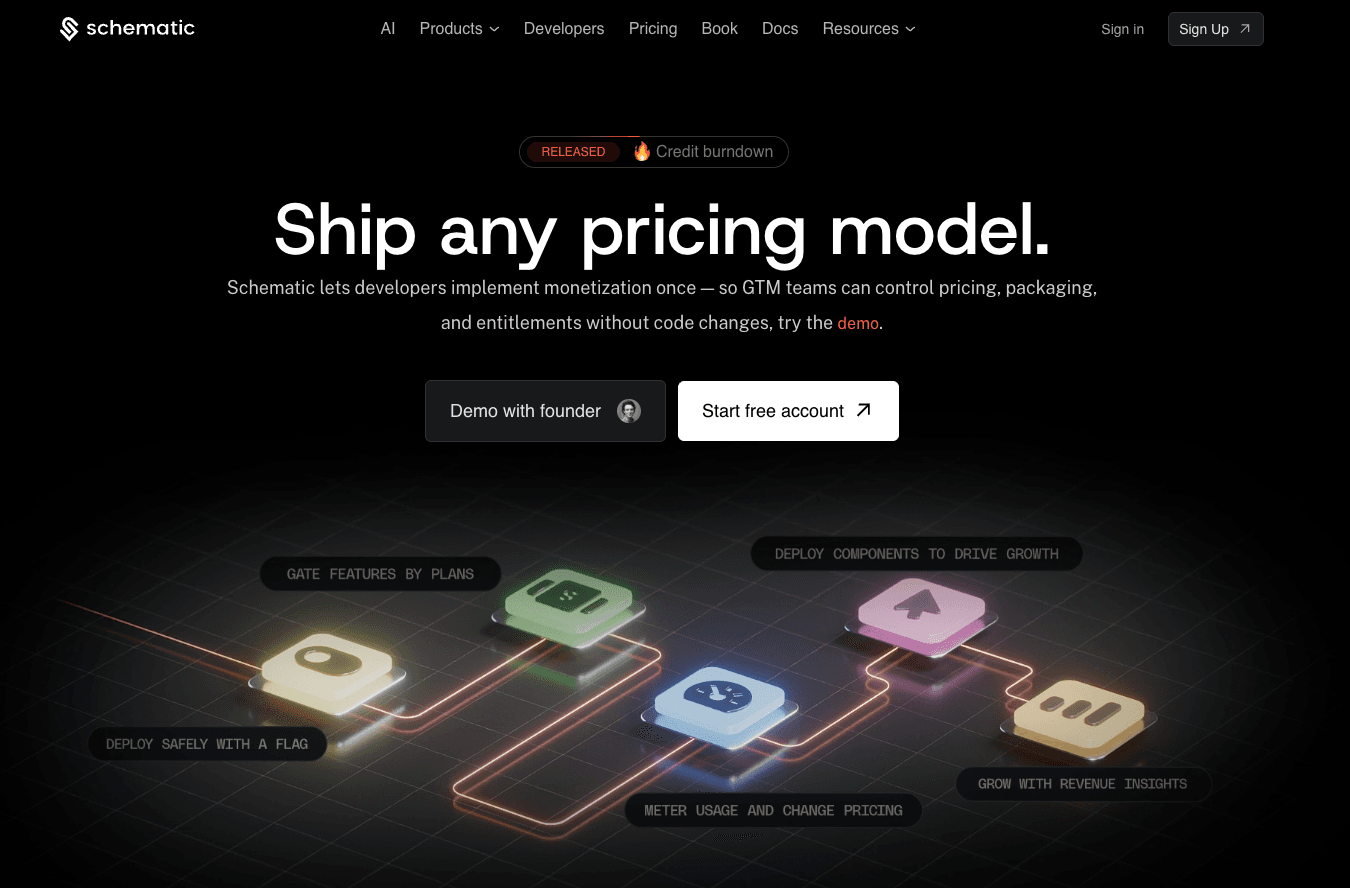
Schematic complements Stripe by adding a product catalog and smart flags to power entitlements. It becomes the source of truth for what a customer is allowed to use inside your application.
Schematic lets you define which features, limits, credit grants, and services are included in each plan. For example, a Starter plan comes with a single seat, basic reports, 50 credits, and community support. A Team plan adds 10 seats, premium reports, 200 credits, priority support, and custom add-ons.
Schematic also offers a native Stripe app, where you can map entitlements to Stripe products and enforce them directly in your app using SDKs.
Stripe continues to own billing, invoicing, and revenue recognition. Schematic makes it better with real-time access control, usage enforcement, and customer lifecycle management.
FAQs About Entitlements for Stripe
What are Stripe entitlements?
Stripe entitlements define when a customer should gain or lose access to product features. They connect features to Stripe products, so teams can see what access rights a customer should receive after buying one or multiple products.
Does Stripe have an entitlements product?
Stripe Billing has an entitlements API, but it is not a complete entitlement management solution. It can help track feature access. However, your team still owns the implementation of access checks, usage rules, and app behavior at runtime.
What are the disadvantages of using Stripe?
Stripe is a robust billing tool, subscription management platform, and payment processor. Still, it has its disadvantages, especially when it comes to entitlement management. Stripe does not enforce access at runtime. Teams need to build custom logic to address this limitation, which can slow down pricing and packaging changes.