 Ryan Echternacht
Many Software-as-a-Service (SaaS) companies and artificial intelligence (AI) businesses launch usage-based pricing to charge customers based on actual consumption. The 2026 State of AI report revealed that 35% of software companies have adopted consumption-based pricing.
However, usage-based pricing only works when teams can track usage with a high level of accuracy. That is where SaaS metering comes in.
It continuously measures raw usage events, such as API calls made, tokens processed, or AI tasks completed, and records the total consumption data. The aggregated data is sent to the billing system for invoicing.
In this article, we'll define SaaS metering and explain its importance in usage-based billing.
TL;DR
- SaaS metering tracks how much of a software product each customer uses so that consumption data can be turned into billable charges.
- Accurate metering is the foundation of usage-based billing that connects product activity to pricing.
- It works through an event-based approach, which tracks product actions, or a resource-based method, which measures consumed capacity like storage in gigabytes or compute minutes.
- Accurate metering can prevent revenue leakage, increase expansion revenue, minimize churn, and support flexible pricing models.
- Schematic can process over one million usage events per second and turn them into billable totals. It also gives customers real-time usage visibility and controls that make usage-based pricing easier to trust.
What Is SaaS Metering?
SaaS metering is the process of tracking and recording how much existing customers use a software product. It measures usage events, such as API calls, tokens, AI credits, storage, compute time, monthly active users (MAU), and transactions.
In usage-based billing, customers pay according to the amount they consume during a predefined billing cycle. It aligns revenue with customer value. This differs from flat-rate pricing, where every user is charged the same flat monthly fee regardless of actual usage.
SaaS metering ingests and aggregates consumption data, which is used for metered billing and invoicing.
Why Is SaaS Metering Important in Usage-Based Billing?
SaaS metering is important because it serves as the foundation of usage-based billing. It creates the data layer that connects customer activity to pricing, so billing systems know how much usage to charge an account for.
Without usage metering, accurate billing becomes difficult. SaaS and AI companies cannot implement usage-based pricing reliably and bill existing customers based on what they actually consumed.
When usage billing platforms rely on inaccurate and incomplete data, several problems can follow:
- Underbilling customers
- Overbilling customers for usage they did not consume
- Revenue leakage from missed billable events
- Customer disputes over unexpected charges
- Loss of trust in usage-based pricing
- Manual reconciliation work for finance and engineering teams
Reliable SaaS metering data ensures billing accuracy. It allows software companies to launch any usage-based pricing model, including pay-as-you-go, credit burndown, and hybrid models, with confidence and transparency.
How Does SaaS Metering Work?
SaaS metering usually falls into two categories. Here's how each one works.
Event-Based Metering
Event-based metering tracks specific actions that customers take inside the SaaS product. Every action becomes a billable unit that the billing software can count.
For example, a software company may meter API calls made, messages sent, reports generated, or AI tasks completed. Each event is tied to a customer account and stored with important details, such as the event type, time, and quantity.
The metering infrastructure aggregates those events and sends the data to the billing system, which applies the right pricing rules.
Resource-Based Metering
Resource-based metering measures how much infrastructure or capacity a customer consumes over time.
Instead of counting individual actions, it tracks resources, such as storage in gigabytes, compute time period, bandwidth, or concurrent seats.
The system records changes in resource usage and calculates the amount consumed during the billing period.
This metering method suits data storage platforms, infrastructure-as-a-service, and developer tools like Vercel.
Benefits of Accurate Usage Metering in SaaS Billing
Accurate usage metering can improve the entire billing process. Below are the benefits you can expect.
Prevent Revenue Leakage
Accurate metering helps SaaS and AI companies capture every billable event or resource an existing customer consumes.
If usage events are missed, duplicated, or assigned to the wrong account, the final invoice may not match actual consumption.
A reliable metering system records usage consistently and gives billing teams a clear record for each account. This helps ensure accuracy before generating invoices.
It also reduces the risk of unbilled API calls, credits, tokens, or other paid usage. That can prevent revenue leakage without depending on manual checks at the end of each billing cycle.
Increase Expansion Revenue
Usage-based billing automatically turns higher product consumption into expansion revenue, eliminating the need for a manual upsell conversation or contract negotiation.
When pricing models are tied to usage, customers who need more API calls, tokens, or credits also spend more.
Accurate metering helps teams record this increased usage and send the data to the billing software.
As customers receive greater value from the product, their bill grows with their consumption under the agreed pricing rules.
SaaS and AI companies can generate more revenue from growing accounts without intervention from sales teams.
Minimize Churn
Accurate metering can track how customer behavior changes over time. SaaS teams see when an account is exceeding usage limits, staying at the same usage level, or starting to use the product less.
A steady drop in API calls made, workflows completed, transactions processed, or other billed activity may point to lower product adoption.
Customer success teams can analyze these patterns to identify accounts at increased risk of churning. Then, they can reach out and address problems proactively before it's too late.
Metering data can also show which customers are hitting plan limits month after month, which usually signifies readiness for expansion.
With reliable SaaS metering, teams can respond based on actual product usage rather than waiting for a renewal or cancellation request.
Support Flexible Pricing Models
SaaS metering provides the foundation needed to support several pricing structures.
Teams can charge customers for only the exact amount of product they use, bill overage fees for consumption beyond agreed limits, or sell prepaid credits.
Metering also allows software companies to combine fixed subscription fees with variable usage-based charges. Hybrid models give businesses stable recurring revenue from the subscription component while still capturing upside from increased consumption.
Meanwhile, customers get cost predictability when they pay for a basic plan with included usage allowances, unlike pure pay-as-you-go models.
Key Features of a Reliable SaaS Metering System
A SaaS metering system depends on several core features to manage usage-based billing at scale. Let's break down each one below.
Real-Time Usage Data Ingestion
A strong metering system supports real-time ingestion to ensure usage events are processed as soon as they happen. It should handle high-volume event streams without dropping data packets or creating long delays.
This feature is especially useful for SaaS and AI products where customers may generate thousands or millions of events in a short period.
Fast data ingestion also keeps usage dashboards, account balances, and billing records up to date throughout the billing cycle.
Idempotent Event Processing
Idempotent processing stops the same usage event from being counted more than once. It works by assigning unique identifiers to each event. This allows the metering platform to recognize duplicates before they affect the customer's final invoice.
It suits scenarios where applications retry failed requests or resend events after a connection issue.
Without idempotency, one API call or AI request could appear several times, leading to incorrect usage totals and higher charges than the customer expects.
High Availability
The best metering system can continue receiving and processing usage events even when part of the architecture fails. High availability reduces service gaps that could cause missed billable activity.
Redundant systems, retries, queues, and recovery processes can prevent data loss when servers or network connections go down. It's important for products that generate usage events around the clock and cannot pause event collection during an outage.
Auditable
An auditable metering solution keeps a clear record of how each billable total was created. This makes it easier to trace a line item in the invoice back to the raw events that produced it.
Records may include timestamps, customer IDs, event types, quantities, and pricing inputs. Finance and support teams can quickly review charges, investigate billing concerns, correct errors, and explain how they calculated a customer’s final invoice.
Developer-Friendly APIs
Developer-friendly APIs allow engineering teams to send, retrieve, and manage usage data from SaaS applications. It also reduces the amount of custom code developers need to maintain around their metering setup.
Make sure the API offers clear documentation, authentication, predictable request formats, and error messages. It should also have the ability to check usage totals, correct records, and retrieve account-level consumption.
Built-In Integrations
Built-in integrations connect metering with the systems that already support sales, finance, and customer support teams.
Check if the metering platform integrates natively with SaaS billing solutions, data warehouses, accounting tools, and customer relationship management (CRM) software.
These built-in connections automatically sync usage data between systems without building integration glue or managing webhooks.
Challenges in SaaS Metering and How to Solve Them
SaaS and AI companies often face three challenges when metering product usage: missing events, billing disputes, and scaling limits. We'll share how to solve each problem below.
Delayed or Missing Usage Events
Usage events may arrive late or never reach the metering system. Network failures, service outages, overloaded queues, and failed API requests can all interrupt event delivery.
When events are missing, the billing system may record lower usage than the customer actually consumed.
Late events introduce another problem. If usage arrives after an invoice has been generated, companies should correct the charge or move that usage data into the next billing period. This adds extra work for finance teams.
It's best practice to invest in streaming architecture that reads from memory instead of the network. This leads to sub-millisecond checks without managing cache or debugging invalidation.
You should also check support for replays and backfills. This allows the metering infrastructure to count every event exactly once and ensure accurate billing.
Billing Disputes
Customers may question an invoice when the amount does not match what they expected. This is more common with usage-based billing because charges can change each month based on actual consumption.
Disputes are harder to resolve when users cannot see what generated the charge. A single monthly total may not explain which API calls, tokens, transactions, or other product actions contributed to the total bill.
To settle disputes and gain a customer's trust, you should provide real-time visibility over usage. Give users access to a usage dashboard or a customer portal where they can track their current consumption, remaining balance, and actual spending.
Customer controls are just as important. Allow users to set per-seat and per-agent limits, configure credit top-up rules, and decide what happens at the predefined usage cap.
Scalability Issues
Metering data becomes harder to manage as product usage grows. A system that works for thousands of events may struggle when it needs to process millions of actions.
Problems can also appear when billing rules are built directly into the product. Every pricing change may require engineering work, code changes, and new software releases. Commercial teams struggle to adjust usage limits, offer add-ons, and grant exceptions as the company scales.
The solution is to decouple metering and billing logic from the application code. The product should send usage events to a dedicated metering layer, while pricing rules are handled separately.
The key takeaway is to keep product activity, metering, and pricing logic separate. This way, each component can grow or change without forcing a billing rebuild.
Schematic Meters Usage in Real Time and Makes Billing Trustworthy
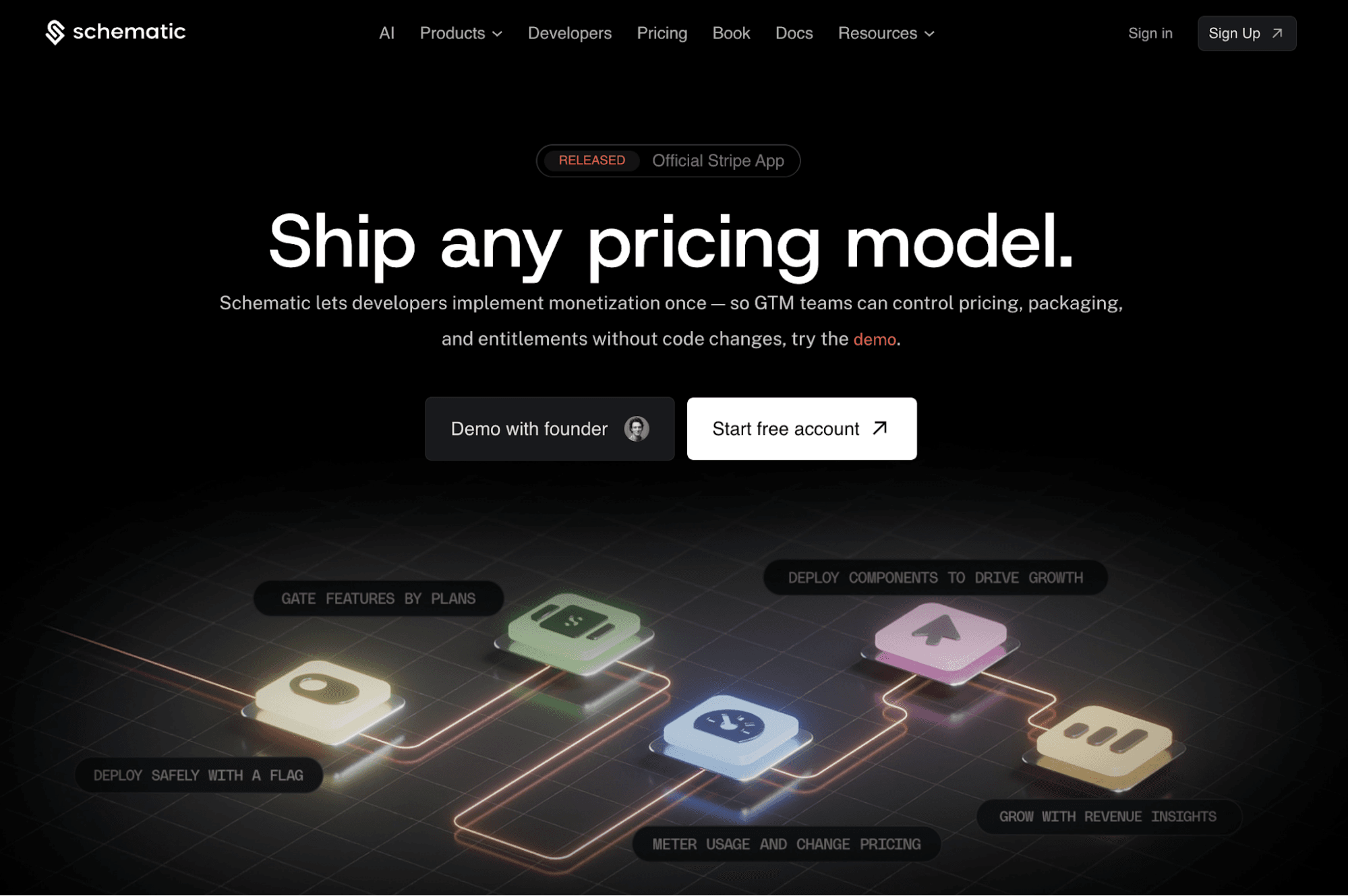
Schematic is a usage-based billing platform for software and AI companies selling to enterprises. It provides all the necessary tools to meter everything you need to monetize, from usage-heavy products to credits.
You simply need to send usage events from your product. Schematic instantly turns them into billable totals while making sure each event is only counted once. It can meter over a million events per second with support for replays and backfills.
Schematic also makes usage-based billing trustworthy and transparent. Customers can see current usage and credit balance in real time.
At the same time, they can set limits per seat or per agent, control top-up rules, and decide what happens when they reach thresholds. Hard limits deny access at the cap, while soft limits enable users to continue using the product.
When you give customers real-time visibility and control over their usage, you can close deals faster, drive expansion, and earn more revenue.
FAQs About SaaS Metering
What is SaaS metering?
SaaS metering is the process of tracking and recording how much a customer uses a software product. In usage-based billing, metering data is used to calculate charges based on actual consumption.
What is a SaaS metric?
A SaaS metric is a key performance indicator that software companies use to monitor pricing performance, customer behavior, revenue growth, and financial health.
What are the most important SaaS metrics for metering?
A reliable usage metering system relies on usage volume, frequency, velocity, and comparison between peak and average consumption. These metrics enable the system to support metered billing and optimize pricing strategies.