All posts
What Is Hybrid Billing? How It Works, Benefits, and Examples
Blog· Ryan Echternacht·Sep 2, 2026
Ryan Echternacht·Sep 2, 2026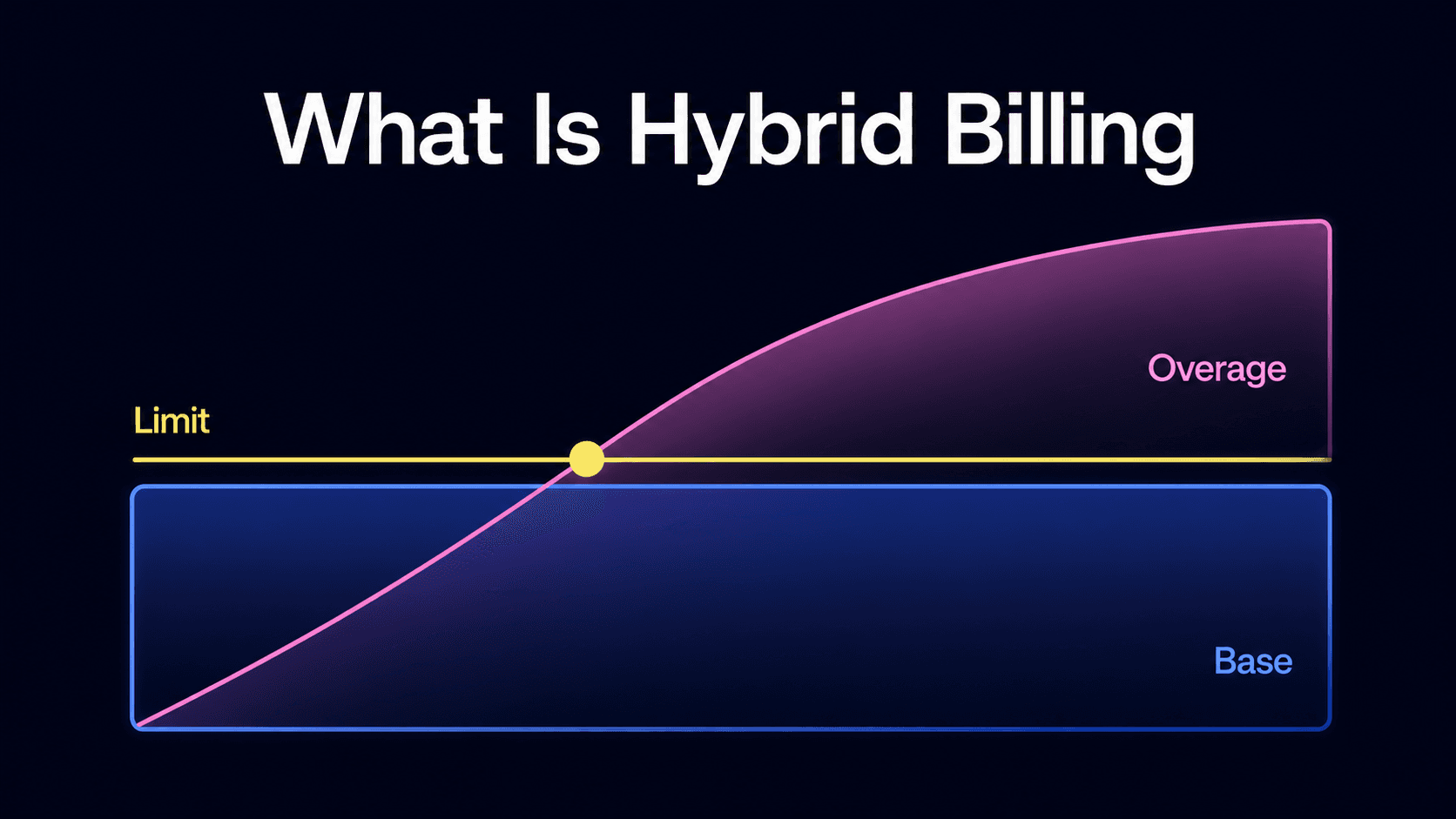
Modern monetization is starting to look more like telecom billing than traditional SaaS pricing.
Instead of charging fixed fees for software access, many AI and SaaS companies now adopt hybrid billing. According to the 2026 State of B2B Monetization report, 37% of software businesses offer a hybrid model.
Hybrid billing combines two or more pricing models in one offer, such as a platform fee with variable charges. This allows customers to pay for basic access and incur extra charges for additional usage beyond the included limits.
In this guide, we’ll explain how hybrid billing works, its benefits, and the popular hybrid models that SaaS businesses can implement.
TL;DR
- Hybrid billing combines two or more pricing models, allowing companies to charge for platform access alongside usage, credits, seats, add-ons, or one-time services.
- The process typically works by billing a recurring fee, metering usage, applying pricing rules, and translating raw product events into accurate invoices.
- The benefits of hybrid billing include revenue predictability, higher expansion revenue, stronger margin control, and flexible pricing that caters to different customer types.
- Common hybrid pricing examples include subscription plus usage, subscription plus one-time fees, per-seat plus usage, subscription plus credits, tiered pricing plus overages, and freemium plus pay-as-you-go pricing.
- Schematic helps SaaS and AI companies ship any pricing model, including hybrid billing, and enforce limits at runtime without hardcoded logic.
What Is Hybrid Billing?
Hybrid billing is a pricing model that combines multiple types of charges on a single customer account or invoice.
Most often, it includes a fixed recurring fee for base access, plus additional charges for usage, seats, AI credits, overages, add-ons, or one-time services. This enables a SaaS company to monetize both platform access and usage through a single offer.
A hybrid billing model is the opposite of static pricing. It is useful when flat fees do not reflect how customers receive value.
With hybrid pricing, teams can charge based on actual consumption, product value, and variable costs associated with different services delivered to customers.
How Hybrid Billing Works
Hybrid billing does not follow a single workflow compared to other pricing models.
A SaaS or AI company may combine subscription fees, usage-based charges, credits, seats, overage pricing, add-ons, or one-time charges in different ways. The exact setup depends on the product, cost model, customer type, and pricing plan.
In most cases, the billing system pulls usage data from the product, applies pricing rules, and sends the final charge to payment systems at the end of the billing period.
After payment processing and reconciliation, finance teams will record revenue following revenue recognition standards.
Here's what a typical hybrid billing process looks like:
- A customer chooses a subscription plan from a pricing page.
- Teams define core features, usage limits, and seats in the contract or product catalog.
- The product tracks usage, seats added, credits burned down, or add-ons purchased during the billing period.
- The billing platform calculates recurring fees, variable usage charges, and other additional fees for one-time purchases.
- All charges are consolidated into a single invoice that customers pay for.
6 Key Benefits of Hybrid Billing
Hybrid billing can benefit modern SaaS and AI businesses in several ways.
1. Improve Revenue Predictability
Pure usage-based pricing makes sense for product-led growth, but it can also lead to unpredictable revenue swings due to variable usage patterns.
Many SaaS and AI companies add a base subscription fee to reduce that risk. This creates predictable revenue from subscription plans while still allowing revenue growth from usage.
The fixed component (subscription) gives the business a steady revenue floor. It supports better cash flow, financial planning, and sales forecasting without removing the upside from increased usage.
2. Support Expansion Revenue
Hybrid billing allows revenue to grow as customers use the product more.
The variable component can be tied to credits, seats, storage, tokens, messages, projects, or transactions. When customers receive more value from the product, they are likely to use it more often. Their total bill can grow with that usage.
With hybrid pricing models, SaaS and AI businesses can also increase their revenue streams. A customer may start with a base subscription plan, then increase usage, add extra seats, or pay for premium features over time.
3. Protect Gross Margins for AI and Usage-Heavy Products
AI tools and usage-heavy platforms often have costs that increase with each action.
If high-usage customers only pay a flat fee, they can create margin pressure. Your business might end up losing money by serving existing customers.
Hybrid billing protects gross margins by adding usage-based fees for costly actions. You can bill customers for API calls, token usage, data processing, or cloud computing.
Pricing feels fair because you are charging in line with actual operational expenses. Low-usage customers pay less, while power users cover the extra cost they create.
4. Enable Flexible Pricing Strategies
A hybrid billing model provides more ways to package and price the same product.
You can test different pricing structures, such as subscriptions with overages, per-user charges, prepaid credits, or add-ons. Flexible pricing gives you more room to align price points with the product's value.
You can also easily adjust pricing strategies as the product evolves. Additional features, higher costs, or new customer needs can fit into the hybrid model without changing the entire pricing setup.
5. Serve Different Customer Segments
Not all customers want the same buying path.
Hobbyists or startups may want a free plan with room to grow. Mid-market teams might prefer higher plan limits and add-ons. Enterprise buyers often look for custom terms, commitments, or volume discounts.
Hybrid billing lets you serve a wider customer base by providing several pricing options. You can support small teams, fast-growing accounts, and large organizations without forcing everyone into one static plan.
6. Increase Customer Satisfaction and Loyalty
Hybrid billing can make pricing feel fairer when it is clear and easy to track.
Customers are charged for base access, then only pay for additional fees when they add seats, consume credits, or exceed plan limits. This can make the bill feel tied to value instead of a random price increase.
Hybrid billing also creates natural upgrade paths for existing customers. Instead of forcing a full plan change, companies can offer add-ons, credit top-ups, or extra limits.
This increases customer retention and loyalty because users can add more value over time and avoid paying for a plan that no longer fits their needs.
Examples of Hybrid Billing Models
A hybrid billing system can support several pricing strategies. Here are some popular examples.
Subscription + Usage-Based Billing
This hybrid pricing model combines a subscription plan with usage charges.
For example, a project management tool may charge $29 per month, then bill extra for additional projects created beyond the monthly limit.
A subscription plan with usage-based billing works well when customers need basic access, but usage varies by account.
The subscription fee gives the company predictable revenue. The usage-based charge helps capture expansion revenue when customers use more.
Subscription + One-Time Fee
It combines a recurring annual or monthly subscription plan with a one-time charge.
Let's say you offer a monthly platform fee for access to your SaaS product. If the customer needs help with onboarding, you can bill for that extra support.
This hybrid model suits SaaS and AI companies that provide upfront work that is not covered by the regular plan. The subscription model covers ongoing access, while the one-time fee covers special setup or services.
Per-Seat + Usage-Based Billing
In this hybrid billing model, invoices may include per-seat and usage-based charges.
A popular example is HubSpot's marketing software. Its Starter plan costs $7/month/per seat with 1,000 marketing contacts. If customers need to use more, they can purchase extra marketing contacts at any time.
Combining seat-based pricing with usage billing makes sense when the product's value comes from both team size and usage volume.
The seat fee reflects account access, while the usage charge reflects actual activity. It also helps companies avoid undercharging large teams with heavy usage.
Subscription + Credits
This hybrid model charges customers a recurring subscription fee, with each plan having a predetermined credit balance.
For example, an AI image tool may include 1,000 credits each month. Customers spend credits on image generation, edits, or exports. If they run out, they can buy more credits or upgrade to another plan with a higher credit limit.
Subscription and credit-based pricing are popular among AI companies. Instead of charging customers for raw usage events, teams offer a shared pool of credits that burn down every time a user performs an action or uses an AI-powered feature.
Tiered Pricing + Overages
This hybrid billing model provides a usage limit for each plan, then applies overage pricing when customers exceed thresholds.
For example, a SaaS platform may offer Starter, Growth, and Enterprise plans. Each tier includes a set amount of storage, events, or API calls. If the customer goes past the limit, the SaaS company charges for overage.
It works well when subscription tiers define access, but usage can still grow inside each plan.
Customers start with a clearly defined package, giving the company a way to earn variable revenue from increased usage.
Freemium + Pay-As-You-Go Pricing
In this hybrid billing model, freemium pricing gives users free access to a basic version of the application. Pay-as-you-go pricing kicks in when customers need premium features, higher usage limits, or better support.
PostHog is a popular example of a SaaS product that combines freemium with pay-as-you-go. Its product analytics tool is free to use if you process fewer than 1 million events. If you need to analyze more than 1 million events, you will pay for what you use.
This hybrid strategy supports product-led growth. It lets users try the platform before paying. Once they see value, they can move into paid usage without manual intervention from sales teams.
How to Implement Hybrid Billing
Below are some tips to implement hybrid billing successfully.
Identify Your Value Metric
First, choose the unit that best reflects customer value. For SaaS platforms, this may be seats, projects, storage, messages, or workflows. Meanwhile, AI products usually have credits, tokens, API calls, tasks, or model runs.
The right value metric should be easy to understand and tied to how customers gain value from the product.
It should also connect to your cost structure. If consumption drives your costs, your pricing should account for that usage.
Keep Pricing Simple
Hybrid pricing can quickly turn into complex billing if you add too many fees, limits, or exceptions. Keep the model clear enough for customers to understand before they buy.
Stick to a base plan with a usage allowance and clear overage rates. Avoid hidden charges or too many plan rules. If customers cannot estimate their bill, they may delay their purchase.
Build Reliable Usage Metering
Usage metering is a key component of hybrid billing models.
Make sure your billing system can track the right events, aggregate them, and translate them into accurate invoices.
Poor tracking can lead to underbilling, overbilling, surprise invoices, and loss of customer trust. Reliable usage metering prevents missed charges, billing disputes, and revenue leakage.
Give Customers Usage Visibility and Billing Updates
Customers should know their plan limits, current usage, and what they may owe without waiting for the invoice to arrive.
Give customers access to usage dashboards and self-service portals inside the product. For example, an AI platform can show credits used, current balance, and the cost of extra usage.
Clear updates reduce surprise bills and help customers make better buying choices. They also build trust because users can see how the company calculates their invoices.
Run a Pilot
Before a full launch, test the hybrid billing model with a small group of customers. Doing so helps you find pricing issues before they affect your entire customer base.
A pilot can show whether customers understand the hybrid model, whether the usage metric fits, and whether invoices match actual product usage.
You can also use the pilot to review internal billing processes before a wider rollout.
Train Teams
Hybrid billing affects more than the pricing page. Sales, support, finance, customer success, and product teams all need to understand how the model works.
Sales reps should clearly explain the pricing model when closing deals. Support teams must answer billing questions. Finance teams need to review invoices, credits, refunds, and revenue rules. Product managers should understand how access, limits, and usage tracking connect to the bill.
Training ensures each department provides consistent answers and reduces mistakes after a pricing launch.
Iterate on Pricing
Hybrid billing should improve as you learn more about customer behavior. After launch, review usage trends, customer feedback, margin impact, and sales objections.
Use advanced analytics to map pricing to customer value, product costs, and account growth. For example, you may adjust the included usage allowance, overage rates, credit rules, or plan limits based on customer needs.
The goal is to make the hybrid pricing model fair, clear, and profitable as the product evolves.
Launch Hybrid Billing Models With Schematic
As SaaS and AI pricing start to look more hybrid, teams need more than a billing platform. They need a control plane that connects pricing, usage, limits, and product access.
Schematic is the monetization operating system that helps SaaS and AI companies ship hybrid billing models without code changes. It serves as the system of record for plans, software entitlements, limits, credits, add-ons, trials, and overrides.
Schematic, built on Stripe, decouples billing state from code and enforces access in product at runtime. Commercial teams can launch and iterate on any billing model that Stripe supports. Engineering writes two calls instead of two hundred lines.
Stripe still handles payments, invoices, taxes, and revenue recognition. Schematic makes it better by providing usage metering, a full credit ledger, smart feature flags, embeddable components, and internal admin dashboards.
FAQs About What Is Hybrid Billing
What are the three types of billing?
The three common types of billing are subscription billing, usage-based billing, and hybrid billing. Subscription billing charges a fixed recurring fee. Usage-based billing charges by actual product consumption. Hybrid models combine two or more pricing models, such as subscription plans with usage billing.
What does hybrid pricing mean?
Hybrid pricing means a business combines two or more pricing models in one invoice or plan. For example, a SaaS company may charge a base subscription plus usage fees, credits, or overages based on customer activity.
What are the benefits of using hybrid contracts?
Hybrid contracts help companies balance steady revenue with usage growth. They can support different customer segments, protect gross margins, and allow teams to refine pricing as product usage, costs, and customer needs change.