All posts
8 Best Enterprise Subscription Management Software in 2026
Blog· Ryan Echternacht·Sep 20, 2026
Ryan Echternacht·Sep 20, 2026
Modern SaaS subscriptions are no longer limited to a flat monthly fee per seat. Companies now charge subscribers for variable usage, sell AI credits, offer paid add-ons, and bill for outcomes. They also offer custom plans, renewal terms, and exceptions for enterprise accounts.
As pricing gets more complex, managing subscriptions in spreadsheets and disconnected systems can lead to errors, inefficiencies, and compliance risks.
An enterprise subscription management platform can unify the entire quote-to-cash process. It helps SaaS teams handle complex subscription pricing models, invoices, contracts, billing data, payments, and revenue recognition in one place.
This article discusses the best enterprise subscription management software worth considering. We'll also cover the benefits and the best practices to implement for success.
TL;DR
These are the best subscription management tools designed for enterprises:
- Stripe Billing
- Metronome
- Chargebee
- Recurly
- Zuora
- Maxio
- Paddle
Top 8 Enterprise Subscription Management Software in 2026
Below is a detailed review of the best enterprise subscription management software.
1. Schematic + Stripe
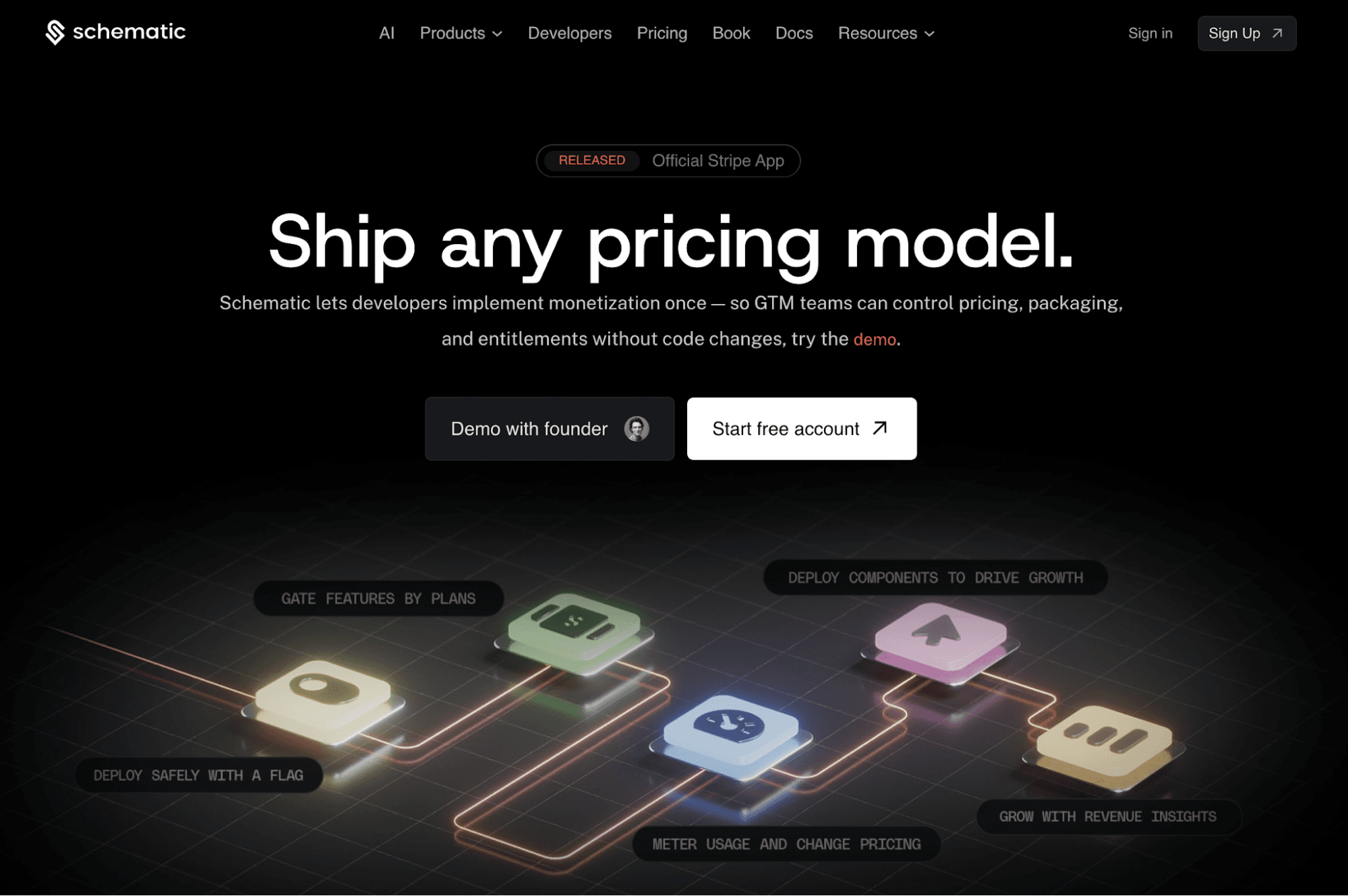
Schematic combines subscription management and feature management in a single monetization operating system. It decouples pricing and billing logic from the application, making it easier to enforce plans, limits, and usage without code changes.
Schematic integrates bi-directionally with Stripe to handle subscription billing. You can quickly import customers, subscriptions, products, and prices. Then, map those to company profiles and software entitlements directly in Schematic.
Each company profile shows subscription details, company keys, traits, usage, limits, and feature access on one scrolling page.
Entitlements, on the other hand, provision or revoke access to the product based on what the customer has purchased.
Schematic also provides customer self-service portals and other drop-in billing components. Users can manage their subscriptions, purchase add-ons, view invoices, change payment methods, and track usage against plan limits.
Schematic automatically syncs changes to Stripe and updates entitlement logic. This eliminates the need to build and maintain custom webhook logic for each change. You can ensure in-product access lines up with subscriptions.
Key Features
- Native Stripe app: Manage entitlements, plans, overrides, and subscriber lifecycle directly in Stripe.
- Unified product catalog: Create subscription plans, launch trial pricing, grant credits, bundle or unbundle features, enforce limits, and manage exceptions in one place.
- Customer profile: View company keys, subscriptions, traits, and usage from a single scrolling page.
- Feature access control: Allow or block access to features based on each customer’s plan, usage, or contract terms.
- Drag-and-drop component builder: Build a flexible customer portal, usage dashboard, and pricing table without writing code.
- Usage-based pricing: Monetize products using any usage-based pricing model, such as pay-as-you-go, volume pricing, graduated pricing, and credit burndown.
- Standalone migrations: Move customers between existing plan versions.
- Revenue insights: Identify accounts that are overusing, underpaying, likely to expand, or at risk of churn.
- Built-in integrations: Connect Schematic to Stripe, Segment, Clerk, WorkOS, Salesforce, and HubSpot.
- SOC 2 and GDPR compliance: The platform meets SOC 2 (Type 1 and Type 2) and GDPR compliance requirements.
Pricing
Schematic offers three pricing plans that cater to different SaaS and AI companies.
- Starter (free): Create one custom plan, handle 10 subscriptions, and meter up to 500k usage events per month. You can also manage unlimited plans, environments, companies, flags, and billing components for free.
- Growth ($200/month): Get everything in Starter plus five custom plans, 100 subscriptions, 20 overrides, and support for 10m monthly events.
- Enterprise (custom pricing): Gain access to unlimited custom plans, subscriptions, company overrides, and usage events. You can also enjoy premium support.
Businesses can also purchase the Teams add-on ($500/month), which allows their team to use unlimited company overrides and webhooks.
2. Stripe Billing
Source: Stripe.com
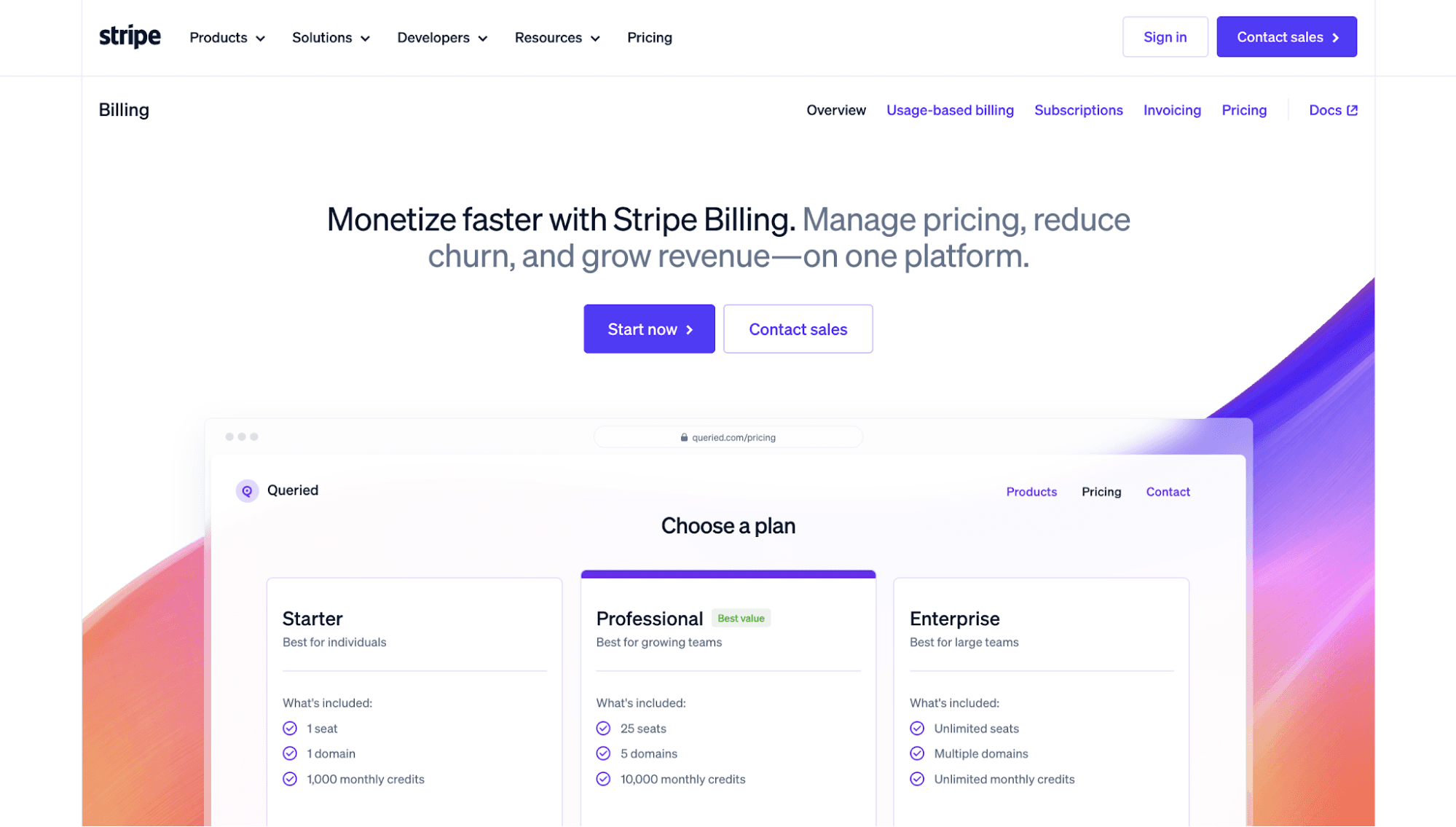
Stripe Billing helps enterprise companies manage recurring revenue streams and build the right subscription pricing model.
Teams can launch products using no-code pricing models or write custom logic inside Stripe. The platform supports flat-rate, seat-based, tiered, and usage-based billing.
When a company creates a subscription, Stripe automatically generates invoices, collects recurring payments, and manages each stage of the subscriber lifecycle.
It also offers multiple payment methods and supports multi-currency billing. It can even simplify sales tax calculations using the built-in global tax tools.
If a payment fails, Stripe helps businesses recover revenue through intelligent payment retries, automated dunning flows, and a card account updater.
On top of these capabilities, Stripe provides centralized analytics to track monthly recurring revenue (MRR), churn, subscription failure rates, and other key metrics.
Key Features
- Support for subscription pricing models: Implement flat-rate, per-seat, tiered, usage-based, and hybrid pricing using no-code tools or custom logic.
- Automated invoicing: Create and send invoices based on each customer’s subscription terms and billing schedule.
- Payment collection and retries: Collect recurring payments and use Smart Retries, dunning emails, and card updates to recover failed charges.
- Tax management: Calculate sales tax, VAT, and GST automatically with Stripe to ensure global tax compliance.
- Billing analytics and benchmarks: Track MRR, churn, and subscription failures, then compare results with similar businesses.
Pricing
Stripe Billing offers pay-as-you-go pricing for flexibility and a monthly plan for predictability.
- Pay-as-you-go (0.7% of billing volume): Companies with low or unpredictable billing volume can pay for only what they use.
- Pay monthly (starts at $620/month): Enterprises that exceed $100,000 in monthly billing volume can pay for a subscription tier that works for their business.
3. Metronome
Source: Metronome.com
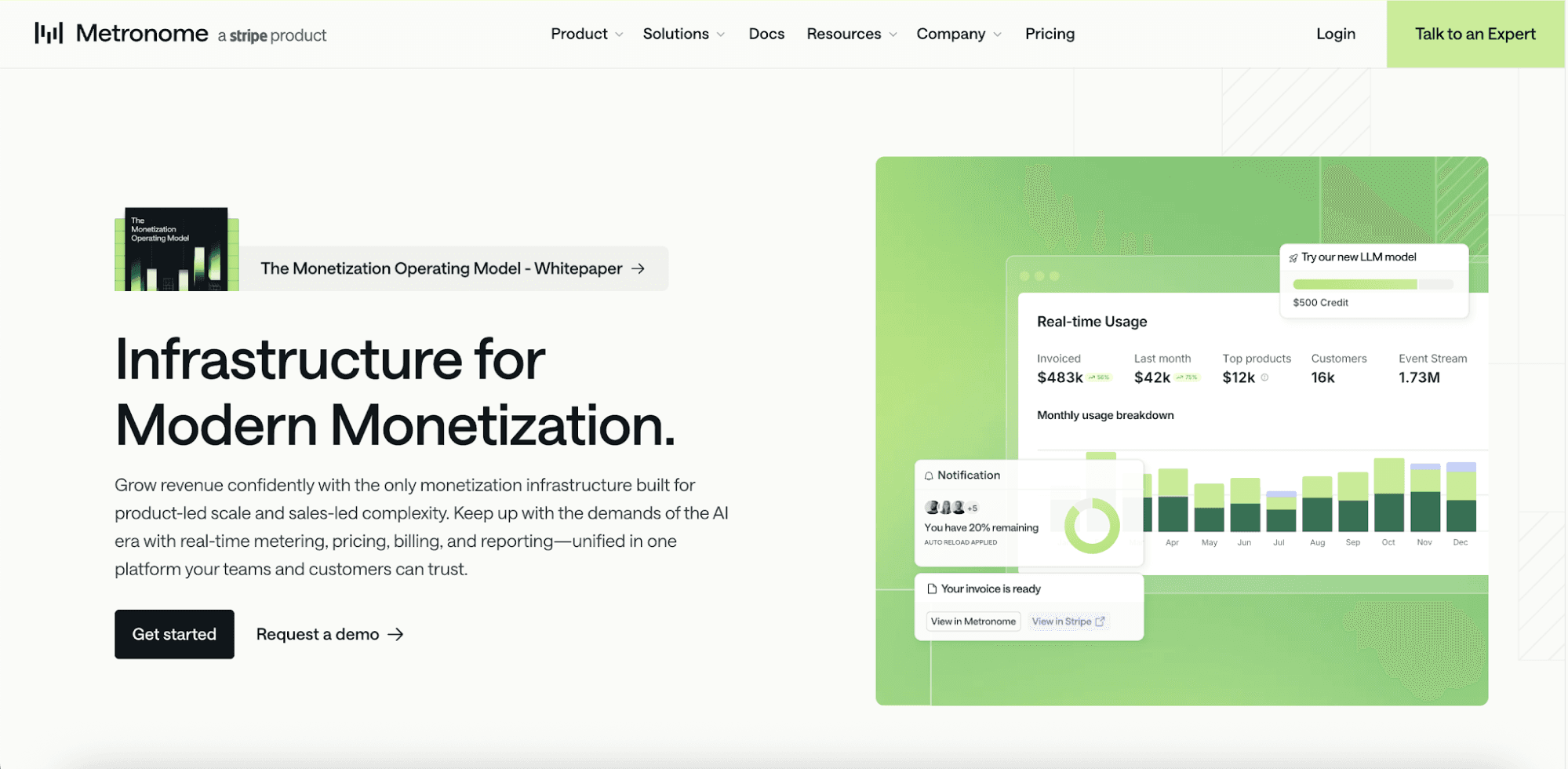
Metronome is known for its usage-based billing platform, but it can still support subscriptions as a product type.
B2B SaaS companies can charge recurring fees for platform access, seat-based pricing tiers, and hybrid plans that combine subscriptions with usage.
With Metronome, teams create one product for each subscription plan, such as Basic, Pro, and Enterprise. They can also add rates for each standard price.
A single product can map to several rates. This allows the company to offer monthly, quarterly, and annual billing for the same plan.
Metronome also supports contracts, which set the quantity, billing cycle, proration rules, and payment collection schedule. It can collect payments in advance or in arrears.
Metronome can even store subscription pricing details in one rate card. To update a plan’s price, teams simply edit the related subscription rate instead of changing each customer contract. Existing contracts will reflect the new pricing at the start of the next billing period.
Key Features
- Custom contracts: Set discounts, overrides, amendments, proration rules, and payment collection schedules for each customer.
- Centralized rate cards: Manage subscription pricing elements and contract terms from a single source of truth.
- Usage metering and billing: Ingest raw usage events at scale and translate them to accurate invoices.
- Pricing levers: Build per-seat, usage-based, credit-based, tiered, and custom pricing rules for different go-to-market strategies.
- In-app reports: Make strategic pricing decisions using real-time billing and revenue data.
Pricing
Metronome's pricing is built to scale with any business.
- Starter (free): Includes usage metering, alerting, billing dashboards, native Stripe integration, and support for different pricing models.
- Custom (custom pricing): Offers everything in Starter plus invoicing integrations, data exports, priority support, and access to a dedicated account manager.
4. Chargebee
Source: Chargebee.com
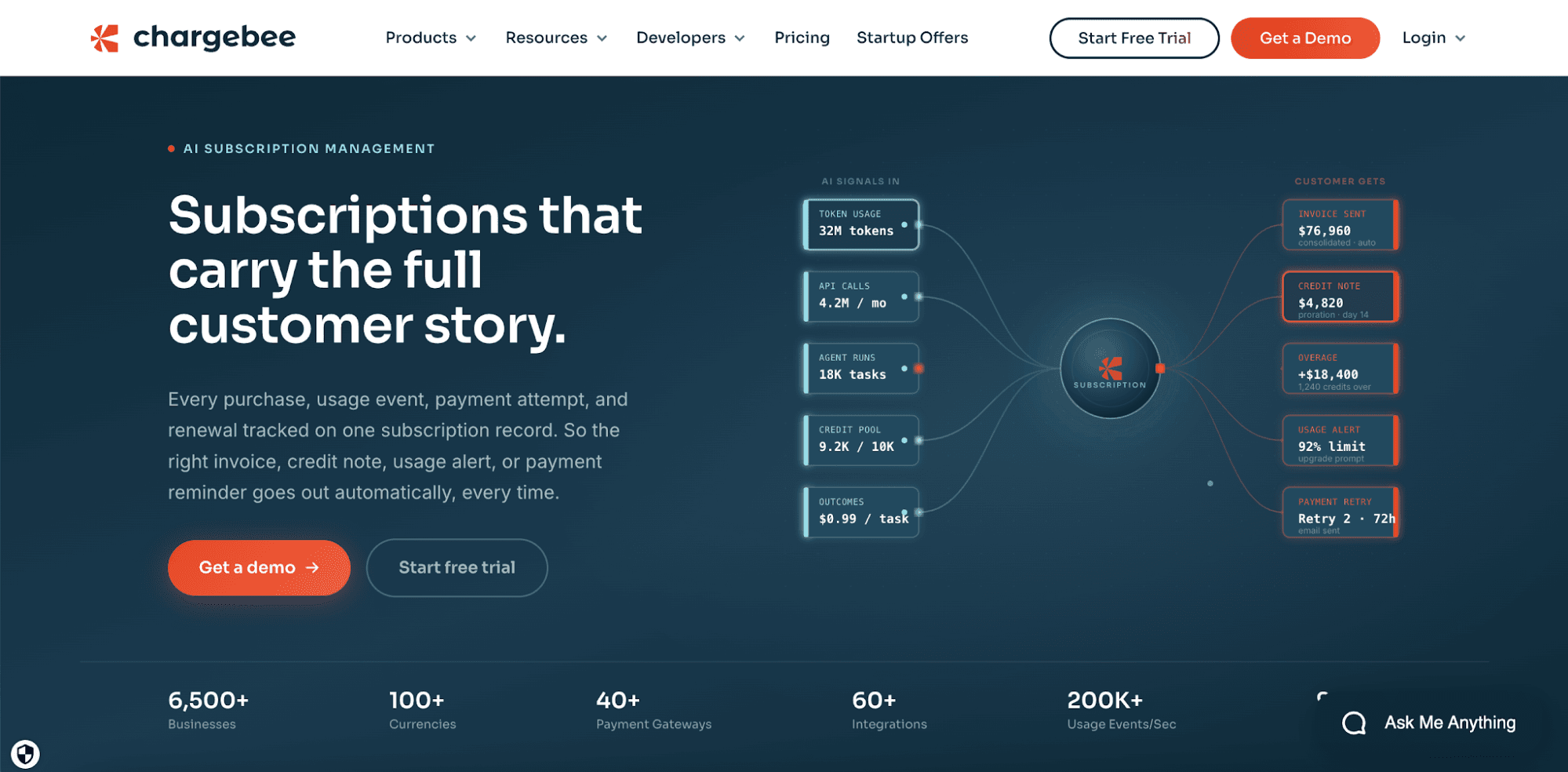
Chargebee manages the entire subscription lifecycle for SaaS and AI companies. It supports multiple pricing models, including flat-rate, seat-based, usage-based, and hybrid pricing, from one subscription management platform.
Enterprise teams can launch new plans, test packaging, and manage complex billing scenarios without changing the application code.
Chargebee automatically handles upgrades, downgrades, proration, pauses, renewals, and other mid-cycle changes. It calculates each charge and generates an accurate invoice without manual intervention. It also allows customers to manage their active subscriptions through a self-service portal.
For failed payments, Chargebee can run dunning sequences, smart retries, and accounts receivable (AR) workflows across multiple payment gateways.
Plus, automated revenue recognition capabilities ensure compliance with ASC 606 and IFRS 15. Finance teams can close books faster without spreadsheet reconciliation.
Key Features
- Product catalog: Define product families, subscription plans, price points, add-ons, and coupons in one place.
- Subscription lifecycle management: Automate onboarding, mid-cycle changes, subscription pauses, plan renewals, and win-back flows.
- Payment recovery tools: Use smart retry logic and dunning sequences to recover failed charges before they affect monthly or annual recurring revenue.
- Automated revenue recognition: Chargebee automatically creates ASC 606-compliant and audit-ready exports for accurate revenue reporting.
- Revenue analytics: Track MRR, ARR, churn, deferred revenue, and subscription health from one data source.
Pricing
Chargebee sells products at different price points. The subscription billing platform offers three pricing plans:
- Starter (free for the first $250k of cumulative billing, then 0.75% on billing volume): Supports flexible billing models, usage aggregation, hosted payments, a self-service portal, and limited payment gateway integrations.
- Performance (starts at 7,188/year): Includes advance invoices, smart dunning features, engineering consultation, and migration support.
- Enterprise (custom pricing): Covers everything in Performance plus account hierarchy, multi-entity support, on-demand discounts, and custom contract terms.
5. Recurly
Source: Recurly.com
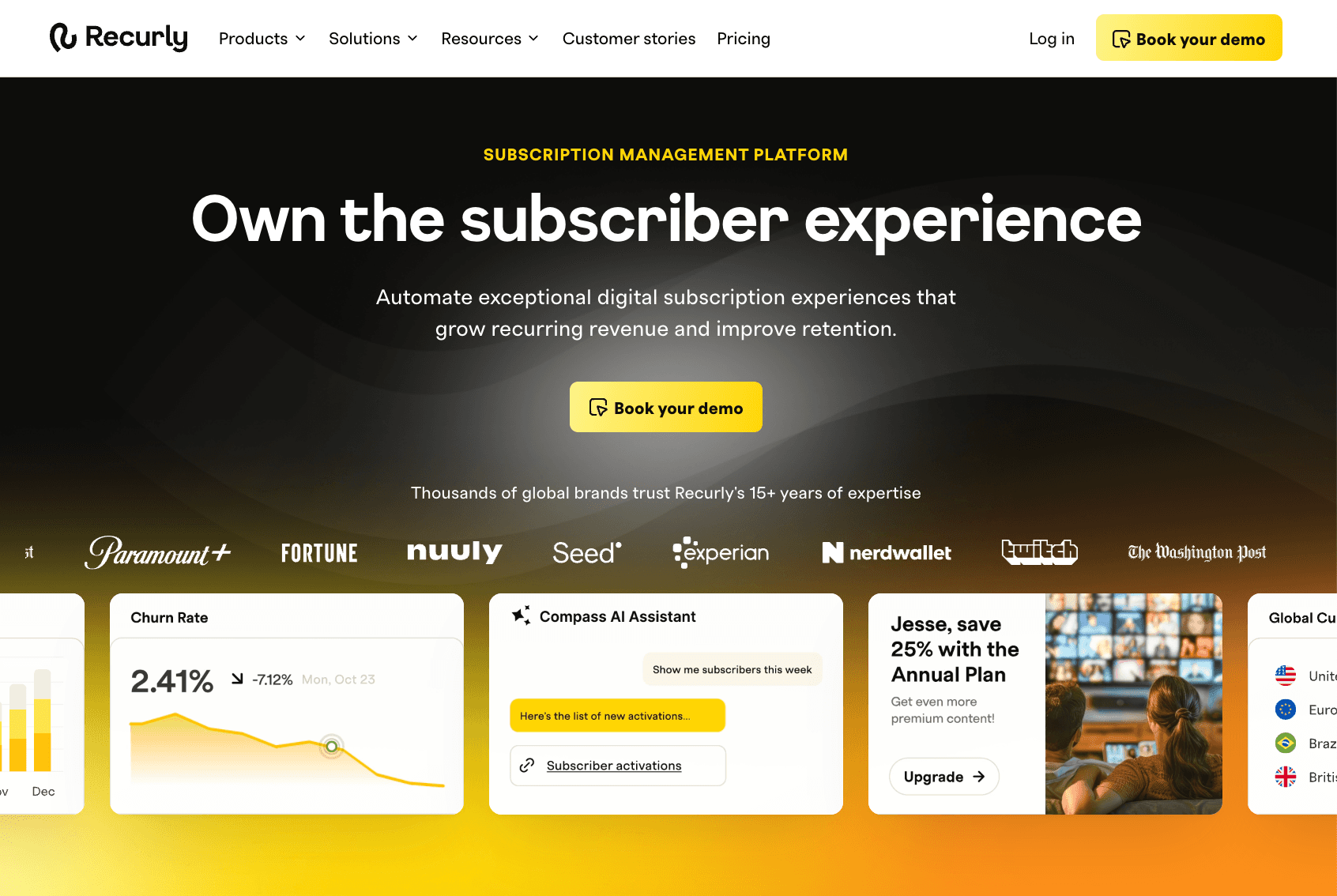
Recurly supports subscription management, recurring billing, payments orchestration, compliance, and churn prevention in one place.
Enterprises can quickly set up plans, pricing, promotions, free trials, coupons, and product bundles for different customer groups.
Recurly provides a unified view of all subscribers and subscription services. This makes it easier to track active, paused, canceled, and expired plans. It can also handle complex parent/child accounts through account hierarchy billing.
Built-in communication tools can engage subscribers at each stage of their journey. Deliver personalized emails to build stronger customer relationships and increase retention.
Recurly even offers global payment method support, fraud management, and revenue recovery tools. These help SaaS companies maximize profitability while preventing revenue leakage.
Key Features
- Subscriber lifecycle management: Manage subscriber records, account hierarchies, and customer communication.
- Automated recurring billing: Eliminate manual billing tasks by automating invoice generation, tax calculation, and credit adjustments.
- Payments orchestration: Route transactions through supported gateways and global payment methods to improve payment success.
- Revenue recovery tools: Use the account updater and intelligent retries to recover failed payments.
- Reporting and analytics: Review subscriber acquisition rates, customer retention, subscription revenue per user, and other key metrics to improve pricing strategies.
Pricing
Recurly offers three subscription products at varying prices.
- Starter ($249 per month + 0.9% of billing volume): Includes global subscription billing automation, one dunning campaign, 10 payment methods, 20 payment gateways, flexible pricing, and churn prevention tools.
- All-Access (as low as <1% of billing volume): Adds AI-powered agents, multiple dunning campaigns, additional payment methods, advanced plans, custom reporting, and single sign-on.
- All-Access for Shopify (as low as <1% of billing volume): Connects directly to Shopify and offers prepaid subscriptions, gifts, custom bundles, hybrid subscription support, surveys, and passwordless login.
6. Zuora
Source: Zuora.com
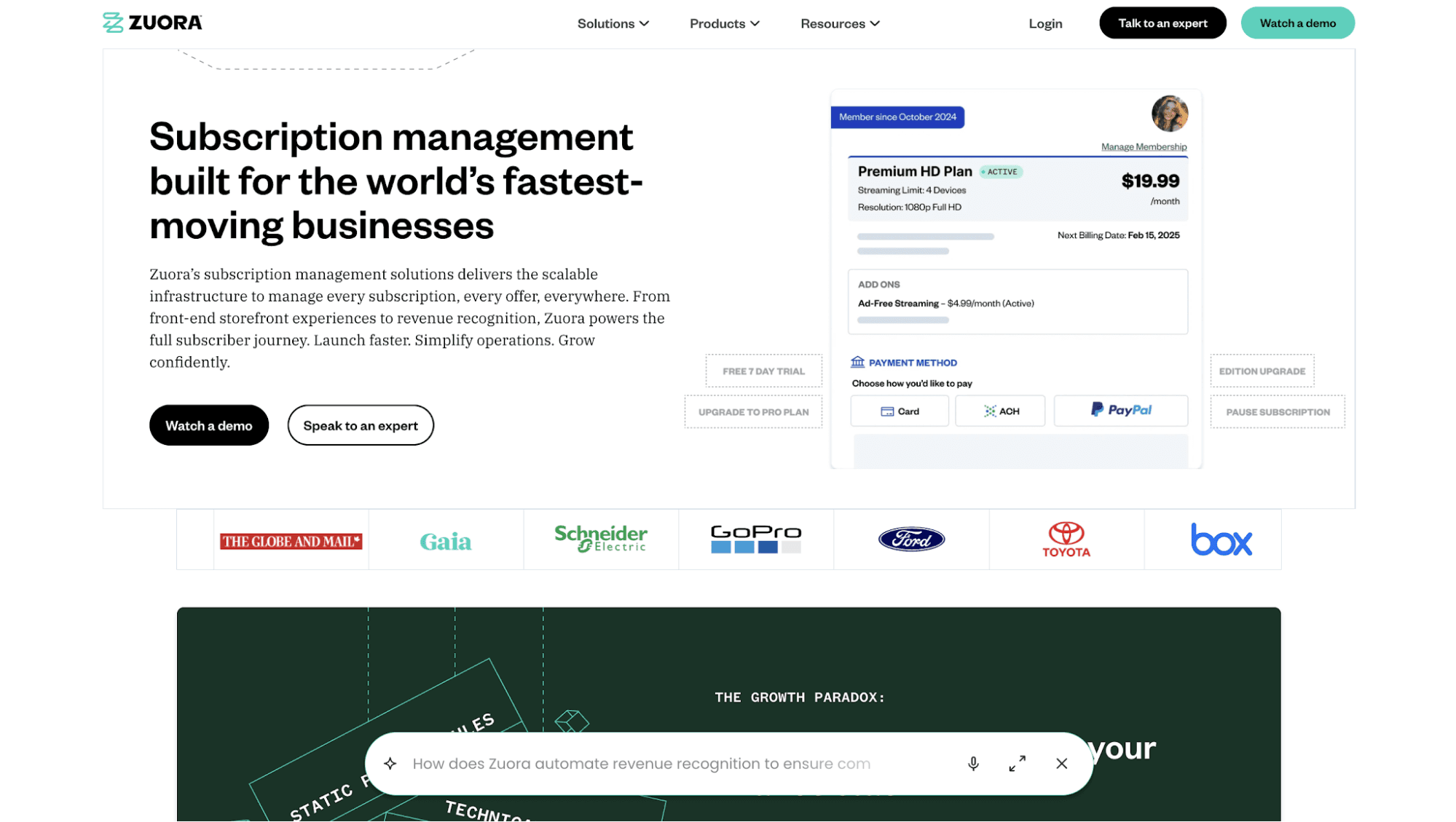
Zuora is an enterprise subscription management platform designed for fast-moving companies. It connects front-end experience to back-end accuracy to ensure seamless monetization implementation.
SaaS teams can quickly update pricing, enter new markets with confidence, launch new subscriber experiences, and deliver dynamic offers without custom dev work.
Zuora supports different subscription types, including fixed recurring plans, tiered pricing, usage-based billing, hybrid subscriptions, and freemium pricing.
The subscription platform also automates billing at scale. It keeps every invoice, plan adjustment, and renewal aligned with subscription logic.
Revenue recognition instantly ties to subscription events. This helps finance teams ensure accurate reporting and compliance.
Key Features
- Monetization catalog: Launch new offers, bundles, and promotions without touching code.
- Unified quote-to-cash process: Connect quoting, billing, payments, and revenue recognition in one system.
- Flexible pricing: Support flat-fee, usage-based, one-time, volume pricing, and hybrid models.
- Automated billing system: Replace manual processes with automated invoicing, subscription management, and payment processing.
- Revenue recognition support: Link subscription events to real-time revenue schedules and compliance reporting.
Pricing
Zuora's pricing varies based on the products or modules selected.
7. Maxio
Source: Maxio.com
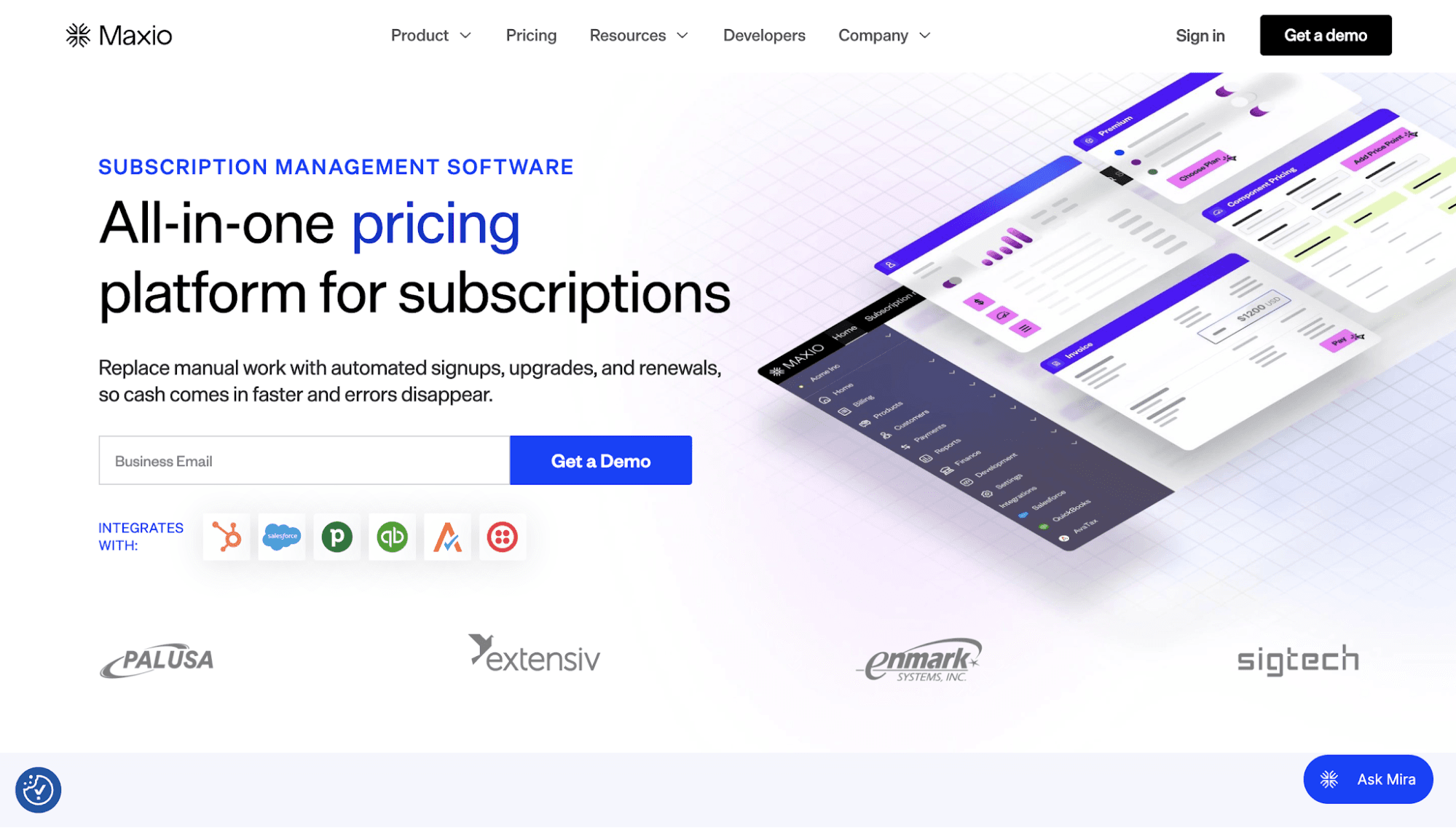
Maxio automates billing processes, invoice creation, and subscription management to improve cash flow and reduce errors.
Customers receive recurring invoices on schedule without manual follow-ups. They can choose from multiple payment methods and pay using their preferred currency.
Maxio can also alert the relevant teams to follow up with customers before their subscription ends. Customizable dunning strategies and reminder emails also help prevent involuntary churn.
Meanwhile, a self-serve billing portal lets existing customers upgrade, downgrade, cancel, change payment methods, and manage subscriptions without contacting support.
Plus, Maxio provides real-time visibility into MRR and churn. It helps SaaS teams identify trends and forecast future revenue growth.
Key Features
- Customizable subscription models: Create custom contracts, plans, or individual subscriptions for your products.
- Automated billing and invoice creation: Meter usage, generate recurring invoices, and collect payments using multiple payment gateways.
- Subscriber lifecycle management: Calculate prorated charges during mid-cycle changes, send follow-up emails before contracts expire, and run dunning workflows.
- Self-serve billing portal: Give customers the ability to manage subscriptions on their own.
- Built-in reporting: Track key metrics, generate financial reports, and visualize trends through interactive dashboards.
Pricing
Maxio keeps its pricing page simple with two plans.
- Grow ($599/month): Offers subscription management, automated billing, payment processing, standard one-click financial reports, revenue recognition, and AR management.
- Scale (custom pricing): Includes advanced features, usage metering, expense amortization, multi-entity support, and optional modules.
8. Paddle
Source: Paddle.com
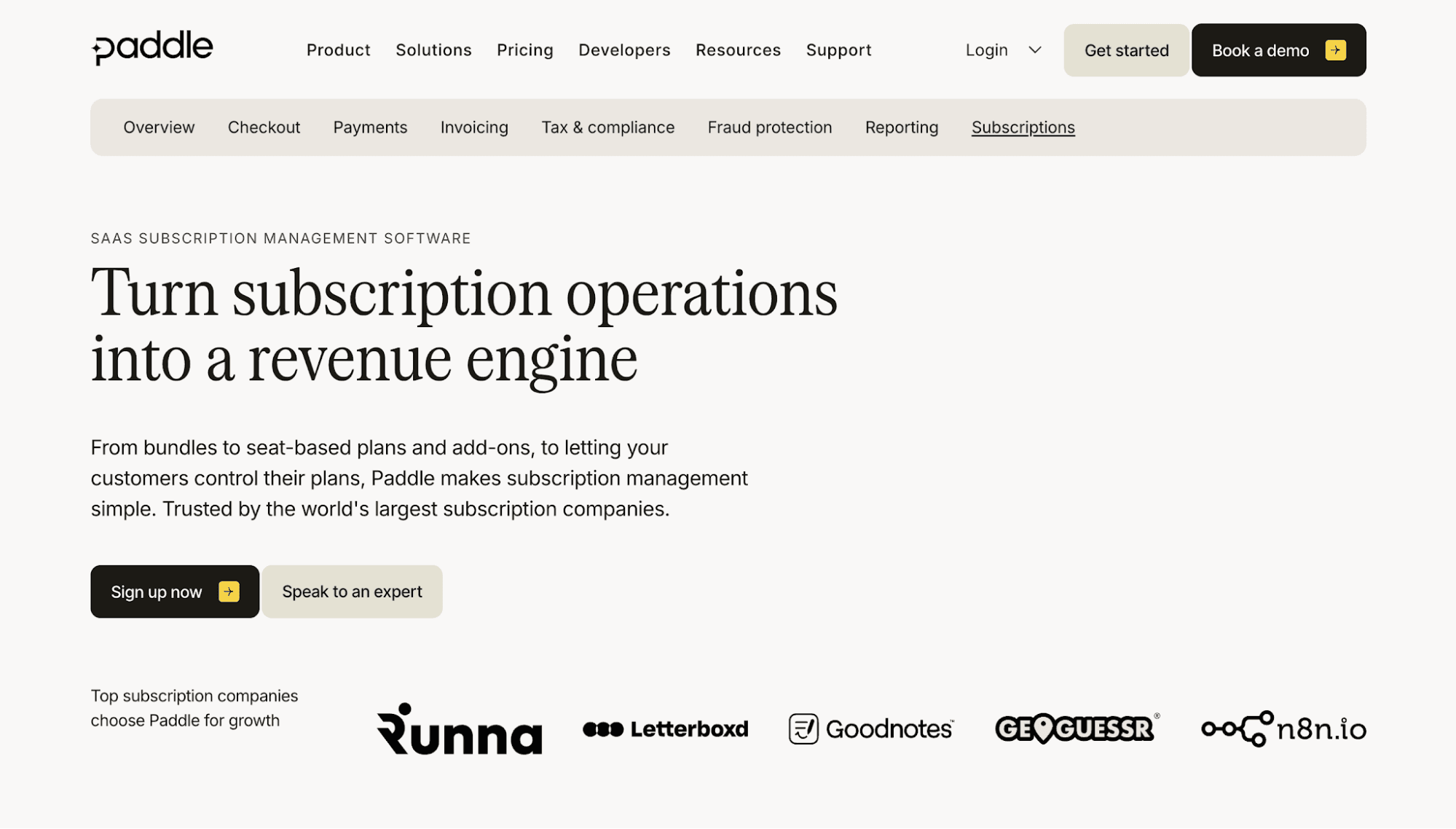
As a merchant of record for SaaS companies, Paddle handles subscriptions, payments, sales tax, fraud, and billing across global markets. Enterprise teams can sell in different regions and focus on product development without worrying about tax compliance.
It offers a flexible subscription management platform that supports any selling motion. Businesses can monetize products using flat-fee, multi-seat pricing, or paid add-ons.
Paddle automatically calculates prorated payments when customers change their subscription plan in the middle of the billing cycle. It also gives users the ability to pause their accounts (instead of canceling them) and reactivate them once they're ready to use the product again.
On top of these capabilities, Paddle provides access to an extensive subscription dataset. It allows companies to compare performance with other organizations and identify growth trends.
Key Features
- Tax and compliance management: Paddle handles tax for every transaction, so you no longer need to worry about compliance.
- Automatic proration: Calculate prorated charges when customers change plans, products, or quantities mid-cycle.
- Benchmarking data: Compare results against revenue and customer data from 40,000 SaaS subscription companies.
- Subscription pause and reactivation option: Prevent customer churn by allowing users to pause their plan at any time.
- Payment routing and fraud protection: Paddle chooses the right payment gateway and protects every transaction from fraud.
Pricing
Paddle offers an all-inclusive price for its products.
- Pay-as-you-go (5% + $0.50 per transaction): Combines billing and global payments with protection against fraud and chargebacks.
- Custom pricing: Suits scaling businesses and established enterprises that need custom migration services, implementation support, and premium services.
Key Benefits of an Enterprise Subscription Management Platform
Here are the advantages of using the right subscription management software for your enterprise business.
Simplify Revenue Operations and Financial Reporting
Enterprise subscription management software provides a single source of truth for products, contracts, customer profiles, plans, invoices, and payments.
It reduces manual handoffs between billing tools, customer relationship management (CRM) systems, spreadsheets, and accounting software.
Finance teams can collect payments faster, close the books more efficiently, review deferred revenue, and trace changes back to the correct contract. They spend less time checking mismatched records or fixing invoice errors at month-end.
Reduce Involuntary Churn and Prevent Revenue Leakage
Customers may lose access to your product even when they want to keep paying. Expired cards, blocked transactions, bank errors, and missed invoices can all cause unwanted cancellations.
According to Baremetrics, around 9% of monthly recurring revenue could be lost to failed payments.
A good subscription management software can detect payment failures and start recovery steps right away.
Enterprise teams can set retry logic, send payment reminders, let customers update their card details, and offer grace periods before blocking access.
Automated payment recovery workflows reduce involuntary churn and prevent revenue leakage. They also lower the workload for support and finance teams, since fewer cases need manual follow-up.
Ensure Accurate Revenue Forecasting
Large SaaS companies need a clear view of renewals, upgrades, cancellations, usage charges, and contract end dates.
Subscription management software consolidates these records, enabling finance teams to build forecasts based on current customer activity rather than outdated spreadsheets.
The platform can also separate committed fees from variable usage and show how subscription changes may affect future growth. It provides a more accurate view of predictable recurring revenue while still accounting for expansion.
Boost Profitability Through Upselling and Cross-Selling
An enterprise subscription management platform shows how each customer uses the product, which features they have, and when they may hit plan limits. Sales and customer success teams can use this information to find accounts that are ready to expand.
The system can then trigger upgrade prompts, recommend add-ons, or alert account owners when a customer is better suited for a higher tier. These offers feel more relevant because they connect to actual product activity.
Effective upselling and cross-selling strategies can increase revenue from current accounts and raise customer lifetime value. It also reduces dependency on new customer acquisition for growth.
Support Flexible Pricing
Enterprise customers often need more than one fixed monthly plan. They may ask for extra seats, higher usage limits, prepaid credits, volume discounts, annual commitments, add-ons, or custom contract terms.
A subscription management platform helps companies ship pricing and packaging changes without a billing rebuild. This makes it easier to test new offers and support both product-led growth and sales-led contracts.
Teams can offer multiple pricing tiers while still providing custom terms for larger accounts. They can also combine recurring fees with usage-based charges or set different rates by region, contract length, or customer segment.
Improve Customer Experiences
Customers expect billing information to be clear and simple to manage.
Good subscription management software offers a self-service portal where users can view invoices, change payment methods, update seat counts, add more products, or cancel a plan.
Meanwhile, usage dashboards can show how much of a limit or credit balance remains. These help customers avoid surprise charges and give them enough time to adjust their plan before reaching a cap.
Runtime entitlement enforcement is also important. When a customer upgrades to a higher tier or purchases an add-on, their access inside the product should change right away. It reduces support requests and ensures a smoother billing experience.
Best Practices for Enterprise Subscription Management
Here are the best practices you can implement to ensure successful enterprise subscription management.
Automate Complex Billing Scenarios
Configure your enterprise subscription management software to automate recurring charges, credit enforcement, discount management, seat changes, and overage pricing. This is especially important when you offer usage-based pricing or combine subscriptions with metered billing.
You should also automate each proration calculation when customers upgrade, downgrade, or pause subscriptions in the middle of a billing cycle. Define how the system should handle refunds and partial charges.
Maintain Clear Plan Versioning
Keep a separate version of every subscription plan, price, feature set, and limit you release. Do not overwrite old plan terms when you introduce new pricing. Customers should remain on the version they purchased unless they agree to move.
Record the start date, billing rules, included features, and usage limits for each version. Add notes that explain why a change was implemented and who approved it. This gives product, sales, finance, and support teams a shared record.
Clear plan versioning also helps your SaaS company manage grandfathered contracts without creating hidden exceptions.
Integrate With Your Existing Tech Stack
Make sure your subscription management tools integrate with your accounting systems, CRM software, data warehouses, and payment solutions.
Map how data moves between systems and what happens when a sync fails. Use webhooks or APIs to send updates without delay.
It's also important to generate audit logs so that teams can trace missing or conflicting records.
Well-planned integrations reduce manual data entry and help each department act on the same subscription, billing, and customer data.
Monitor Key SaaS Metrics
Track metrics that show how subscriptions change over time. Review annual or monthly recurring revenue, churn, expansion, renewal rates, and average revenue per account. Compare these figures by plan, customer segment, region, and sales channel.
Pay close attention to net revenue retention because it shows whether expansion from current accounts offsets churn and downgrades.
Then, connect financial reports with product usage to help you see which plans drive adoption and growth.
You can even set up alerts for monetization events, such as payment failures or an account nearing its limits. These will notify sales and support teams to act before a customer churns.
Iterate on Pricing and Packaging
Software pricing shouldn't be static. Change SaaS pricing and packaging regularly to meet new customer needs, ensure product value alignment, and keep up with market expectations.
Test one change at a time, such as a new add-on, credit bundle, usage limit, or annual discount. Use feature flags to manage software releases. Then, gather customer feedback or analyze in-product behavior to evaluate performance.
The most successful enterprise companies iterate on pricing frequently and use it as a growth lever.
Manage Subscriptions, Pricing, and Access With Schematic
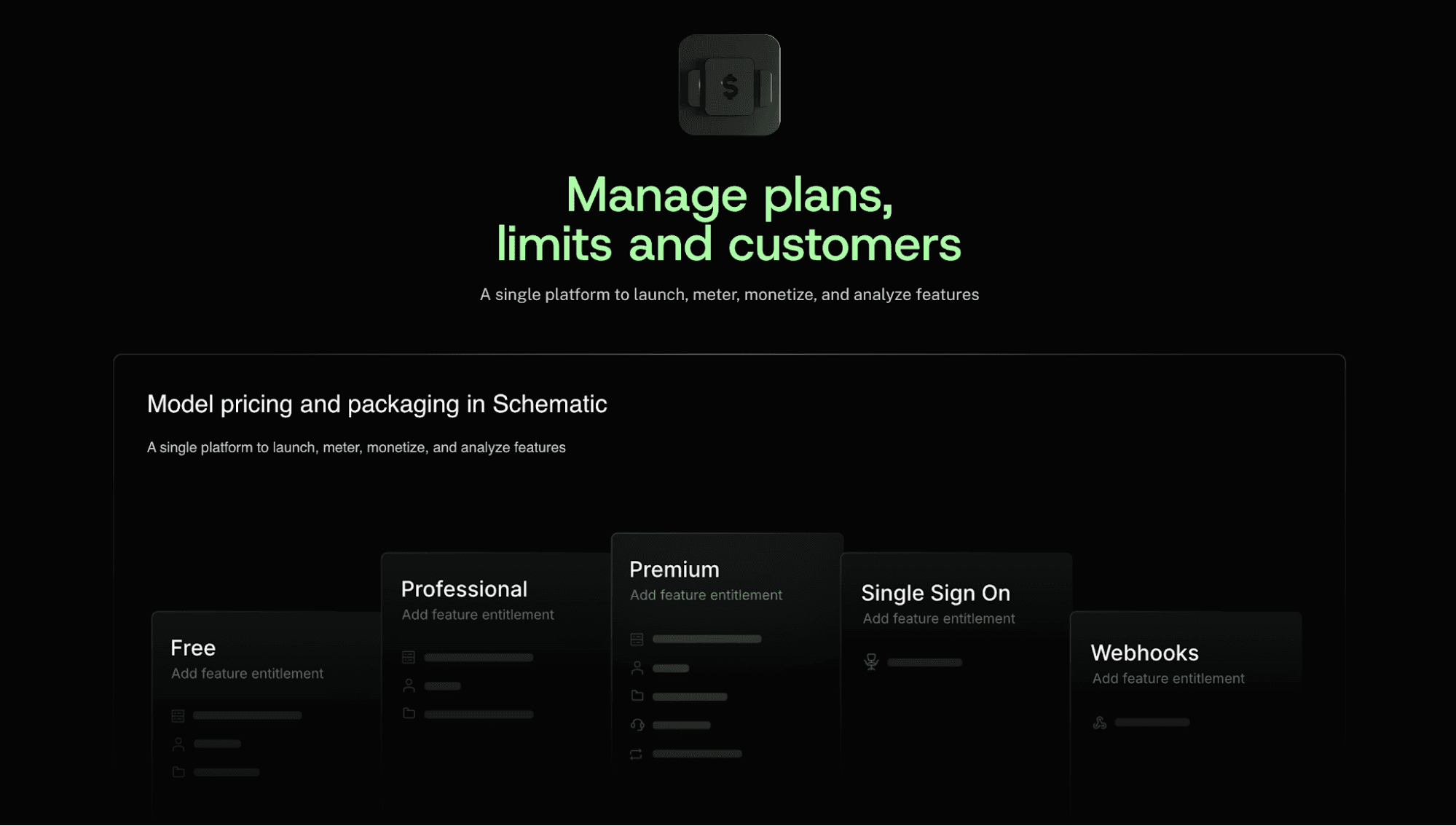
Schematic offers a monetization control plane for subscription plans, SaaS entitlements, limits, trials, credits, add-ons, and customer exceptions. It connects what customers buy with what they can use inside the product.
It supports any pricing model, including subscription, seat-based, usage-based, credit burndown, and hybrid pricing.
By decoupling billing logic from the application, Schematic allows product teams to change packaging, feature access, usage limits, and enforcement rules without waiting for developers.
Go-to-market teams can quickly launch trials, grant exceptions, sell add-ons, and close custom deals while staying aligned with what the product actually allows.
Engineering, on the other hand, stops writing billing and entitlement code. Schematic enforces in-product access at runtime based on the customer's subscription state.
FAQs About Enterprise Subscription Management
What is enterprise subscription management?
Enterprise subscription management is the process of handling plans, billing, payments, renewals, usage, entitlements, and account changes. It helps large SaaS companies keep subscription records, product access, and revenue operations aligned.
What is the difference between recurring billing and subscription management software?
A recurring billing platform charges customers on a set schedule. Subscription management software covers the entire customer lifecycle, including sign-ups, upgrades, downgrades, renewals, cancellations, and reactivation. It also handles subscription pricing, usage metering, financial reporting, and revenue recognition.
How does enterprise subscription management software support revenue operations teams?
Enterprise subscription management software gives RevOps teams a unified view of products, subscriptions, contracts, pricing, limits, and contract terms. Teams can reduce manual reconciliation, automate complex billing scenarios, and forecast future revenue growth more accurately.