 Ryan Echternacht
Recurly and Zuora are among the most popular billing software for subscription businesses. Both help companies handle recurring billing, manage subscriptions, and track revenue.
At first glance, these platforms may seem similar. But they are built for different types of teams and use cases.
Recurly is known for its automated dunning and billing capabilities, helping growth-stage companies launch pricing fast.
Zuora, on the other hand, focuses on revenue recognition and compliance. It supports enterprise customers handling complex billing scenarios at a larger scale.
In this comparison guide, we'll break down the key differences between Recurly and Zuora. We'll also explain their limitations and why you should consider other alternatives when pricing becomes complex.
TL;DR
- Both Recurly and Zuora handle recurring billing and subscriptions, but they are built for different levels of complexity and scale.
- Recurly suits mid-market businesses that want fast setup, flexible subscription management, and strong dunning management capabilities.
- Zuora makes sense for enterprises with complex billing models, global operations, and revenue recognition needs.
- Recurly and Zuora offer powerful billing solutions, but both fall short when pricing starts to affect access inside the product.
- Schematic fills that gap by turning billing data into real-time access control, usage enforcement, and customer lifecycle management.
What Is Recurly?
Recurly is one of the best subscription management software and billing systems for subscription-based businesses.
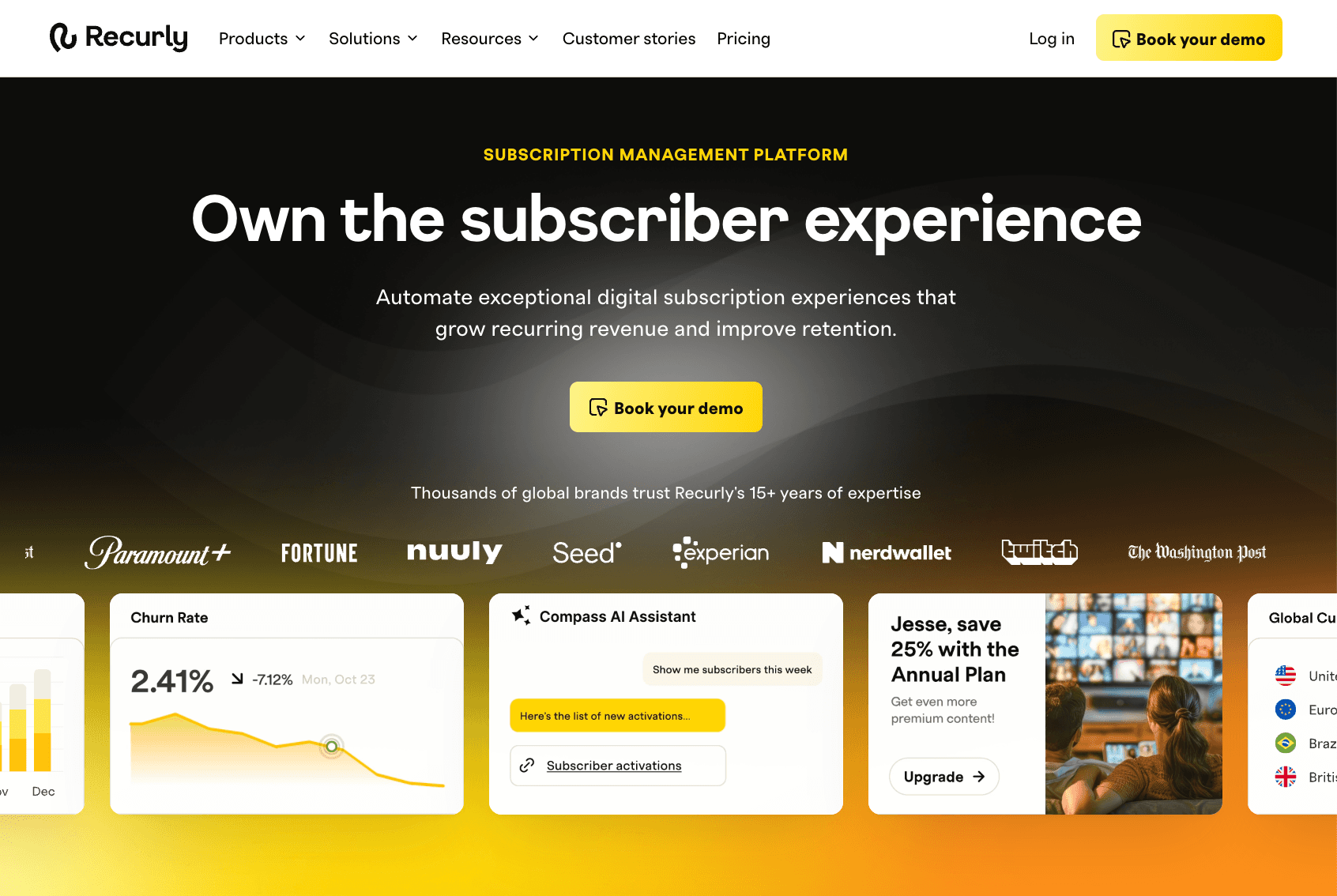
Source: Recurly.com
Recurly automates the entire subscription lifecycle management process, including invoicing, payment collection, account management, and dunning.
The platform helps businesses increase subscription revenue and reduce involuntary churn by providing positive customer experiences.
Best for: Mid-market businesses and growing SaaS companies that want a scalable subscription billing platform.
Core Features
- Subscription lifecycle management: Manage client base data, upgrades, downgrades, and account updates in one place.
- Recurring billing: Automate invoices and charge customers on a set schedule.
- Flexible pricing: Launch new pricing plans quickly and tailor each plan with trial offers, discounts, and add-ons.
- Payment orchestration: Connect multiple payment gateways and protect subscriber data with always-on fraud management.
- Churn management: Use revenue recovery tools, such as intelligent retries and dunning campaigns, to reduce churn rates.
- Revenue recognition: Automate ASC-606 and IFRS-15 compliance.
- Global billing: Support multiple currencies, regions, and tax rules.
What Is Zuora?
Zuora offers an extensible and enterprise-grade recurring billing platform designed for AI monetization.

Source: Zuora.com
It combines automation, embedded AI, flexibility, and scalability to help enterprises manage complex monetization models and global tax compliance rules.
Zuora started as a billing solution, but has since expanded to include a subscription management platform, an AI-powered collections software, and a payment processor.
Best for: Large SaaS businesses with complex billing processes and compliance requirements.
Core Features
- Usage-based billing: Turn product usage data into recurring revenue.
- Flexible pricing: Launch hybrid monetization models and iterate continuously on SaaS pricing and packaging.
- Subscription management: Ochestrate customer upgrades, renewals, payments, and account changes.
- Unified quote-to-cash system: Connect your entire revenue lifecycle, including quoting, billing, collections, payments, and revenue recognition.
- Payment orchestration: Use built-in payment gateway connectors to accept global payments.
- Tax compliance support: Meet compliance using Zuora’s native tax engine, country-specific templates, and tax management reports.
- Revenue recognition: Automate calculations, journal entries, and reconcilations to comply with ASC 606 and IFRS 15.
Recurly vs. Zuora: Main Differences Explained
Here's an in-depth comparison of Recurly and Zuora, from their key capabilities to their pricing.
Billing Models Supported
Both platforms support several billing models. However, Zuora offers more diverse pricing models, allowing companies to test different monetization strategies.
Recurly supports these pricing models:
- Fixed recurring pricing for simple subscriptions
- One-time pricing for perpetual software licenses
- Ramp pricing that starts with a lower introductory price and increases fees over time
- Usage-based billing to charge users for actual consumption
- Tiered pricing where the price per unit decreases as the quantity of units increases
- Prepaid account balance that allows customers to prepay and consume their balance over time
- Hybrid pricing that combines multiple pricing models
Zuora's billing models include the following:
- Flat fee with a fixed or recurring charge
- Per-unit pricing based on the quantity used
- Tiered pricing adjusts prices based on volume
- Volume pricing based on the volume purchased
- Usage-based billing with charges tied to consumption
- Overage pricing for usage beyond the included limits
- High water mark based on peak usage in a period
- Delivery pricing based on a list price per delivery
- Prepaid with a drawdown for upfront payments
- Multi-attribute pricing that supports custom object definitions and dynamic pricing adjustments
- Pre-rated pricing where usage is rated outside Zuora
Subscription Management
Recurly focuses on simple and intuitive subscription lifecycle management. It lets you create, update, pause, postpone, and cancel subscriptions based on subscriber preferences or business needs.
It also supports multiple subscriptions for diverse services or different tiers within the same service.
Recurly provides complete visibility and control over each stage of a subscriber's lifecycle. This makes it easier to handle upgrades, downgrades, and subscription billing changes.
Zuora also manages subscription upgrades, downgrades, and proration. The platform can track mid-term contract changes and calculate prorated amounts automatically to improve operational efficiency.
But unlike Recurly, Zuora is built for volume and complexity. It handles the scale of millions of subscribers without chaos.
It also connects revenue recognition directly to subscription management events. Finance teams can automate compliance and accurately report on how much revenue is earned.
Payment Processing
Recurly offers global payments orchestration and supports flexible payment methods, including credit cards, prepaid and gift cards, PayPal, and more.
It allows businesses to choose from one or more payment gateways that match their operational needs and geographic focus. Each gateway comes with robust security measures to ensure secure payment processing.
Recurly supports the following payment gateways:
- Adyen
- Authorize.net
- Amazon Pay
- Braintree
- CardConnect
- Chase Paymentech Orbital
- Check Commerce
- Checkout.com
- Commerce Hub
- Cybersource
- Ebanx
- GoCardless
- FreedomPay
- Nuvei
- PayPal Complete
- Stripe
- TSYS
- Vantiv
- Worldplay
Zuora's end-to-end payment solution accepts various payment methods, such as credit cards, cash, checks, and wire transfers. It also comes with built-in gateway integrations and automated collections.
Zuora customers can use the following payment gateways:
- Adyen
- Alipay
- Allpago (PPRO)
- Amazon Pay
- ANB
- Authorize.net
- BlueSnap
- Braintree
- CardConnect
- Chase Orbital
- Checkout.com
- Citi
- CyberSource
- Chase Mobility
- Ebanx
- Fat Zebra
- First Data
- Fiserv
- GMO
- GoCardless
- Helix
- Mastercard
- Merchant e-Solutions
- Moneris
- NETS
- NMI
- Opayo Direct
- PayPal
- Qvalent Quick
- Saferpay
- SB Payment Service
- SlimPay
- Sony Payment Services
- Stripe
- Vantiv
- Verifi Global
- WePay
- Worldline Global Collect
- Worldpay
Dunning Management
Recurly is known for its robust dunning management capabilities. It provides customizable dunning campaigns, flexible dunning cycles, and built-in email templates for effective customer communication. The platform also sends dunning notifications via webhooks to inform users about failed payments.
Other key features of Recurly include intelligent payment retries, account updater, and expired card management. These reduce churn and recapture lost revenue.
Zuora automates dunning processes through Zuora Collections. It helps businesses collect cash faster and enhance customer relationships by unifying accounting, collections, and billing data.
Zuora also offers configurable payment retry capabilities and automated notifications to minimize revenue loss.
Revenue Recognition
Both Recurly and Zuora automate revenue recognition, but they serve different financial needs.
Recurly RevRec is built for subscription businesses that want faster close cycles and configurable reporting. It simplifies ASC-606 and IFRS-15 compliance by automatically handling revenue recognition workflows.
The platform also provides a single, aggregated view of subscription plans, billing, and revenue growth. Combined with intelligent forecasting across monetization models, Recurly helps finance teams manage contract changes, volume discounts, refunds, and cancellations.
Zuora suits enterprise businesses that manage complex revenue recognition across subscriptions, usage-based, and hybrid pricing models. It automates all five steps of ASC 606 and IFRS 15 compliance to eliminate manual workflows.
It also features an audit-ready design with built-in SOX controls, role-based security, automated reconcilations, and audit trails.
Plus, Zuora unifies order-to-cash operations. Finance teams can move quotes into the general ledger with cleaner amendments.
Reporting and Analytics
Recurly has comprehensive reporting capabilities and advanced analytics dashboards that provide actionable insights into subscription health. It can track plan performance, campaign results, customer base trends, and subscription revenue per user (RPU), among other key metrics.
Recurly also enables subscription businesses to build custom reports, benchmark against competitors, and connect to data warehouse tools for deeper insights.
Zuora, on the other hand, offers a fully integrated analytics solution that monitors customer churn, usage, and deferred revenue. It dives deep into the financial and operational health of your subscription-based business.
Real-time analytics of billing performance, recurring revenue trends, and customer behavior help teams make informed financial decisions.
Pricing
Recurly offers different pricing for various product types. Here's a quick breakdown:
- Recurly Subscriptions: Charges a single, custom rate based on the total payment volume (minimum of $1M TPV) and contract length.
- Recurly RevRec: Starts at $1,200, with rates depending on TPV and contract length.
Meanwhile, Zuora does not offer a standard price list or published plans because it caters to different needs.
Zuora's pricing ultimately depends on the following:
- Products and modules: Zuora offers billing, revenue recognition, payments, and CPQ solutions. Businesses only pay for what they need.
- Transaction and usage volumes: Costs scale with your invoice volume, total revenue, and pricing model complexity.
- Optional services: Implementation, training, and support are available as paid add-ons.
Integration Capabilities
Recurly is built to work seamlessly with your existing SaaS stack. It offers pre-built integrations across payment gateways, finance, tax management, CRM, helpdesk, and marketing tools.
Recurly also provides API access for custom integrations, making it easier for teams to plug it into their current workflows.
Zuora has a built-in integrations hub. It easily connects to gateways, data warehouses, CRM software, developer tools, and tax management solutions.
It also supports low-code and no-code configuration, so teams can easily set up custom connections to meet business needs.
Implementation Time
Recurly is faster to implement than Zuora. Teams can get Recurly up and running in just a few weeks.
Setting up Recurly's billing and subscription management platform is straightforward. It is also easy to connect to other tools due to its pre-built integrations.
Zuora usually takes longer to implement. According to G2 Reviews, the average time to implement Zuora is six months.
New customers often face a complex billing engine and a steep learning curve that make it difficult to use Zuora. Some businesses may require technical expertise to implement and integrate the subscription management software into their existing tech stack.
Which Is Better: Recurly vs. Zuora?
The right choice between Recurly and Zuora depends on your business needs, subscription billing complexity, compliance requirements, and budget.
Choose Recurly if your SaaS business wants a fast setup and flexible subscription billing management. It works well for teams that need to launch quickly, manage recurring pricing models, and reduce churn without the complexity.
Zuora makes more sense for larger companies with complex billing and compliance needs. It can streamline payments, collections, quote-to-cash, and revenue recognition. This empowers teams to meet customer demands at scale and increase business agility.
What Recurly and Zuora Lack: In-Product Access Enforcement
Recurly and Zuora do not enforce access inside your product at runtime. They track billing events and process payments, but they cannot control what customers can use based on their plan.
Both platforms work well when subscriptions renew as expected, and software monetization remains simple.
Things shift when pricing begins to affect how users interact with the product. Access starts to depend on customer usage, limits, trials, and custom rules.
At that point, billing systems like Recurly and Zuora fall short. They only update after events, such as invoices or subscription renewals, not during product usage. This creates a gap between billing data and actual product access.
Engineering teams often try to fix this by building custom logic inside the application. They add rules to control feature access, usage limits, and plan behavior directly in the product's code.
However, that only creates technical debt over time.
Every pricing change now requires code updates, testing, and deployment. Small updates, like adjusting a usage limit or adding a new plan, become slow and risky.
Companies need a well-designed entitlement management system. It separates billing from access control and enforces limits directly in the product as users interact with it.
Where Schematic + Stripe Fits In
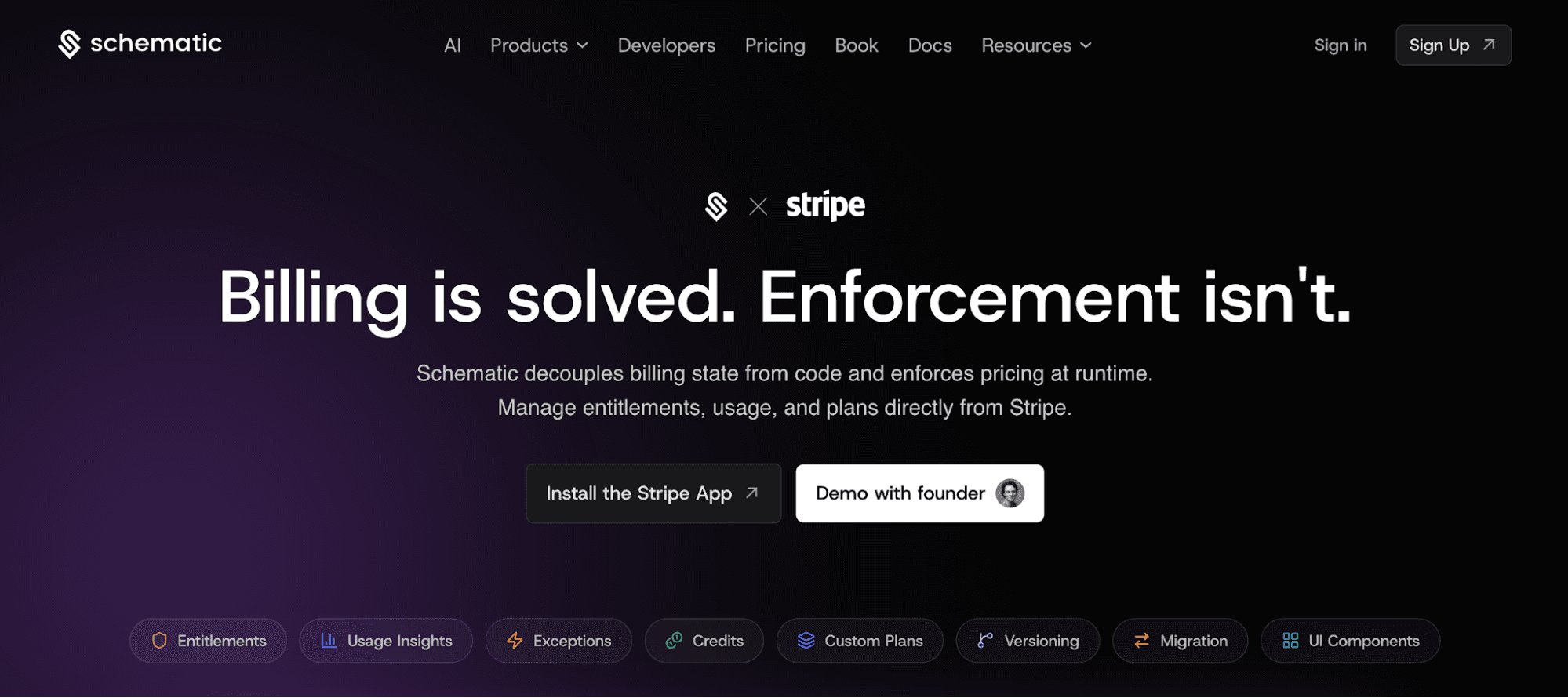
Schematic is the monetization operating system for modern SaaS and AI companies. Teams define plans, software entitlements, limits, trials, credits, add-ons, and exceptions in one place.
The platform, built on Stripe, serves as the system of record for your product catalog. Stripe is the billing infrastructure that handles payments, invoices, subscriptions, dunning, and revenue recognition.
Schematic adds the layer that Stripe, Recurly, and Zuora do not fully cover: in-product access control.
When a customer upgrades, starts a trial, cancels, reaches a limit, or gets a custom deal, Schematic can enforce the right access inside the product at runtime.
The main benefit is that billing logic no longer has to live in the application codebase. Businesses can continuously iterate on monetization without deploying code, while Stripe remains the billing layer.
Schematic Is Built For Teams Who Have Outgrown Recurly and Zuora
Recurly and Zuora are powerful billing and subscription management platforms, but they can fall short when pricing starts to shape access, limits, and usage. Teams need a way to enforce access in-product at runtime.
That's where Schematic becomes valuable.
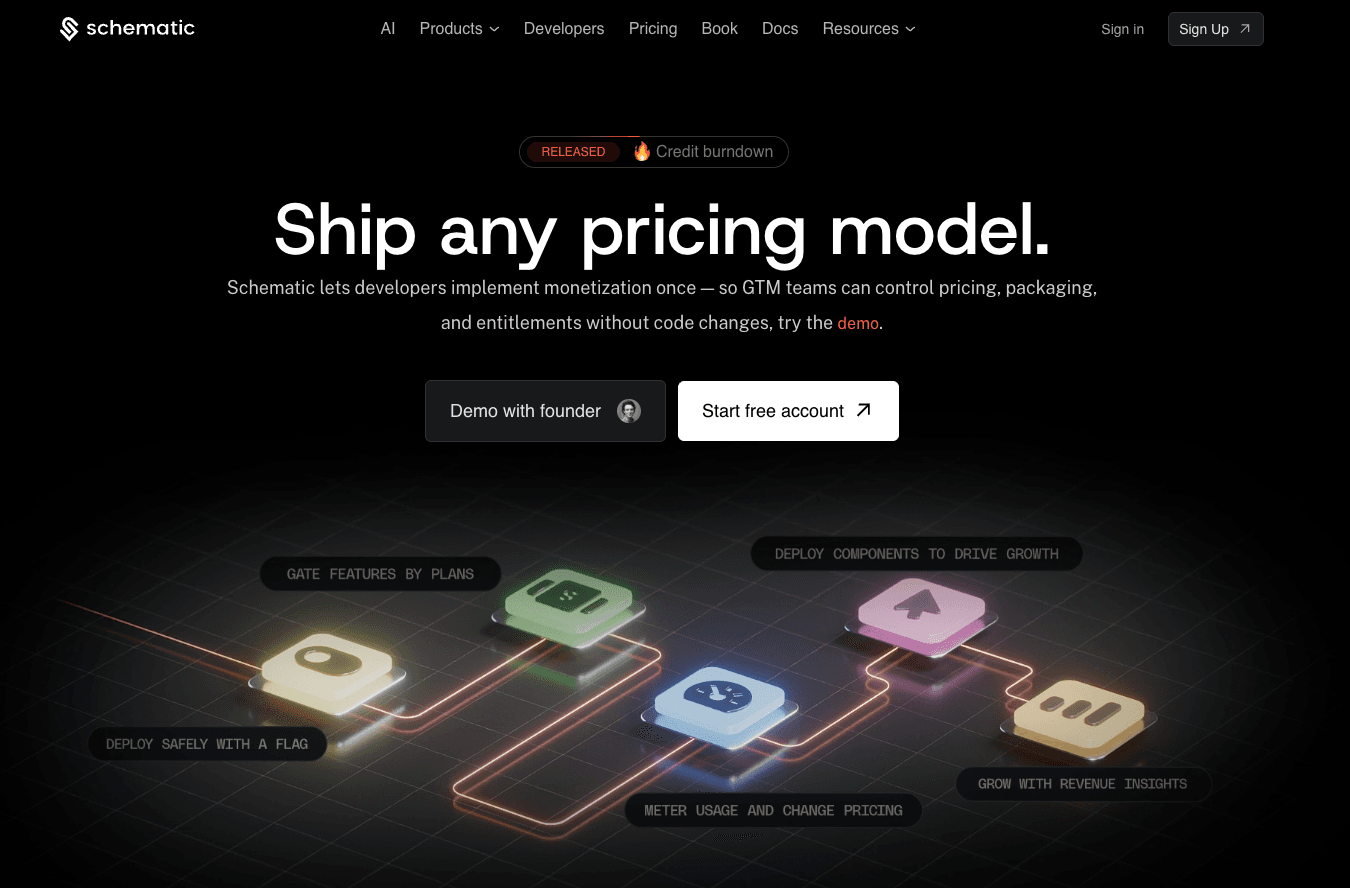
Schematic turns Stripe billing state into application behavior. Stripe takes care of billing, while Schematic owns what customers can do. Data syncs seamlessly between the two without building integration glue or managing webhooks.
Schematic works by decoupling pricing and billing logic from application code. Modern SaaS and AI businesses can ship any pricing model without rebuilding their billing stack.
Engineering no longer maintains the billing and entitlement code. They can focus on product development.
Meanwhile, GTM and product teams can change plans, limits, and pricing models without waiting on developers.
FAQs About Recurly vs. Zuora
Who are Zuora's main competitors?
Zuora’s main competitors include Recurly, Chargebee, Stripe Billing, and Maxio. SaaS teams also compare Zuora with Schematic when they need to control product access, usage limits, and plans beyond billing.
How much does Recurly cost?
Recurly's pricing depends on the product. The cost of Recurly Subscriptions is based on total payment volume and contract length, with a $1M TPV minimum. On the other hand, Recurly RevRec pricing starts at $1,200 USD.
Is Recurly PCI-compliant?
Yes, Recurly meets PCI-DSS Level 1 standards. It can protect credit card transactions and consumer data.