 Ryan Echternacht
Finding the right pricing model is difficult for many software and AI companies. A fixed subscription makes revenue easier to predict, but it may not reflect value. On the other hand, usage-based pricing can align costs with customer value. The downside is that it creates unpredictability.
Hybrid pricing offers a middle ground. It combines two or more pricing models in one structure, such as a base subscription fee with usage-based charges.
The base provides steady recurring revenue, while variable usage allows businesses to capture upside from power users. A hybrid model also supports different customer segments with distinct buying needs.
In this article, we'll share the benefits, key components, and examples of a hybrid pricing model.
TL;DR
- Hybrid pricing is a flexible pricing model that combines multiple structures into one offer, such as a fixed subscription fee with variable usage-based charges.
- Key benefits are predictable base revenue, higher expansion revenue, stronger value alignment, reduced dependency on a single model, better margin protection, and wider market reach.
- Core components include a base fee, usage-based or overage charges, feature-based tiers, and add-ons or one-time fees.
- To implement hybrid pricing successfully, choose the right value metric, a fixed component, a variable element, and the best monetization platform that provides real-time usage visibility.
- Schematic helps software and AI companies model hybrid pricing from one engine while giving customers visibility, control, and predictability over variable usage.
What Is Hybrid Pricing?
Hybrid pricing is a software monetization model that combines multiple models into one pricing structure.
For example, a SaaS company may charge a fixed fee for product access and bill for consumption (e.g., API calls, AI credits, tokens) at the same time.
A hybrid model has become popular with AI and SaaS companies because one pricing strategy may not fit every customer or product. According to the 2026 State of Go-to-Market report, 48% of B2B software businesses now use hybrid pricing models.
Hybrid pricing strikes the right balance between predictability from the base fee and scalable revenue growth from the variable component.
It is designed to reflect the different ways customers use and value a SaaS product.
6 Key Benefits of a Hybrid Pricing Model
Here are the advantages of implementing a hybrid pricing model.
1. Gain Predictable Base Revenue
Hybrid pricing includes a fixed recurring fee that provides a steady revenue floor each month or year. This is useful for companies offering subscription services that want stable income without giving up the revenue growth potential from usage-based charges.
Pure pay-as-you-go and other usage billing models can cause revenue to rise or fall as customer activity changes.
Adding a base charge introduces more predictability because the SaaS business still collects revenue even during lower-usage periods.
Hybrid pricing improves cash flow. It also helps finance teams forecast revenue more accurately and create a better financial model.
2. Capture Upside From Higher Usage
Hybrid pricing allows revenue to grow when customers use more of the product. The variable part of the hybrid model can be tied to API calls, credits, data storage, compute, messages, transactions, or other usage units.
Instead of seeing the same fixed amount on their invoice, customers pay more as their usage increases. This allows a company to capture more revenue from users that depend heavily on the SaaS product.
Hybrid pricing makes sense for platforms where some buyers consume larger amounts of resources compared to the rest.
For example, customers might subscribe to a base plan with predefined usage allowances. As their needs grow or as they start to rely on a product daily, they will eventually reach a point where they will exceed the included usage limit.
Once they do, they can purchase more credits to ensure uninterrupted usage. Alternatively, the SaaS company can bill users for overage charges.
Either way, the business can earn more from usage growth without requiring customers to upgrade to a higher tier.
3. Align Pricing With Customer Value
A hybrid model connects pricing to how customers receive value from the product. A base fee can cover access to the platform, while the variable part can reflect how much a buyer uses a specific feature or service.
For example, a SaaS product might charge a monthly subscription fee and bill for credits used for model runs or automated tasks. Customers who frequently use the product and receive more value can spend more money.
As a result, businesses can maximize the revenue earned from each user.
4. Reduce Dependency on a Single Pricing Model
Relying on one pricing method can limit how a company sells its product. A flat subscription fee may not capture heavy usage, while pure usage-based pricing makes revenue less stable.
Hybrid pricing spreads revenue between different pricing models. A company might combine subscriptions, seats, usage, credit burndown, and add-ons. This gives teams flexible pricing options for different products and customer needs.
Sales reps have more wiggle room when creating custom plans and commercial terms. They can change included usage limits, adjust minimum commitments, or offer discounts without replacing the entire pricing structure.
For example, an enterprise account may pay an annual base charge with lower usage rates. Meanwhile, a small business follows standard monthly pricing.
AI and SaaS companies can use different ways to close deals while still keeping a common pricing framework.
5. Protect Margins Against Variable AI Costs
Model inference, API calls, compute, storage, and data processing can all create variable expenses for an AI company.
Flat-rate pricing does not always account for these operational costs. If one account uses far more AI capacity than another but pays the same amount, heavy usage can reduce gross margins.
Hybrid pricing connects part of the customer bill to these costly actions. Power users who incur more costs for the business pay a higher price than low-usage accounts.
This model protects margins without forcing every customer into an expensive plan that assumes high usage from the start.
6. Expand Market Reach
Different customers have unique buying needs. A startup typically wants a low entry price, while a large enterprise usually demands annual commitments, custom limits, or volume discounts.
Hybrid pricing serves different customer segments under the same product.
Hobbyists or small businesses can start with a lower base plan and pay more only as usage grows. Mid-market companies can choose price tiers with higher usage allowances or advanced features. Enterprise buyers can receive custom commitments, usage rates, and limits.
With hybrid models, sellers can offer pricing that fits each customer's budget and expected product consumption. They can expand their reach and serve clients of all sizes.
Core Components of a Hybrid Pricing Model
Hybrid pricing brings multiple pricing components together in a single offer. Let's break down each component below.
Base Fee
The base fee refers to the fixed amount a customer pays for access to the product. It can be billed monthly or annually. This fee often covers the core platform, standard features, and basic support.
The base fee creates a steady revenue floor before adding variable charges.
SaaS companies can set different fixed fees for each product based on account size, customer needs, or included usage allowance.
Usage-Based or Overage Fees
Usage-based or overage fees charge customers when they consume the product or go beyond an included limit.
Usage-based billing can be tied to API calls, tokens, credits, transactions, storage, compute, or other measurable activity.
A subscription plan might include a set amount of usage in the base fee. Once the customer exceeds that limit, an overage rate applies.
This pricing component allows revenue to grow as consumption increases while still giving customers a predictable starting cost.
Feature-Based Tiers
In feature-based tiered pricing, SaaS companies group product capabilities into different plans.
A lower tier typically includes basic features, support, and services. Meanwhile, a higher tier usually offers advanced tools, premium support, and higher limits.
Price tiers give customers a clear reason to upgrade as their needs change and usage grows.
Software and AI companies gain a simple way to charge for new features. Commercial teams can place those capabilities in higher tiers instead of overhauling the entire pricing model.
Add-Ons or One-Time Charges
Add-ons let customers pay for extra products or services outside their main plan. Common examples include premium integrations, higher data storage, priority support, additional credits, or specialized AI agents.
One-time charges cover costs that do not repeat each billing cycle. These may refer to onboarding, setup, training, migration, or implementation services.
Both options let companies earn more revenue without increasing prices for customers who do not need additional services.
Examples of Hybrid Pricing
Hybrid pricing can take many forms. These four companies show how software and AI products combine fixed and variable charges into one pricing structure.
Plotly (Freemium Pricing + Seats + Credits)
Plotly offers data visualization tools and platforms that enable teams to run, publish, and share their applications in any secure environment.
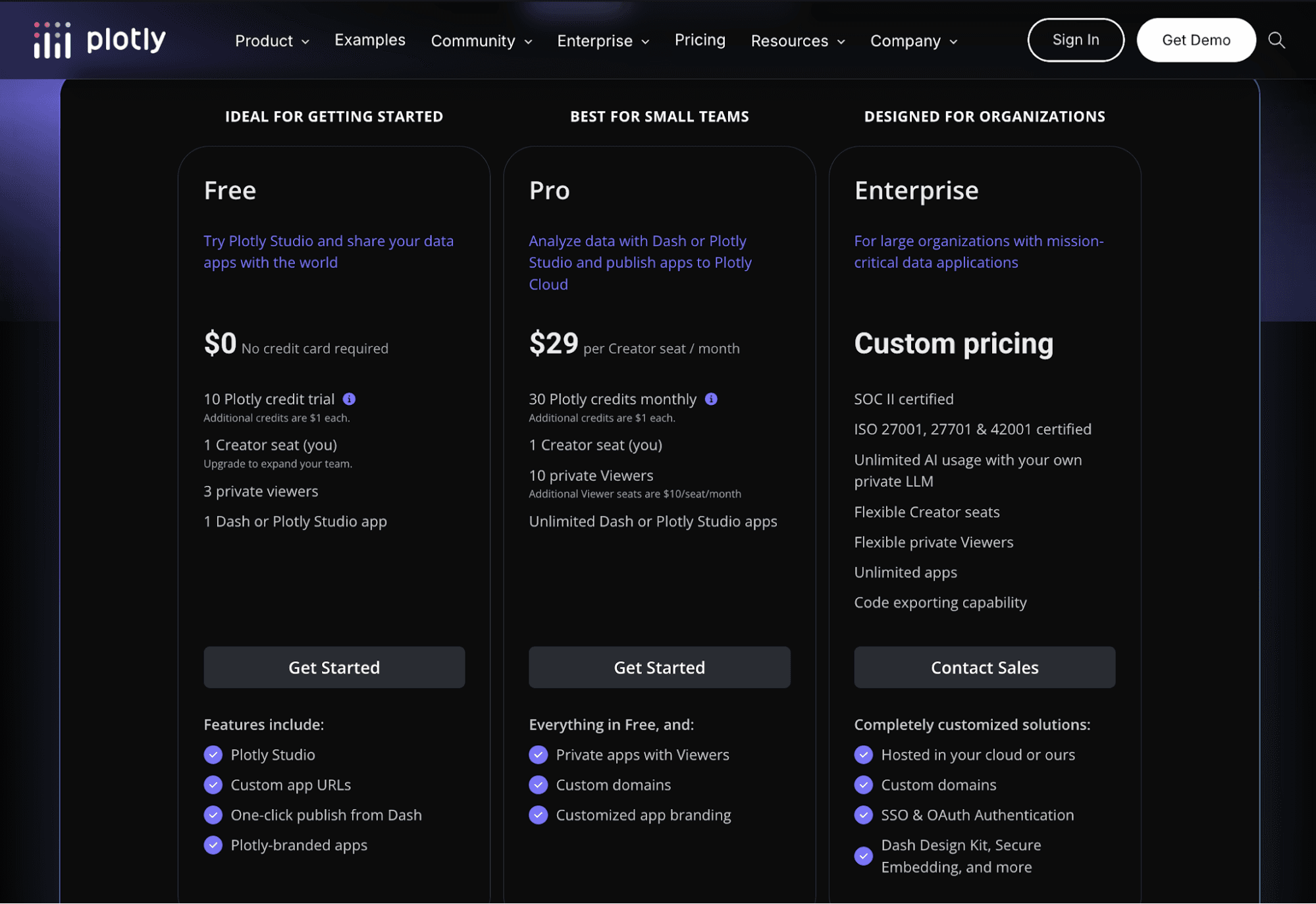
Source: Plotly.com
Plotly turned to Schematic, a complete monetization platform, to manage hybrid billing the right way.
It combines a free plan, seat-based pricing, and credits. The freemium model gives users access to 10 trial credits, a single creator seat, a single Plotly Studio app, and three private viewers.
Free users need to upgrade to the paid Pro plan to unlock more credits, unlimited Plotly Studio apps, and 10 private viewers.
Pro subscribers can also pay additional fees if they need extra credits ($1 for a single credit) and viewers ($10/seat/month).
A hybrid pricing model lets Plotly charge for team access while also earning revenue from credit usage.
Vercel (Seats + Overage Pricing)
Vercel is a popular developer tool for deploying cloud applications and websites. Its agentic infrastructure allows AI coding agents to build, test, and ship apps autonomously.

Source: Vercel.com
Vercel's pricing blends seat-based charges, credits, and overage fees to reflect the value customers receive.
The Hobby plan is free and includes limited usage. If customers want to build and scale their app, the Pro tier is the better choice. It comes with a single developer seat ($20/month), $20 worth of usage credits, and higher infrastructure limits.
Power users that go beyond the predefined usage threshold are billed additional fees. For example, Pro subscribers receive 10m edge requests per month. If they need more, they pay an extra $2 per 1m edge request.
By using hybrid pricing, Vercel gains monthly recurring revenue from the developer seat and captures upside from users who consume more resources.
Intercom (Tiers + Seats + Outcome-Based Pricing)
Intercom is an automated SaaS tool for customer support. It's known for its native AI agent called Fin, which handles and resolves questions instantly.
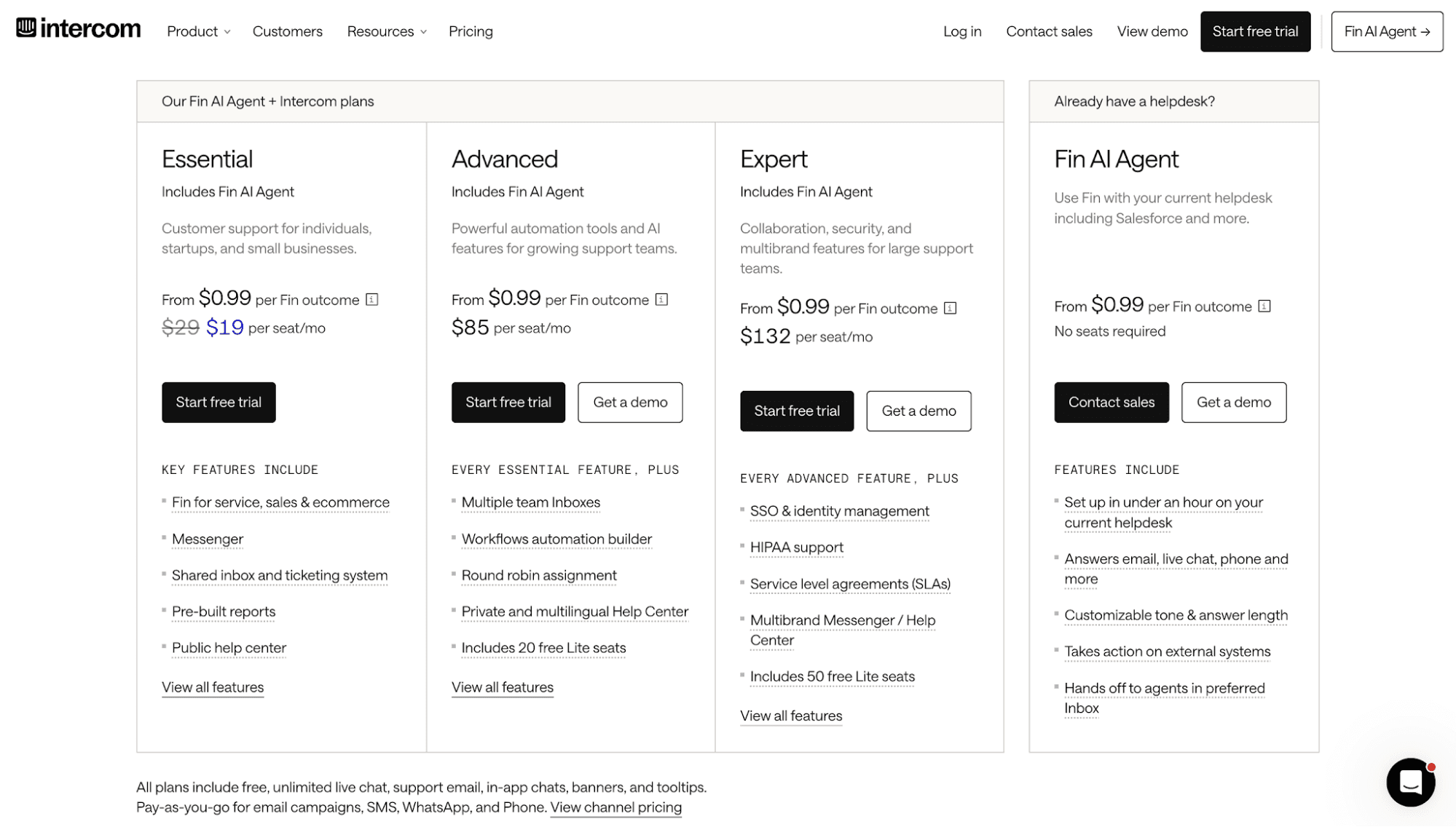
Source: Intercom.com
Intercom has a unique hybrid pricing structure. It offers three pricing tiers with per-seat charges while implementing outcome-based pricing for its Fin AI agent.
Customers pay per seat based on their selected Intercom plan. Each tier includes different features and seat limits.
For example, the Essential seat costs $19/month and offers pre-built reports, a messenger, a shared inbox and ticketing system, and a public help center. Meanwhile, the Advanced plan charges $85/seat/month and includes multiple team inboxes, round-robin assignments, a workflow automation builder, and a private help center.
The cost of the Fin AI agent starts at $0.99 per outcome. An outcome is charged when Fin resolves a customer issue or hands off a procedure to a human agent.
Hybrid pricing connects part of Intercom's revenue to team size and another part to the work its AI agent completes.
Zep (Subscription Pricing + Credits)
Zep builds the infrastructure that lets agents remember chat, documents, events, and business data to provide more relevant answers. It's designed to serve long-term memory management for large language models (LLMs).
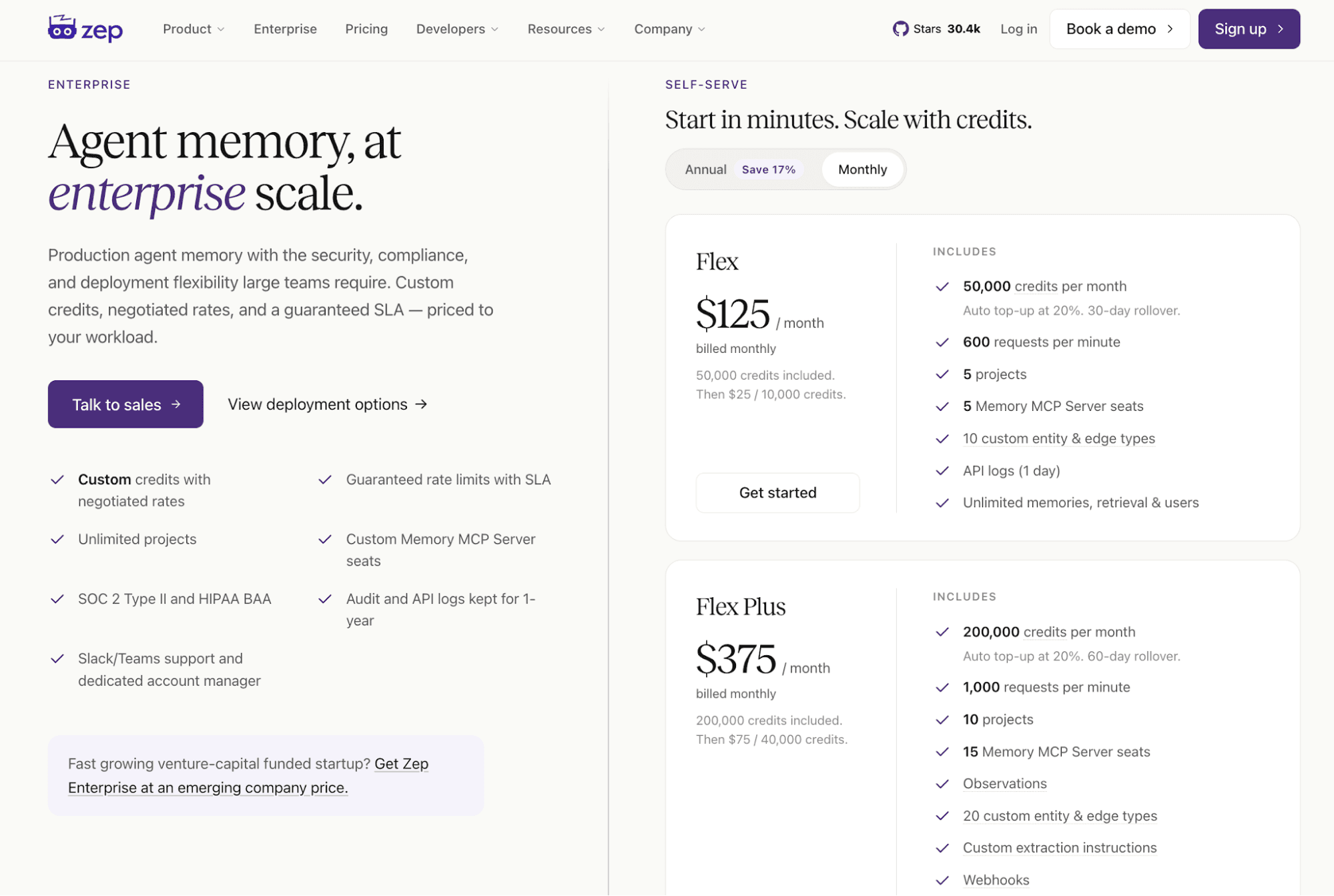
Source: getZep.com
Zep worked with Schematic to scale their pricing. It combines recurring subscription fees with credit-based pricing.
The Flex plan costs $125/month and includes 50,000 credits. If customers need extra, they pay an additional $25 for 10,000 credits. Alternatively, they can enable automatic top-ups to ensure uninterrupted usage.
At $375/month, the Flex Plus tier gives users a total of 200,000 monthly credits and higher usage limits. An extra 40,000 credits cost $75.
Hybrid pricing gives Zep a steady revenue floor from the subscription fee and a potential for upside when credit usage increases.
Common Challenges in Implementing Hybrid Pricing
Combining several pricing structures into one can introduce operational and financial problems. Below are the challenges of implementing hybrid pricing.
Billing Complexity
Hybrid pricing makes billing much harder to manage.
A single invoice may include base fees, seats, usage-based charges, credits, overages, and one-time fees. Each charge may follow different pricing rules, billing periods, and terms.
Custom enterprise contracts add another layer of complexity because of the exceptions granted.
Finance and billing teams need to track how each component affects the final amount owed.
Pricing and Invoicing Errors
Due to its complexity, hybrid pricing often leads to errors. Usage events may be missed, counted twice, delayed, or linked to the wrong customer.
Teams might also apply pricing rules incorrectly. A user may receive the wrong overage rate, credit deduction, seat charge, or plan allowance.
These errors can lead to underbilling or overbilling. Finance teams end up spending more time double-checking invoices by hand because it includes several types of charges tied to different product events.
Loss of Customer Trust
Customers find it hard to trust the usage-based component of hybrid pricing. They may struggle to understand why their monthly total changed or how a usage fee was calculated.
Unexpected overages, credit deductions, or surprise fees can make customers question whether the invoice is accurate. This problem becomes worse when buyers cannot connect what they used with what they were charged.
Repeated billing disputes can damage trust. Customers become less willing to expand usage if they feel they cannot predict how much they will pay.
Inaccurate Revenue Forecasting
Hybrid pricing makes revenue harder to forecast because part of the bill can change with customer activity.
Subscription revenue remains steady, but usage, credits, and overages can rise or fall each month. Customer behavior can also change quickly, especially for AI products with automated agents and workloads.
Heavy usage may create sudden revenue increases, while lower activity can reduce expected income.
Finance teams need to analyze several revenue streams instead of relying only on recurring subscription amounts to forecast revenue growth.
Best Practices for Hybrid Pricing
Follow these best practices to implement hybrid pricing successfully.
Know Your Core Value Metric
Determine the unit that best reflects how customers get value from your product.
For example, if you sell a project management platform, you can charge customers for seats or projects created.
On the other hand, monetizing AI agents usually means billing for credits, tokens, or outcomes.
The value metric should be easy for customers to understand and simple for your product to track.
It should also tie costs directly to consumption. If costs increase with usage, the metric must account for those expenses to protect margins.
Set the Fixed Pricing Component
Choose what customers will pay on a recurring basis before variable charges begin. The fixed component could be a one-time license fee, a monthly subscription, a minimum commitment, or an enterprise contract term.
The right choice depends on how customers buy the product. Self-service SaaS products may work well with monthly subscriptions. Enterprise platforms might need annual commitments or usage minimums.
The fixed pricing should cover the cost of basic product access. At the same time, it must create a steady revenue floor without making the starting price too high for the customer segment you want to target.
Choose the Variable Pricing Element
Next, decide what will cause the customer's bill to grow and change over time. You can charge buyers for usage, credits, seats, transactions, storage, compute, API calls, or completed outcomes.
Select a variable pricing element that customers can understand and connect to product value. It should also be easy to measure without creating billing disputes.
For an AI product, credits make sense when several actions have different costs because they introduce an abstraction layer. On the other hand, raw usage units (e.g., API calls, tokens, and compute minutes) work well for developer tools.
Avoid Too Many Variables
Hybrid pricing is one of the more complex monetization models.
When a plan includes too many meters, fees, limits, and exceptions, customers may struggle to estimate their bill. Sales and finance teams may have trouble explaining it.
Stick to two or three pricing elements to avoid overwhelming users.
There's a reason why many businesses choose a base subscription plus usage-based charges. The combination of two pricing models is easier to understand compared to a structure that includes multiple tiers, credits, add-ons, and outcomes.
Use only the necessary metrics to prevent hybrid pricing from becoming even more complex than it already is.
Invest in the Right Monetization Platform
Traditional billing solutions break when pricing includes variable usage-based charges. They cannot accurately meter, rate, and aggregate usage events for invoicing. They also fail to manage entitlements, which can lead to overprovisioned access and revenue leakage.
Invest in a complete monetization operating system that can meter usage, grant credits, handle software entitlements, and enforce limits at runtime.
This platform will help you define, manage, and iterate on hybrid pricing in one place. It lets you combine several pricing structures with speed, control, and trust.
Communicate Pricing Clearly
Customers should know how much they will pay before they start using the product. Explain the base fee, included usage allowance, variable rates, overage rules, credit terms, and extra fees in plain language.
When customers understand all the pricing elements included, they can estimate spending more easily.
A clear pricing page also reduces confusion when usage grows and the total bill changes every month.
Give Customers Real-Time Visibility and Control Over Usage
Customers shouldn't wait for an invoice to arrive at the end of the billing period to learn how much they used and owe.
It's important to show current usage, remaining credits, plan limits, and estimated costs inside the product. Provide real-time dashboards, customer portals, and spend forecasts.
You should also give users the ability to manage their consumption through self-service controls and configurable spending limits.
These allow customers to define usage limits, configure auto top-up rules, and set thresholds for alerts, making it easier to trust hybrid pricing.
Schematic Helps You Launch Hybrid Pricing Your Customers Can Trust
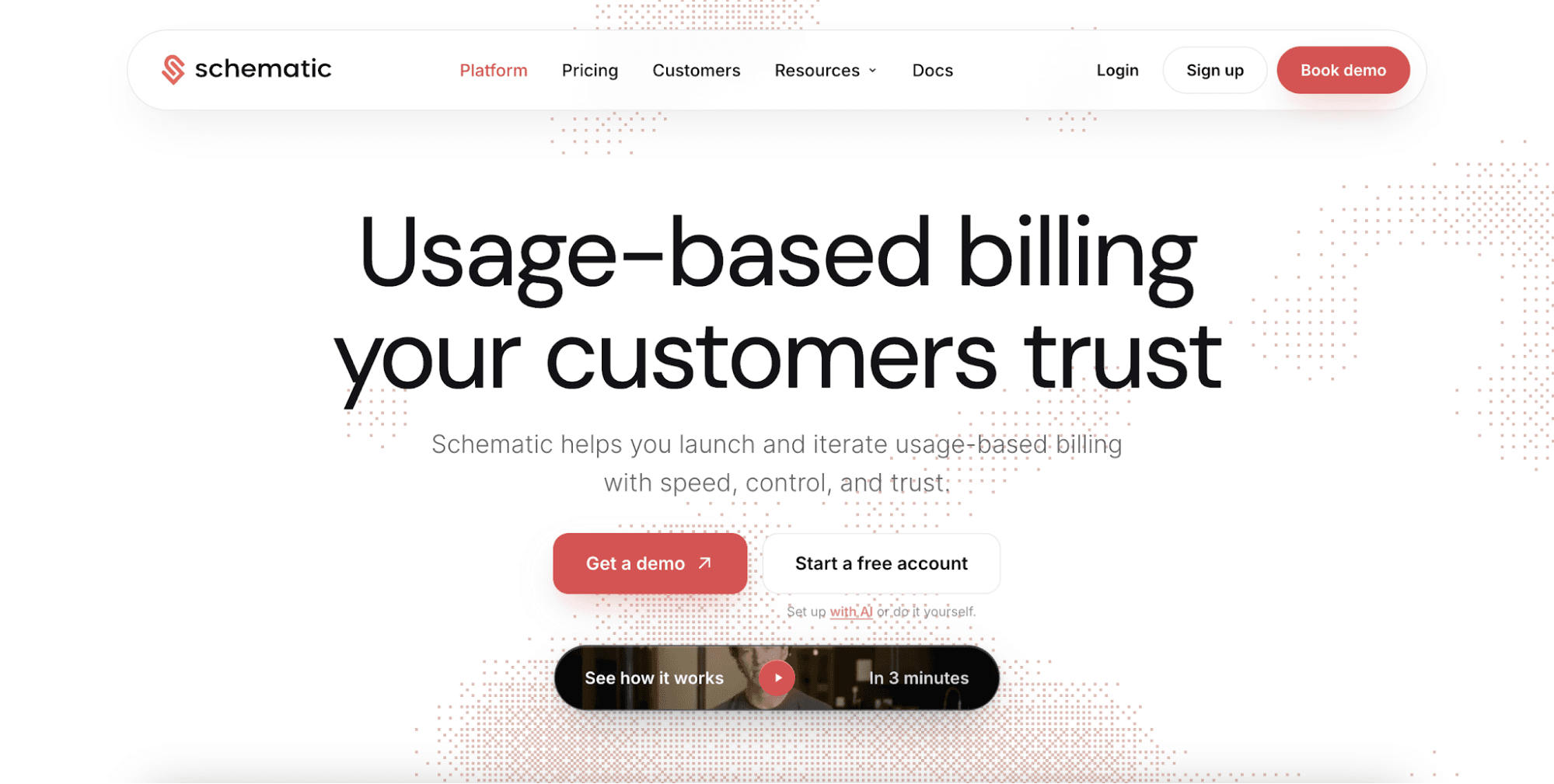
Schematic provides a complete monetization platform for software and AI companies selling to enterprise customers.
Businesses can model hybrid pricing, usage-based pricing, seats, and credits from one engine. Pricing lives as data on a real-time ledger, so a plan change only requires configuration instead of one-off code.
Schematic also provides enterprise credit wallets that give customers complete visibility, control, and predictability over their usage. Users can set limits per seat or agent, control top-up rules, and define what happens at the cap.
Schematic's real-time entitlement engine automatically enforces those policies without code deployment or a support ticket. It prevents billing disputes and unexpected access throttling.
By giving both buyers and sellers confidence that usage will stay within budget, procurement becomes smoother, sales cycles are faster, and revenue can naturally grow in the long term.
FAQs About Hybrid Pricing
What is a hybrid pricing model in SaaS?
A hybrid pricing model in SaaS combines two or more pricing methods in one offer. A SaaS company may charge a recurring subscription fee, then add usage-based charges, credits, overages, add-ons, or one-time fees based on customer needs.
Why do SaaS businesses use hybrid pricing?
SaaS businesses use hybrid pricing to combine steady recurring revenue with additional profits from higher usage. It also helps companies serve different customer segments and charge in line with product value and operating costs.
Can you use a hybrid model to monetize AI products?
Yes. AI companies can combine subscriptions with credits, tokens, API calls, model runs, or other usage-based units. Hybrid pricing suits products where AI costs increase with consumption and customers have various usage patterns.