 Fynn Glover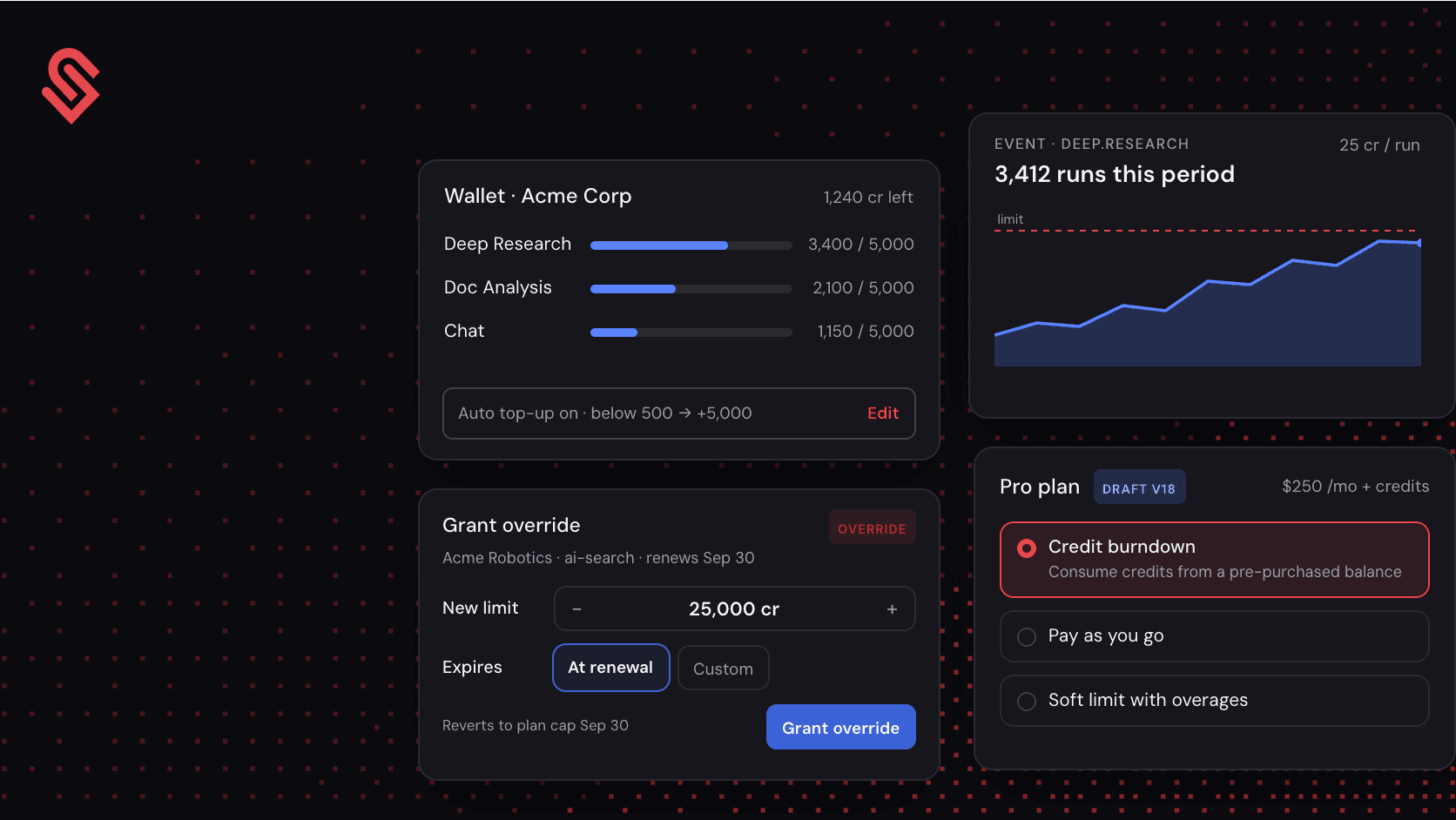
The Enterprise Wallet is generally available today.
I have spent the last 5 years studying how pricing is negotiated between vendors and buyers.
A champion wants the product. An economic buyer wants clear ROI. Procurement wants control and guardrails and good value. The sales rep wants to close a good deal the customer will view as fair for the value and that his or her boss will view as effectively positioned, sized, and negotiated.
I’ve come to believe that most of the time people aren’t trying to take advantage or exploit the other party. Yes, there’s negotiation, but for the large part, these exchanges are good faith attempts to land on something more like an alliance where value is fairly exchanged.
When it comes to pricing, what does your customer want?
I’ve found that again and again, the customers wants three things:
- Visibility. They want to see what they are using, as they use it, broken down in a way that maps to how their organization actually works.
- Control. They want to allocate that usage across their organization in a way that drives effective adoption to realize the value. Historically that’s meant driving adoption across people and teams. Increasingly, it also means driving adoption across agents, which has introduced new demands for how things like limits and usage caps are managed.
- Predictability. They want to know what they’re paying next month, and next quarter, and likely next year. Why? So they can operate within budget and plan effectively.
If you read that list again, you’ll notice that these three things are also exactly what your CFO likely wants from your pricing.
Your CFO wants to see usage as it happens, control what it costs to serve, and forecast where it lands next quarter.
The words are identical in both directions. Pricing enterprise deals with consumption models is a a negotiation, but fortunately, both sides want the same thing.
Recognizing this leads to operating with this knowledge as a principle for pricing and negotiating deals, which ultimately leads to greater trust between vendors and their customers.
The rise of usage-based and the fear of runaway spend
Software is going usage-based, and the reason is not a pricing trend. The product changed.
Your customer opens your product. Which may no longer mean your UI. It may mean your agent, or your MCP.
So does their agent.
So does the fleet of agents they wired to your MCP server at two in the morning while nobody was watching.
A team of forty generates a certain amount of usage. That same team pointing agents at your product generates a different amount, and the ceiling is no longer set by headcount.
What I’m describing is, to me, the reason to be bullish about AI for a long time. If customers can use your product in new ways and perhaps even exponentially, then you have an opportunity to deliver more value to your customers than you ever have.
If you succeed at realizing even some small % of this potential, the impact on your enterprise value could be non-trivial.
But, of course there’s a catch. While usage has the potential to expand exponentially, most customer budgets do not.
This is why token-maxing has become the scary zeitgeist.
Every enterprise now has a story about a consumption bill nobody could explain to finance. The suspicion is not that your price is too high. It is that the three things buyers need are to feel trust and confidence are missing: visibility, control, predictability.
The fair exchange of value creates the conditions of trust and long-term partnership
Fair exchange is not a posture. It is a set of conditions that establish long-term trust and partnership.
What are the conditions? There are 5 essential operating conditions vendors must have to ensure their customers can readily trust their pricing.
- Customer state has to be accurate in real time.
- Real-time metering has to be correct.
- Billing has to be correct.
- What a customer can and cannot do has to be enforceable in real-time.
- And the product catalog has to be the source of truth, so that what was sold, what is being metered, and what is being enforced are all the same thing.
When implemented poorly, or with inferior billing infrastructure, these 5 conditions disagree with each other endlessly, and not only do you paper over it with expensive ops people and billing engineers, but you also sacrifice the trust and confidence your customers have in the exchange of value.
The results are billing disputes, churn, missed expansion opportunities, and skepticism about the type of partner you are to do business with.
Those five conditions when implemented intentionally comprise a efficient distributed engine for fairly exchanging value, giving a company running it visibility, control, and predictability. And that company can pass the same three things to its own customers, unchanged, because they are drawn from the same ledger rather than assembled after the fact.
I have just described Schematic.
Schematic is a billing system for companies selling usage-based pricing to enterprise customers, built by people who believe billing either builds trust or breaks it.
What that looks like in practice
Macabacus launch deck check, a new AI product, priced with seats + credits, and sold custom deals to large financial institutions who knew that in Macabacus they could trust the guardrails placed around predictability, and control.
Plotly launched Plotly Studio and saw 57,000 companies adopt their credit-based pricing model self-serve, while also packaging custom usage based deals for enterprises.
Onecrew leveraged Schematic to handle custom usage based plans as they scaled their business to hundreds of enterprise customers.
Tightknit decoupled pricing from code to fully control their offerings so they could deliver custom packages to each customer.
The list goes on, and Schematic is now helping high growth startups and growth stage companies like Menza, Automox, Airia, Sema4, and dozens of others make the shift to usage based billing their customers can trust.
None of them used the same words. Some of them described the need for a billing engine to handle custom plans for usage-based deals. Some of them described credit-based pricing for enterprise customers. Some of them described the desire to give product & GTM full control over monetization without pulling engineers into billing projects.
But as we’ve worked with these companies, the underlying value they derive from Schematic is that it creates the conditions for them to monetize their products in a way that their customers find visible, controllable, and predictable.
The Enterprise Wallet
Today we are excited to announce the GA release of the Schematic Enterprise Wallet.
The Enterprise Wallet is the culmination of years building composable billing UI. Is it a suite of headless components, powered by our entitlements API that allows you to deliver visibility, control, and predictability to your enterprise customers.
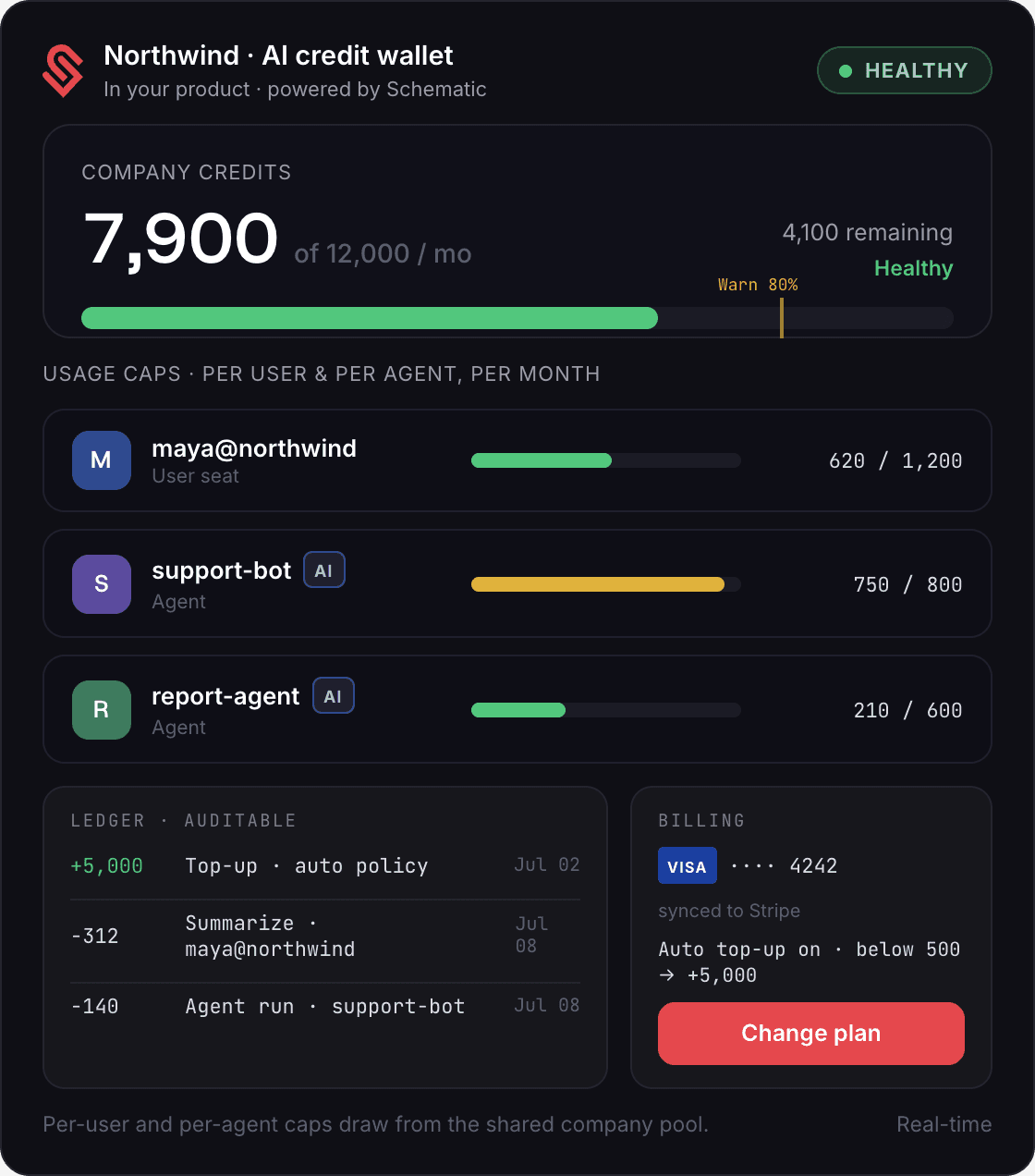
In your product, your customers can see their usage against their commit as it happens, not reconciled at invoice time. Burn rate and runway are visible, so in October a finance lead can tell whether they bought the right amount for the year instead of finding out in January. Consumption breaks out by feature, by user, by org, by workspace, by role, and yes, by agent.
You can give your customers the ability to control their usage. Spend caps they set themselves, by user, by role, by agent type, per day or per period. A separate budget for the SDR, the AE, and the workflow running unattended overnight. Top-up policy they configure instead of discovering. Alert thresholds agreed in advance, so nobody learns about a limit by hitting it mid-quarter.
For you it is headless components and an API. Send events & and provide usage controls. Build the experience inside your own product, in your own design, with your own words. Plans, credit grants, rollover, burn rates, and top-up rules are configured by whoever owns pricing.
If you’re selling upmarket, closing enterprises on usage based pricing only gets harder: enterprise deals bring a chasm of complexity, custom pricing, ramp periods, credit overages, usage caps, and more.
Many of our customers start here, as they’re trying to cross this chasm and the need to be able to price and bill for custom deal terms, non-standard term periods, soft limits, customizable overage behavior, etc. begins to drag on their engineering teams.
Who it is for
If your pricing does not change, you do not need this.
If you are moving to credits, selling usage into companies with procurement departments, or watching agent traffic outrun what your plans were built to hold, this is what we made. Automox, Macabacus, Plotly, Onecrew, Tightknit, Pagos, Menza, grw.ai, and Cloudraker are running on it now.
Every enterprise deal is a wager that both sides will still feel good about it a year from now. Pricing is where that wager gets placed, and it has always been placed on trust alone. Show both sides the same number and give them both the controls, and it stops being a wager.
Meet with our team to see how Schematic can help.