All posts
Schematic vs. Orb for Usage Billing: Which One to Choose?
Blog· Ryan Echternacht·Oct 19, 2026
Modern software and AI companies now charge customers based on consumption instead of billing a fixed recurring fee. That could mean API calls, tokens, credits, compute, AI agent actions, or other product activity.
But tracking usage is only one part of the billing process. Teams also need to price usage-based plans, grant AI credits, generate accurate invoices, and give buyers clear visibility into what they spend.
Schematic vs. Orb has become an important comparison for companies that want to implement usage-based billing. Both platforms can meter consumption, support credit-based pricing, send alerts before usage stops, and provide self-service controls.
However, they differ in functionality and philosophy when it comes to monetization. Orb focuses on metering and invoicing at scale, while Schematic is a complete usage billing platform with metering, price modeling, and runtime enforcement in one.
This comparison guide discusses the key differences between Schematic and Orb to help you find the best usage billing software.
TL;DR
- Schematic and Orb are popular usage billing platforms with similar features, but Schematic supports faster pricing and packaging changes because everything is configurable through the user interface.
- Schematic is known for its enterprise credit wallets, runtime entitlements, billing engine, metering system, price modeling, and self-service controls. These capabilities address customer trust structurally.
- Orb tracks usage granularly and at scale, which makes sense for infrastructure companies dealing with high-volume events.
- Schematic is ideal for software and AI companies selling usage-based plans to enterprise customers that want to iterate on monetization continuously.
Schematic vs. Orb: What's the Difference?
Schematic is a complete usage-based billing platform for software and AI companies that want to close enterprise accounts. It provides one engine for SaaS metering, price modeling, credits, software entitlements, and self-service controls.
Teams use Schematic to meter consumption events, enforce limits in real time, and bill for what customers actually use.
The platform also gives customers real-time visibility into usage, accurate forecasts, and configurable spending limits to prevent runaway bills. It can even provide pre-flight cost previews to show current balance before a paid action runs.

Orb is another popular usage billing software among SaaS businesses. However, it focuses on usage metering and invoicing at scale instead of access control.
Orb ingests product events, turns them into billable metrics, and generates detailed invoices using complex pricing calculations.
Finance and product teams have greater control over usage billing. Engineering, on the other hand, can focus on building the product instead of pulling usage data and calculating corrections.
The main difference between Schematic and Orb comes down to philosophy and scope of features. Orb provides scalable and reliable billing infrastructure that can track granular usage.
Meanwhile, Schematic takes a broader approach by connecting usage billing to product access, credit enforcement, and the customer experience.
Schematic Key Features and Pros
Schematic stands out because it gives buyers full visibility and control over their consumption. It's the only billing software that addresses customer trust.
Schematic unifies usage metering, modeling, credits, entitlements, and self-service controls in one engine. This setup prevents engineering from building billing logic from scratch.
Pricing is stored as data on a real-time ledger to make sure faster pricing and packaging changes through configuration.
Here are the key features of Schematic:
- Enterprise credit wallets: Track credit grants, burn-down, rollovers, expiry, and auto top-ups.
- Runtime entitlements: Check a customer's plan, current usage, and limits before a paid feature runs. The product can return an allow or deny decision in real time.
- Usage metering: Meter usage activity to power entitlements, invoices, and analytics.
- Real-time usage visibility and spend controls: Give customers live usage views, spend forecasts, and proactive alerts.
- Credit management: Set credit rollover rules, expiration windows, and priority consumption.
- Schematic MCP: Connect AI assistants to access billing information stored in Schematic and let them run automated workflows.
- Plan versioning and migration: Create new plan versions and move selected customers to the latest pricing.
Max Ade from Pickleheads says, "Schematic lets us change plans in one place and cascade updates to everyone, migrate customers between plans, and run pricing experiments without any manual implementation."
Orb Key Features and Pros
Orb gives SaaS and AI companies an automated billing system that can meter large volumes of usage data without manual work.
It also treats pricing as a real-time strategy function that connects to a company's existing tech stack. This aligns different teams, customers, and contracts to drive revenue growth.
Below are the core capabilities of Orb's usage billing engine:
- Scalable usage ingestion: Handle high-volume events and translate raw usage data into billable quantities.
- Flexible pricing: Support token-based, credit-based, and per-action pricing for AI products.
- Experience kit: Give customers access to a self-serve checkout flow, pricing calculators, and dashboards.
- Simulations: Test different monetization models and pricing points before shipping.
- Invoicing and dunning workflows: Turn customer activity into accurate invoices, send automated reminders, and retry failed payments.
- Revenue recognition: Metered usage data can feed into financial books and enterprise resource planning (ERP) systems for ASC 606 compliance.
Schematic vs. Orb: A Side-by-Side Comparison
Both Schematic and Orb can support usage-based billing. However, they differ in metering depth, access enforcement, and developer experience, among other factors.
Let's take a look at their differences below:
Usage Metering and Billing
Schematic meters usage events once to power SaaS entitlements, invoices, and revenue analytics. All you need to do is create a metered feature, give plans a set usage allowance, and add feature flags for tracking.
The application will automatically report the event. Then, the company's record can show a last seen timestamp for the most recent activity Schematic received. Teams can use this information to identify paying accounts that are no longer using the product and prevent churn before it's too late.
Schematic also supports different usage-based billing models. You can ship:
- Pay-in-advance
- Fixed subscription fees with overages
- Volume pricing
- Credit burndown models
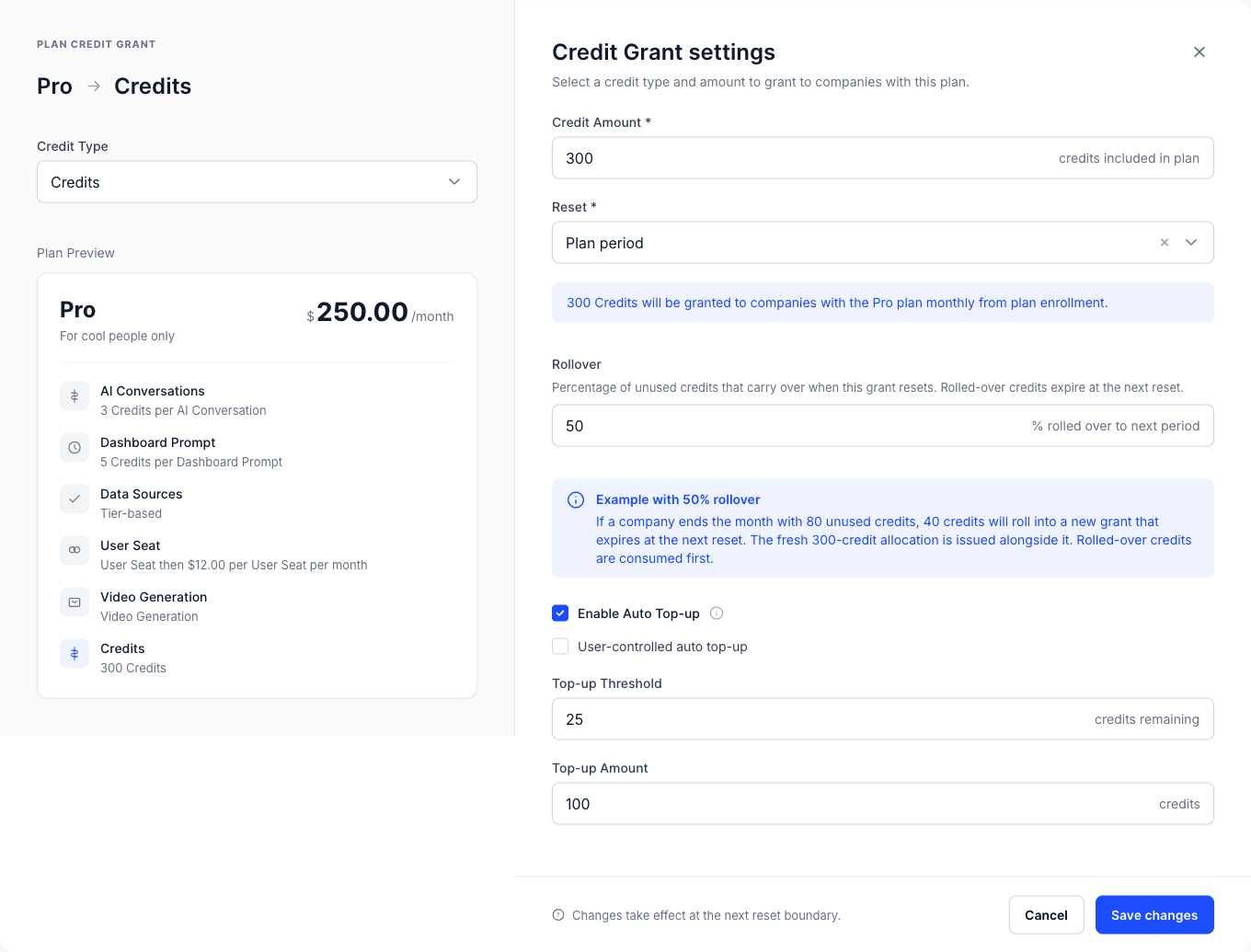
It's easy to configure credit burn, grant, and rollover policies.
Orb focuses on large-scale event ingestion and invoice calculations. It uses five interconnected concepts to bill customers for usage.
First, it records customer activity sent to Orb's ingestion API. Next, teams define what to measure and configure usage-based rates.
The fourth concept involves bundling prices into a product offering. This could be a monthly subscription fee, storage costs, or an annual commitment.
Lastly, customers are connected to a subscription plan that specifies versions, start date or optional end date, and overrides.
Orb can even aggregate billions of events per day when higher usage volume is needed.
Price Modeling
Schematic provides one engine for modeling. It can ship seat-based, usage-based, credit-based, and hybrid pricing models.
It also stores pricing as data on a real-time ledger. That means a plan change becomes a config change.
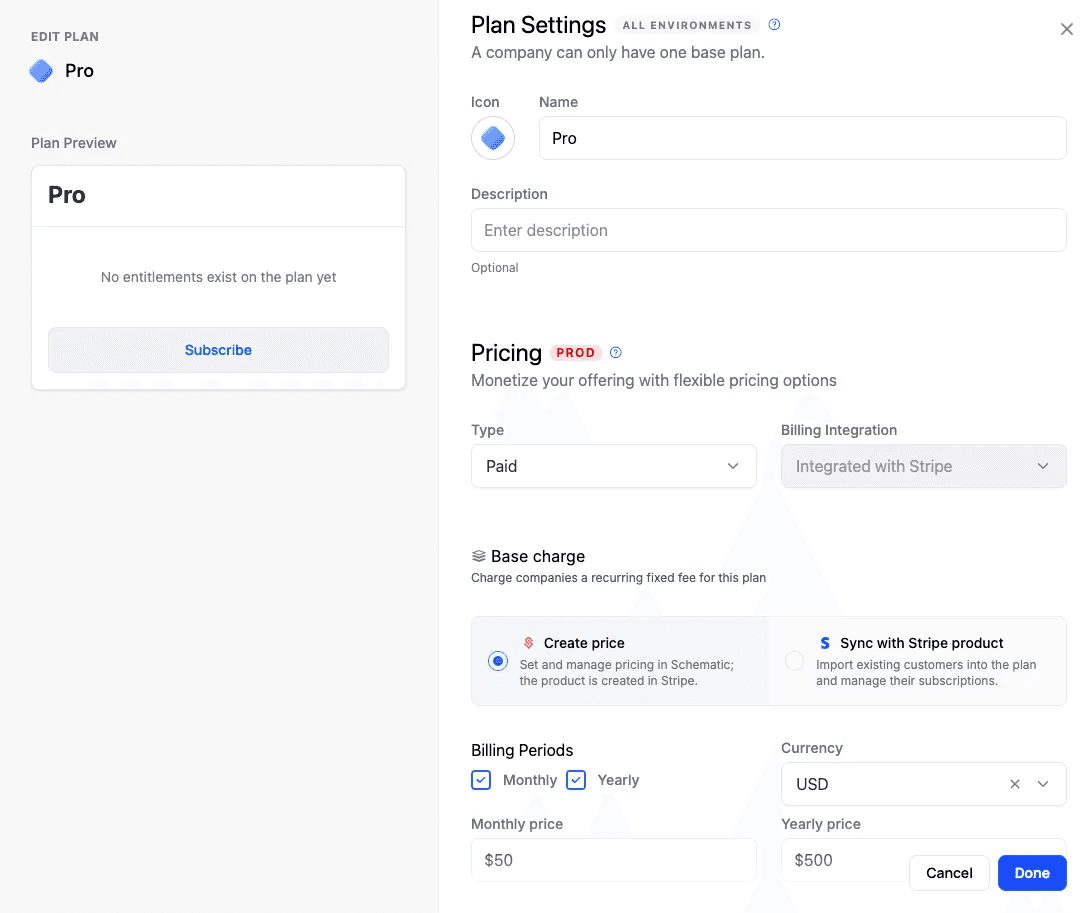
With Schematic, you can model any pricing or packaging without code and continuously iterate on monetization. Define the charge type, set the billing period, and change the currency for global billing.
Zach Hawtof from Titanet shares, "Schematic gives us the ability to reconfigure plans without having to reconfigure the product itself, which is huge when we need to iterate quickly."
Orb supports flexible price modeling. It can implement seat-based pricing, tiered pricing, fixed subscriptions, prepaid credits, dimensional pricing, and threshold billing.
It can also adjust price points by offering volume discounts, minimums, and maximums. Plus, custom pricing models can be embedded into the platform using Python code.
The main difference between Schematic and Orb is the amount of time required to change pricing. Schematic lets you configure plans, limits, trials, add-ons, and overrides via the user interface (UI) without engineering. Orb needs significant engineering time to implement different pricing models.
Entitlement Management
Schematic includes runtime entitlements as part of its complete usage billing platform.
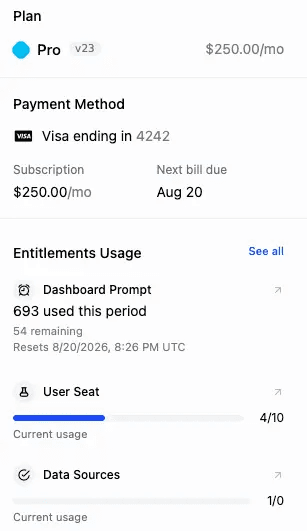
The product calls on Schematic to check the customer's plan, current usage, remaining balance, limits, and account overrides before allowing a feature to run.
Policies, such as spending caps and the top-up amount, take effect the moment they are saved without deploying code.
Every entitlement check and metered event streams back to the ledger used for billing. This allows the product to read accurate balances, limits, and usage in real time.
Orb lacks a built-in entitlement management system. It only supports generic entitlements for seats, bots, AI agents, and machines tied to a subscription plan.
Orb's metering system can send alerts, webhooks, and billing signals, but developers still need to connect those signals to feature gates, upgrade flows, and metered paywalls inside the product. That requires writing and maintaining complex entitlement logic inside the product.
Usage Visibility and Spend Controls
Schematic gives customers real-time visibility and control over their consumption, making it easier to trust usage-based pricing.
Buyers can see usage in a portal and filter consumption by seat or by agent. They can quickly predict spending and identify which users typically cause bills to spike.
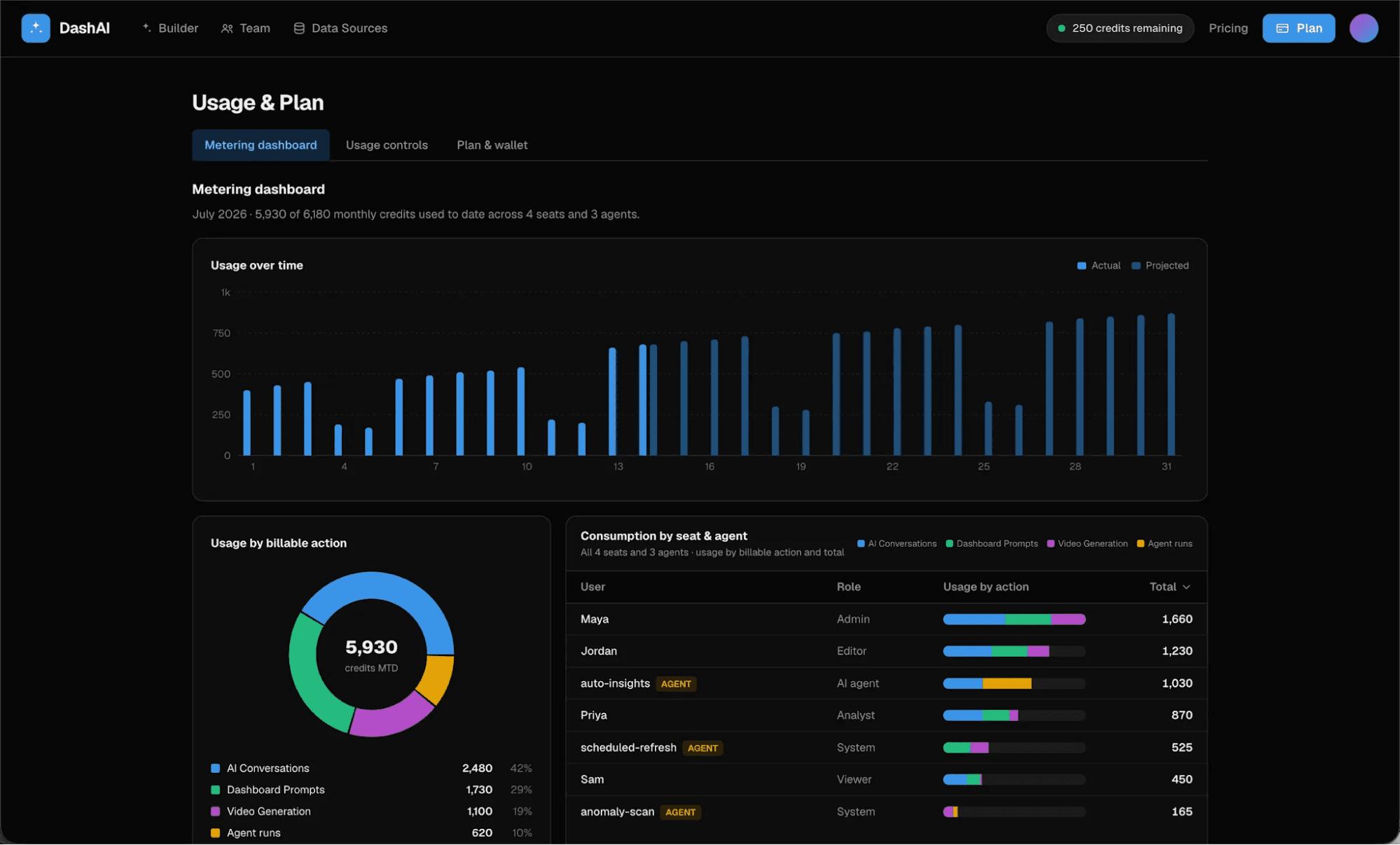
With Schematic, customers can also set spending limits, receive warnings before usage stops, and define what happens at the cap. Hard limits block access once the threshold has been reached, while soft caps enable continued access and overage pricing for usage beyond the set allowance.
Orb provides self-service spend controls, pricing calculators, checkout flows, and advanced dashboards. These prevent billing surprises because customers already know their current usage before the billing period ends.
The key difference between the two platforms is how the product responds once the limit is reached. Schematic has runtime entitlement checks built into the billing platform for access control. Orb still requires engineering to write custom logic and maintain product behavior in real time.
Pricing Simulations
Both usage-based billing platforms let teams test pricing changes before billing customers.
Schematic can replay real usage against a draft plan and see how the new model may affect revenue.
Teams can test new subscription fees, included credits, and other plan settings before publishing the final version. Every plan edit becomes a new draft version that you publish once you’re ready.
After publishing new plans, decide how to handle current subscribers. You can migrate all of them, choose specific companies, or keep them on their legacy version.
Max Ade from Pickleheads says, "Schematic lets us change plans in one place and cascade updates to everyone, migrate customers between plans, and run pricing experiments without any manual implementation."
Orb lets teams test price models against real product usage, compare different scenarios, apply changes to specific customers, and analyze monetization trends before launch.
The platform also helps companies understand the impact of a price change on their most valuable customers. This allows them to know whether an update is right or wrong.
Orb even provides built-in tools for deeper pricing analysis. Schematic's advantage is that simulation sits beside plan configuration, billing, credits, and runtime entitlements, so teams can test a model and then apply it using the same monetization platform.
Revenue Recognition
Schematic records each credit grant, draw, expiration, transfer, price, and timestamp in its append-only ledger.
Finance teams can send this data to their accounting or revenue recognition system and apply their own policy under ASC 606 and IFRS 15.
Schematic simply acts as the usage metering and billing platform. It does not create journal entries or deferred revenue schedules.
Orb takes a different approach. It turns product usage data into financial information that accounting professionals can operate in real time.
Teams no longer pull data manually or connect an API. They can see data directly inside Orb and forward it to existing revenue recognition tools. Those platforms make sure that revenue is recognized in compliance with GAAP and ASC 606.
Developer Experience
Schematic makes developers' lives easier so they can focus on core product development, not billing infrastructure.
It's easy to connect Schematic to your app. Developers simply install the monetization SDK, tell Schematic which company is active, meter consumption, and enforce entitlements.
The people closest to the customer relationship (sales reps, product managers, and RevOps) can configure pricing in the dashboard. They can quickly change plans, features, and allowances without requiring engineering time.
In Orb, engineering owns most of the billing stack. They need to define event schema and ingestion data before expressing SQL-based billable metrics.
To send the first usage event, teams must enable test mode, generate an API key, set up Postman, construct event payloads, send the event, and check the response.
When pricing needs to change, billing engineers should sync updates between different systems to ensure accuracy.
Orb provides full control over usage billing, but that also means a lengthy engineering sprint before launching a new model.
Security and Observability
Both Schematic and Orb provide enterprise-level security features for software and AI companies.
Schematic complies with SOC 2 Type 2, GDPR, and PCI Level 1 requirements through the native Stripe integration.
It also offers single sign-on (SSO), two-factor authentication (2FA), and real-time audit logs for faster implementation and debugging.
Schematic also uses client-side rule evaluation and the Replicator to ensure reads do not leave your network.
Orb protects sensitive data using encryption, access controls, and best practices for data handling. It maintains SOC 1 and SOC 2 Type 2 certifications.
Meanwhile, role-based permissions, authentication mechanisms, and audit logs help teams manage internal governance workflows.
Pricing Plans
Schematic offers three plans for companies at different growth stages.
- Starter (Free): Gives small businesses and startups free access to the whole platform. Companies receive 10 subscriptions, 2 company overrides, 500k monthly events, and unlimited flags, companies, components, and features.
- Growth ($400/month): Offers unlimited subscriptions on top of 20 company overrides, 10m events per month, data exports, and a 30-day audit log retention.
- Enterprise (Custom pricing): Supports scaling organizations with unlimited overrides, events, webhooks, service level agreements, and direct access to a dedicated billing engineer.
Orb is also available in three different pricing options. However, the cost of each plan is not fixed and publicly accessible. Instead, the platform follows custom pricing for each option.
- Core: Offers real-time event ingestion, alerting, usage billing, invoicing, automated price changes, and integrations with tax management solutions.
- Advanced: Adds more integration options with data warehouses, Salesforce, and NetSuite.
- Enterprise: Includes enterprise service level agreements and dedicated customer support.
How to Choose Between Schematic and Orb
The decision will depend on how much billing control your team needs and how much engineering time you want to spend on monetization.
Schematic suits companies that need faster pricing changes, self-service controls, credit management, and runtime enforcement.
The ability to iterate quickly is especially important as software pricing moves away from seat-based pricing. The PricingSaaS Trends Report reveals that one in five companies are making AI pricing changes.
Orb fits teams that want granular control over large usage volumes.
Choose Schematic when you need to:
- Ship pricing and packaging changes without deploying code.
- Meter usage events in just a few clicks.
- Enforce plan limits and software entitlements inside the product.
- Give customers complete visibility and control over their consumption.
- Implement any pricing model, including seats, credits, and custom pricing.
- Support self-serve, sales-led, and hybrid go-to-market strategies.
- Version plans, migrate customers, and test new pricing without filing an engineering ticket.
Use Orb when you want to:
- Process high volumes of usage events.
- Build complex, multidimensional billing metrics.
- Create detailed invoices with tier and dimension breakdowns.
- Give finance teams deep control over invoice calculations.
- Use a dedicated billing engineering team to build gating, portals, paywalls, and upgrade flows.
Schematic Implements Usage-Based Pricing Faster Without Hurting Customer Trust
Schematic is the best usage-based billing platform for AI and software companies that want to close large accounts faster.
Pricing lives as data on a real-time ledger. That means teams can configure plans, limits, features, add-ons, and exceptions through the UI.
Engineering no longer needs to deploy code or maintain complex billing logic inside the product. The people closest to the customer relationship can continuously iterate on monetization.
Speed doesn’t mean you need to compromise customer trust. Schematic solves the trust problem in usage-based pricing by giving buyers real-time visibility into usage, spend forecasts, and self-service controls.
Enterprise credit wallets let them set usage limits, change auto top-up policies, and decide how the product will react once the cap has been reached.
Rahul Gill from Macabacus shares, "Schematic's ability to offer usage caps, bundles, and top-ups gave our customers the cost predictability they need."
Native wallets also record every grant, burn-down, rollover, and expiry to help finance teams reconcile data and meet revenue recognition rules.
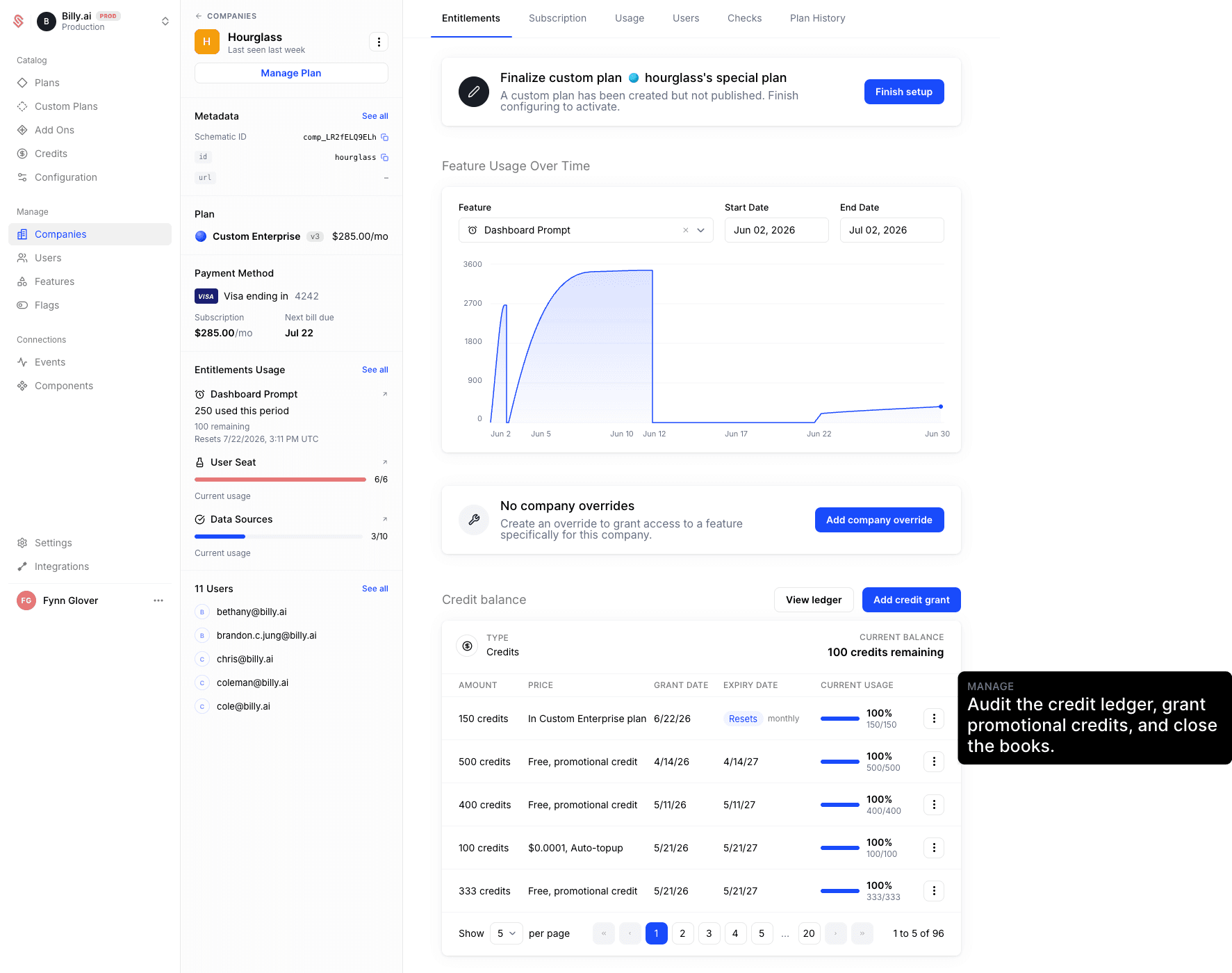
The entitlement engine enforces limits at runtime and uses one flag check that works in React, Node, Python, and Go. Balances, limits, and usage stay current everywhere your product reads them.
FAQs About Schematic vs. Orb
Which is the better usage-based billing system: Schematic or Orb?
Schematic is better suited for teams that want usage metering, billing, credit wallets, entitlements, runtime enforcement, and customer controls in one platform. Orb makes more sense for companies that need deep billing logic, complex invoice calculations, and large-scale event ingestion.
Can companies use Schematic for monetizing AI products?
Yes. Schematic supports AI monetization by charging customers based on tokens, API calls, credits, agent actions, and other usage metrics. Companies can sell prepaid credits, meter consumption, enforce limits in real time, and show customers current usage.
Why should you choose Schematic over Orb?
Choose Schematic if you want to change pricing and plans faster without requiring engineering time. It also connects usage billing to runtime entitlements, credit wallets, spend controls, and real-time usage portals. These prevent runaway bills and unexpected access throttling.