Rollout vs. LaunchDarkly: Feature Management Tool Comparison
Read our Rollout vs. LaunchDarkly review and find out how the two platforms compare. Discover what makes Schematic the superior alternative to both.
 Ryan Echternacht
On this page
- Overview
- TL;DR
- Rollout vs. LaunchDarkly: What's the Difference?
- Rollout Key Benefits and Features
- LaunchDarkly Key Benefits and Features
- Rollout vs. LaunchDarkly: A Detailed Comparison Breakdown
- Feature Management
- Feature Release Controls
- Targeting and Segmentation
- Health Checks
- Product Analytics and Insights
- Audit Logs
- Integration Options
- Security Features
- Pricing Plans
- How to Choose Between Rollout and LaunchDarkly
- Beyond Feature Flag Management: Why Do You Need Software Entitlements?
- Schematic Offers Entitlements and Usage-Based Billing Your Customers Can Trust
- FAQs About Rollout vs. LaunchDarkly
- What is LaunchDarkly used for?
- What is the best feature flag management tool?
- Who does LaunchDarkly compete with?
- Is Rollout the same as CloudBees Feature Management?
A new feature can work in testing and still cause problems when customers use it in production. For SaaS and AI companies, that risk grows when a feature release changes how users work or how an AI tool responds.
Feature management tools help teams release software changes to a small group first, watch what happens, and turn a feature off if needed.
Both Rollout and LaunchDarkly are feature management platforms that control who sees a feature after code goes live. But they are at different points today.
CloudBees acquired Rollout, and its feature management capability is currently a part of CloudBees Unify. LaunchDarkly combines feature flags, release controls, and a runtime control system for AI and software products.
This article covers the main differences between Rollout and LaunchDarkly to help you choose the right platform that meets your core business needs.
TL;DR
Both Rollout and LaunchDarkly can control software releases with feature flags.
Rollout is now part of the CloudBees Unify platform. It focuses on releasing features at the speed of business, improving real-time visibility, and governing each change by default.
LaunchDarkly extends feature flags into a runtime control platform. It can control feature exposure, monitor behavior in real time, and adapt instantly as conditions change.
Feature management tools fall short because they only handle releases. Companies also need software entitlements to determine what a company can access for monetization purposes.
Schematic is the complete monetization platform that combines usage-based billing with runtime entitlements enforced inside your product.
Rollout vs. LaunchDarkly: What's the Difference?
Rollout lets engineering teams and product teams decide who sees a feature after it has been deployed. They can use feature flags to target users, release a change in stages, and turn it off if problems arise.
Rollout's feature management tool is now part of the CloudBees Unify platform. CloudBees adds continuous integration/continuous delivery (CI/CD), smart tests, release orchestration, and analytics on top of feature flags.
LaunchDarkly is a runtime control platform that gives companies full control over code and AI agent behavior while their products run in production.
Multiple teams can change who sees a feature, test different versions through experimentation, and monitor individual user behavior in real time without code deployment. They can even respond to problems and take action instantly after software and AI systems have been released.
The main difference is scope.
Rollout handles feature releases alongside governance, security, and compliance throughout the software development lifecycle. LaunchDarkly extends feature flags into a complete runtime control system. It focuses on changing prompts, routing, and system behavior in production.
Rollout Key Benefits and Features
Rollout’s main benefit is that teams can release features faster and manage access control after deployment.
The platform helps software and AI companies test a release with a small group, expand access in stages, or turn a feature off if something goes wrong. This gives them complete control over feature exposure without a new deployment.
It also connects feature flags to the tools developers use to build and release software. Teams can see what changed, review flag activity, and track release decisions.
Below are the key features of Rollout:
Git-native release controls: Developers can manage feature flags through Git. Working in a familiar environment leads to less friction, faster outcomes, and fewer errors.
Flag impressions: Evaluate feature flags and record impressions to reveal whether flags are active, have a fixed value, or have become entirely quiet.
Configurable targeting and rollout: Control which users receive specific features and when they receive them.
Release orchestration: Coordinate feature releases in various environments and support automated sequencing, approvals, and rollback.
Governance controls: Define who can change a flag, require reviews before deployment, and track every release decision for audit purposes.
Built-in AI assistant: Use the AI assistant to filter content, ask questions, and navigate the CloudBees Unify platform.
LaunchDarkly Key Benefits and Features
LaunchDarkly helps SaaS and AI teams control what happens after they deploy code. Feature flags determine which users or features get released. LaunchDarkly extends those flags to show how a change performs and take action instantly in production.
That link between seeing a problem and acting on it is the main benefit of using LaunchDarkly. Teams can test changes with selected users, watch for errors, and roll back a release when results get worse.
For organizations shipping AI features, the same approach can help them manage changes to code and agent behavior.
Here are the core capabilities of LaunchDarkly:
Progressive and guarded rollouts: Select the release option based on your desired outcome. Progressive rollouts automatically increase traffic to a flag variation over time. A guarded approach monitors metrics before rolling out the feature.
User targeting and segmentation: Show a feature to individual users or customer segments based on account details, traits, or custom rules.
Automated rollbacks: Disable problematic features immediately without deploying code.
A/B tests and continuous experimentation: Run experiments to measure the impact of feature releases on your app or infrastructure. For example, you can track page views, clicks, load time, and infrastructure costs.
Real-time observability: Use session replay, error monitoring, logging, and observability metrics to optimize performance, identify bugs, and troubleshoot issues.
Native data warehouses: Connect LaunchDarkly to an external data warehouse and use stored data to measure audience behavior.
Rollout vs. LaunchDarkly: A Detailed Comparison Breakdown
Here is a side-by-side comparison of Rollout and LaunchDarkly.
Feature Management
In Rollout, feature management is not just a standalone tool. It connects release decisions, governance, and visibility into a system of control.
Teams can set targeting rules, release a feature to a small group, and change exposure after deployment using Git-native controls.
Rollout also provides real-time insights into configuration and activity statuses. These help companies track what’s live, what’s changing, and who owns risk in multiple teams and services.
Meanwhile, LaunchDarkly uses feature management as a framework for software development, testing, and experimentation.
To manage feature flags, developers first need to create them in LaunchDarkly and describe feature variations. Next, they connect their application using built-in SDKs and use the same SDK to define rollout and targeting rules.
The server-side SDKs send analytics events to LaunchDarkly to record each context, which describes the entities that encounter flags inside the app. It focuses on monitoring and optimizing releases once they've been deployed.
Feature Release Controls
Rollout supports coordinated releases for several environments or databases. It can automate sequencing, approvals, and rollbacks to implement complex changes safely.
Teams can also create staged workflows, which break down release activities into structured stages. These enable organized releases, faster debugging, and end-to-end visibility.
Companies can even trigger multiple workflows from a single step, either in parallel or sequentially. This is useful when a release stage needs to coordinate multiple independent deployment workflows for different components.
LaunchDarkly provides several release options so that teams can choose one that meets their release goals.
A percentage rollout serves a flag variation to a fixed percentage of contexts. A progressive rollout raises that share over time. A guarded rollout watches selected measures and can roll back when results get worse.
In addition to release options, LaunchDarkly provides release management tools. These include approvals, triggers, monitoring, required comments, required confirmation, and scheduled changes.
Targeting and Segmentation
Both Rollout and LaunchDarkly support feature flag targeting, but they are configured differently.
In Rollout, targeting enables gradual rollouts, user segmentation, and scheduled releases based on user traits, groups, and complex conditional logic.
Teams can control flag behavior and target customers using built-in or custom properties, such as location, device type, or user attributes. Alternatively, they can show features to pre-defined segments through target groups.
Companies can also create dependencies where one flag’s behavior affects another. When this option is enabled, related functionality activates together.
LaunchDarkly can target specific context attributes, individuals, segments, mobile apps, and devices.
Teams can configure feature flags in LaunchDarkly to serve different software variations to multiple end users. Each feature flag must have a default rule and may include prerequisites, individual targets, and targeting policies.
Companies can even release features based on custom rules and set expiration dates. Adding expiry means customers only receive a flag for a specific period of time.
Health Checks
Rollout analyzes four main signals that impact flag health, namely impressions, activity status, environment comparison, and cleanup candidates.
Impression data: Determines whether a flag is active, settling, or dormant.
Activity: Describes where a flag sits in its lifecycle.
Environment comparison: Reveals whether a flag is configured consistently. For example, a flag can be active in production but stale in staging.
Cleanup candidates: Stale or inactive flags that warrant a closer review.
By providing valuable insights into flag health, Rollout helps companies determine whether feature releases are affecting user behavior or accumulating as technical debt.
LaunchDarkly only supports health checks for progressive and guarded rollouts. It displays a health check status to confirm the release setup and troubleshoot any configuration issues.
Progressive releases can show either of these messages:
[context kind] contexts are evaluating your flag: The flag receives evaluations from the expected context kind.
[context kind] contexts are not evaluating your flag: The flag fails to receive evaluations because of a switched-off flag or the SDK omits evaluations from that context kind.
Possible status messages for guarded rollouts include the following:
Health check waiting: The platform needs additional evaluation or metric data before evaluating the rollout’s health.
Healthy: LaunchDarkly successfully receives evaluations, while selected metrics receive events. The context also aligns with selected randomization units.
Health warnings: This means that at least one configuration issue prevents the system from measuring the rollout.
Product Analytics and Insights
Rollout supports feature flag analysis by collecting data from workflows, integrations, and platform operations. It can surface performance, security, and business metrics to improve decision-making around delivery quality and team velocity.
Analytics dashboards can compare deployment performance against industry benchmarks and identify areas for improvement.
The platform also monitors flow metrics (e.g., value stream efficiency or process bottlenecks) to help you optimize the software development lifecycle.
LaunchDarkly offers product analytics events with observability features. These make it easier to understand how system performance affects user behavior.
Supported SDKs can record web clicks, mobile taps, page views, screen views, app launches, lifecycle changes, and custom metric events.
You can view those events alongside errors, log messages, and other app data. You can see whether a slow or faulty release changed how customers use a feature.
Audit Logs
Both Rollout and LaunchDarkly provide audit logs to help you track feature changes.
Rollout shows the audit history for individual flags to meet compliance and help you troubleshoot problems faster.
You can filter that history by app, entity type, entity name, environment, or date range. You can also access the "audit log" tab, which makes it easier to check what changed during a release.
LaunchDarkly records all changes applied to any resource in the system. You can review them using the audit log API to search by time and select entries.
On the client side, the information appears on the "change history" page inside LaunchDarkly's user interface.
Integration Options
Rollout connects feature management to the tools you already use to build and ship software. It integrates with source code management (SCM) systems, CI/CD software, container registries, and project management tools.
You can easily create, update, test, and delete integrations in one place. This helps unify your entire development and deployment ecosystem.
LaunchDarkly works with several third-party vendors so you can configure the product to your specific needs.
LaunchDarkly integrates with collaboration platforms, edge tools, environments as a service (EaaS), internal developer platforms (IDP), and monitoring tools, among others.
Choose the feature management platform depending on where you need the connection. CloudBees ties flags to the delivery process, while LaunchDarkly gives teams more ways to act on production signals.
Security Features
Rollout adds security scanning to existing pipelines. It shares regular feedback on code vulnerabilities as part of your company's regular development workflow so you can ship features with confidence.
The platform also offers security scanning tools through the built-in Marketplace. It lets you choose which tools to enable and configure their settings.
Plus, Rollout provides access to the security overview dashboard. This is where you can monitor the latest security metrics for all your applications and filter findings by SLA status or severity.
LaunchDarkly focuses on securing access to its platform and the release controls used in production. It supports single sign-on, multi-factor authentication, domain checks, IP allowlists, and session management.
You can also create API access tokens to authenticate users through LaunchDarkly's REST API. You can even enable or disable organization access settings. These allow employees to find and join your LaunchDarkly accounts.
Pricing Plans
CloudBees hides the cost of Rollout and feature management on its website. Pricing differs based on a team’s delivery environment. This can slow down the procurement process because companies need to talk to sales.
On the other hand, LaunchDarkly shows three plans on its pricing page.
Developer (Free): It includes unlimited seats, unlimited flags with targeting, AI configs, A/B tests, and observability for apps and large language models (LLMs).
Foundation (Pay-as-you-go): LaunchDarkly bills companies for what they use. This plan adds unlimited projects, unlimited environments, and approval requests for flags and experiments.
Enterprise (Custom pricing): It provides full controls and security for engineering teams at scale. SCIM provisioning, IdP team sync, custom roles, unlimited audit history, bulk targeting, and code references are available in this tier.
How to Choose Between Rollout and LaunchDarkly
Deciding between Rollout and LaunchDarkly depends on your feature release workflow and what you need to control after deployment.
Choose Rollout when you already use Jenkins controllers or CloudBees CI or Jenkins and want to orchestrate software releases within a unified interface. You'll also find Rollout suitable if you need to ship features continuously and turn problematic releases off without redeploying code.
LaunchDarkly makes sense if you want a complete runtime control system that goes beyond feature flags. You can manage product behavior after deployment, adapt to real-world conditions, and respond to issues faster.
Beyond Feature Flag Management: Why Do You Need Software Entitlements?
Feature flags turn a feature on or off in code. Software entitlements determine what a customer has bought and can use, such as a feature, a seat count, or a usage limit.
Developers often use flags to control a feature release, while product managers and billing teams need SaaS entitlements to manage paid access.
This difference becomes important when a customer upgrades, buys an add-on, or signs an enterprise deal. The product needs to give that customer the correct access at the right time.
If access rules live only in separate flags or backend checks, a plan change requires manual work and leaves the product out of sync with the contract.
Software entitlements translate commercial agreements (custom plans, add-ons, overrides) into technical capabilities within your product.
The 2026 State of B2B Software Monetization report shows that 80% of respondents rated entitlement management a high investment priority for the next 12 months. This makes sense since entitlements control what customers can access and how much they pay.
Schematic Offers Entitlements and Usage-Based Billing Your Customers Can Trust
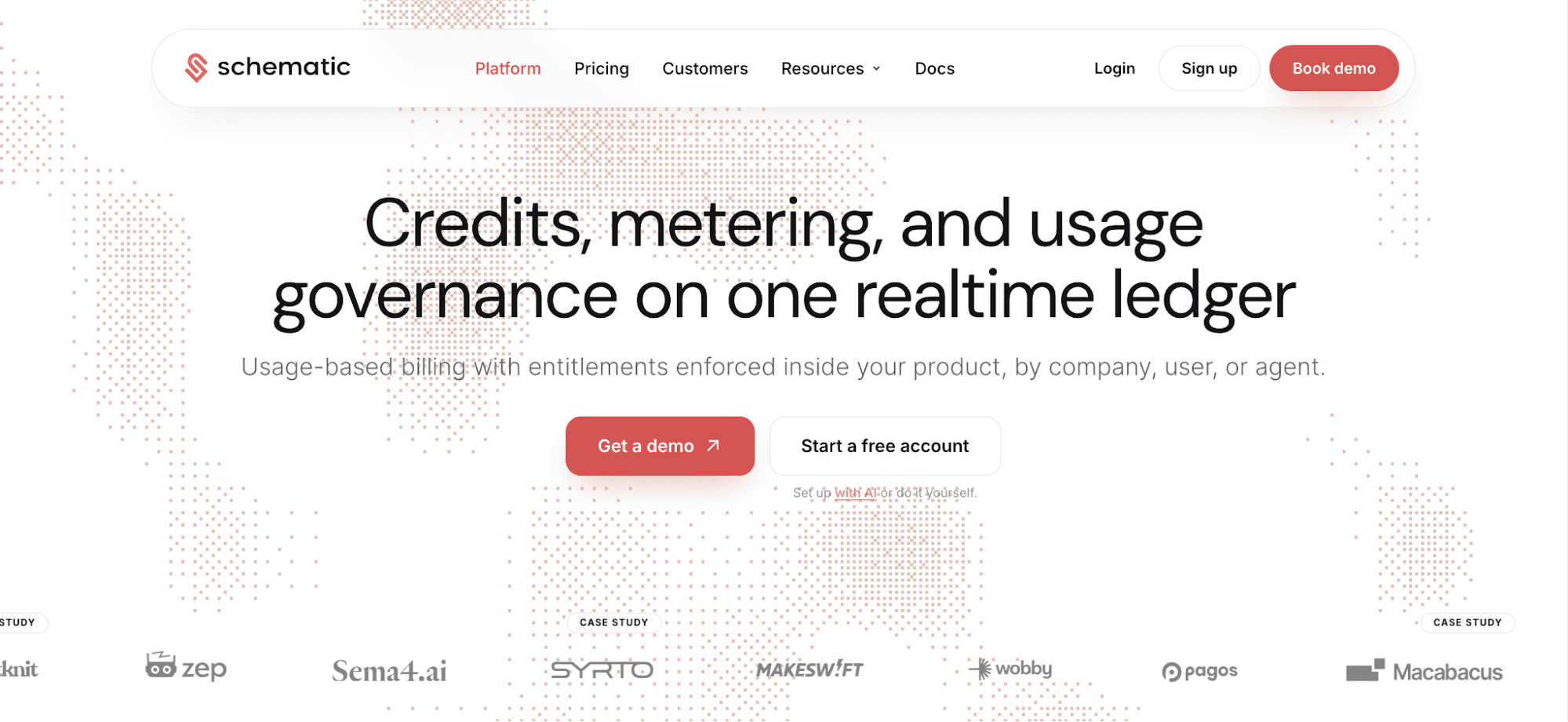
Schematic is a complete billing platform for software and AI companies selling to enterprises. It combines usage-based billing, credits, and metering with entitlements enforced inside your product at runtime.
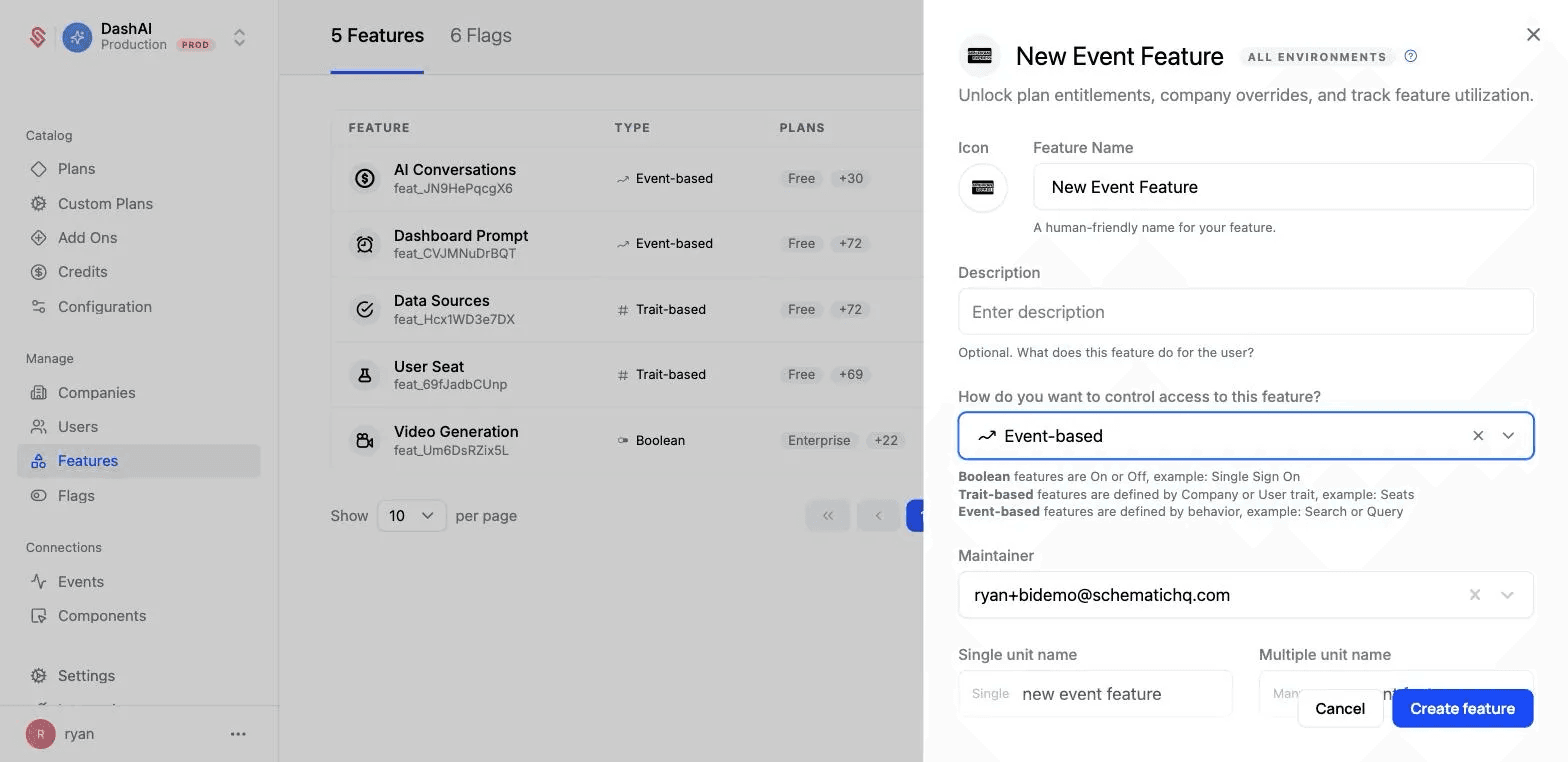
In Schematic, you define feature flags, plans, add-ons, and limits as data. Create boolean, event-based, or trait-based features and map them to plans. Then, enforce them everywhere your product reads them.
Schematic also stands out for its enterprise credit wallets that show users exactly what they use and owe. Customers can set budget caps, forecast spending, receive alerts before usage stops, and manage auto top-ups.
Rahul Gill from Macabacus shares, "Schematic's ability to offer usage caps, bundles, and top-ups gave our customers the cost predictability they need."
In addition to self-serve motions, Schematic can handle sales-led deals. Grant company overrides with an expiration date, create a custom plan, or set payment terms without filing an engineering ticket.
Plus, out-of-the-box billing tools allow you to:
Version plans and migrate customers.
Support any pricing model without a billing rebuild.
Set credit rollover policies, expiry windows, and priority consumption.
Record every grant, deduction, and check for faster debugging.
Use an append-only ledger for ASC 606-compliant revenue recognition.
FAQs About Rollout vs. LaunchDarkly
What is LaunchDarkly used for?
LaunchDarkly helps teams release features to selected users without redeploying code. Companies use it for controlling rollouts, testing different versions, analyzing results, and turning off a feature if problems appear. It also provides the ability to take action instantly in production.
What is the best feature flag management tool?
The best tool depends on your needs and release workflow. LaunchDarkly is a strong choice for teams that want a full runtime control platform for optimizing both code and AI systems. Rollout may suit companies that need to release and roll back features at the speed of business.
Who does LaunchDarkly compete with?
LaunchDarkly competes with Rollout, Statsig, Flagsmith, and Unleash. All these tools support feature flags, but they differ in how they handle targeting, tests, and release controls.
Is Rollout the same as CloudBees Feature Management?
Yes, CloudBees acquired Rollout and merged it into its feature management platform. CloudBees Feature Management provides the control layer that lets developers ship features continuously while retaining real-time visibility and governance.