All posts
Schematic vs. Metronome: Which Is Better for Usage Billing?
Blog· Ryan Echternacht·Oct 18, 2026
Usage-based billing is becoming a popular choice for SaaS and AI companies. Instead of charging only by seats or software access, organizations can bill customers based on API calls, tokens, credits, storage, or other product consumption.
That shift makes usage billing platforms much more important. Teams need software that can meter usage, apply pricing rules, support AI credits, enforce usage limits, and connect product access to what customers pay for.
This is where Schematic vs. Metronome becomes an important comparison. Both platforms support usage-based billing, but they focus on different parts of the billing stack.
Metronome mainly provides metering for infrastructure companies with substantial event volume. Meanwhile, Schematic fits software and AI businesses looking for a complete usage billing platform that combines metering, runtime entitlements, credit wallets, and self-service controls.
This guide breaks down the key differences between Schematic and Metronome to help you decide which one fits your usage billing requirements.
TL;DR
- Both Schematic and Metronome are usage-based billing platforms, but Schematic offers more features when it comes to AI monetization.
- Schematic combines metering, billing, runtime entitlements, limit enforcement, and self-service controls to solve the trust problem in usage-based pricing.
- Metronome is best known for usage metering and contract management, but it doesn't enforce access and limits inside the product.
- Schematic is the better choice for software and AI companies selling to enterprises that need real-time usage visibility, detailed invoicing, and customer-facing wallets.
Schematic vs. Metronome: What's the Difference?
Schematic is a complete usage-based billing platform for AI and software companies selling to enterprises. It helps teams close larger accounts by solving the trust problem in usage-based pricing.
Unlike traditional billing solutions, Schematic gives customers real-time visibility and control over their consumption. Runtime entitlement enforcement also helps teams manage what customers can access in the product.
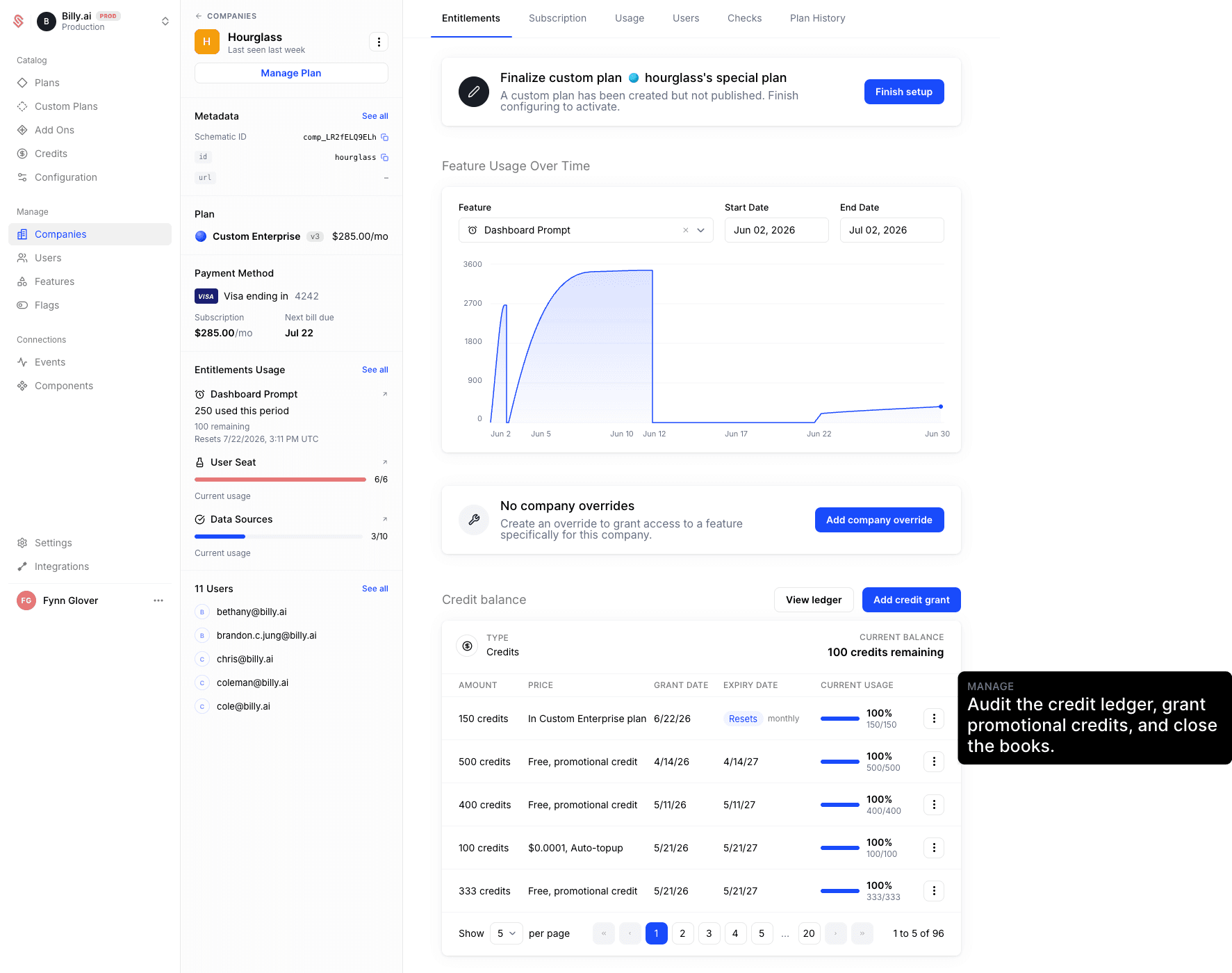
Schematic can also model any pricing, including usage, seats, credits, and hybrid pricing. It even includes out-of-the-box billing tools for AI monetization, such as credit grants, concurrency-safe holds, overrides, plan versioning, and an auditable ledger for ASC 606 compliance.
Metronome provides the monetization infrastructure for product-led scale and sales-led motions. It has partnered with Stripe Billing to handle usage billing for AI and infrastructure companies dealing with high event volume.
Metronome combines real-time metering, pricing, billing, and financial reporting in one platform. It's the central source of truth that product, finance, and go-to-market (GTM) teams use for value-based pricing.
Both platforms are comparable because they support metering, flexible pricing, and usage-based billing. The main difference is that Schematic also focuses on entitlement logic, runtime controls, and credit management.
Schematic Key Features and Pros
Schematic provides one engine for price modeling, metering, billing, software entitlements, and customer-facing credit wallets.
It's the only billing platform that addresses customer trust.
Here are the capabilities that stand out.
- Enterprise credit wallets: Track credit balances, grants, top-ups, expiry dates, and burn-down in one place.
- Runtime entitlement engine: Monitor customer usage against its cap and enforce limits at runtime.
- Usage metering and billing: Turn metered usage into accurate invoices and support usage-based pricing models (pay-as-you-go, fixed fee with overages, or credits).
- Configurable spending limits and self-service controls: Let customers view usage, set limits, manage auto top-ups, and decide what happens at the cap.
- Credit pricing management: Use credit expiry windows, configure priority consumption, and concurrency-safe holds.
- Plan versioning and customer migration: Version plans, migrate customers, and run trials without engineering help.
- Audit-ready ledger: Track credit-based revenue in an append-only, export-ready ledger for revenue recognition.
- Schematic MCP: Claude, Codex, or your own agent can read billing data from Schematic. Then, send a prompt to list subscription plans, identify customers about to churn, and check real-time usage.
Max Ade from Pickleheads shares, "The Schematic MCP is fantastic, and we now do most of our work in Claude, accessing plan and billing information directly without leaving our workflow."
Metronome Key Features and Pros
Metronome is known for its scalable billing infrastructure. It supports both self-serve and sales-led motions, making it a good fit for companies that need to manage high usage volume and custom plans.
It also gives teams flexibility over pricing, packaging, contracts, and add-ons. Engineering owns most of the billing lifecycle to ensure fine-grained control. But this approach introduces substantial ownership when it comes to pricing changes.
Below are the key features of Metronome.
- Pricing levers: Align pricing with your go-to-market strategy. Support usage-based, subscription, seat-based, credit-based, hybrid, tiered, and custom pricing models.
- Usage tracking and aggregation: Ingest product events, measure billable usage, and translate raw activity data into billable metrics.
- Centralized rate cards: Manage pricing rules, rates, discounts, and customer-specific terms in one place.
- Invoice generation: Apply pricing logic based on the customer's contract and create accurate invoices that reflect usage charges.
- In-app billing dashboards: Give customers real-time visibility into usage and spending inside the product.
- Financial reporting: Create custom or standard reports for margin analysis, revenue tracking, and accurate forecasting.
Metronome suits SaaS companies already running Stripe Billing but need in-depth usage billing capabilities.
Schematic vs. Metronome: Detailed Comparison
Both Schematic and Metronome are powerful usage billing systems, but they differ in entitlements, limit enforcement, credits, and customer-facing controls.
Here's a closer look at their key differences.
Usage-Based Billing
Schematic helps AI and software companies meter consumption and bill for usage using any pricing model. It supports pay-as-you-go, pay-in-advance, subscription-based fees with overage pricing, volume pricing, tiered usage pricing, and credit burndown pricing.
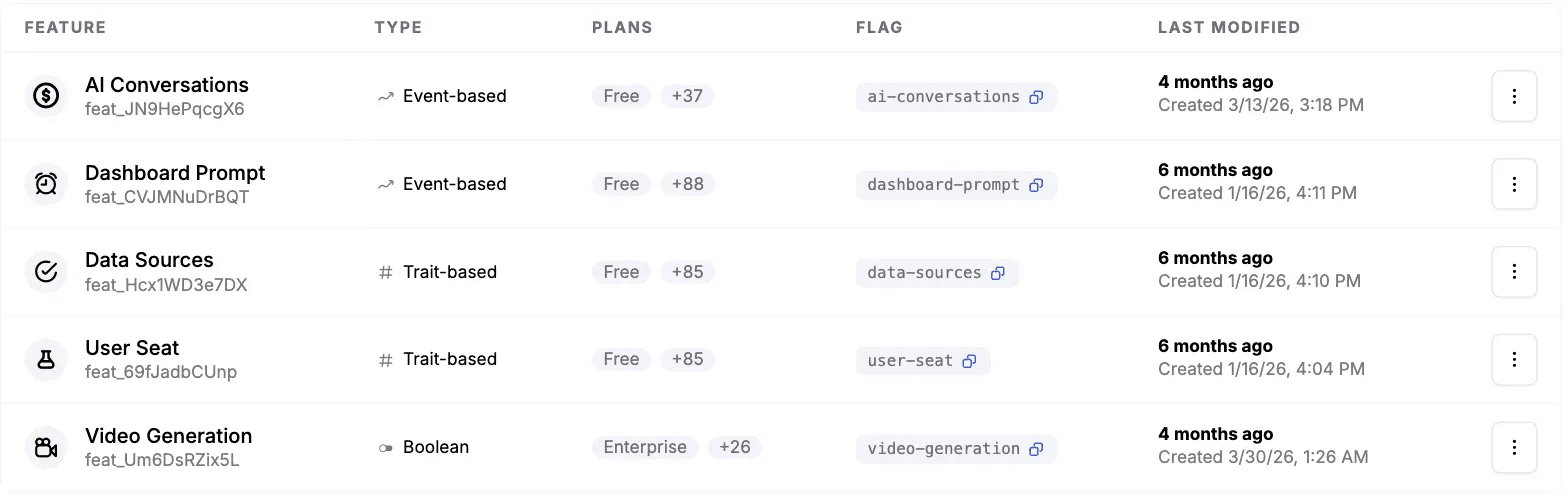
To use Schematic for usage billing, teams simply need to define a metered feature. This could be event-based, such as API calls, tokens, and agent runs, or trait-based for things like active user seats.
Each feature includes the type, plan details, and feature flags. Flags are what the application checks for access decisions and tracks for billing.
Metronome focuses on usage metering and billing calculations. It captures raw events directly from the app and turns them into billable metrics.
To set prices for each usage metric, teams use the product catalog and centralized rate cards inside Metronome. The former is where you define what you're selling, while the latter records the number or amount you are charging for the products.
Metronome generates invoices and sends billing data to another system for payment processing and revenue recognition.
Software Entitlements and Feature Flags
Schematic includes SaaS entitlements and feature flags as part of its complete usage billing platform.
A plan can define which features a customer can use, how much they can use, and what happens when a limit is reached. One runtime check can return access decisions, limits, and current usage, so product access stays tied to billing rules.
Metronome can define product access within contracts, but it does not provide the same product-side entitlement management system.
Engineering needs to build application logic and entitlement infrastructure from scratch that can enforce access and gate features.
That's why Schematic is the better choice when pricing, packaging, and product access need to work from the same source of truth.
Runtime Enforcement
Schematic can enforce usage limits inside the product at runtime. Commercial teams or customers themselves can set hard caps, soft limits, warning thresholds, spending caps, and priority consumption rules by company, user, or agent.
Policies take effect the moment they are saved, so further activity can be blocked before costly usage occurs. This prevents runaway bills and unexpected access throttling.
Metronome can meter usage, provide configurable alerts, and create written contracts with spend thresholds. However, it doesn't handle runtime access and limit enforcement.
The platform regularly has customers, for example, that burn through their credit limit accidentally or fraudulently. This leads to issues, such as margin compression or overspend that leads to surprise bills.
Credit-Based Pricing Support
Both Schematic and Metronome support credit-based pricing, but Schematic wins narrowly in this category due to its robust enterprise credit wallets.
SaaS teams can create a credit type, grant credits on a subscription plan each billing period, and set how many credits each feature consumes.
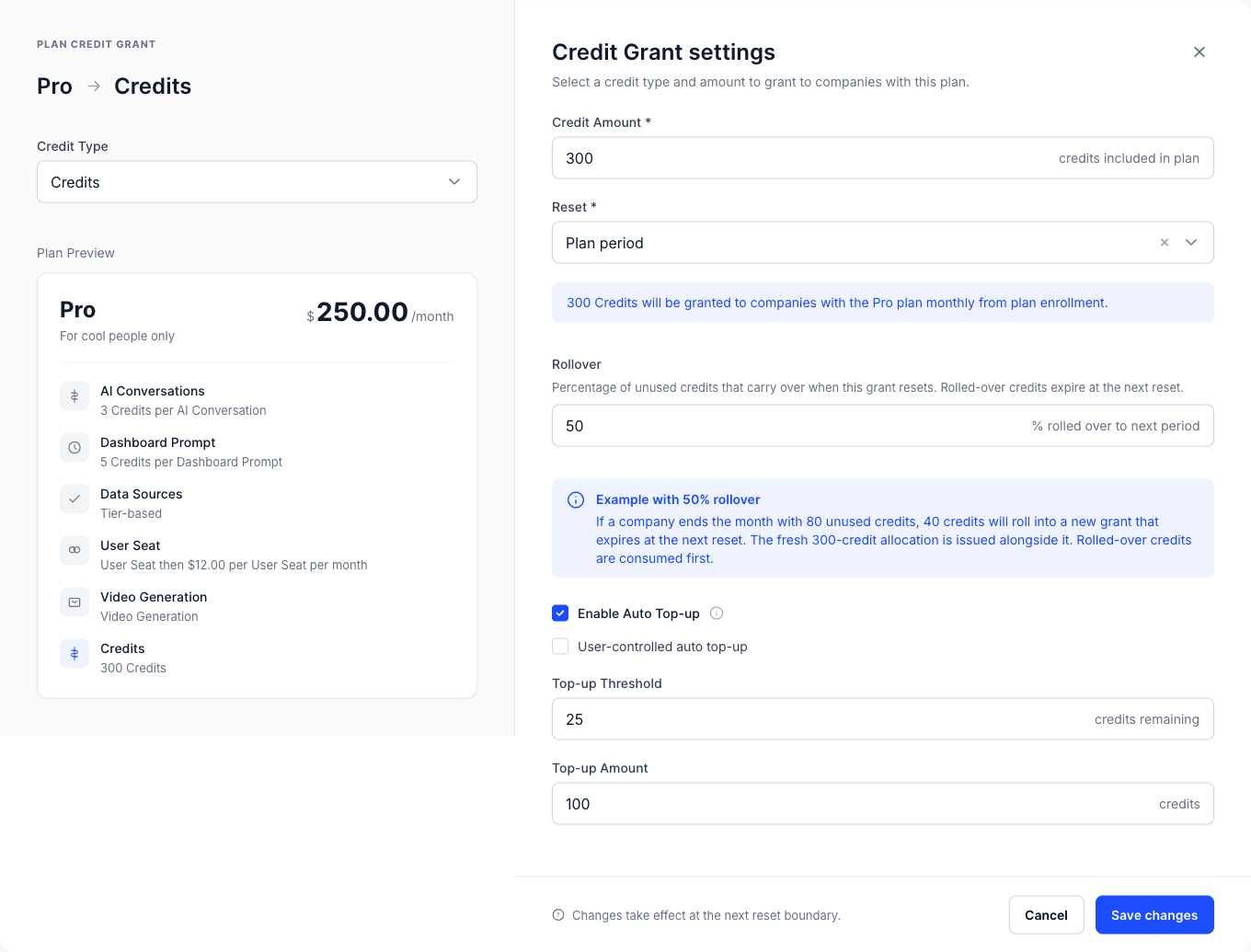
Schematic burns down the balance as customers use metered features. It also enables auto top-ups that customers can configure to ensure uninterrupted usage.
The append-only ledger records every grant, draw, and expiry with its price attached. This is the data that powers revenue recognition.
Metronome uses pricing building blocks to implement credit models. Teams first need to set up a billing provider (e.g., Stripe) to ensure that payments are complete before granting credits.
Metronome also offers automatic recharge and spend previews for credits. However, Metronome must still send webhooks to your billing system, which can lead to delays.
For teams selling AI usage, Schematic is ideal when credits need to control access in real time and give users spend predictability.
Usage Visibility and Self-Service Controls
Schematic gives enterprise customers real-time visibility into their consumption. Buyers can see how much they have used, how much they owe, and when they may hit a limit.
This creates usage transparency and governance while also giving customers full control over variable spending.
Users can set caps per company, seat, or agent and receive warnings before usage stops. They can even configure auto top-ups, forecast spend, and decide what happens at the cap.
Buyers and sellers gain confidence that usage will stay within budget and that customers will only be charged for what they expect.
Rahul Gill from Macabacus shares, "Schematic's ability to offer usage caps, bundles, and top-ups gave our customers the cost predictability they need."
Metronome can power in-app billing dashboards through its APIs. It gives customers clarity over their actual usage and spend.
Metronome can also send alerts when users are near their limits to prevent billing surprises. Plus, cost previews help companies understand the financial impact of their actions before committing.
Developer Experience
Schematic reduces how much billing logic developers keep inside application code. Instead, pricing lives as data on a real-time ledger. That means a plan change becomes a config change, not a code deployment.
Developers tell Schematic who the companies and users are, send usage events for metering and billing, and check entitlements before allowing features to run. They can use monetization SDKs, the REST API, and the model context protocol to integrate Schematic into the company's existing billing stack.
Pricing and packaging changes are configured outside the codebase so they are not disruptive to engineering teams.
In Metronome, developers own usage ingestion, metric definitions, contracts, and alerts. They need to build feature gates, dashboards, customer portals, and upgrade flows to monetize software.
This level of control makes sense for SaaS companies with infrastructure-scale usage models and deep billing engineering resources. But for most businesses, it often leads to weeks or months of engineering work to launch pricing models.
Pricing Iteration
Pricing shouldn't remain static as products, operational costs, and customer needs evolve. According to Growth Unhinged, three in four software companies made changes to their pricing and packaging in 2025.
Schematic treats plans and pricing as configuration instead of application logic. RevOps teams can version plans, preview changes, migrate customers, keep legacy subscriptions active, and apply customer overrides without engineering help.
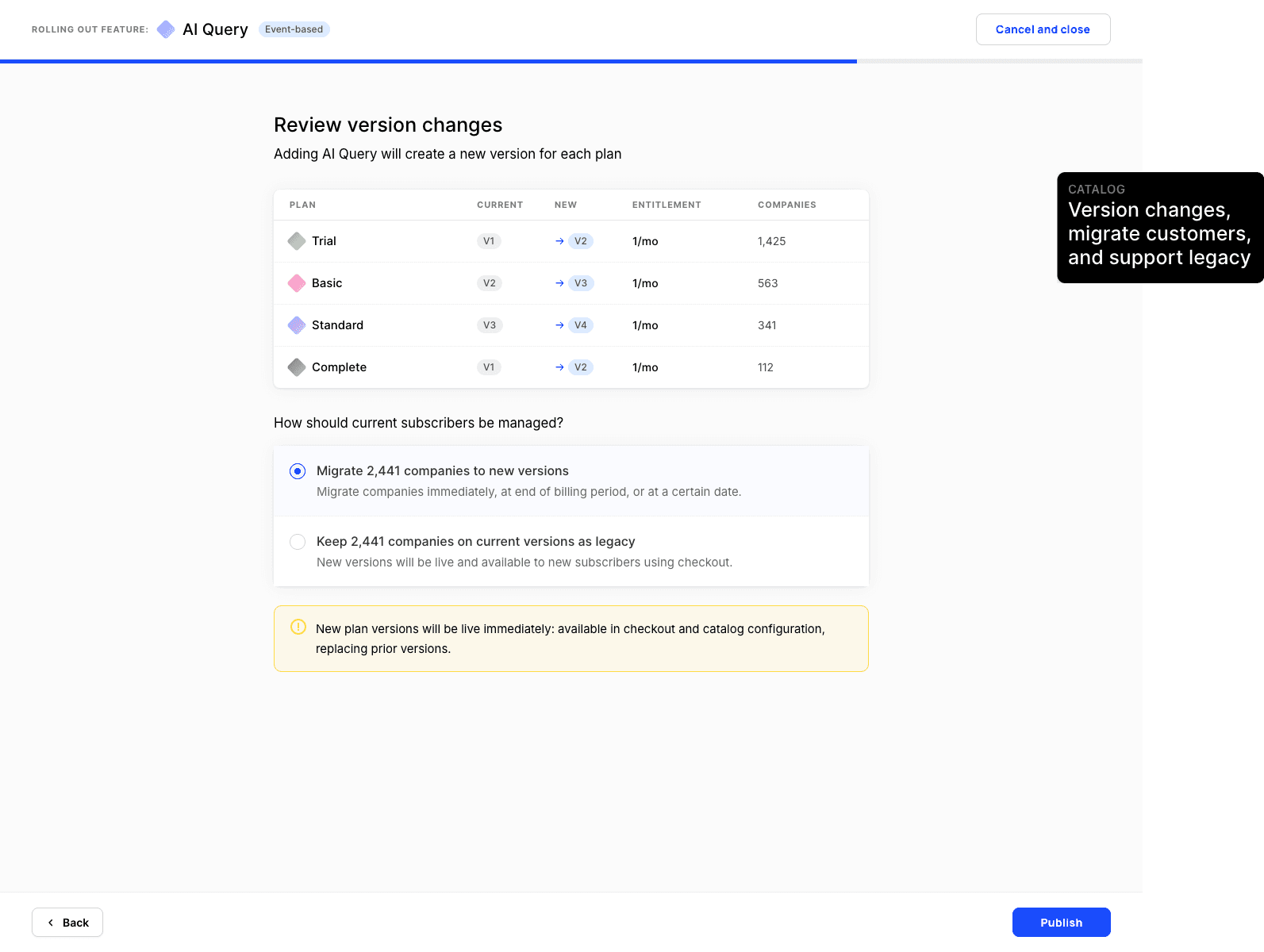
Teams can also test pricing and simulate impact on revenue before billing customers. They can even configure per-seat or per-agent limits, with each credit drawn from a shared company pool.
Metronome offers built-in pricing levers to optimize revenue and align value with GTM strategies. Centralized rate cards enable teams to configure pricing terms and contract agreements in one place.
It can also provide real-time visibility into core pricing models, schedule pricing updates, and customize contracts with flexible discounts, amendments, or customer overrides.
The key difference is that product behavior tied to those changes still requires engineering work when using Metronome.
Integration Capabilities
Schematic integrates with payment solutions, identity providers, customer relationship management (CRM) software, and data warehouses, among other systems.
Customer billing state, organizations, and users come from the identity provider (e.g., Clerk or WorkOS). Meanwhile, usage events can flow from Segment, Salesforce, and HubSpot.
In setups where Stripe handles payments, Schematic supports a two-way sync. That means subscriptions and customers flow into Schematic to power entitlements, and plan changes made through Schematic are sent back to Stripe.
Metronome offers extensive integrations designed to connect your company's entire revenue workflow.
It’s compatible with invoicing and accounting tools, CRM software, tax management solutions, and data warehouses.
The platform even integrates with cloud marketplaces where you can post your products while configuring pricing inside Metronome.
Pricing Plans
Schematic offers three pricing plans that cater to different SaaS and AI companies.
- Starter (Free): Includes 2 company overrides, 10 subscriptions, 500k monthly events, and unlimited flags, companies, components, and features.
- Growth ($400/month): Adds 20 overrides, unlimited subscriptions, 10m events per month, a single webhook, and a 30-day audit log retention.
- Enterprise (Custom pricing): Offers everything in Growth plus unlimited overrides, events, premium support, role-based access control, and other premium features.
Metronome provides two options to simplify the decision-making process, but it doesn’t disclose pricing publicly.
- Startup: Designed for teams that are just beginning to launch usage-based products, this plan includes real-time usage metering and alerting, Native Stripe integration, and embeddable billing dashboards.
- Custom: Scaling companies choose this option to get invoicing integrations, data exports, priority support, and a dedicated account manager.
How to Choose Between Schematic and Metronome
The choice between Schematic and Metronome depends on how much control and flexibility you need for usage billing. Both can meter usage and support consumption billing, but Schematic goes further by providing credit wallets, runtime entitlements, and customer controls.
Schematic fits your monetization stack if you need:
- Usage metering, billing, and runtime entitlements in one platform
- Customer-facing usage visibility and spend controls
- One event stream to power entitlements, invoices, and revenue analytics
- Implement different pricing models and preview changes before shipping
- Support for sales-led, self-serve, or hybrid GTM motions
- Faster pricing and packaging changes without engineering time
- One engine to carry a customer from first checkout to renewal
Metronome makes sense when you need:
- High-volume usage metering
- Centralized rate cards and pricing levers
- Complex enterprise contracts
- Custom billing terms by customer
- Real-time reporting and insights
- A metering system that feeds other billing and payment systems
- Extensive integrations with your existing revenue stack
If you only require usage metering and billing logic, Metronome might be enough. But if you need to control what customers can use and spend inside the product, Schematic is the better choice.
Launch Usage-Based Billing Your Customers Trust and Enforce Limits With Schematic
Schematic is the best usage-based billing platform for software and AI companies selling to enterprises. It solves the trust problem in usage-based pricing by providing runtime entitlements, metering, billing, and self-service controls.
Your app does not need to track each customer’s billing state. One call can return allow or deny before a feature runs. Engineering can skip building entitlement infrastructure from scratch.
What sets Schematic apart is its entitlement engine and robust enterprise credit wallets. These give enterprise customers real-time visibility into usage, spend forecasts, self-service controls, and configurable spending limits.
Buyers no longer fear surprise bills or unexpected access throttling. Instead, they feel confident that usage will never exceed their budget and they only pay for what they expect.
Schematic helps teams close enterprise deals faster, drive expansion, and earn more revenue.
FAQs About Schematic vs. Metronome
Which is the better usage-based billing platform: Schematic or Metronome?
Schematic is the better fit for usage metering, billing, credits, entitlements, and runtime limit enforcement. Metronome makes more sense if you only need usage metering and support for complex billing contracts.
How do Schematic and Metronome monetize AI products?
Both platforms support usage-based and credit-based pricing for AI products. Schematic also ties billing to feature access, credit balances, and usage limits. Metronome focuses more on metering AI usage, applying pricing rules, and turning AI activity into billable charges.
Can Schematic work with Metronome?
Yes. Schematic can work with Metronome as the unified source of truth for entitlements, limits, and credit controls. Metronome can handle metering and billing calculations, while Schematic uses billing data to control access and enforce limits inside the product.