All posts
How Does a Credit-Based Pricing Model Benefit SaaS Companies
Blog· Ryan Echternacht·Oct 1, 2026
Ryan Echternacht·Oct 1, 2026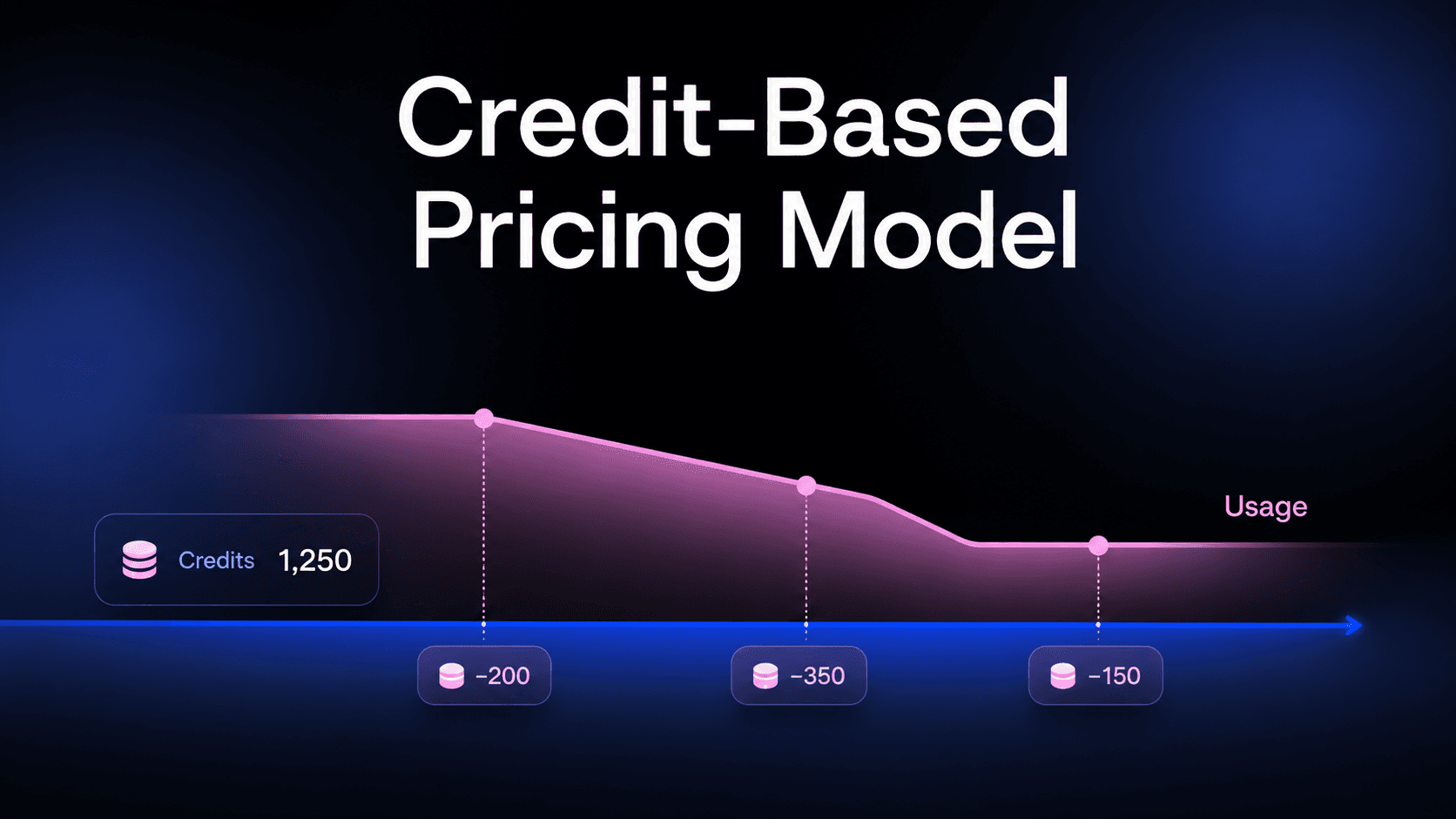
Credit-based pricing lets customers prepay or receive a set number of credits that they can spend inside the product. Each action, feature, or service uses a defined amount of credits.
This gives software and AI companies a simple way to charge for products where usage varies a lot from one customer to another.
Instead of using flat-rate pricing and seat-based pricing, companies implement credit-based models to tie costs directly to usage. Pricing feels fair because customers only pay for credits when they need them.
This article discusses the key benefits of using a credit-based pricing model and who can benefit the most from it.
TL;DR
- A credit-based pricing model is a type of usage-based pricing where customers buy or receive credits, then spend them on specific product actions, features, or services.
- SaaS companies that implement credit-based pricing benefit from more predictable revenue, stronger value alignment, better gross margin control, natural expansion revenue, and more flexible pricing.
- Credit-based pricing is especially effective for businesses that sell AI agents, cloud infrastructure services, API and developer platforms, and SaaS automation tools.
- Schematic helps companies launch credit-based pricing that customers can trust with enterprise credit wallets, an append-only ledger, self-service controls, and configurable spending limits.
What Is a Credit-Based Pricing Model?
Credit-based pricing is a type of usage-based pricing model where customers pay for a set amount of credits and spend them inside the product.
Each credit represents a defined unit of value tied to a feature, task, or service. Simple actions may use one credit, while premium features or complex tasks cost more credits.
A credit-based pricing model suits products with variable usage patterns and costs. Prepaid credits give customers a fixed amount to spend over time, even if the underlying usage varies.
Buyers don't need to budget for token spend, API calls, compute hours, or other raw usage metrics directly. They simply purchase a pool of credits that burn down as they use the product.
A credit system also gives users control over their actual consumption. Customers decide how many credits to buy, enable automatic top-ups to ensure continued access, monitor actual usage, plan future spend, and adjust customer behavior accordingly before the credit balance gets depleted.
Credit-based pricing also brings several advantages to software and AI companies, including increased customer retention, revenue predictability, and unified pricing across complex products.
Credit-Based vs. Pay-As-You-Go vs. Subscription-Based Pricing
Credit-based pricing bills customers for credit consumption and additional credit purchases as they scale usage.
Pay-as-you-go (PAYG) is a pure usage-based pricing model that charges customers for raw usage events (e.g., API call, token, gigabyte of data, or compute minute).
Meanwhile, subscription-based pricing is where customers pay a fixed recurring fee for software access.
Here's a table that breaks down the key differences between these SaaS pricing models.
Area | Credit-Based Pricing | Pay-As-You-Go Pricing | Subscription-Based Pricing |
Primary value metric | Standardized internal currency (credit) | Raw infrastructure or compute usage | Software access and plan level |
Revenue predictability for sellers | Medium to high (vendor collects cash upfront) | Low (revenue fluctuates based on actual usage) | High (consistent monthly/annual recurring revenue) |
Cost predictability for buyers | Medium (budget is capped by purchased credits) | Low (risk of surprise bills if usage suddenly spikes) | High (fixed recurring subscription fee) |
Billing period | Prepaid or granted monthly via a plan allowance | Postpaid (invoice sent at the end of the billing period) | Prepaid at the start of each billing period |
Margin protection | Strong when credit values match usage | Strong if usage-based charges cover infrastructure costs | Low to negative if usage spikes |
Unused capacity handling | Unused credits expire or roll over to the next billing cycle | Not applicable (customers never pay for unused capacity) | Use-it-or-lose-it access (customers pay regardless of consumption) |
Billing complexity | High (requires credit ledgers, metering, credit enforcement, etc.) | High (requires metering, rating, limit enforcement, etc.) | Low (requires standard subscription billing logic) |
How Credit-Based Pricing Benefits SaaS Companies
A well-designed credit model offers several advantages to software and AI companies.
Revenue Predictability and Stable Cash Flow
Credit-based models give SaaS companies financial stability because customers purchase credits to consume inside the product. This upfront commitment gives the seller cash before usage happens.
Credit-based pricing also creates more predictable revenue compared to other consumption-based pricing models, such as pay-as-you-go. An enterprise customer may agree to buy a set number of credits for the year, then spend them as needed.
Finance teams can accurately forecast future revenue and growth. The stable cash flow acts as a buffer to fund other business initiatives, like market research and product development, without immediate pressure.
Increased Customer Satisfaction and Retention
Credits give customers more flexibility than rigid plans that lock them into fixed feature bundles or user counts.
When customers purchase credits, they can spend their credit balance on the features they need instead of paying for access or seats they rarely use. This can make pricing feel fairer.
Credit-based pricing also introduces some predictability to usage-based pricing. Buyers may have different levels of usage each month, but purchasing credits in advance gives them a clear spending balance.
They can see how many credits remain and decide when to adjust in-product behavior, buy more credits, or change their plan. This makes variable usage easier to manage than an open-ended bill that changes without a clear limit.
When customers can view real-time credit balances and forecast upcoming costs, they are less likely to be surprised by runaway bills. That significantly boosts satisfaction and, in turn, retention.
Stronger Value Alignment
A credit-based model connects pricing more closely to the customer's perceived value of the product.
Instead of charging the same amount regardless of actual usage, SaaS companies can set credit costs based on the importance of each action and how much it costs to serve.
A simple task that triggers a cheap and fast inference might consume only one credit. Meanwhile, a high-value AI workflow that executes a multi-step chain may use ten credits.
Determine how much value each action or feature provides to the customer. Credit prices should reflect that benefit, not only your internal costs.
When the pricing model reflects real value, customers can easily understand why some tasks consume more credits than others.
Simplified Pricing for Complex Products
Complex SaaS and AI products include several features, APIs, models, workflows, and professional services. Pricing each one separately can confuse customers and make it difficult for commercial teams to monetize software.
Credits act as a universal currency for product consumption. Customers buy a pool of credits and use them for different actions inside the product.
SaaS companies can then assign credit values based on the cost, value, or complexity of each action. For example, an image generation request uses one credit, while video processing consumes five credits.
Commercial teams no longer need to manage several pricing structures and SKUs. They also avoid pricing based on raw usage events. Instead, they can communicate product value through a simple credit unit.
Gross Margin Protection
According to Bessemer Venture Partners, AI companies have an average 50-60% gross margin compared to the median 80-90% margin for traditional SaaS. AI agents, model calls, third-party APIs, and data processing can incur higher costs as usage grows.
Credit-based pricing closes this gap by connecting customer spend more closely to the cost of serving each action.
AI companies can set higher credit costs for resource-intensive actions and lower credit costs for lighter tasks. This prevents power users from incurring high operational costs that can eat into margins.
Teams can also adjust credit rates as AI or infrastructure costs change. With a credit model, they gain more control over unit economics while still charging customers based on actual consumption.
Natural Expansion Revenue
Credit-based pricing creates a natural path to expansion revenue because customer spend can grow with product usage.
Unlike subscription-based and seat-based pricing models, a buyer doesn't always need to add more seats or upgrade to a higher tier.
When customers use their credit balance faster than expected, they can purchase additional credits, increase their recurring allocation, or agree to a larger annual commitment. They might also enable automatic top-ups when balances fall below a preset level.
A credit pricing model supports account growth without relying on plan upgrades or sales-led contract changes.
Pricing and Packaging Flexibility
Credits introduce an abstraction layer, which makes it easier to price and package software.
Commercial teams can offer flexible credit pack sizes for small customers, growing teams, and large enterprise accounts that expect custom pricing.
Revenue operations (RevOps) teams also launch credit models quickly with subscriptions to support hybrid pricing. Alternatively, they can sell prepaid packs, offer annual commitments, or provide extra credits as part of promotions.
With the right credit billing system, SaaS companies can easily change how many credits specific actions or features cost. They can increase prices to cover higher operational costs or offer volume discounts for enterprise customers who purchase a large amount of credits.
Who Can Benefit the Most from Credit-Based Pricing
A credit-based pricing model is especially effective for software companies that sell the following:
- AI agents: Autonomous agents consume resources faster than human users. Consumption can also vary based on tasks, workflows, or completed actions. Credits allow companies to price agent capabilities while controlling variable AI costs.
- Cloud infrastructure services: Cloud providers use credit-based pricing for compute, storage, bandwidth, or processing. Vendors can connect revenue closely to actual usage, while buyers gain spending flexibility.
- API and developer platforms: API tools can deduct credits for requests, data calls, or premium endpoints. This simplifies pricing even when different API actions have variable costs.
- SaaS automation tools: Automated platforms execute tasks that have unpredictable costs. Prompt inputs, model choice, and customer behavior can all affect pricing. Credits introduce predictability for both buyers and sellers.
Common Challenges in Credit-Based Pricing and How to Solve Them
Credit-based pricing introduces several challenges to software companies. Fortunately, you can implement best practices to solve these difficulties. Let's take a closer look below.
Customer Confusion
Credits make pricing harder to understand when customers cannot tell what one credit buys inside the product. Unclear credit definitions force them to convert credits into dollars or product actions on their own.
Buyers may also struggle to predict credit usage if they do not know how quickly each action reduces their balance.
The solution is to define credit costs clearly before customers buy. Explain how many credits common tasks require and give practical examples. For example, a company profile lookup costs one credit, while a one-minute video transcoding task consumes five credits.
SaaS companies should also display current balances, recent activity, and expected costs inside the product so customers can estimate their spend.
Loss of Trust
Customers may lose trust in the product when they cannot see how credits are deducted from their account. They cannot easily verify unexpected changes in the number of credits consumed.
Unclear policies around expiring credits also introduce more friction in the buying process. Customers may feel they paid for value they never received if unused credit balances disappear without advance notice.
To solve this trust problem in credit-based pricing, companies should give buyers complete visibility and control over usage.
Let users view credit balances, transaction history, and upcoming expiration dates in real time. Give them the ability to set usage limits, configure low-balance alerts, adjust automatic top-up rules, and control what happens at the cap.
Real-Time Metering
Credit pricing depends on accurate usage data. When the system records activity late or counts the same action twice, it can lead to inaccurate customer balances.
High-volume products create another problem. Many usage events may arrive at the same time, especially for AI agents, APIs, and automation tools. Simple balance updates may fail when several requests try to spend the same credits at once.
Software companies should use a reliable monetization platform designed for real-time credit tracking. It should support concurrency-safe holds, exactly-once event semantics, idempotent writes, and replay safety.
These controls help prevent duplicate charges, incorrect balances, and overspending when many product actions happen at once.
Pricing, Expiration, and Rollover Policy Management
Credit pricing rules become harder to manage as the business adds more plans and customer types. One plan may allow credit rollover, while another tier dictates that unused credits expire each month. Enterprise contracts may also have custom terms.
Companies must track which credits expire first, which balances can roll over to the next billing period, and how refunds or bonus credits should behave. Monitoring everything manually can lead to errors.
A real-time credit ledger stores these policies in one system. It can record when credits were issued, spent, refunded, rolled over, or expired. This provides a shared record that commercial teams can use for credit pricing management.
Revenue Recognition
Selling credits before customers use them creates an accounting gap. Your company may receive cash upfront, while the related product usage happens weeks or months later. This makes revenue recognition more complicated than traditional subscription-based pricing.
Finance teams also need to know when credits were sold, consumed, refunded, or expired. Missing transaction records can make reporting harder and create extra manual work when closing the books.
An append-only, export-ready credit ledger provides a full history of every credit change. Each transaction remains recorded instead of being overwritten.
Finance teams can then export credit activity into their accounting systems and match revenue treatment with actual consumption and contract terms.
Launch Credit-Based Pricing Your Customers Can Trust With Schematic
Schematic provides a complete usage-based billing platform for software and AI companies. It helps teams sell usage-based plans, meter credits, manage SaaS entitlements, enforce limits at runtime, and give customers clear consumption visibility and control.
Enterprise credit wallets include spend forecasts, self-service controls, and configurable spending limits. These tools help customers stay within budget and avoid surprise bills or unexpected access throttling.
Another thing that sets Schematic apart is its real-time entitlement engine. It uses smart feature flags to answer from the same credit ledger that bills customers.
Every check and meter event streams back in milliseconds to ensure credit balances and usage limits are displayed accurately inside the product.
Schematic gives buyers and sellers confidence that product access and usage-based pricing charges match actual consumption. That makes it easier to trust credit pricing models.
FAQs About Credit-Based Pricing Model
What are the different types of pricing models?
Popular software pricing models include subscription, per-seat, usage-based, credit-based, tiered, and outcome-based pricing. Companies often combine several models to match how customers use the product and align costs with actual usage.
How does credit-based pricing work?
Credit-based pricing works by giving customers a set number of credits they receive as part of a subscription plan or buy in advance. Each product action uses a defined amount of credits and reduces the available account balance. If their balance becomes zero, they can purchase additional credits, renew their allowance, or enable automatic top-ups.
Which types of businesses benefit from credit-based pricing?
Credit-based pricing works well for software and AI companies selling autonomous agents, API platforms, cloud services, automation tools, and software products with variable usage.
Why do companies use credit pricing?
Many companies use credit-based pricing to align costs with usage, improve cash flow, give customers spend predictability, and unify pricing across complex products.