 Ryan Echternacht
Software companies selling artificial intelligence (AI) products need dedicated billing systems that can keep up with how their products are used. Flat-fee subscription plans may work for traditional SaaS, but many AI platforms charge based on tokens, API calls, credits, tasks, or other usage-based units.
The best AI billing software can meter usage, apply pricing rules, create invoices, and manage customer payments. It can also support credit-based plans, custom contracts, and other pricing models used by AI businesses.
This guide reviews the top six AI billing platforms to consider. But first, let's define AI billing and how it differs from traditional software billing processes.
TL;DR
Below are the six best tools for AI billing:
- Metronome
- Maxio
- Lago
- Zuora
- Stigg
How Is AI Billing Different from Traditional Software Billing?
AI billing differs from traditional software billing because AI usage and costs can change with every customer request.
Traditional SaaS companies often implement flat-fee subscription or seat-based pricing because product costs and customer usage remain predictable.
However, AI businesses usually pay for model inference, API calls, GPU time, and other compute resources each time a customer uses a feature.
This requires a billing strategy and monetization model tied to tokens, API calls, AI credits, tasks, or workflows instead of software access.
Charging per seat is also a poor fit for AI products because the main value comes from how much work the AI performs, not how many people log in.
A small business (with fewer than 10 employees) may generate far more usage and incur higher expenses than a large enterprise account (with 100 employees).
AI billing operations must track consumption closely, apply the correct rates, and support pricing models that scale as usage grows. This is especially important, considering that AI companies see 50-60% average gross margins compared to 80-90% for SaaS, according to Bessemer Venture Partners.
Consumption billing helps AI businesses protect margins, secure financial returns, and ensure profitability.
Top 6 AI Billing Software Worth Considering in 2026
These are the best AI billing software options that help companies monetize AI products.
1. Schematic
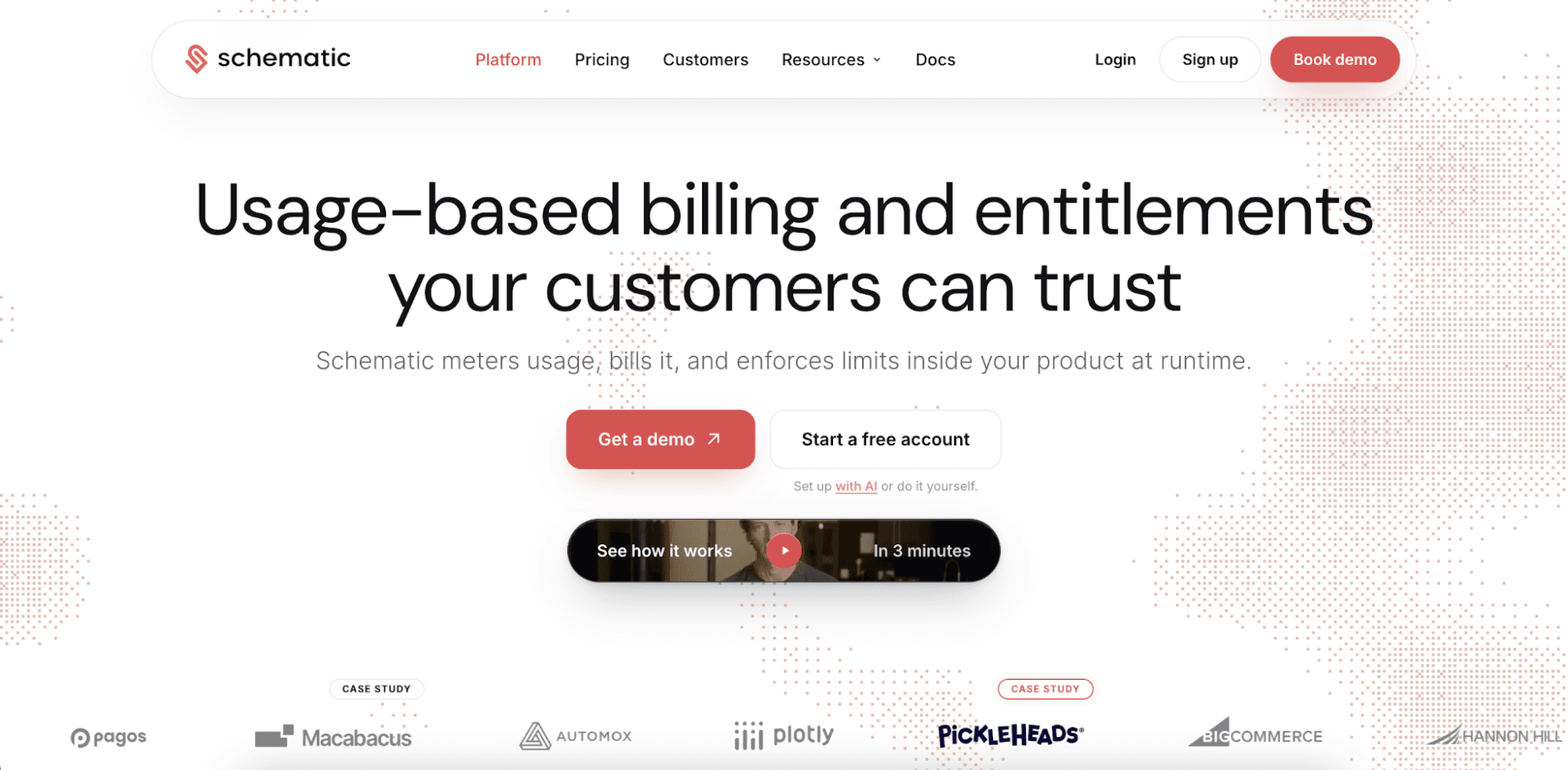
Schematic is the best AI billing software for software and AI companies selling to enterprises. It provides out-of-the-box billing tools. These include price modeling, native credit wallets, an entitlement engine, plan versioning, and concurrency-safe holds.
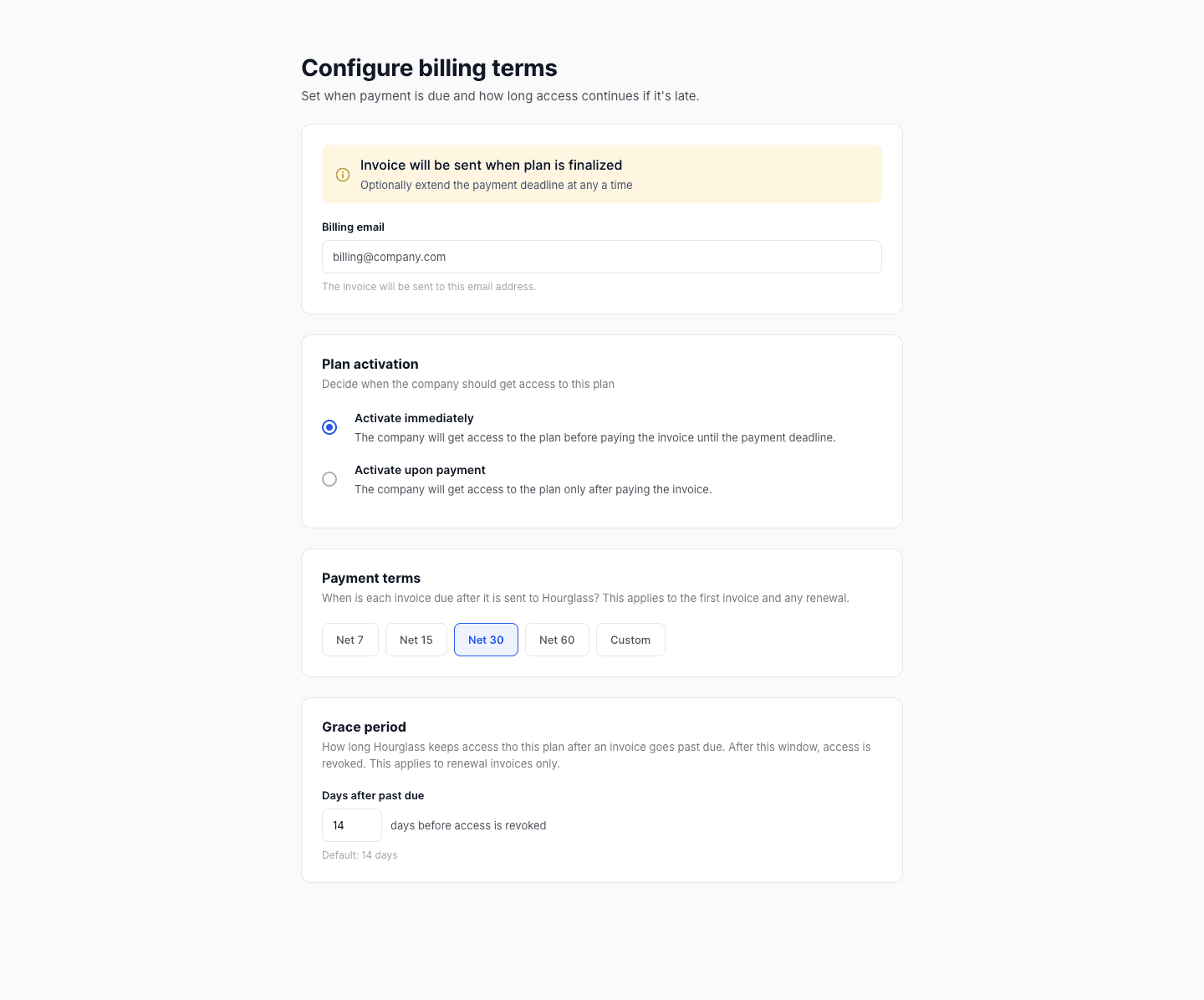
Schematic supports any pricing model, such as usage-based, credit-based, tiered, and hybrid plans. Changing pricing, packaging, payment terms, and plan activation can happen through configuration instead of writing code.
Enterprise credit wallets give customers real-time visibility over their consumption. Meanwhile, spend forecasts, self-service controls, and configurable spending limits prevent runaway bills.
Buyers can set caps per seat or per agent, configure automatic top-up policies, and decide what happens at the limit. Hard caps block access once the account hits the usage limit. Soft limits allow continued usage and bill extra consumption as overage fees.
The entitlement engine enforces those policies the moment you or your customers save them. A single flag check can gate features and answer access questions from the same ledger that bills clients.
Zach Hawtof from Titanet shares that, "With Schematic, everything has a feature flag that we upgrade into plan features over time, and it lets us learn how different customers use features so we can recommend the right plan."
Key Features
- Usage metering and billing: Meter product events once to power usage-based billing, invoices, and predictive analytics.
- Enterprise credit wallets: Give customers real-time visibility into credit grants, rollovers, top-ups, and burndown while helping finance teams reconcile billing data.
- Credit pricing management: Set credit rollover policies, expiry windows, and priority consumption rules to consume the oldest or promotional credits first.
- Concurrency-safe holds: Reserve, commit, or release credits to ensure that concurrent agents cannot double-spend the same balance.
- Plan versioning: Create new plan versions, migrate selected customers, and keep existing customers on legacy pricing when needed.
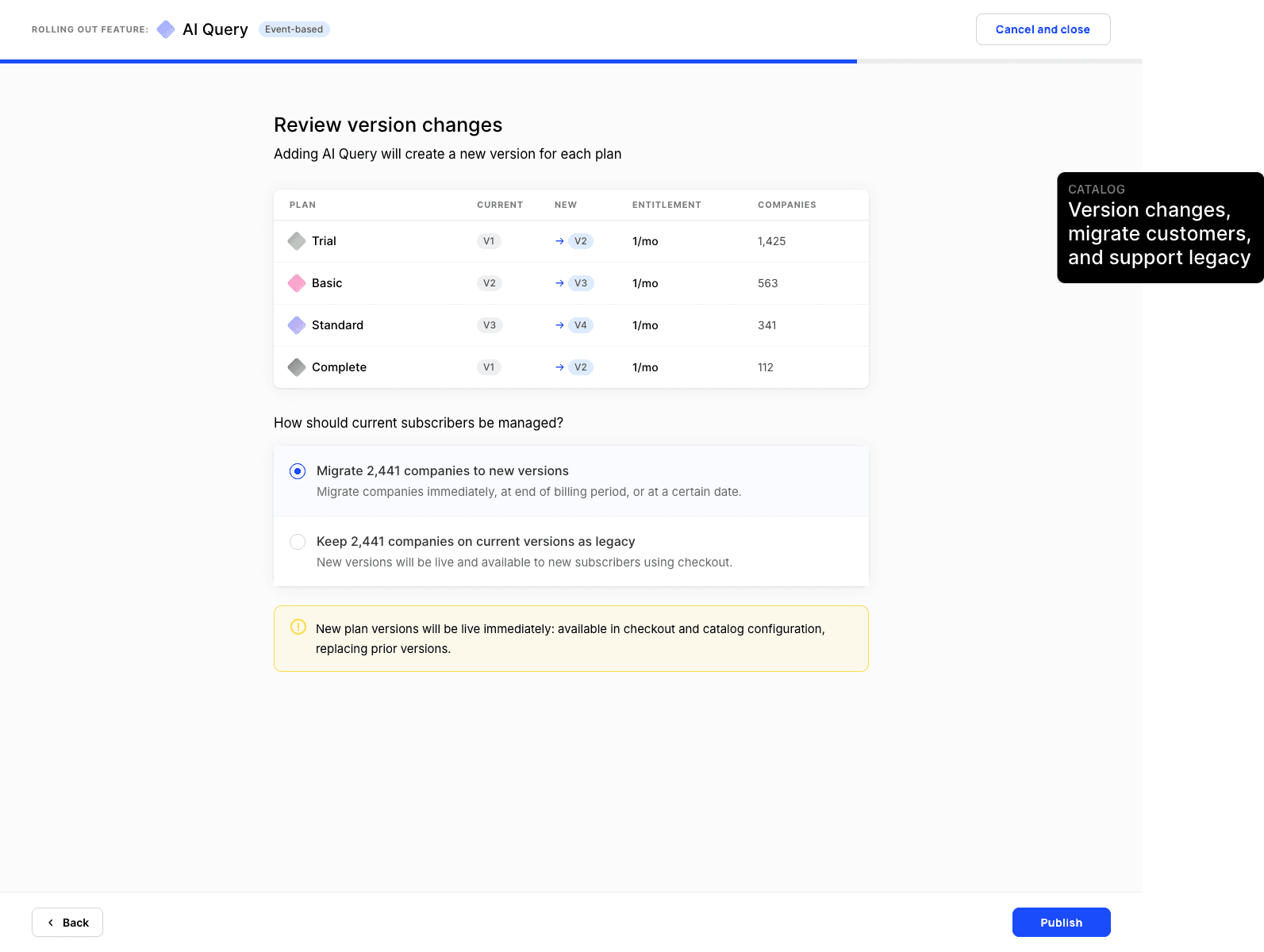
- Self-service controls: Let customers set usage caps, manage top-up rules, switch plans, and monitor their usage inside the product.
- Runtime software entitlements: Check customer access against current plans, usage allowances, credits, and limits while the product is being used.
- Real-time event log: View grants, credit deductions, and entitlement checks as they happen for faster debugging.
- Revenue recognition: Track an account's credit activity through an append-only ledger that supports ASC 606 revenue recognition rules.
- Schematic MCP: Let AI agents list available plans, check customer usage, read balances, and find accounts nearing their limits.
2. Metronome
Source: Metronome.com
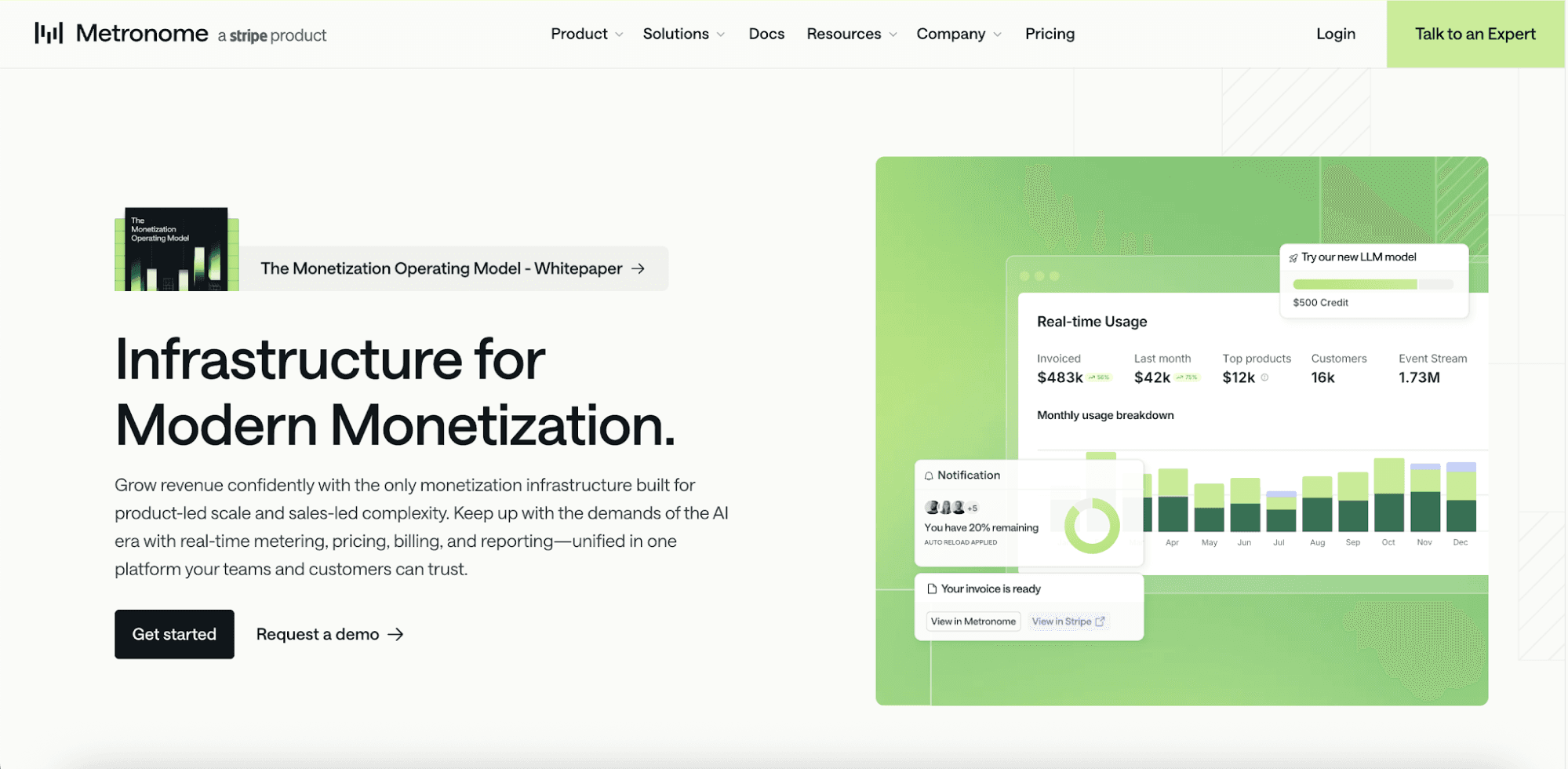
Metronome provides the monetization infrastructure for AI products. It supports billing, pricing, metering, and financial reporting in one platform.
AI companies can manage pricing centrally, run pricing experiments, and roll out changes to selected customer groups without manual contract re-provisioning.
Teams can also meter large volumes of raw usage events and build pricing models for product-led and sales-led go-to-market strategies.
Metronome even integrates billing into the customer experience. AI companies can add in-product dashboards that show real-time usage and expenses. Meanwhile, configurable alerts and limits give buyers more control over their spending.
Plus, Metronome gives finance teams the ability to filter and export billing data. This is useful for tracking consumption, reviewing daily revenue, and conducting margin analysis.
Key Features
- Pricing levers: Support pay-as-you-go, prepaid credits, commitments, discounts, dimensional pricing, and freemium pricing.
- Usage metering and billing: Meter and store raw usage events while supporting flexible SQL-based billable metrics.
- In-product dashboards: Show customers real-time usage and spend with configurable alerts and limits.
- Real-time reports and insights: Use billing data for margin analysis, consumption tracking, and revenue forecasting.
- Built-in integrations: Connect Metronome to payment processors, customer relationship management (CRM) software, accounting tools, and other platforms.
3. Maxio
Source: Maxio.com
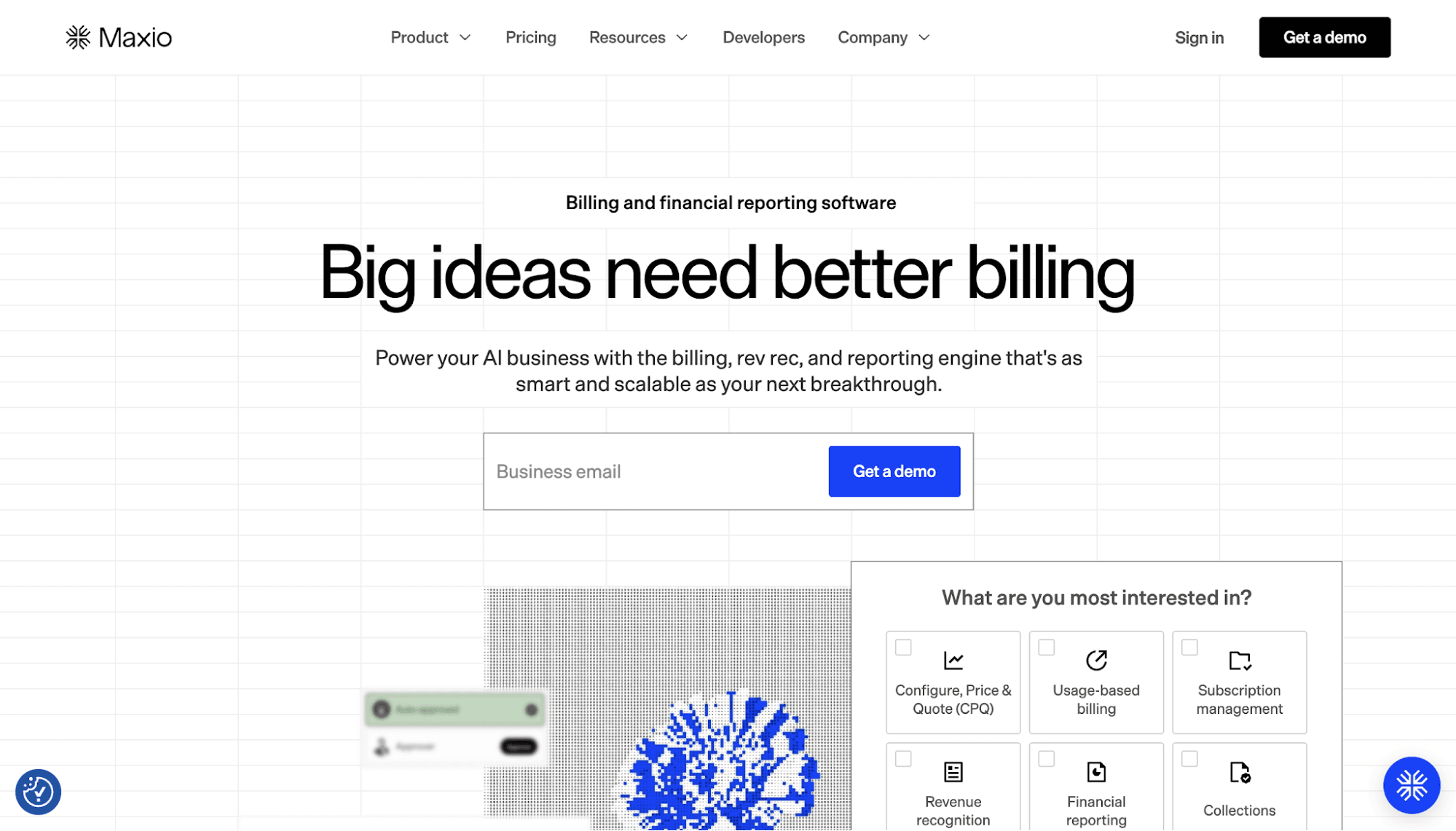
Maxio combines billing, revenue recognition, reporting, and subscription management. AI companies can bill by usage, seats, credits, or a mix of all three through one connected system.
Usage metering records consumption in real time and sends that data to the billing infrastructure. Meanwhile, the subscription management feature handles subscription upgrades, downgrades, renewals, and plan changes without manual tracking.
Maxio also provides wallets that track prepaid credits and balances alongside billed activity. This setup helps AI businesses support usage-based, subscription, credit-based, and hybrid billing models without engineering implementation.
Finance teams use Maxio to simplify ASC 606 and IFRS 15 revenue recognition workflows. The AI billing software automatically adjusts schedules by customer, contract, or transaction. It also generates a complete audit trail behind reported figures.
The built-in financial reporting tool tracks SaaS metrics, giving leadership a single place to review pricing performance so they can make better decisions.
Key Features
- Usage metering and billing: Meter raw usage events and charge for consumption using any pricing model.
- Subscription management: Handle subscriptions in one place, send automated reminders to internal teams before contracts expire, and run custom dunning workflows to prevent churn.
- Credit wallets: Monitor prepaid credit balances from the time funds enter the wallet and keep balances tied to billing activity.
- Automated revenue recognition: Adjust revenue schedules while supporting ASC 606 and IFRS 15 compliance with a full audit trail.
- Financial reporting: Track annual/monthly recurring revenue (ARR/MRR), churn rates, non-GAAP revenue, and other important SaaS metrics to improve decision-making.
4. Lago
Source: getLago.com
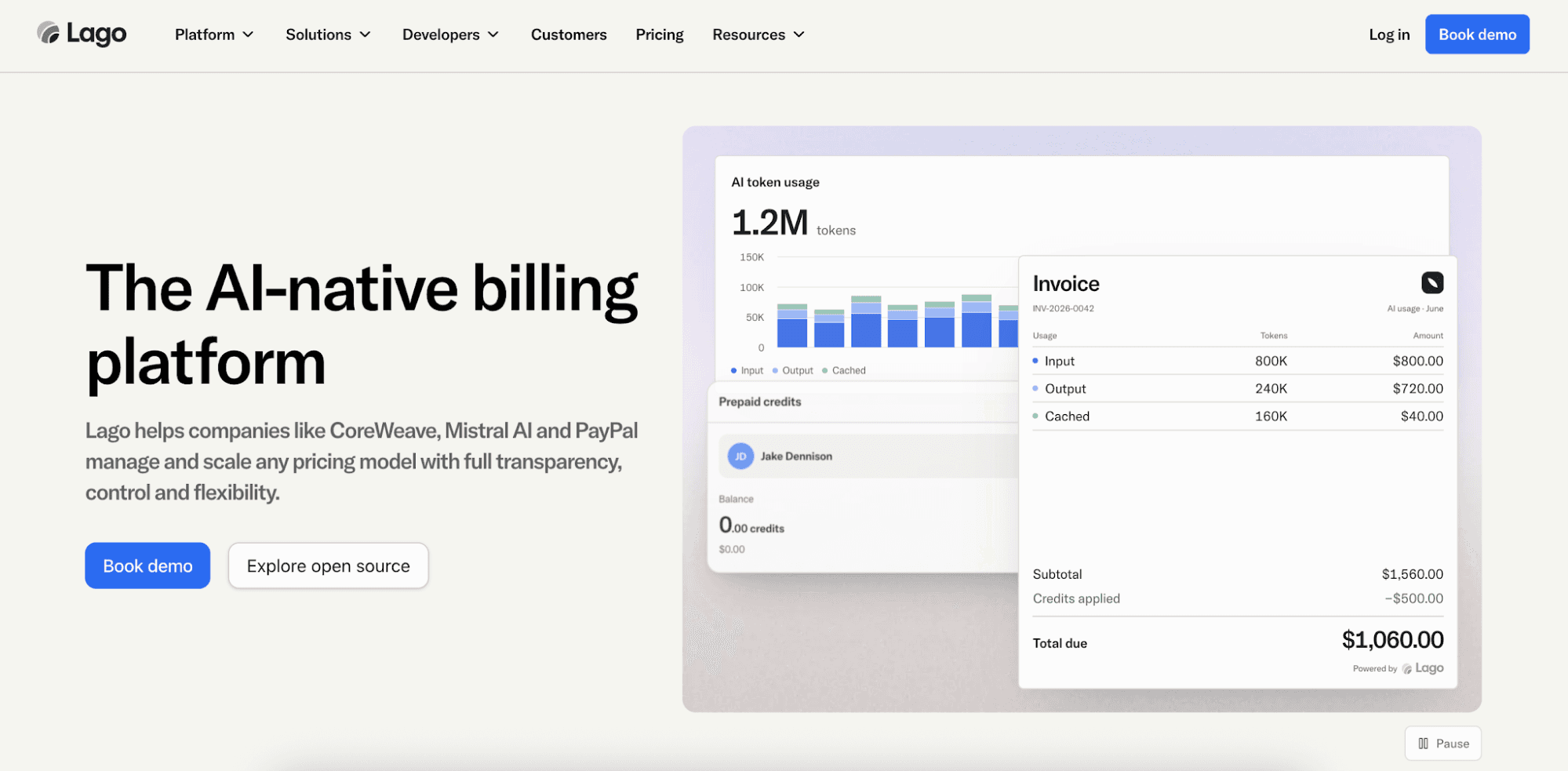
Lago is an open-source AI billing platform built for complete billing transparency, control, and flexibility. Software and AI businesses can run Lago in the cloud or host it on their own infrastructure.
The software handles event-driven metering, billing, and invoicing for usage-based and hybrid pricing models. It can capture raw usage events from HTTP APIs, streaming connectors, AI gateways, and large language models (LLMs).
For invoicing, Lago automatically calculates what each customer owes based on billable metrics and plan rules. It can create and send invoices, apply taxes, and provide PDF and XML files for e-invoicing.
Finance teams can filter invoices, record payments, issue refunds, void invoices, export records, and send late payment reminders from the platform.
Lago even provides role-based access controls (RBAC) for managing user permissions. Companies can control which employees can view or change billing data while keeping an audit trail of account activity.
Key Features
- Real-time metering and usage billing: Ingest usage events from every source and convert them into accurate charges for usage-based plans.
- AI invoice automation: Create and send invoices automatically to reduce time spent on manual data entry and calculations.
- Flexible deployment: Run Lago on your premises, in a virtual private cloud (VPC), or in other self-hosted setups.
- Enterprise-grade security: Support SOC 2 Type II compliance, audit logs, and configurable user roles via RBAC.
- Revenue analytics: Forecast revenue based on historical data, create custom dashboards, reconcile different revenue streams, and export reports to CSV.
5. Zuora
Source: Zuora.com
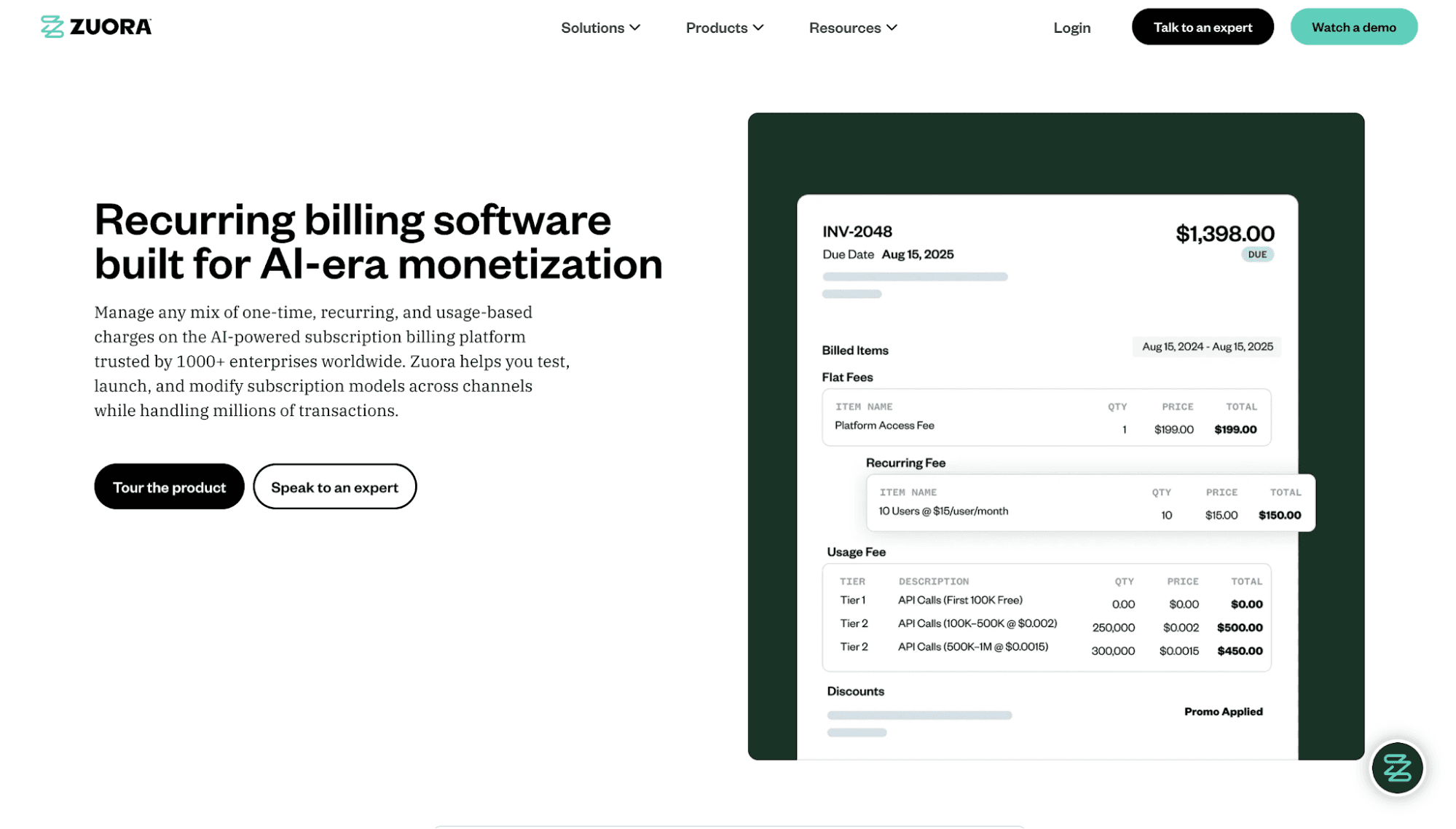
Zuora offers an AI billing solution for software companies that need flexible pricing, usage billing, invoicing, and payment support.
Teams can quickly design and change pricing with a low-code or no-code tool, support multiple currencies, bundle products, and implement dynamic pricing by charging based on API calls or gigabytes of storage.
Built-in mediation and rating can capture usage and support pay-as-you-go, prepaid credits, minimum commitments, overages, and tiered pricing.
Zuora also uses AI technology to identify anomalies and emerging usage trends. Finance teams rely on it to forecast revenue accurately. They also use built-in tax tools and country-specific invoice templates to meet billing requirements in different markets.
Zuora even helps companies get paid faster by reducing quote-to-cash friction through an integrated configure, price, and quote (CPQ) system.
Key Features
- Flexible pricing and packaging: Design recurring, usage-based, hybrid, and multi-attribute pricing with low-code or no-code tools.
- Usage mediation and rating: Capture, process, and rate high volumes of usage events for consumption billing.
- AI-powered insights: Detect unusual usage patterns and forecast revenue from consumption.
- Integrated CPQ: Create quotes for different stages of the customer lifecycle, from new sign-ups to plan renewals and upsells.
- Global payments orchestration: Connect to payment processors while ensuring compliance with tax and invoicing requirements.
6. Stigg
Source: Stigg.io
Stigg is an AI monetization platform that works with your existing billing stack. It acts as a usage runtime layer that checks what each customer, user, or agent can consume before an AI request runs.
The platform combines credit systems, entitlements, metering, and governance. Stigg's credit infrastructure includes wallets, ledgers, burn-downs, expiry rules, and priority consumption policies to solve edge cases.
Teams also use Stigg to move entitlement logic outside application code. That makes it easier to release new pricing models, tiers, and features without requiring an engineering sprint.
The software can also meter large volumes of usage events, such as tokens, inference calls, and agent actions. Deploy the metering system in a virtual private cloud for full data ownership.
Plus, Stigg allows customers to set budget caps per user, per team, or per agent. The entitlement engine enforces those limits at runtime to prevent runaway bills and improve security.
Key Features
- Credit infrastructure: Manage wallets, ledgers, burn-downs, expiry rules, and priority consumption in one place.
- Runtime enforcement: Check remaining credits, limits, and entitlements before an AI request proceeds.
- SaaS entitlement management: Store plan and feature-access logic outside the application codebase so commercial teams can change it without engineering help.
- Usage metering: Capture and aggregate tokens, inference calls, and agent actions every second.
- Self-service spend controls: Let customers set budget caps and apply those limits at call time.
Benefits of Using AI Billing Tools
AI billing software can bring several advantages to software and AI companies.
Simplify Billing Workflows
AI billing software can instantly generate invoices, meter usage events, calculate charges, and connect to payment solutions. This simplifies AI billing workflows.
Companies can bill customers for AI usage more accurately and with confidence. The platform takes care of the repetitive tasks so that teams can focus on other important activities.
Billing software also unifies billing, invoicing, subscription, and payment data. Finance teams can track charges, payments, and outstanding balances from one place instead of checking several tools.
Some advanced platforms even use AI and machine learning algorithms to flag payment issues, detect unusual billing activity, and send payment reminders for outstanding balances to help companies improve cash flow.
Reduce Human Errors
Manual AI billing can lead to incorrect usage totals, missed charges, duplicate records, and inaccurate invoices. Automated metering and billing can lead to fewer errors by applying pricing logic consistently.
AI companies can also improve billing accuracy by connecting usage data directly to rating and invoicing systems instead of transferring data between different tools.
Audit logs and built-in reporting tools are also useful for finding problems and reducing errors caused by manual data entry.
Prevent Runaway Spending and Billing Disputes
Unlike traditional software, concurrent AI agents can cause usage and cost to scale rapidly. Customers may face a higher bill than what they expect.
Fortunately, the best AI billing software gives buyers real-time visibility and control over their consumption.
Clients can see exactly what they use and how much they owe at any time without waiting for the invoice to arrive at the end of the billing period.
They can also set budget caps, change top-up policies, and configure usage limits before costs get too high.
AI companies benefit from improved customer experiences, higher retention rates, and reduced billing disputes.
Support Different Pricing Models
Monetizing AI products requires more than recurring subscription plans.
AI billing tools can support pay-as-you-go, prepaid credits, tiered usage, minimum commitments, and hybrid models that combine subscriptions with usage-based charges.
Product and finance teams can change pricing rules from a central system without requiring engineers to write billing logic for every new plan.
This makes it easier to run pricing experiments, create custom plans, and add new billable units as the product evolves.
Ensure Compliance With Revenue Recognition Rules
AI companies often implement usage-based and credit-based pricing because it aligns costs with product value.
However, these models can make revenue recognition more difficult to manage. Revenue may depend on when usage happens, when credits are consumed, whether credits expire, and how prepaid balances are treated.
AI billing software can automate revenue recognition workflows to ensure compliance with ASC 606 and IFRS 15. It works by translating complex contract terms into accurate, periodic journal entries.
It also tracks when performance obligations are met and handles deferred revenue liabilities without manual reconciliation.
Launch AI Billing, Metering, and Entitlements Your Customers Can Trust With Schematic
Schematic provides a complete billing platform for AI and software companies. It can meter usage, bill customers, and enforce limits at runtime.
Out-of-the-box billing tools let commercial teams define and change pricing without waiting on engineering. Sales or product teams can version plans, preview changes, select a credit grant amount, set rollover rules, create custom plans, and implement different pricing models.
Rahul Gill from Macabacus shares, "Schematic's custom plans are easy to create, which is essential when selling usage-based billing to enterprise customers."
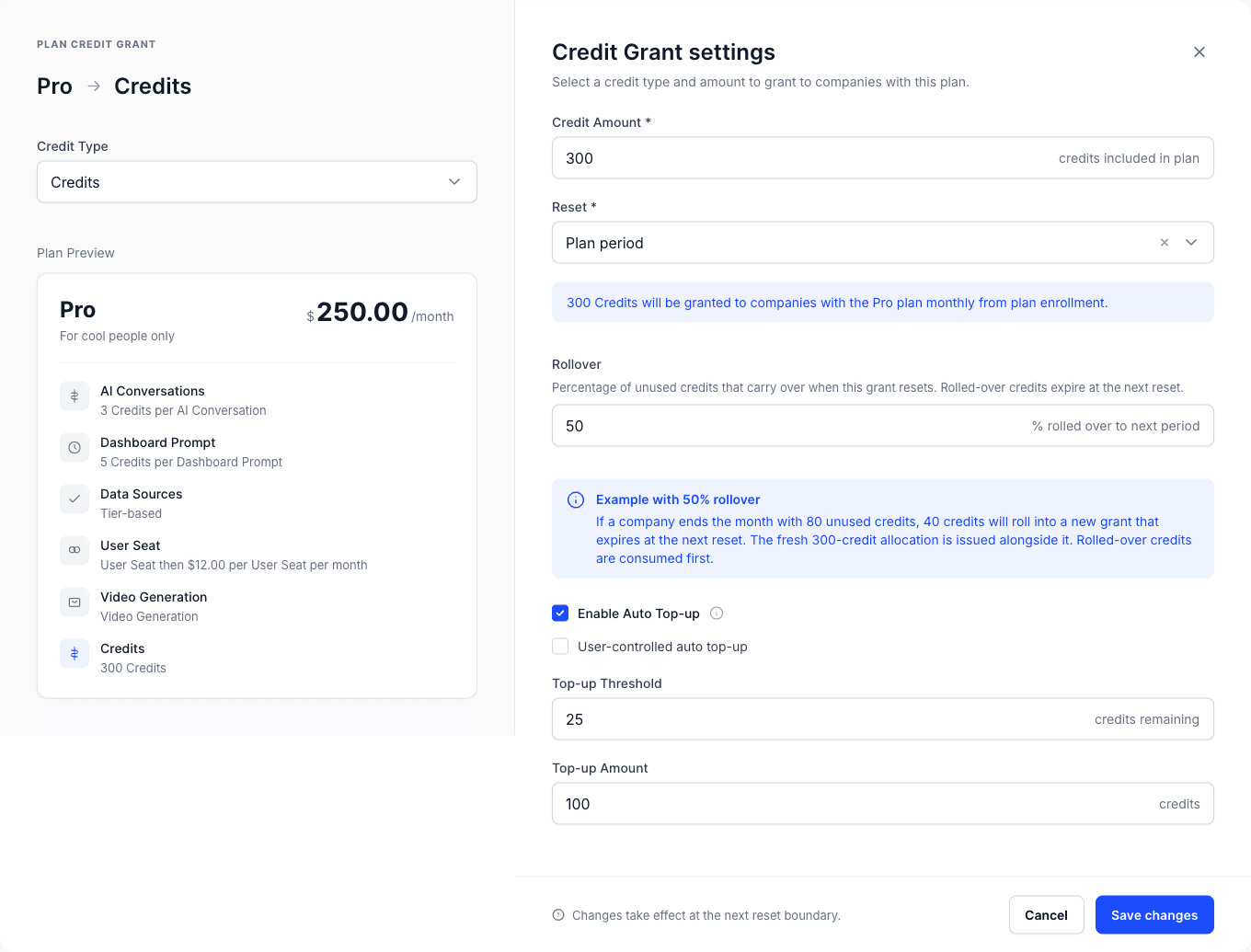
Schematic also stands out for its enterprise credit wallets. These give enterprise customers real-time visibility into usage, spend forecasts, self-service controls, and configurable spending limits to prevent runaway bills or unexpected access throttling.
Both buyers and sellers gain confidence that usage will stay within budget and that customer invoices meet expectations. The result is less friction during procurement, faster sales cycles, more predictable expansion, and higher long-term revenue.
FAQs About AI Billing Software
Can AI do billing?
Yes. AI can support billing by collecting usage data, turning raw events into accurate invoices, accepting payments via connected payment gateways, and tracking unusual activity.
How can AI be used in billing?
AI tools can help companies meter usage, generate invoices, process payments, manage taxes, and automate revenue recognition. AI can also review customer usage and spending behavior, helping finance teams manage billing activity and track money more closely.
What is the best AI tool for generating invoices?
The best AI tools for invoice generation include Schematic, Metronome, Maxio, and Lago. The right choice depends on whether you need other features for AI monetization, such as usage metering, price modeling, revenue recognition, credit enforcement, and runtime entitlement management. Schematic includes those capabilities to support AI and software companies selling to enterprises.